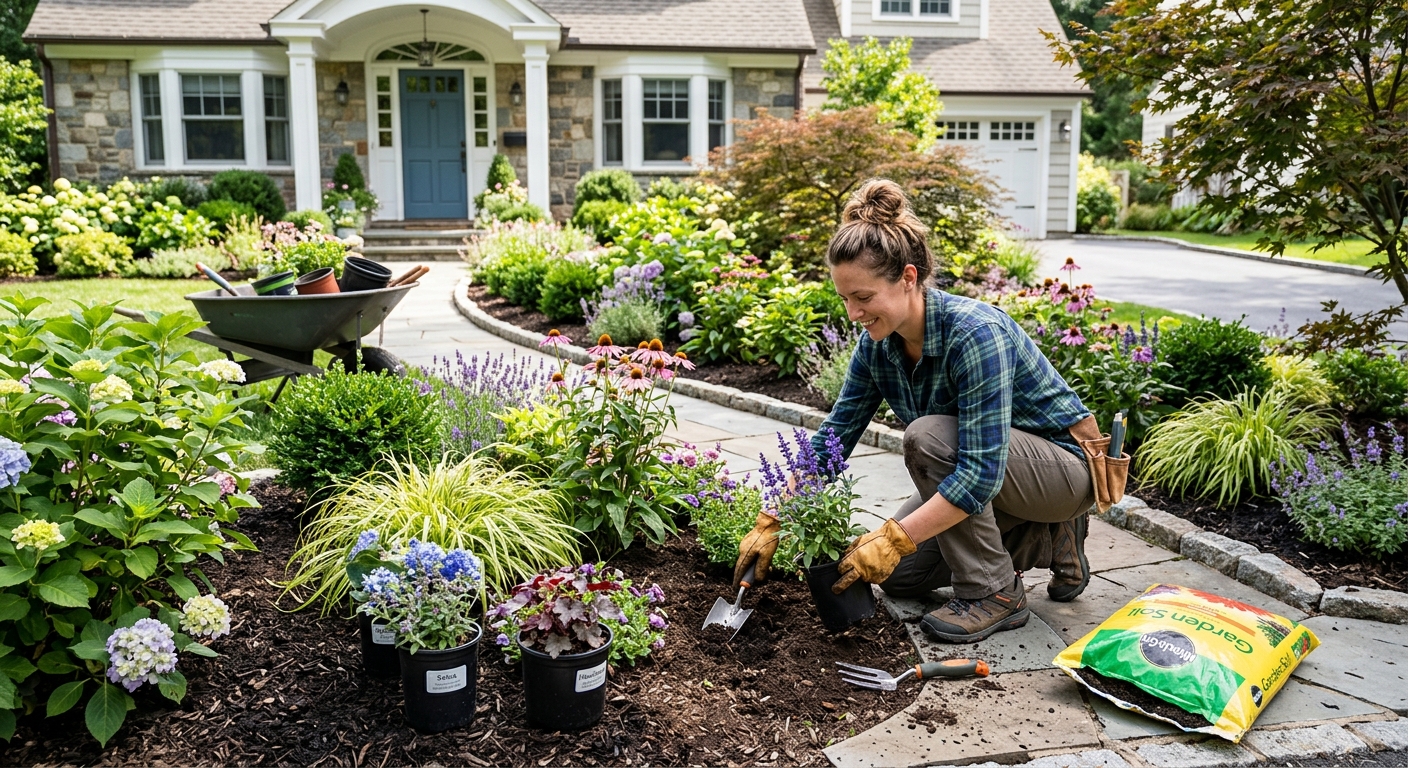
Landscaping options and costs in Carstairs
Carstairs homeowners usually have plenty of backyard space—given that single-detached houses account for 79.9% of dwellings—so landscaping often becomes a meaningful part of everyday living, not just curb appeal. With 86.4% of households owning their homes, many residents invest in patios, walkways, and low-water gardens that can handle Prairie winter swings. At the same time, Carstairs sits in the Calgary area’s climate reality: Prairie plant hardiness zones 3–4, late-spring frosts, and early fall cold snaps. That combination shortens the on-site working window and increases the cost of thorough base preparation because freeze–thaw cycles are severe. You’ll also see price variation across the Calgary region because labour typically represents 40–60% of a full landscaping project; when crews are booked during the spring and early summer rush, scheduling and mobilization add cost.
In Carstairs, demand is especially strong around the newer residential stretches near the downtown/central core and along active growth areas on the edge of town, where many lots were graded at build time and now need drainage tuning and a finished landscape plan. For many homeowners, the decision comes down to what you want to get done right away versus what can be improved in stages—hardscape first, then planting and irrigation once the grading settles. Use the comparison table below to line up typical options and price ranges, then we’ll cover what moves the numbers up or down in the next section.
| Service |
Description |
Season |
Price Range |
| Full landscape design and installation |
Site visit, concept + layout, grading notes, irrigation plan (if needed), supply and install of hardscape, softscape, and planting |
Late April to early October (weather-dependent) |
$12,500–$38,000 |
| Sod installation (supply, grade, lay, roll) |
Minor regrade, soil prep to grade, sod delivery and placement, edging tie-ins, light starter fertilizer |
May to early August (best establishment) |
$2,500–$6,000 |
| Lawn seeding (grade, seed, starter fertilizer) |
Topdressing where needed, seed broadcast, starter fertilizer, light raking and rolling |
Late spring to early fall |
$1,500–$3,500 |
| Interlocking patio or walkway |
Excavate, deep compaction base, sand set bed, pavers/bricks, edge restraints, finishing |
Spring to early fall (best before frost) |
$7,500–$22,000 |
| Retaining wall (interlocking block) |
Excavation, granular base below frost influence, drainage layer, block installation, caps and backfill |
Spring to early fall |
$10,000–$35,000 |
| Tree and shrub planting |
Soil improvement, planting layout, hardy species selection for zones 3–4, staking, watering plan |
May to September (or fall planting windows) |
$1,200–$12,000 |
Prices are estimates only and vary by project scope, site access and material selection.
What affects the price of landscaping in Carstairs
In Carstairs (Calgary economic region), you can see the same landscaping scope come in 30–50% apart because pricing hinges on more than “square footage.” Two yards can look similar, but if one needs extensive regrading, deeper compacted base prep for freeze–thaw, and an irrigation design that matches Alberta’s semi-arid conditions, the labour and materials stack up quickly. Market timing matters too: crews are busiest in late spring, so mobilization and scheduling can shift costs, especially when excavation and hardscape trades are competing for the same window.
Climate and hardiness drive both what grows and what’s feasible on-site. In Prairie zones 3–4, late frosts mean contractors must avoid work that risks heaving—particularly without proper drainage and a deep, well-compacted base for patios, walkways, and retaining walls. In coastal BC (zone 7–8), a longer growing season encourages broader planting palettes, but heavy rainfall makes drainage and soil management non-negotiable. In the BC interior, water restrictions often push drip irrigation and xeriscape approaches; in Calgary/Alberta, restrictions can still influence design, but the bigger cost factor is usually the need for soil amendment and efficient zoned irrigation.
Concrete examples from Carstairs: (1) Adding slope correction from a yard that drains toward a foundation can turn a straightforward seed job into a grading-and-drainage package, pushing you from a lower lawn band toward the mid-range of sod/installation pricing. (2) A retaining wall with the wrong base depth or missing drainage layer can fail under freeze–thaw; getting the base and drainage right is what protects the investment, which is why retaining walls often sit in the $10,000–$35,000 band instead of being “just masonry.” (3) Older housing stock is common—25.8% of homes were built before 1981—so you may also inherit mature trees, irregular beds, or buried features that increase excavation time and disposal costs. When the project grows into full design + install, the total typically aligns with the $12,500–$38,000 range once you include grading, hardscape, planting, and irrigation.
| Price Factor |
Why It Matters |
Cost Impact |
| Yard size in sq ft — the primary cost driver for softscape |
Determines topsoil, seed/sod quantities, mulch, and labour hours |
Small lawns can stay near the low end; larger yards often move you into mid or higher bands |
| Grading and drainage work — slope corrections add significant cost |
Freeze–thaw and pooling must be managed before turf or stone can perform |
Can add substantial labour and machine time, pushing overall cost up 15–35% on some sites |
| Drainage bed or French drain installation |
Helps relieve water pressure and reduces foundation moisture risk |
Often a “must-have” when downspouts or swales are problem areas; typically a major driver in hardscape failures |
| Plant material tier — native shrubs vs. ornamental vs. mature specimen trees |
Hardy nursery stock varies widely in price and labour to set/anchor |
Upgrades to mature specimens can multiply material costs and extend planting time |
| Hardscape vs. softscape ratio — walls and patios cost more per sq ft than lawn |
Pavers, excavation, base, and compaction require more trades and equipment |
Shifting 200 sq ft from lawn to patio can move budgets fast into the interlocking bands |
| Irrigation system design and installation |
Zoning, wiring, heads, and freeze-aware components affect both performance and longevity |
Can add meaningful cost, but it reduces long-term watering losses and plant stress |
| Soil amendment and topsoil required |
Compacted or clay-heavy soils need structure for rooting and drainage |
Increases material and haulage; typically essential for reliable turf and shrubs |
| Tree removal or stump grinding before new planting |
Extra equipment, disposal, and surface restoration time |
Often shifts a “planting-only” job into a fuller hardscape/softscape scope |
Permits & regulations in Alberta
For most homeowners in Carstairs, the good news is that planting and most softscape work typically does not require a permit. Installing sod, laying seeding, adding topsoil and mulch, and planting trees and shrubs are usually treated as landscaping maintenance or improvements. The work that more often triggers permitting is structural: retaining walls above a height threshold—commonly 1.0 m (3.3 ft) in many municipalities—may require a building permit and, in some cases, engineered drawings. Also watch the grading side of the job: changes to lot grading that could affect drainage toward neighbouring properties or toward storm connections can require approvals.
Before any digging for planting holes, French drains, or wall footings, ask the contractor to arrange utility locates (and confirm who is responsible for the locate process). Locates are critical because a wall footing or drainage line can hit buried services even when the yard “looks clear.”
To verify a contractor’s Alberta readiness, homeowners can take a step-by-step approach:
- Request their Alberta business details and confirm they are properly set up to do the work they’re quoting.
- Ask for certificate of liability insurance showing coverage amounts and active policy dates.
- Confirm workers’ coverage: ask whether they hold WSIB/WCB coverage appropriate for their crew.
- Get proof of clearance/coverage in writing (commonly a clearance letter or insurer document).
- Match the insured name to the quote and invoice; don’t accept “same person, different business name” without paperwork.
- Keep a copy of all documents with your contract and drawings/scope.
If you’re also installing irrigation, confirm seasonal start-up expectations and how they handle freeze protection (backflow prevention and drain-down approach) in Alberta conditions.
Planning a landscape that thrives in Carstairs's climate
Planning for Carstairs’s climate means choosing plants for hardiness zones 3–4 and building a yard that can survive freeze–thaw cycles instead of simply looking good in July. Start with plant selection: focus on native and zone-appropriate shrubs, hardy perennials, and trees that tolerate wind exposure and shorter growing seasons. These choices reduce watering demand and help avoid winter burn on less-tough ornamentals. For lawns, decide between sod and seed based on timeline: sod gives instant cover but effectively costs about 3–4x per sq ft versus seeding, because you’re paying for turf production, delivery, and lay labour. Seeding is slower but often more budget-friendly when you’re prepared to water and protect new growth.
Drainage and grading are where many Carstairs yards make or lose money. If water ponds near a foundation, turf and shrubs will struggle, and pavers can shift over time. In Calgary-area practice, patios and retaining walls depend on deep, well-compacted bases and proper drainage layers so water can move away rather than freeze in place. That’s why “add a walkway” can become “rebuild the sub-base” when the existing base is under-compacted.
For low-maintenance design, use mulch in shrub borders, add groundcovers to reduce bare soil, and select perennials that return reliably. Xeriscape and rain-garden concepts can work well even when you’re irrigating: a rain-garden in a low spot can capture roof downspout runoff and feed drought-tolerant plantings, while drip irrigation and zoned controllers prevent overwatering during dry periods. As a practical price example, a sod installation may land in the ~$2,500–$6,000 range for a typical residential area, while seeding might be ~$1,500–$3,500—so sod is most justified when you need fast visual results for an event, a quick curb-appeal refresh, or immediate erosion control.
| Element |
Climate Consideration |
Maintenance Level |
Price Band |
| Sod lawn installation |
Needs reliable establishment before late-spring frosts and summer dry spells; base prep prevents heaving |
Medium (watering during establishment, then routine mowing) |
$2,500–$6,000 |
| Native perennial garden |
Zone-appropriate species handle wind and winter variability with less watering |
Low to medium (spring cleanup, occasional mulch top-ups) |
$1,800–$7,500 |
| Mulched shrub border |
Mulch improves soil moisture retention and reduces freeze–thaw stress at the surface |
Low (weeding reduction, periodic fertilizer and mulch) |
$1,200–$6,500 |
| Interlocking stone patio |
Deep compacted base and edge restraints protect against freeze–thaw movement |
Low (occasional joint sand top-up) |
$7,500–$22,000 |
| Retaining wall (block) |
Requires drainage layer and properly prepared backfill to prevent water buildup and heave |
Low (inspection of drainage outlets and joints) |
$10,000–$35,000 |
| Drip irrigation system |
Efficient watering for drought-tolerant planting; designed for Alberta pressure and freeze-aware operation |
Low (seasonal checks and controller updates) |
$3,000–$12,000 |
How to choose a landscaping contractor in Carstairs
Start by verifying Alberta coverage and legitimacy. Ask the contractor for a certificate of liability insurance and confirm the policy is active and matches the name on the contract. For workers, confirm they have WSIB/WCB coverage; reputable firms will provide a clearance letter or insurer document upon request. If they can’t produce these, that’s a strong signal to keep looking.
Next, get 2–3 itemised written quotes. You want labour and materials broken out—especially for excavation, base materials (crushed gravel depth and compaction), geotextile and drainage components, paver thickness, and planting quantities. Avoid a “lump sum” quote without line items, because it becomes hard to compare scope and easier for exclusions to surface later.
Read the scope line-by-line. Is permit work included where required (commonly for larger retaining walls or grading-related approvals)? Is disposal/haul-away included for soil, stumps, or old turf? Are utility locates included, and who pays if locates uncover delays? Also confirm warranty terms: ask for the workmanship warranty length, whether product warranties transfer to you, and what happens if plants fail due to incorrect watering (your role should be documented).
For payment, never pay more than 10–15% upfront. Use a progress milestone schedule and hold back payment until final grading and cleanup are complete. Finally, require a start date and an estimated completion window in writing—Carstairs projects can slip with chinooks, frost, and rain depending on the groundwork schedule.
- Ask for Alberta licence/business details and confirm the quote is under that legal name.
- Request certificate of liability insurance and verify coverage limits and expiry dates.
- Confirm WSIB/WCB coverage for their crews; ask for a clearance letter/document.
- Get 2–3 itemised quotes (labour + materials, with quantities where possible).
- Verify excavation and base depth/compaction specs for patios/walkways/walls.
- Confirm drainage scope: French drain, outlet location, and tie-in plan.
- Ask what’s included in soil prep: topsoil depth, compost/soil amendment amount.
- Clarify disposal/haul-away and whether recycling fees are included.
- Check irrigation scope: controller/zoning, freeze protection approach, and start-up.
- Confirm plant list or plant specs (variety, caliper/container size, spacing).
- Review warranty: workmanship duration, exclusions, and who pays for rework.
- Use a payment schedule with a holdback until punch-list items are done.
Red flags to watch in Carstairs: (1) quotes that don’t specify base depth, drainage, or compaction for hardscape; (2) “we’ll figure it out later” language about grading and drainage; (3) no proof of liability insurance or unclear WSIB/WCB status; (4) pressure to pay most of the cost upfront; and (5) no written timeline or scope exclusions (like permit/disposal) listed clearly.
Frequently asked questions — landscaping in Carstairs
How deep should a retaining-wall base be for local frost?
For a retaining wall in Carstairs, the right base depth is more than a “one number fits all” rule—it depends on wall height, block system, and site drainage. In practice, we design the base so it sits below the zone where freeze–thaw movement can destabilize the wall, and we also build a proper granular drainage layer behind it. That’s why reputable quotes specify base materials and compaction rather than just “we’ll dig a trench.” If your home is in a spot with poor drainage (common when lawns were graded at build time), we also add drainage provisions because water that freezes behind the wall can increase pressure. If your wall could be near or above the typical 1.0 m threshold, expect permit requirements in many Alberta municipalities.
How much does professional landscape design cost?
Professional landscape design costs in the Calgary area generally fall within the broader “design & installation” pricing, especially when design is bundled with construction. For homeowners who only want design, it’s usually quoted separately as a fixed fee or hourly design work, then may be credited toward installation if you hire the contractor. In a full Carstairs project, design + installation totals often align with mid five-figure budgets—commonly in the $12,500–$38,000 range—because the design covers grading logic, plant selection for zones 3–4, and hardscape/drainage details that prevent costly rework. Since 86.4% of Carstairs households own their homes (Statistics Canada, 2021 Census), many residents prefer paying for proper design upfront to avoid rebuilding after freeze–thaw or pooling becomes obvious.
How do I compare landscaping quotes?
To compare landscaping quotes in Carstairs, don’t just compare total dollars—compare scope, quantities, and how each quote manages Alberta’s freeze–thaw. Ask for an itemised breakdown: excavation depth, base material layers, compaction approach, drainage components (like French drains or drainage gravel), and disposal. For lawns, compare whether sod is supply/grade/lay/roll included versus seeding with seed rate and starter fertilizer. For hardscape, confirm paver thickness, edge restraints, and whether the contractor addresses grading toward storm connections or away from the foundation. If one quote includes irrigation and another doesn’t, totals will be misleading. As a benchmark, if one contractor is offering sod-related work around $2,500–$6,000 while another is much higher, check base prep, haul-off, and drainage first—those are usually the real differences.
How long does a landscaping project take in Carstairs?
Timelines in Carstairs depend on weather, frost risk, and whether you’re doing softscape only or a full hardscape + drainage project. Sod and seeding generally need workable ground conditions; crews often target late spring through early fall. A planting-only job (tree/shrub installs) can be completed in a short window—often a day or two on average residential lots—while patios, walkways, and retaining walls require longer because excavation, base work, compaction, drainage, and settling time all matter. Full design + installation projects can stretch across multiple site visits to avoid working in wet soil and to match material availability. If your quote includes grading, drainage, and irrigation, expect scheduling to be staged around freeze–thaw and rain; that’s normal for southern Alberta lawns and yards.
What is the best grass type for a Carstairs lawn?
In Carstairs (Prairie zones 3–4), the “best” grass type is usually a cold-tolerant, drought-aware seed mix designed for northern Prairies rather than a fragile fancy turf. Many lawn failures happen because people choose a grass that looks good initially but can’t handle late-spring frosts, wind, and dry spells without proper watering. For homeowners deciding between sod and seeding, seeding with a blend matched to Alberta conditions often performs well when paired with soil amendment and good grade. Sod can also work, but it still needs proper base prep to avoid heaving under freeze–thaw. If you’re trying to refresh an older lawn, a contractor should discuss aeration/overseeding timing and whether soil compaction is the underlying issue—not just the grass choice.
When should I aerate and overseed my lawn in Carstairs?
In Carstairs and the broader Calgary area, the timing for aeration and overseeding is usually driven by temperature and frost risk. Typically, aeration is done in spring after the ground is workable or in early fall when the grass can establish roots before cold weather sets in. Overseeding works best when the lawn can germinate and grow—without being beaten down by late-spring frosts or early cold snaps. If you seeded recently, wait until the stand is established before heavy aeration. If your yard has compacted areas (common where contractors parked during build, especially on older lots), aeration helps the seed-to-soil contact that makes seeding succeed. If you’re comparing budgets, professional lawn seeding commonly sits around $1,500–$3,500, but it performs best when the timing is right and the soil is prepared.