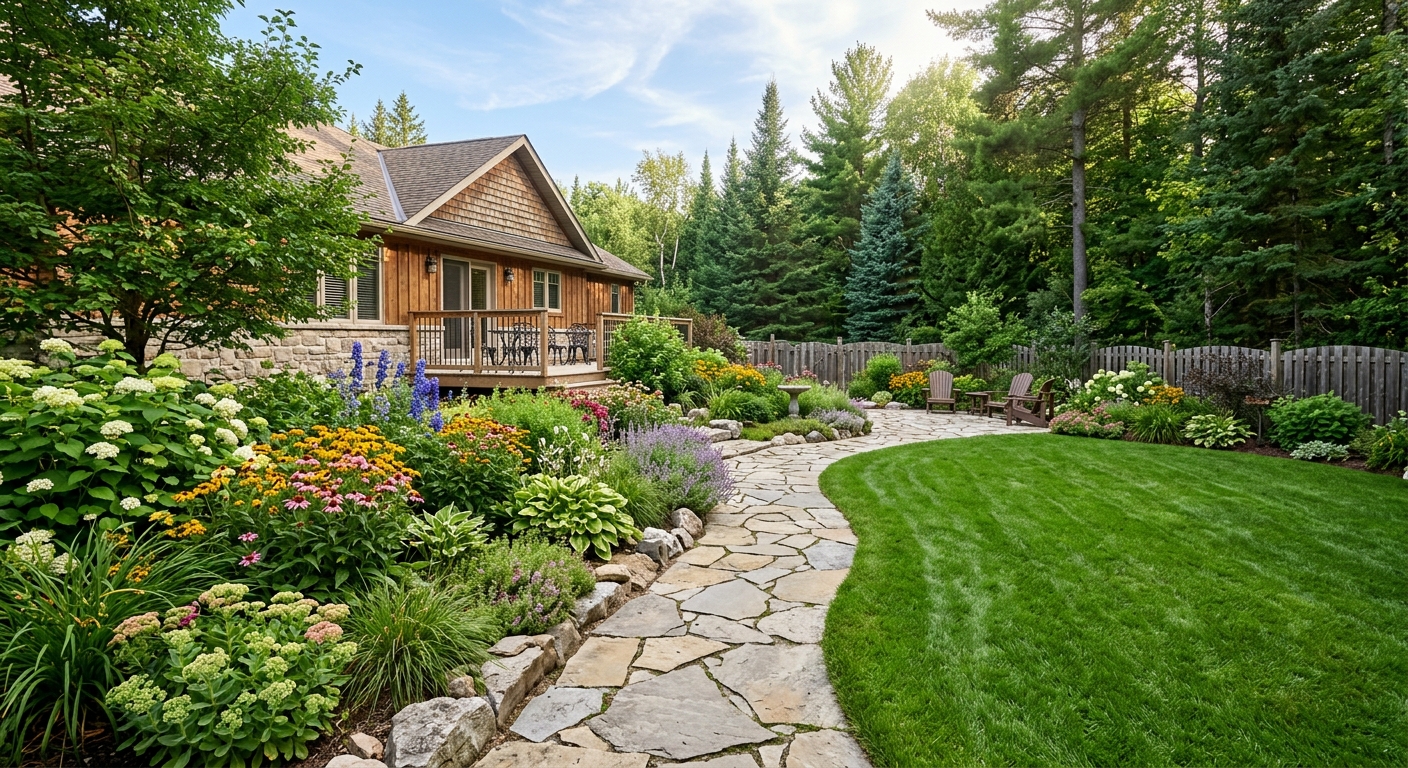
Landscaping options and costs in Elk Point
Elk Point homeowners typically have a lot to work with: with detached properties making up about 80.5% of dwellings, most yards have enough space for meaningful softscaping, not just small touch-ups. And because homeowner households represent 64.8% of households, you’ll often see residents investing in curb appeal and long-term maintenance reductions, especially as older homes reach the point where front yards and walkways start to fail (57.4% of homes were built before 1981). (Statistics Canada, 2021 Census)
In the Wood Buffalo–Cold Lake economic region, the cold continental Prairie climate (hardiness zones 2b–3a) and the short growing season strongly shape scheduling and cost. Spring frosts can linger into May, and fall frosts often arrive by late September, so installs must be planned for root establishment and safe compaction. Freeze–thaw cycling is a major cost driver for patios, pavers, and retaining walls—contractors need deeper granular bases and proper drainage to reduce heaving and settling.
Labour and equipment rates in Alberta commonly run about CAD 50–100 per hour depending on crew size and machinery. Where demand is high in Elk Point—often around the more established residential strips near the downtown core and along busier roadways—quotes can also reflect faster scheduling for homeowners who want work done within the safe seasonal window. Use the comparison table below to ballpark common projects before you request itemised pricing.
| Service |
Description |
Season |
Price Range |
| Full landscape design and installation |
Site visit, concept and grading plan, plant list, soil amendments, labour and materials coordination |
Late April to September |
$5,000–$40,000 |
| Sod installation (supply, grade, lay, roll) |
Base prep, grading and compaction, sod delivery, laying, rolling and initial watering plan |
May to early September (best window before heat stress) |
$1,500–$8,000 |
| Lawn seeding (grade, seed, starter fertilizer) |
Fine grading, seed blend selection for Prairie conditions, starter fertiliser and light covering |
May to mid-June; sometimes early fall |
$800–$4,500 |
| Interlocking patio or walkway |
Excavation, compacted granular base, sand setting bed, edging, pattern layout and cleanup |
June to August (with weather contingencies) |
$3,000–$18,000 |
| Retaining wall (interlocking block) |
Wall layout, drainage layer/weep provisions, granular base and block placement |
June to August |
$4,500–$25,000 |
| Tree and shrub planting |
Planting holes, soil backfill, staking where needed, mulch rings, and initial watering guidance |
Late April to September (roots establishment window) |
$800–$10,000 |
Prices are estimates only and vary by project scope, site access and material selection.
What affects the price of landscaping in Elk Point
In Elk Point and across Wood Buffalo–Cold Lake, it’s common for quotes for the same “front yard refresh” to land 30–50% apart. The swing usually comes from hidden scope items—grading, drainage corrections, topsoil depth, haul distance, and whether the contractor is building to Prairie freeze–thaw conditions rather than minimum-daylight prep. Market factors matter too: availability of crews during the late-spring window and how quickly contractors can mobilise equipment into remote work areas can change the final number.
First, the climate and planting window define both what grows and what can be installed safely. With hardiness zones around 2b–3a and frost persistence into May, contractors often price for a tighter schedule. For Prairie yards, the plan must prioritise cold- and wind-tolerant, drought-capable plants and robust soil prep. Retaining wall and hardscape bases also must be taken below the frost-affected zone—if excavation and granular base are underestimated, freeze–thaw movement becomes an expensive repair later.
To illustrate why regional conditions change budgets: on the Prairie, durable turf and soil amendments matter, and drainage design can push a project upward into the higher part of the sod and design bands (for example, sod installs often land between $1,500–$8,000 depending on grade correction). In contrast, coastal BC’s longer growing season supports denser planting palettes, but heavy rainfall places higher emphasis on drainage engineering. (Water restrictions in the dry interior can also push irrigation design upgrades.) Southern Ontario typically has a longer workable season than Elk Point, but still sees summer dry spells that raise irrigation costs.
Concrete examples from Elk Point: 1) If your yard slopes toward your foundation, adding regrading and a drainage bed can be the difference between a minor update and a more involved installation in the $3,000–$50,000 retaining/hardscaping bracket. 2) On older homes built before 1981, buried drainage issues or compacted topsoil can require extra excavation and topsoil—commonly adding hundreds to low thousands before a plant budget even begins. That’s why the starting point in the full landscape band ($5,000–$40,000) is often appropriate for “simple” makeovers when drainage and grading are truly included.
| Price Factor |
Why It Matters |
Cost Impact |
| Yard size in sq ft — the primary cost driver for softscape |
More area means more labour hours, soil, seed/sod, and edging |
Can shift total by $2,000+ on common front yards |
| Grading and drainage work — slope corrections add significant cost |
Proper slope prevents pooling and foundation moisture; requires excavation and re-compaction |
Often adds 10%–30% to the base scope |
| Drainage bed or French drain installation |
Subsurface drainage reduces freeze–thaw damage; needs rock, fabric, and discharge planning |
Typically increases hardscape/softscape costs by $1,500–$8,000 depending on length |
| Plant material tier — native shrubs vs. ornamental vs. mature specimen trees |
Mature trees cost more to source and install; they also require better staking and soil conditioning |
Can move planting from the low hundreds to several thousands |
| Hardscape vs. softscape ratio — walls and patios cost more per sq ft than lawn |
Patios and pavers require excavation, base materials, and precise compaction |
May push the project into higher bands quickly |
| Irrigation system design and installation |
Even with efficient Prairie design, zones, backflow, trenching, and controllers add cost |
Often adds $800–$4,500 for small systems |
| Soil amendment and topsoil required |
Compacted clay needs conditioning; new lawns and shrubs need consistent depth and fertility |
Commonly adds $500–$3,000 based on haul and depth |
| Tree removal or stump grinding before new planting |
Removal/disposal and grinding require extra equipment and time |
Can add $300–$2,500 per stump/tree depending on access |
Permits & regulations in Alberta
In Alberta, most everyday landscaping work—such as planting trees and shrubs, sodding, seeding, and typical softscape installation—usually does not require a permit. However, some projects do cross into permit territory. Retaining walls generally require a building permit once they exceed the local height threshold, which is commonly around 1.0 m (3.3 ft) in many municipalities, and engineered drawings may be requested for larger or complex walls. Also, changes to lot grading that affect drainage patterns toward neighbouring properties or storm sewer connections can trigger approval needs because drainage impacts can extend beyond your property line.
No matter what you’re doing, call for utility locates before digging. That includes post holes, planting holes, trenching for drip irrigation, and retaining-wall footings. It’s a basic safety step and it prevents expensive repairs and liability issues if utilities are present.
To keep your Elk Point project compliant and protected, verify your contractor’s credentials in a step-by-step way: 1) Confirm the contractor’s Alberta licensing status (if applicable for the scope and business type) using their provided registration information and any public registry details they reference. 2) Request a certificate of insurance (liability) and confirm it covers landscaping/hardscape operations. 3) Ask for proof of WSIB/WCB coverage (or the relevant exemption documentation if they claim none is required). 4) If they’re insured and covered, ask for a clearance letter or coverage confirmation number. Lastly, get any permit responsibilities stated clearly in writing—who pulls the permit, what drawings are required, and how long approvals might add to your schedule.
Planning a landscape that thrives in Elk Point's climate
Planning for Elk Point means designing with your hardiness zone and frost cycle, not fighting them. Elk Point sits in a Prairie climate with long winters and a short growing season, so plant selection should favour cold-hardy, wind-tough species that can establish quickly during the workable months. Many homeowners in Elk Point do best with native or well-adapted shrubs and perennials that handle freeze–thaw and can bounce back after winter stress with less watering and winter protection.
On lawns, sod versus seed is a common decision. Sod gives instant visual payoff and faster functional use, but it costs roughly 3–4x more per sq ft than seeding once you account for supply and labour intensity. Seeding—when done with good grading, correct seed blend, and starter fertiliser—fits the Prairie reality of a shorter establishment window and lower material costs. For example, a basic lawn seeding program may fall around $800–$4,500, while a comparable sod install is often closer to $1,500–$8,000 when grade correction is needed.
Drainage and grading are non-negotiable in Wood Buffalo–Cold Lake. Pooling water near foundations can freeze, expand, and accelerate foundation and wall movement. Hardscape base preparation matters too: patios and block walls need deeper, well-compacted granular bases so freeze–thaw cycling doesn’t lift or shift the surface.
For low maintenance, design for seasonal structure: use mulch in shrub zones, pick durable groundcovers, and group perennials so you’re not fighting bare soil. Xeriscape ideas can still look “lived-in” by combining cold-hardy ornamental grasses, rock mulch, and a targeted drip irrigation design where needed. Where water is a concern, consider rain-garden style depressions (built with proper underdrains) to capture and direct runoff away from your home.
| Element |
Climate Consideration |
Maintenance Level |
Price Band |
| Sod lawn installation |
Needs good grading and timely installation before summer stress and late frosts |
Medium (water early, occasional patching) |
$1,500–$8,000 |
| Native perennial garden |
Cold-hardy plants establish better and handle Prairie wind and winter stress |
Low to medium (spring cleanup and occasional weeding) |
$800–$6,500 |
| Mulched shrub border |
Mulch buffers freeze–thaw and helps regulate soil moisture during dry stretches |
Low (mulch refresh 1–2 times per year) |
$900–$5,500 |
| Interlocking stone patio |
Requires deeper base and compaction to resist heaving |
Low (periodic sand joint topping if needed) |
$3,000–$18,000 |
| Retaining wall (block) |
Needs drainage layer and stable base below frost-affected movement zone |
Low (check weep/drain outlets during annual inspection) |
$4,500–$25,000 |
| Drip irrigation system |
Efficient watering supports establishment in short seasons without waste |
Low (seasonal adjustments and winterisation) |
$800–$4,500 |
How to choose a landscaping contractor in Elk Point
Choosing the right contractor in Elk Point starts with proof, not promises. For Alberta projects, verify three basics: licensing/registration (if applicable to their business type and scope), liability insurance, and WSIB/WCB coverage. Ask for their certificate of insurance and confirm the policy is active and specifically covers landscaping/hardscape work (not just “general business”). Next, request WSIB/WCB clearance or proof of coverage so you know you’re not exposed if a worker is injured on your property. If they claim subcontractors, ask for their subcontractor’s coverage details too.
Then get 2–3 itemised written quotes—especially for Prairie freeze–thaw work where the base build matters. You want line items that break down labour and materials: excavation depth, granular base type and thickness, geotextile use, topsoil depth, seed/sod specifications, and disposal/haul costs. Avoid vague “we’ll prep the yard” language; require specifics for grading and drainage.
Read the scope for exclusions: is permit pulling included for retaining walls over the threshold? Is equipment access covered? Is disposal (old sod, soil, rock) included, or is that a surprise charge? Confirm warranty terms: workmanship warranty length, product/manufacturer warranty details, and whether warranties transfer if you sell the home. For payment, never pay more than 10–15% upfront; use a holdback until the job is complete and deficiencies are addressed. Finally, insist on a written timeline with start date and completion estimate—spring weather and frost constraints in this region can shift schedules, but the plan should still be documented.
- Provide written quotes with labour + materials breakdown, not a single lump sum.
- Include excavation depths and granular base specs for patios and block walls.
- Confirm drainage scope: swales, French drains, weeps, and discharge location.
- State whether disposal/haul is included (and the disposal destination, if practical).
- Verify liability insurance expiry date and coverage amount.
- Verify WSIB/WCB coverage or obtain clearance documentation.
- Ask if crews are experienced with Zone 2b–3a hardy planting and short-season installs.
- Confirm sod/seed specs: grass variety, coverage rate, starter fertiliser, and watering guidance.
- Ask about weather contingencies for late frosts in May and early fall cold snaps.
- Require a written warranty: workmanship duration and what “fix” means.
- Use a payment schedule with a holdback until punch list completion.
- Confirm permit responsibility for retaining walls above typical 1.0 m thresholds.
Red flags in Elk Point: contractors who won’t put drainage and base build details in writing, quotes that exclude disposal but assume “you’ll handle it,” no proof of WSIB/WCB or insurance, vague warranty language (“guaranteed” without duration and scope), and pressure to pay most of the money up front before materials are on site.
Frequently asked questions — landscaping in Elk Point
How do I improve drainage in my yard?
If water pools near your house in Elk Point, start by observing where runoff collects during snowmelt and heavy rain. Then address it at the source: regrading the top 4–8 inches for proper slope, creating swales that direct water away from foundations, and adding a drainage bed or French drain where subsurface water is the real issue. In Wood Buffalo–Cold Lake, drainage also protects against freeze–thaw damage; standing water freezes, expands, and can destabilise patios, block edges, or retaining-wall bases. If you’re considering a lawn refresh, make sure the quote includes grading and drainage—otherwise sod can fail quickly. A small drainage correction paired with softscaping may still land within typical landscaping bands (for instance, many “drainage + seed/sod” projects start around the lower end of the $1,500–$8,000 sod range), but major underground work pushes budgets higher.
What is xeriscaping and does it suit Elk Point?
Xeriscaping is a water-smart landscaping approach that uses drought-tolerant plantings, efficient irrigation (often drip), and soil/groundcover strategies to reduce water waste. In Elk Point, it can suit your yard well because Prairie summers can be dry and the establishment window is short. The key is not “no plants”—it’s choosing hardy, cold-adapted species that can survive Zone 2b–3a winters and still handle moisture swings. Xeriscape designs often include mulch, rock accents, groundcovers, and selective drip lines for plants that need extra help during establishment. It’s especially practical in areas where you’d otherwise over-water turf. If you’re comparing costs, xeriscaping can still require up-front work for grading and irrigation design; however, it can reduce ongoing watering and maintenance. If you prefer lawn, you can still xeriscape borders and keep a smaller sod area for appearance.
How do I plan a low-maintenance yard?
A low-maintenance yard plan in Alberta starts with “right plant, right place.” Pick cold-hardy shrubs and perennials that don’t need constant replacement and group them so you’re not constantly battling weeds. In Elk Point, mulch shrub borders and durable groundcovers usually perform better than high-maintenance, delicate ornamentals that struggle with wind and winter stress. Design for structure: use a mix of evergreen and perennials for winter interest, and keep turf areas compact if you want to reduce mowing and watering complexity. For hardscaping, reliable base preparation on patios and walkways reduces the likelihood of uneven settling after freeze–thaw cycles. Budget-wise, a practical approach is to combine a smaller high-impact hardscape with planting zones; for example, a driveway-to-entry walkway might sit in the $3,000–$18,000 interlocking range while shrub planting and mulching stays in the lower $800–$10,000 planting band depending on plant size and quantity. Always include drainage scope to prevent “maintenance by repair.”
How deep should a retaining-wall base be for local frost?
For Elk Point and the wider Wood Buffalo–Cold Lake region, the exact base depth depends on wall height, soil conditions, and engineering details, but the guiding principle is that the wall system must extend beyond the frost-impacted movement zone. Retaining walls also require drainage layers (like a proper granular backfill and weep provision) to reduce water pressure behind the wall. Because freeze–thaw cycling is a major cause of movement, contractors typically excavate deeper than homeowners expect to build a stable granular base with correct compaction and drainage. If your wall is near or above the typical permit threshold (commonly around 1.0 m in many municipalities), you should expect tighter requirements and possibly engineered drawings. The safest way to confirm depth is to have a contractor assess your site and provide base-build specs in writing. Cost can vary widely—many block wall projects fall within the $4,500–$25,000 band when excavation and drainage are done properly.
How much does professional landscape design cost?
Professional landscape design cost in Elk Point varies based on how much concept work you need and whether the designer is producing a full installation-ready package (grading concepts, plant palette, and hardscape layout). In practice, many homeowners choose a full landscape plan as part of the overall project, and design is then integrated into the project budgeting. Across this market, full landscape design & installation commonly falls in the $5,000–$40,000 range, with smaller layouts and simpler grading corrections landing closer to the low end and more complex drainage, retaining walls, and plant/irrigation packages pushing toward the higher end. The big variable is how much “engineering-like” detail is required due to frost and drainage needs—Prairie yards can’t rely on cosmetic fixes when pooling water or soil instability is present. Ask your contractor if design is included, or if they charge a standalone design fee, and request an itemised quote so you can compare like-for-like scopes.
How do I compare landscaping quotes?
To compare landscaping quotes in Elk Point, you need apples-to-apples scope. Ask for itemised estimates that separate labour and materials and clearly state what each quote includes: excavation depth, granular base specs for patios/walkways, soil depth and amendments for lawns, and whether drainage corrections (swales or French drains) are included. Confirm if permit pulling is included for retaining walls above the typical height threshold and who handles it. Also compare disposal/haul costs and whether site access affects pricing. Warranty terms matter too—workmanship warranty length and what counts as a defect should be in writing. For payment, reputable contractors typically keep upfront payments modest (often 10–15%) and use a holdback until completion. If you’re choosing between options, use realistic price markers: for example, sod installs often fall around $1,500–$8,000, while interlocking patios commonly sit in the $3,000–$18,000 band. The lowest quote isn’t automatically best if it shortcuts drainage or base construction.