Landscaping options and costs in Mayerthorpe
Landscaping in Mayerthorpe is shaped by the realities of small-town lot sizes, an aging housing stock, and the Edmonton-region climate that swings from deep winter freezes to short, fast summers. With 69.6% of dwellings being single-detached homes, many properties have the yard space to invest in curb appeal and functional improvements. Also, 61.8% of homes in the area were built before 1981, which often means older drainage patterns and foundation edges that were never designed for today’s landscaping-grade soil depth and planting density.
In the Edmonton economic region, contractors price landscaping with freeze-thaw cycles and generally drier conditions in mind. That affects everything from excavation depth for retaining wall bases to the soil prep required before sod can knit in and survive establishment watering. It also tightens the working window: crews schedule around frost, thaw, and access so that hardscape base and drainage can be properly compacted. In Mayerthorpe, demand is particularly noticeable in areas with more mature lots and established trees—where homeowners want safer walkways, refreshed garden beds, and better runoff control after spring melt.
Below is a practical cost comparison of common project types—use it as a baseline for budgeting before you request itemised quotes for your specific yard and materials.
| Service |
Description |
Season |
Price Range |
| Full landscape design and installation |
Site walk, grading/drainage plan, planting palette, softscape & hardscape layout, then installation |
Late spring to early fall |
$8,000–$45,000 |
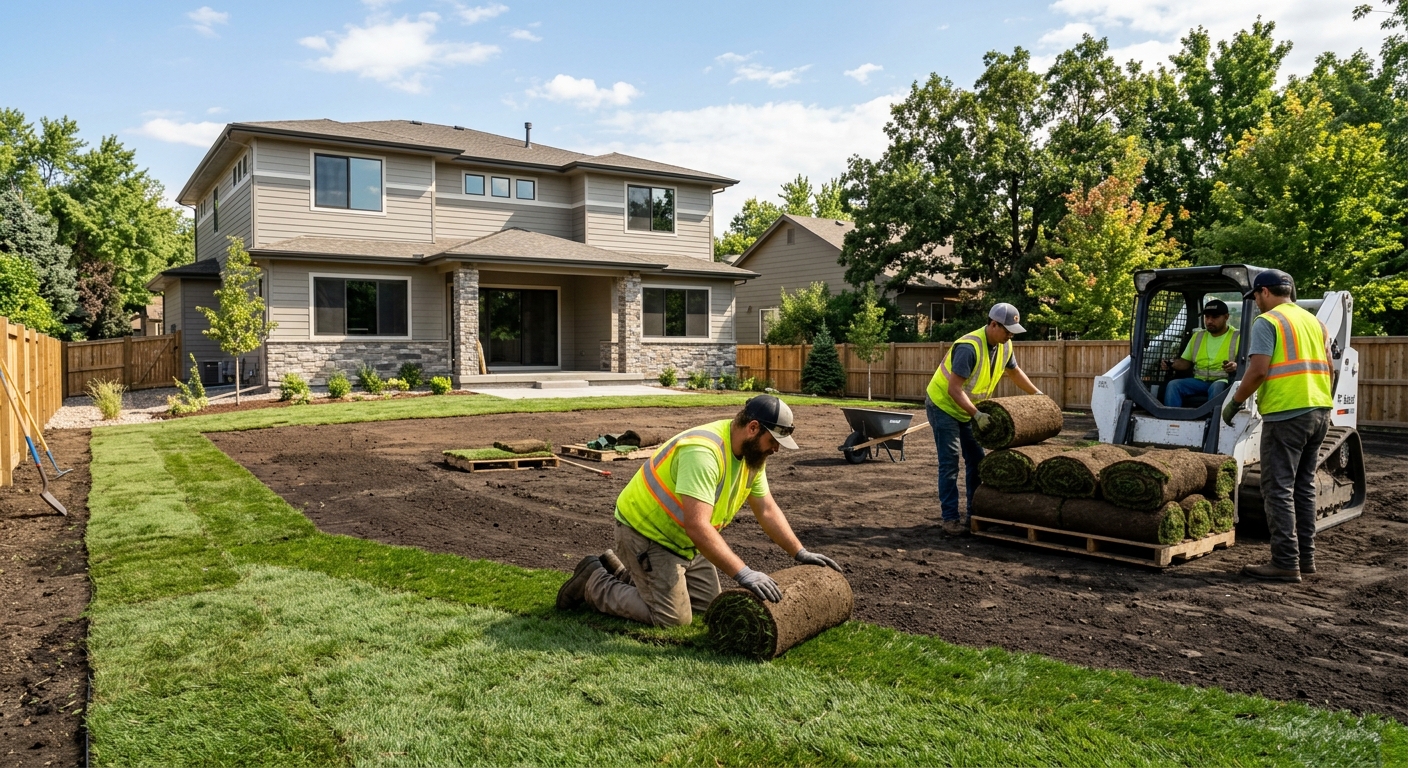
| Sod installation (supply, grade, lay, roll) |
Remove/grade existing ground, add topsoil/soil amendment, install sod, roll and water-in |
May to September |
$3,000–$8,000 |
| Lawn seeding (grade, seed, starter fertilizer) |
Fine grading, seed selection for prairie conditions, starter fertiliser, light topdress |
Spring or early fall |
$1,800–$5,200 |
| Interlocking patio or walkway |
Excavate, compact base, edging, interlocking stone, and jointing sand |
May to September |
$6,500–$28,000 |
| Retaining wall (interlocking block) |
Wall layout, excavation and properly drained base, geotextile, block units, caps and backfill |
Late spring to early fall |
$45–$120 |
| Tree and shrub planting |
Soil preparation, amendments, staking/tying where needed, mulch rings, initial watering plan |
Spring and fall |
$500–$5,000 |
Prices are estimates only and vary by project scope, site access and material selection.
What affects the price of landscaping in Mayerthorpe
Even when two homeowners in the Edmonton region want the “same” landscaping job, quotes can land 30–50% apart. The main reason is that scope details—yard size, soil condition, grading needs, drainage, and whether you’re adding hardscape or irrigation—don’t translate consistently from one estimate to another. Labour availability and haul distances also matter in smaller markets like Mayerthorpe, where crews may travel farther and must plan for compaction, disposal, and material delivery windows.
Climate and seasonal constraints directly influence cost. In the prairie belt (about Zone 2–4), freeze-thaw shortens how long crews can safely excavate, compact, and lay base materials. That means contractors often build in extra time for proper sub-base and drainage so features won’t shift when the ground expands and contracts. Drier establishment conditions also drive plant choices toward drought-tolerant, wind-hardy species and require a watering plan that protects new sod and fresh plantings. By contrast, coastal BC (Zone 7–8) can support a longer growing season and lush palettes, but heavy rainfall changes drainage design and water management priorities; similarly, southern Ontario’s more moderate season still demands summer irrigation during dry spells.
In Mayerthorpe specifically, you’ll see common cost swings. Example: if your yard has slope and you need to correct pooling near a foundation, grading and drainage can push a lawn-only budget into full design & installation territory that sits closer to the $8,000–$45,000 band. Example two: replacing an uneven turf area with sod often costs more than seeding because sod prep and establishment watering time are higher—while seeding can be the lower-entry option when your soil is workable and you can wait for a full lawn build. If your property has older drainage and compacted subsoil (common in homes built before 1981), soil amendment and deeper base work may also add cost before plants even go in.
| Price Factor |
Why It Matters |
Cost Impact |
| Yard size in sq ft — the primary cost driver for softscape |
More area means more labour, materials, soil work and maintenance inputs |
Low to high; can swing the total by 20–60% |
| Grading and drainage work — slope corrections add significant cost |
Pooling and runoff control requires excavation, re-shaping and compaction |
Often increases cost by 15–40% |
| Drainage bed or French drain installation |
Intercepts water that freezes/expands and damages foundations and pavements |
Can add a major standalone line item (commonly 10–35%) |
| Plant material tier — native shrubs vs. ornamental vs. mature specimen trees |
Inventory cost and handling effort rise sharply with size and species |
Small shrubs: minor; mature trees: can add 30–100% to planting budgets |
| Hardscape vs. softscape ratio — walls and patios cost more per sq ft than lawn |
Hardscape involves thicker base construction and more material per square foot |
Shifts project toward the upper bands (sometimes doubling total) |
| Irrigation system design and installation |
Establishment watering is critical in short prairie seasons and dry spells |
Often adds 5–25% depending on zones and layout |
| Soil amendment and topsoil required |
Compacted or low-quality soil increases the amount of imported material |
Typically 5–20%, higher if significant re-grade is needed |
| Tree removal or stump grinding before new planting |
Removal changes access, disposal needs, and root-related excavation |
Can add 10–40% depending on size and number |
Permits & regulations in Alberta
In Alberta, most landscaping and planting work typically does not require a permit. That usually includes planting beds, sodding, seeding, mulch, topsoil placement for planting, and general softscape installation. For homeowners in Mayerthorpe, the items that more commonly do require approval are retaining walls above a municipal height threshold—often around 1.0 m (3.3 ft) in many municipalities—and any associated structural considerations (especially where drainage is altered or the wall is tasked with stabilizing significant grade). Changes to lot grading that affect how water drains toward neighbouring properties, storm sewer connections, or municipal drainage infrastructure can also trigger review.
Before anyone digs, confirm utility locates. Calling for locates is essential prior to planting holes, trenching for drainage, and wall footing excavation. Even if you’re only installing a small patio extension, you still want to know where service lines run to avoid costly repairs.
To verify a contractor’s credentials in Alberta, do it step-by-step:
- Licensing: ask for their Alberta business information and any applicable trade registration, then confirm using the relevant online registry sources they reference.
- Liability insurance: request a current certificate of insurance (COI) and verify it lists your address as additional insured where applicable.
- WCB/WSIB coverage: ask for clearance or proof of WCB registration/coverage for workers; don’t rely on verbal confirmation.
- Insist on written scope: make sure the quote lists excavation, base prep, drainage tie-ins, disposal, and whether any permits are handled.
- Get product documentation: warranties for pavers/blocks and plant stock should be documented.
Planning a landscape that thrives in Mayerthorpe's climate
Designing for Mayerthorpe means working with prairie freeze-thaw and moisture stress, not against it. Start by choosing plants suited to your hardiness zone and by planning for frost timing—so roots establish before deep winter and surfaces drain well before freeze. Many homeowners do best with native or zone-appropriate shrubs and perennials that tolerate wind and winter desiccation with less intensive protection.
For turf, decide early whether you want instant coverage or long-term value. Sod provides rapid visual results, but it requires correct grade, soil amendment, and consistent establishment watering—especially during dry stretches after installation. Seeding is usually cheaper and can perform well when done with proper grading and starter fertilizer, but it needs patience for full density.
Drainage and grading are critical in the Edmonton market because pooling water can freeze, expand, and shift base materials over time. This is where retaining walls, patios, and walkways earn their longevity: base preparation, drainage layers, and proper compaction should be built around the local frost line concept so the system moves as designed rather than cracking or settling.
Low-maintenance strategies that still look sharp include mulched shrub borders, groundcovers, and perennial “repeaters” that come back reliably each year. If you want a water-smart approach, consider xeriscaping elements and rain-garden style planting pockets that safely store and infiltrate runoff—just be sure the excavation and underdrain plan matches your soil.
Price reality check: upgrading from seed to sod can be justified when you need quick curb appeal for a sale or you want to protect bare soil from erosion. But if you’re budgeting, a smaller seeding area can keep you closer to the lower end of lawn costs, while focusing the higher spend on drainage and a durable patio base.
| Element |
Climate Consideration |
Maintenance Level |
Price Band |
| Sod lawn installation |
Requires correct grade and establishment watering to survive prairie dryness and early frosts |
Medium (watering-in, early weed control) |
$3,000–$8,000 |
| Native perennial garden |
Hardy root systems handle winter exposure and reduce watering stress |
Low (mulch refresh, occasional pruning) |
$1,200–$4,500 |
| Mulched shrub border |
Mulch buffers freeze-thaw heave and conserves moisture |
Low to medium (spring tidy, re-mulch) |
$800–$3,200 |
| Interlocking stone patio |
Base prep and drainage prevent frost-related movement and settling |
Low (seasonal cleaning, joint sand check) |
$6,500–$28,000 |
| Retaining wall (block) |
Backfill and drainage must be designed to manage meltwater and freeze-thaw |
Low (inspection after spring melt) |
$45–$120 |
| Drip irrigation system |
Efficient watering supports establishment during short prairie growing windows |
Medium (seasonal turn-on/off, checks for clogs) |
$2,000–$6,500 |
How to choose a landscaping contractor in Mayerthorpe
Choosing the right landscaping contractor in Mayerthorpe comes down to proof, process, and clarity. Start with Alberta coverage: request liability insurance documentation (certificate of insurance) so you know you’re protected if something is damaged on-site. Next, verify WCB coverage—ask for proof/clearance that they are registered and that workers are covered. Licensing requirements can vary by task, but you should still confirm the contractor is operating lawfully and ask for their business registration details.
Then get 2–3 itemised written quotes, not a single lump sum. Your quote should break out labour vs. materials (pavers, block, sod/seed, soil amendment, drainage components), and include disposal and any haul charges. Make sure exclusions are explicit: for example, whether tree removal, stump grinding, or utility locating are included. If a permit is required for a retaining wall above the typical height threshold, confirm who pulls it and who bears the cost.
Warranty matters for both workmanship and products. Ask for: the workmanship warranty length (and what it covers), product/manufacturer warranty on interlocking stone or block, and whether warranties are transferable to you as the homeowner.
Payment schedule: don’t pay more than 10–15% upfront. Hold back the remainder until key milestones are done and the site is cleaned to standard. Finally, insist on a start date and completion estimate in writing—freeze-thaw scheduling and material lead times should be reflected in the timeline.
- They do a site walk and ask about drainage, downspouts, and spring melt patterns.
- They describe base construction (thickness, compaction, and drainage layers) for patios and walls.
- Quotes are itemised with line-by-line quantities, not “allowances” that hide costs.
- They include disposal/hauling if excavation is part of the scope.
- They clarify whether utility locates are included or your responsibility.
- They specify topsoil/soil amendments and whether they’re screened and tested.
- They state plant types and sizes (container size or caliper), not vague labels.
- They provide an irrigation plan if you’re adding zones, and timing for watering-in.
- They confirm what happens if frost hits mid-job (protection of base and soils).
- They document start date, milestone dates, and completion conditions.
- They explain warranty terms in writing, including what “settling” or movement means.
- They won’t pressure you into large upfront payments or cash-only arrangements.
Common red flags in Mayerthorpe include: vague scopes that don’t mention drainage and base prep, refusal to provide a certificate of insurance and WCB proof, payment requests above 10–15% upfront, no written warranty terms, and quotes that treat retaining wall work like simple block stacking without specifying footing depth and drainage backfill.
Frequently asked questions — landscaping in Mayerthorpe
How much does a retaining wall cost in Mayerthorpe?
In Mayerthorpe, retaining wall pricing typically depends on length, height, and whether drainage is included behind the wall. As a budget baseline for the Edmonton region, interlocking-block retaining walls often price in the $45–$120 range as a per-unit budget band for wall work, but your final number can be higher when excavation, proper base depth, geotextile, and weeping/backfill drainage are included. If you’re correcting grade near a foundation or dealing with spring melt water, expect drainage components to matter as much as the blocks themselves. Also note that if the wall is above a typical permit threshold (commonly around 1.0 m in many municipalities), you may have additional process costs tied to approvals and documentation.
When is the best time to landscape in Mayerthorpe?
For most landscaping in Alberta, the practical window is late spring through early fall—when soils are workable and crews can compact base material before freeze. Sod and irrigation establishment are usually scheduled from May into summer, while seeding often works best in spring or early fall when temperatures support germination. For planting trees and shrubs, spring and fall are commonly preferred because temperatures are gentler and roots can establish before the coldest months. In Mayerthorpe specifically, the freeze-thaw cycle means you should avoid rushed installs late in fall: base prep and drainage need stable conditions to perform through winter. If your project includes hardscape and drainage, contractors will often schedule that first to ensure the system is stable before deep freezes.
Do I need a permit for a retaining wall in Alberta?
Often, yes if the retaining wall height is above the municipal threshold—commonly around 1.0 m (3.3 ft) in many Alberta municipalities. Since rules can vary by location and the specifics of grade change and drainage, the safest approach is to confirm with the local requirements for your property address before construction. Softscape like planting beds, mulching, seeding, and sodding typically do not require permits. However, excavation and grading changes that redirect drainage, plus any structural wall work, are more likely to trigger approval. For your peace of mind in Mayerthorpe, ask your contractor: (1) whether the proposed wall height crosses the threshold, (2) who pulls the permit, and (3) whether engineered drawings are needed based on the design.
How do I improve drainage in my yard?
Improving drainage usually starts with observing water during spring melt and after heavy rain: where it pools, how fast it drains, and whether downspouts discharge too close to foundation edges. In Mayerthorpe and the Edmonton region, drainage matters because freeze-thaw can magnify movement—standing water freezes, expands, and can damage patios, walkways, and wall bases. Common solutions include re-grading the slope away from the house, installing a drainage bed or French drain where water collects, and correcting downspout extensions so runoff is managed safely. A professional quote should include excavation details, geotextile layers, proper backfill, and whether the drainage ties into an appropriate outlet. If you’re budgeting, drainage and grading can influence your project total as much as hardscape does.
What is xeriscaping and does it suit Mayerthorpe?
Xeriscaping is a design approach that reduces water demand by using drought-tolerant plants, efficient irrigation (when needed), and smart soil/mulch strategies. In Mayerthorpe, it can suit many yards because prairie conditions are dry for part of the year and winter exposure stresses plants. A well-planned xeriscape often includes native perennials, mulched shrub borders, and groundcovers that limit evaporation and suppress weeds. If you add drip irrigation only where plants need it, you can reduce establishment watering stress without overwatering. For lawn areas, xeriscape doesn’t necessarily mean eliminating turf—some homeowners keep smaller lawn zones and use planting beds elsewhere. When comparing costs, seeding or sod is still a distinct budget line, while a planting-focused xeriscape can keep you closer to the lower end of tree and garden planting budgets.
How do I plan a low-maintenance yard?
A low-maintenance yard in Mayerthorpe is mostly about reducing repeated labour: choose hardy plants, build correct drainage, and use materials that handle winter movement. Start with a plant palette suited to your climate—native perennials and shrubs that tolerate Alberta’s temperature swings require less winter protection and fewer interventions. Layer your design: mulched shrub borders and groundcovers reduce weeding, while perennials provide seasonal curb appeal with simple spring tidy-ups. For turf, consider whether sod or seeding fits your lifestyle; sod gives faster results but needs establishment care, while seeding can be a more budget-friendly option when you can wait for density. If hardscape is part of the plan, invest in proper base prep for patios and wall systems so you’re not doing repairs after freeze-thaw. Many homeowner projects fall within the $8,000–$45,000 design-and-install band when drainage, irrigation zoning, and durable surfaces are combined thoughtfully.