Landscaping options and costs in 100 Mile House
In 100 Mile House, homeowners typically choose landscaping upgrades based on budget, yard size, and how well the design holds up through Cariboo winter freeze–thaw cycles. With a community population of 1,980 (Statistics Canada, 2021 Census), local contractors can be selective with scheduling—especially during the short planting window when conditions are workable. Landscaping demand is also driven by the mix of housing stock that includes single-detached neighbourhoods, where yards are large enough to justify drainage improvements, patios, and planting beds. In practice, that means you’ll see more full-service design-and-build projects concentrated around active residential areas near Highway 97 and the central service corridors.
Cost in the Cariboo is shaped less by “how it looks in July” and more by durability and water-wise design. Most of the region sits around plant hardiness zones 3–4, so we price in cold-hardy species, deeper bases under paving, and better drainage beneath retaining walls. The frost-free season is roughly May to late September, which compresses labour and equipment time into about 4–5 main working months; that compression can raise scheduling premiums. Water restrictions in the dry BC interior also influence irrigation design—efficient drip and smart controls add upfront design time, but they help control long-term operating costs.
Below is a realistic planning table for common options you can use to compare contractor proposals before you book a site visit.
| Service |
Description |
Season |
Price Range |
| Full landscape design and installation |
Site measurement, grading/drainage plan, plant palette, soil prep, hardscape/softscape installation, irrigation recommendations |
May to September (often best booked early) |
$8,000–$40,000 |
| Sod installation (supply, grade, lay, roll) |
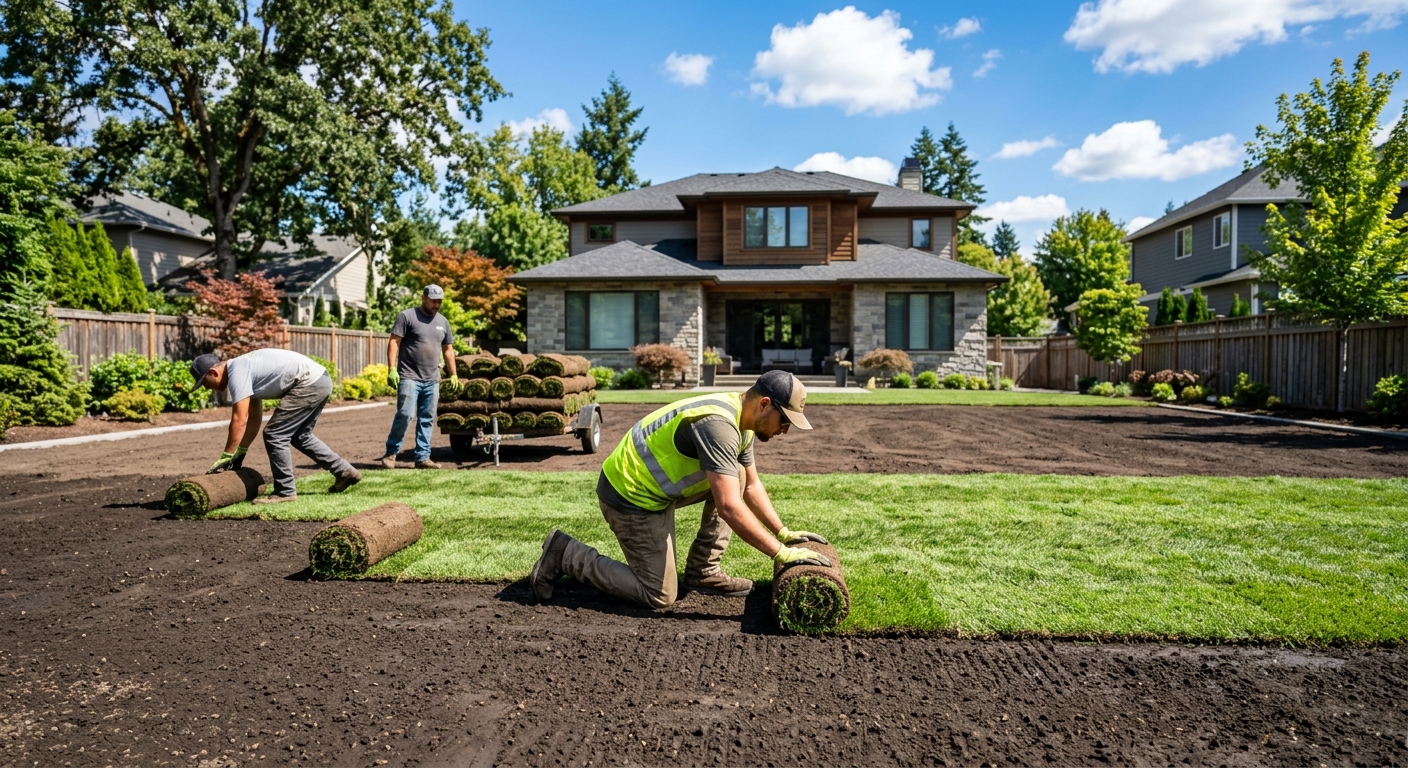
Remove existing dead turf, grade and compact, topsoil/loam, sod delivery and install, roll and starter watering plan |
Late spring to early fall |
$3–$7 |
| Lawn seeding (grade, seed, starter fertilizer) |
Minor grading, seed selection for interior BC, starter fertilizer, light raking and establishment watering plan |
May to August (seeding timing matters) |
$1,200–$3,500 |
| Interlocking patio or walkway |
Excavation, compacted base, geotextile, sand setting bed, interlocking stones, edge restraints |
Late spring to early fall |
$120–$300 |
| Retaining wall (interlocking block) |
Layout, excavation and base compaction, geogrid if needed, block installation, drainage gravel and weeping considerations |
May to September |
$1,800–$6,500 |
| Tree and shrub planting |
Soil amendments, digging, planting, staking (as needed), watering plan and mulch rings/bed edging |
May to September (weather-dependent) |
$300–$8,000 |
Prices are estimates only and vary by project scope, site access and material selection.
What affects the price of landscaping in 100 Mile House
In 100 Mile House and across the Cariboo, the same landscaping job can come in 30–50% apart between contractors because the true cost drivers aren’t always visible on a first call. The biggest differences come from how deep contractors go with grading and drainage, what plant tier they use, and whether irrigation is designed for water-restriction realities. Work also needs to fit a short planting and paving window—labour and equipment in interior BC can be booked tightly from roughly May through late September, and that can change labour rates per crew-hour compared with longer-season regions.
Hardiness zone and frost timing define both what grows and what can be installed. In Cariboo zones 3–4, cold-hardy selections are a must, and base work under patios and paths must be planned for freeze–thaw. In Prairie regions (often Zone 2–4), contractors budget for wind-hardy, drought-tolerant choices and careful compaction; similar logic applies here, but the freeze–thaw effect in a forested interior often makes drainage detailing just as important. Coastal BC (Zone 7–8) typically supports faster plant establishment, but heavy rainfall demands excellent drainage under pavers. Southern Ontario (Zone 5–6) often has a moderate season—different from the Cariboo—but still needs irrigation planning during summer dry spells.
Concrete examples in 100 Mile House: (1) upgrading drainage from “basic regrading” to a proper drainage bed or French drain can shift your project by thousands, even if the visible landscaping stays the same. (2) Choosing sod for instant coverage usually pushes the lawn portion into the higher end of interior installs—while seeding can be dramatically more budget-friendly, especially on larger areas where establishment is acceptable. As a reference point, full landscape design-and-install commonly lands somewhere in the $8,000–$40,000 band, while a more focused planting package often sits in the $300–$8,000 range depending on specimen size and quantities.
| Price Factor |
Why It Matters |
Cost Impact |
| Yard size in sq ft — the primary cost driver for softscape |
More turf and more bed area means more excavation, soil, materials, and time to install |
Large yards can double material and labour totals |
| Grading and drainage work — slope corrections add significant cost |
Cariboo freeze–thaw punishes poorly drained soil; correcting grades takes excavation and compaction |
Often increases the bill more than homeowners expect |
| Drainage bed or French drain installation |
Proper sub-drainage reduces pooling and foundation moisture risk |
Can add substantial cost versus surface-only fixes |
| Plant material tier — native shrubs vs. ornamental vs. mature specimen trees |
Mature stock costs more to source and handle; cold-hardy selection affects survival and replant risk |
Specimens can be the largest single softscape swing |
| Hardscape vs. softscape ratio — walls and patios cost more per sq ft than lawn |
Paving and retaining systems require heavier base prep, stone, and precise installation |
Higher hardscape ratio moves projects up quickly |
| Irrigation system design and installation |
Interior BC water restrictions make zoning and efficient layout important for long-term operating costs |
Adds labour and components, but reduces waste |
| Soil amendment and topsoil required |
Poor native soil in some yards needs loam/topsoil and amendments for root establishment |
Transport and placement costs can add up |
| Tree removal or stump grinding before new planting |
Roots and stumps can interfere with grades, drains, and bed layout |
Often adds a noticeable line item and scheduling time |
Permits & regulations in British Columbia
In British Columbia, most planting and typical softscape work does not require a permit. That generally includes tasks like seeding or sod installation, planting trees and shrubs, laying mulch and topsoil, and installing standard ground-level drainage improvements. Retaining walls, however, are the work item that most often triggers a permit requirement: retaining walls above a height threshold—commonly around 1.0 m (3.3 ft) in many municipalities—typically require a building permit, and sometimes engineered drawings depending on the wall design and site conditions.
Grading is another area to watch. If you plan to change lot grading in a way that affects drainage toward a neighbouring property or storm sewer connections, approvals may be required. Before anyone digs holes or installs wall footings, contractors should call utility locates to mark buried services. This is especially important in older serviced neighbourhoods where “unknown” lines can show up during excavation.
To verify your contractor’s compliance in 100 Mile House, ask for: (1) a British Columbia business licence/registration proof (where applicable) and confirm their trade credentials, (2) liability insurance certificate (ask for the coverage limits), and (3) WSIB/WCB coverage documentation. Where you look: request the certificate of insurance directly for the named insured and check the expiry dates; for WSIB/WCB/clearance documentation, ask for the most recent clearance letter from the provider. For safety, ensure the company’s name on the insurance matches the quote’s contracting entity.
Planning a landscape that thrives in 100 Mile House's climate
To plan a yard that performs in 100 Mile House, you need to build around the Cariboo’s cold-hardy reality: roughly zones 3–4 plant survivability, a freeze–thaw cycle, and a frost-free window that runs about May to late September. The goal is not just “getting it planted,” but getting it established before the first hard setbacks. Start with plant selection: choose native and zone-appropriate species that are naturally tougher and typically require less watering and winter protection. For lawn areas, decide early whether sod or seeding fits your timeline and budget. Sod gives instant curb appeal, but it usually costs about 3–4 times more per sq ft than seeding, because you’re paying for sod production, delivery, and high-touch installation.
Drainage and grading are where the Cariboo climate can quietly burn budgets. Poor drainage leads to pooling, winter heaving, and foundation moisture. If you’re adding hardscape like patio stones or any base-heavy work, make sure the base prep respects the local frost line behavior: properly excavated, compacted, and separated from fine soils with geotextile as needed. For low maintenance, use groundcovers, mulched shrub borders, and perennials that return reliably—then reduce annual upkeep with a clean mulch strategy and weed-suppressing fabric only where appropriate.
If you want a water-wise angle, xeriscaping concepts—like drought-tolerant planting palettes and drip irrigation—often suit interior BC well, especially under watering restrictions. A rain-garden or swale can also help manage stormwater where drainage is a challenge, but it should be designed with the soil and slope in mind.
Dollar example: if you’re considering lawn renewal, upgrading a small area with sod may be justified for a front entry touchdown zone where you want fast results; on a larger lawn stretch, seeding is often the better value. A full landscape project can still fit within the $8,000–$40,000 band when drainage and irrigation are done right—otherwise, you may spend on appearance changes that don’t solve winter performance.
| Element |
Climate Consideration |
Maintenance Level |
Price Band |
| Sod lawn installation |
Needs consistent establishment watering before cold snaps; grade and soil contact are critical through freeze–thaw |
Medium during establishment, then lower |
$3–$7 per sq ft |
| Native perennial garden |
Cold-hardy plants survive winter better and typically need less watering once rooted |
Low to medium (spring cleanup) |
$300–$8,000 total |
| Mulched shrub border |
Mulch moderates soil temperature swings and helps protect roots in winter |
Low (mulch top-ups, occasional pruning) |
$1,500–$6,000 |
| Interlocking stone patio |
Proper base build reduces movement during freeze–thaw |
Low (periodic cleaning, occasional edge checks) |
$120–$300 per sq ft |
| Retaining wall (block) |
Needs well-draining backfill and appropriate base depth for frost behavior |
Low (monitor drainage outlets) |
$1,800–$6,500 |
| Drip irrigation system |
Supports watering efficiency during drought restrictions and reduces waste in short seasons |
Medium (seasonal adjustments) |
$1,200–$5,000 |
How to choose a landscaping contractor in 100 Mile House
Start by verifying your contractor’s ability to work legally and safely in British Columbia. Ask for a certificate of insurance (liability) and confirm the expiry date and coverage limits. For workers’ compensation, request proof of WSIB/WCB coverage and, if provided, a current clearance letter. Where to check: most firms can provide their insurer certificate on the spot; you can also confirm the clearance documentation with the agency referenced on the letter. If they can’t produce paperwork promptly, that’s a practical risk signal.
Next, get 2–3 itemised written quotes—not lump sums. A good quote breaks out labour and materials, shows quantities (sq ft, linear ft, number of plants), and includes line items for key scope like excavation, disposal, geotextile, drainage rock, topsoil/loam, and stone base components. Ask whether permits are included and who pulls them if required (for example, retaining wall permitting may apply above the local height threshold). Clarify exclusions: what happens if unsuitable subgrade is discovered? Is disposal of extra material included? Are there protections for existing trees, fences, and walkways during construction?
Warranty matters in a freeze–thaw climate. Look for a workmanship warranty length for grading, base build, and installation. Product/manufacturer warranties may cover plant material replacements, but workmanship and drainage performance should be clear and separate. Payment should be controlled: never pay more than 10–15% upfront; hold back a portion until the job is complete and cleanup is verified. Finally, require timeline details: a written start date and a completion estimate tied to weather and the short working window.
- Provide current liability insurance certificate (matching contractor legal name) and confirm expiry.
- Provide WSIB/WCB proof or clearance letter before work starts.
- Use an itemised quote with quantities and unit pricing (labour + materials).
- Confirm whether excavation includes disposal or haul-away (and where it goes).
- Ask for drainage specifics: depth, bedding, and how water will be routed.
- Clarify soil sourcing: topsoil/loam quality and how much is imported.
- Confirm base build specs for patios/paths (geotextile, compaction, thickness).
- Ask what plant sizes and root types are included (and substitutions policy).
- Check if irrigation is included or only recommended; get design details if included.
- Require a workmanship warranty statement in writing.
- Make payment schedule milestones clear; hold back until final walkthrough.
- Get start/completion dates in writing, with weather contingencies explained.
Red flags specific to landscaping contractors in 100 Mile House: vague “materials included” language without quantities; refusing to show drainage and base build details (common when bids look too low); missing insurance or workers’ compensation proof; pressuring for full payment upfront; and no written start/completion timeline for the short working season.
Frequently asked questions — landscaping in 100 Mile House
When is the best time to landscape in 100 Mile House?
In 100 Mile House, the best time is usually late spring through early fall, because the Cariboo’s frost-free season is roughly May to late September. Sod and seeding both need establishment time before cold weather sets in; sod should be planned for periods with stable temperatures and reliable watering capacity. For hardscape like patios and walkway bases, late spring is often ideal once soils aren’t saturated from early melt, and before fall rains reduce compaction quality. If you’re doing a full design and installation, booking early helps because labour and equipment are limited during the 4–5 main working months. As a budget reference, full landscape projects commonly sit in the $8,000–$40,000 range depending on drainage and hardscape scope.
Do I need a permit for a retaining wall in British Columbia?
In British Columbia, planting and most softscape work typically doesn’t require a permit, but retaining walls are where rules often change. Many municipalities require a building permit for retaining walls above a height threshold—commonly around 1.0 m (3.3 ft)—and some walls may also require engineered drawings based on design and site conditions. Grading changes can also trigger approvals if they affect drainage toward neighbouring properties or storm sewer connections. The most practical next step in 100 Mile House is to ask your contractor to confirm whether your wall height and design require a permit before excavation starts, and to show you the permitting responsibility in the written scope.
How do I improve drainage in my yard?
In the Cariboo, drainage is often the difference between a yard that looks good and a yard that survives freeze–thaw. Start by identifying where water pools after rain or melting snow, and whether runoff is directed toward foundations. Typical improvements include regrading to positive slope away from structures, adding a drainage bed, or installing a French drain where subsurface moisture is the problem. Good drainage work may increase your quote significantly, but it reduces later failures like heaving pavers or struggling turf. If you’re planning hardscape, ensure base preparation includes drainage considerations. For budgeting, drainage-focused upgrades often push projects toward the higher end of the $8,000–$40,000 landscape band when paired with new patio and planting.
What is xeriscaping and does it suit 100 Mile House?
Xeriscaping is landscape design that reduces water use by using drought-tolerant plants, efficient irrigation, and soil strategies like mulch and proper grading. In 100 Mile House and interior BC, it often suits the climate well because watering restrictions are commonly a reality during summer dry periods, and winter protection is easier when plants are hardy and established. A xeriscape doesn’t mean “no colour”—it means planning for fewer, tougher plants and smarter moisture delivery (often drip irrigation with zoning and smart controllers). Many homeowners combine xeriscape principles with a smaller lawn area for play and comfort. If you’re doing irrigation plus planting, it can be a worthwhile investment compared to repeated lawn re-seeding in dry summers.
How do I plan a low-maintenance yard?
A low-maintenance yard in 100 Mile House is usually built on three things: correct drainage, hardy plant selection, and a layout that doesn’t demand constant rework. Choose native and zone-appropriate shrubs and perennials that tolerate cold snaps and can handle the region’s freeze–thaw cycle. Use mulch around beds, and consider groundcovers to reduce weeding. Reduce “high-effort” lawn size—sod or seeding can be great, but large turf areas require more mowing and watering. If you want instant results near a front step, sod can be justified; note that sod installs commonly land in the $3–$7 per sq ft range. For a more budget-efficient approach over large areas, seeding is often less expensive when properly timed for establishment.
How deep should a retaining-wall base be for local frost?
For a retaining wall in 100 Mile House, base depth isn’t one-size-fits-all; it depends on wall height, soil conditions, and whether drainage backfill is used correctly. The key concept is that the base must be designed to manage freeze–thaw movement, and it typically goes below frost-affected zones with proper compaction and drainage gravel behind the wall. In practice, the retaining-wall contractor should design the base build to local soil and wall specifications and confirm the design requirements in writing. If your wall is near or above a common height threshold (often around 1.0 m / 3.3 ft), you should also expect that permitting and potentially engineering may be required. Ask for the proposed section details before any block is installed.