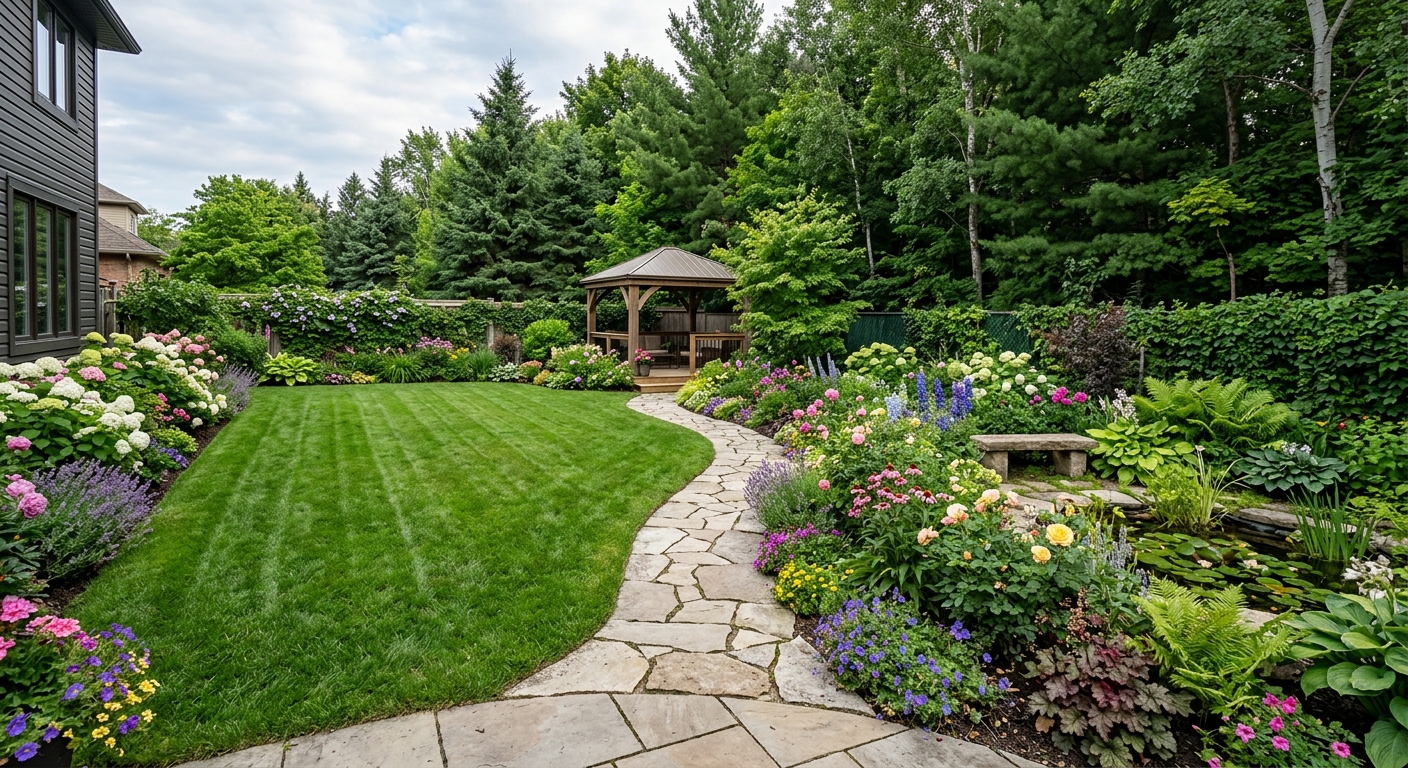
Landscaping options and costs in Abbotsford
Landscaping in Abbotsford is often driven by the fact that the majority of households are homeowners—36,600 homeowner households (68.8% of households own) in the 2021 Census—and many lots on detached homes (37.1% of dwellings are single-detached) can accommodate a more complete front-and-back yard refresh. That’s why you’ll see strong demand in areas like West Abbotsford, where families commonly upgrade patios, add garden structure, and improve drainage after buying older properties (29.0% of homes were built before 1981).
In the Lower Mainland–Southwest, costs are shaped by a long working and growing season in plant hardiness zones 7–8, plus frequent wet winters and freeze–thaw cycles that affect hardscape foundations. Contractors can install softscape for much of the year, but patios, retaining walls, and any grading still require disciplined base prep, drainage lines, and compaction to prevent frost heave and settlement. Labour availability is typically steadier than in Prairie regions, which also helps keep installation schedules predictable. At the same time, Abbotsford’s heavier rainfall periods mean drainage work (French drains, catch basins, soil amendments) can add meaningful scope compared with drier areas. Finally, as water costs rise and homeowners look for designs that tolerate occasional restrictions, many quotes now include efficient drip irrigation and smart controllers rather than broad sprinklers.
Below are practical cost ranges you’ll see for common jobs in Abbotsford, so you can compare bids and understand what “scope differences” usually mean.
| Service |
Description |
Season |
Price Range |
| Full landscape design and installation |
Consultation, layout, plant selection, grading/drainage plan, planting, mulch, and hardscape/softscape build-out |
Spring–Fall (with some winter prep possible) |
$5,000–$50,000 |
| Sod installation (supply, grade, lay, roll) |
Topsoil/grade corrections, weed control prep, sod supply, installation, rolling, and initial watering plan |
Spring–Early Summer; Fall is often excellent |
$2,000–$8,000 |
| Lawn seeding (grade, seed, starter fertilizer) |
Light grading, seed mix, starter fertilizer, and turf establishment care guidance |
Late Spring–Early Fall |
$1,500–$6,000 |
| Interlocking patio or walkway |
Excavation, compacted base, sand/capping, pavers, edging, and drainage considerations |
Spring–Fall (avoid soggy freeze–thaw weeks) |
$10,000–$80,000 |
| Retaining wall (interlocking block) |
Block wall build with proper drainage layer, geotextile, and compaction; includes excavation and shaping |
Spring–Fall |
$12,000–$75,000 |
| Tree and shrub planting |
Soil prep, planting layout, mulch ring, staking/tying where required, and watering guidance |
Spring–Fall (best after wet periods) |
$1,000–$15,000 |
Prices are estimates only and vary by project scope, site access and material selection.
What affects the price of landscaping in Abbotsford
If you receive multiple quotes in Abbotsford for “the same” landscaping project and see differences of 30–50%, it’s usually because the scope isn’t truly identical—grading depth, drainage design, base materials, plant size, and installation labour intensity often change the real cost. Across British Columbia, the quote spread is also tied to climate and scheduling. Lower Mainland–Southwest (zones 7–8) supports a longer growing season, so planting and softscape labour is less constrained. Prairie regions (zone 2–4) tend to compress the frost-free window and push design toward drought-tolerant, wind-hardy selections; that can increase labour intensity when crews are working. Coastal BC supports lush, layered palettes with generally lower winter damage risk, but heavy rain means drainage and soil conditioning become non-negotiable. Meanwhile, the dry BC Interior and Alberta can require different irrigation strategy due to restrictions, affecting equipment choice and ongoing maintenance. Southern Ontario (zone 5–6) is moderate, but it often needs summer irrigation planning during dry spells.
In Abbotsford specifically, two common cost drivers raise totals quickly. First, older lots (especially homes built before 1981) may have settled grades or poor downspout routing, so drainage bed and French drain work can add significant line items before planting or sod goes in. Second, sloped yards common in the area often need retaining wall base prep that goes deeper for stability—this is part of why hardscaping can land in the $10,000–$80,000 band even before adding decorative stone. On the other hand, a simple lawn upgrade may stay closer to $2,000–$8,000 when grading is minimal and the site is easy to access.
| Price Factor |
Why It Matters |
Cost Impact |
| Yard size in sq ft — the primary cost driver for softscape |
More area means more labour hours, more soil, more mulch, and more turf/plant stock |
Low yards can land near the bottom of estimate ranges; larger properties frequently move you to mid/upper tiers |
| Grading and drainage work — slope corrections add significant cost |
Correcting slope affects how water moves, how bases compact, and how plants survive |
Can add several thousand dollars depending on cut/fill volume and site complexity |
| Drainage bed or French drain installation |
Captures and redirects subsurface water to prevent pooling and foundation moisture |
Often a major scope component for wet lots; prices rise with trench length and disposal complexity |
| Plant material tier — native shrubs vs. ornamental vs. mature specimen trees |
Smaller plants are cheaper; mature specimens require heavier stock and more labour for proper placement |
Can swing the job by thousands within the tree & shrub planting band |
| Hardscape vs. softscape ratio — walls and patios cost more per sq ft than lawn |
Concrete, pavers, base stone, and compaction are labour- and material-intensive |
Projects with patios/retaining walls typically land closer to the hardscaping ranges |
| Irrigation system design and installation |
Drip lines, controllers, backflow prevention and zoning affect materials and installation time |
Adds cost, but improves reliability and helps manage water use efficiently |
| Soil amendment and topsoil required |
Heavy clay, compacted soil, or thin topsoil increases prep time and material delivery |
More amendments and haul-off increases total project cost |
| Tree removal or stump grinding before new planting |
Impacts schedule, disposal, and sometimes requires specialized equipment |
Can turn a “planting-only” quote into a multi-day job |
Permits & regulations in British Columbia
In British Columbia, most planting and softscape work typically doesn’t require a building permit—things like installing sod, seeding, planting trees/shrubs, adding mulch beds, and building many garden structures are generally treated as landscaping. However, retaining walls can be the exception. Retaining walls above a height threshold—commonly 1.0 m (3.3 ft) in many municipalities—often require a building permit and, in some cases, engineered drawings. Also, if your project involves changing lot grading in a way that affects drainage toward neighbouring properties or storm sewer connections, approvals may be triggered.
Before any digging, you should plan utility locates. Calling for utility locates is essential when excavating planting holes, trenching for drainage, or installing wall footings. This reduces the risk of hitting buried services and helps the contractor schedule work safely.
To verify an Abbotsford contractor’s compliance, homeowners can follow a simple checklist:
- Licence/registration: look up the contractor on the appropriate online registry for the trade/contract category they claim to hold.
- Liability insurance: request a current certificate of insurance naming you as the certificate holder if required by your agreement.
- WSIB/WCB coverage: in British Columbia, ask whether they carry WCB coverage for workers and obtain proof/clearance documentation.
- Ask for written confirmation: keep a copy of insurance and coverage documents with your quote.
Finally, confirm irrigation and water-use bylaws in your neighbourhood—especially important if you want automatic irrigation tied into water restrictions policies.
Planning a landscape that thrives in Abbotsford's climate
A landscape in Abbotsford should be planned around Lower Mainland–Southwest realities: mild, wet winters; long cool summers; and freeze–thaw cycles that can move poorly built hardscape bases. Start with plant selection for plant hardiness zones 7–8. Choose native or zone-appropriate species, and favour plants that handle wet winters and summer cool-downs without constant replanting. For turf, consider the sod versus seed decision carefully. Sod gives instant results and can be worth it when you need quick curb impact or your lawn area will see traffic, but it typically costs about 3–4x more per sq ft than seeding when comparing materials and installation. Seeding is slower to look “finished,” but it’s often a smart fit for homeowners spreading budget across more garden beds.
Next, design drainage and grading up front. Pooling is a common headache in Abbotsford because soil conditions vary widely from lot to lot and downspouts may not direct water away from foundations. Correct grades, add topsoil where needed, and consider French drains or a drainage bed where water sits after storms. For hardscape like patios and retaining walls, base preparation must account for frost behaviour—this is where proper depth, compaction, and drainage layers prevent settlement and wall movement.
For low maintenance, use groundcovers, mulched shrub borders, and long-blooming perennials to reduce annual weeding and watering. A rain-garden approach—using a planted depression to capture downspout runoff—can be especially helpful in the Lower Mainland’s wet periods while still supporting beautiful curb appeal.
Here’s a realistic dollar example: if you want a fresh lawn and you’re deciding between sod and seeding for a similar-sized area, sod may cost in the $2,000–$8,000 band while seeding often comes in lower; the price difference is usually justified when you need quick results or can’t tolerate a longer establishment timeline.
| Element |
Climate Consideration |
Maintenance Level |
Price Band |
| Sod lawn installation |
Quick establishment for wet-to-spring conditions; still needs proper grading and drainage to avoid waterlogging |
Low-to-moderate (initial watering and light maintenance while rooting) |
$2,000–$8,000 |
| Native perennial garden |
Better resilience through wet winters and cool summers; fewer failures when chosen for zones 7–8 |
Low (mulch top-ups and seasonal pruning) |
$1,500–$10,000 |
| Mulched shrub border |
Mulch moderates soil moisture and helps suppress weeds during rainy seasons and shoulder months |
Low (weed control, occasional edge trimming) |
$2,000–$12,000 |
| Interlocking stone patio |
Needs deep, compacted base and drainage to handle freeze–thaw impacts |
Low (occasional joint sand refresh) |
$10,000–$80,000 |
| Retaining wall (block) |
Requires drainage layer behind the wall to prevent water pressure and movement |
Low (periodic inspection of weep/drain areas) |
$12,000–$75,000 |
| Drip irrigation system |
Efficient water delivery supports healthier plants during occasional restrictions and reduces overwatering in wet months |
Low-to-moderate (seasonal controller checks) |
$1,000–$7,500 |
How to choose a landscaping contractor in Abbotsford
Choosing the right contractor in Abbotsford starts with proof you’re protected. Ask for British Columbia WCB/coverage documentation (or proof of coverage where applicable) so you’re not left dealing with workplace injury costs. Request current general liability insurance and a certificate of insurance showing your property is covered under the policy terms if required by your agreement. For licensing, confirm the contractor’s trade authorization through the relevant online registry for the work they’re advertising—especially for services like retaining wall construction and any work that may require regulated contracting categories.
Next, get 2–3 itemised written quotes. You want labour and materials broken out clearly: excavation, base stone, drainage components (geotextile, perforated pipe), pavers or block units, and plant stock sizes. A proper quote should also state inclusions and exclusions—such as whether disposal/hauling is included, whether utility locates are handled, and whether permits (if required) are included or billed separately.
Warranty matters. Ask for a workmanship warranty length (how long they stand behind installation), the product/manufacturer warranty for materials (pavers, block, sod/seed guarantees if offered), and whether any warranty transfers if you sell the home.
For payments, don’t pay more than 10–15% upfront. Hold back the remainder until key milestones are complete, ideally at substantial completion after final grading, clean-up, and irrigation/planting verification. Also insist on a timeline: a start date and an estimated completion date written into the contract.
- Confirm insurance and coverage documents before work begins; keep copies.
- Verify the contractor’s trade credentials via the appropriate BC registry.
- Request itemised labour vs. materials breakdown, not a single lump sum.
- Check whether drainage work includes pipe, fabric, gravel, and daylighting details.
- Ask how they will handle freeze–thaw: base depth, compaction plan, and slope.
- Confirm topsoil source and amendment plan (especially for older lots).
- Clarify plant sizes and substitutions if materials are unavailable.
- Make sure disposal/haul-away is explicitly included or excluded.
- Confirm utility locates responsibility and timing.
- Review warranty terms in writing and what voids coverage.
- Use a payment schedule with a final holdback until you’ve walked the site.
- Get start and completion dates (and weather contingencies) in writing.
Red flags in Abbotsford include: quotes that don’t describe drainage/base prep in any detail; refusing to provide insurance or coverage proof; demanding large upfront payments (well beyond 10–15%); vague scopes like “interlocking pavers” without area, thickness, and base specs; and “fast” timelines that ignore wet-weather scheduling and compaction requirements.
Frequently asked questions — landscaping in Abbotsford
How much does a retaining wall cost in Abbotsford?
In Abbotsford, retaining walls built with interlocking block commonly fall into the $12,000–$75,000 range depending on wall height, total linear feet, and how much excavation and drainage are required. Costs rise when the site is steep, access is tight, or when additional drainage layers (weep/drainage stone, geotextile, and proper grading) are needed to manage Lower Mainland–Southwest rainfall and freeze–thaw cycles. Older properties (including homes built before 1981) can also have subsurface issues that increase prep time. A detailed quote should break out block quantity, base excavation depth, drainage components, and disposal/haul-away. If you’re comparing bids, ask each contractor to describe the drainage layer and base-compaction plan, not just the block price.
When is the best time to landscape in Abbotsford?
The best time depends on the type of work, but in Abbotsford you generally have a longer window than in colder regions. Planting is usually strongest in spring and fall because soils stay workable and roots establish before winter. Sod and seeding can be done in spring through summer, with fall often offering great conditions for establishment as nights cool. Hardscaping—patios and retaining walls—should be scheduled to avoid the soggiest winter weeks, and it must be built to tolerate freeze–thaw cycles. If you plan a full landscape redesign, many homeowners aim for spring start-up so we can coordinate grading, drainage, then planting and finish work as weather stabilizes. A written start date matters because rainfall can affect excavation and compaction timelines in the Lower Mainland–Southwest.
Do I need a permit for a retaining wall in British Columbia?
Often, yes—retaining walls may require a permit in British Columbia when they’re above a height threshold, commonly around 1.0 m (3.3 ft) in many municipalities, and sometimes when engineered drawings are needed. Because requirements can vary by location and wall specifics, the safest approach is to have your contractor confirm the threshold for your area before scheduling excavation. In Abbotsford, the key is also drainage: if the work changes lot grading in a way that affects how water moves toward neighbouring properties or storm connections, approvals may be required. Practical tip: in your contract, ask whether the contractor will pull the permit (if required) or provide documentation for you to do it, and ensure the quote clearly lists any permit-related costs as included or excluded.
How do I improve drainage in my yard?
Start by identifying where water actually goes after storms—pooling at the foundation, soggy turf areas, or water that runs toward neighbours changes the fix. In Abbotsford’s Lower Mainland–Southwest climate, good drainage commonly involves correcting grade, improving soil structure, and adding dedicated drainage like a French drain or drainage bed where water gathers. A contractor should typically assess downspout discharge routes, soil compaction, and slope toward storm systems. For many sloped or older properties, we also recommend soil amendment/topsoil where required and careful edge design so water doesn’t sit against foundations. If you’re installing a patio or block wall, drainage is part of the base prep—don’t treat it as an “add-on.” A well-written drainage plan is usually the difference between a yard that looks great immediately and one that stays dry through freeze–thaw.
What is xeriscaping and does it suit Abbotsford?
Xeriscaping is a water-wise landscaping approach that uses drought-tolerant plants, smart irrigation, mulching, and design techniques to reduce water demand. While Abbotsford gets more rainfall than the drier BC Interior, it can still make sense—especially because homeowners want gardens that handle occasional restrictions and avoid wasting water in wet seasons. The best xeriscaping plans here use zone-appropriate plants (often natives and hardy perennials), groundcovers to limit evaporation, and efficient drip irrigation rather than high-volume sprinklers. You can also blend in rain-garden concepts to capture downspout runoff and let it soak where it’s needed. If you’re budgeting, xeriscaping can help reduce long-term maintenance and watering costs, but it won’t replace drainage where pooling is a problem. For lawn-heavy areas, you’ll often see better ROI shifting portions of turf into planted beds.
How do I plan a low-maintenance yard?
A low-maintenance yard in Abbotsford usually comes from reducing the “jobs you have to do every year”—weeding, reseeding, and constant watering—while keeping the design layered and tidy. Aim for a mulched shrub border, groundcovers, and long-blooming perennials selected for zones 7–8, then use mulch and good edging to suppress weeds. Where you need turf, decide between sod and seeding based on your timeline and budget; sod often lands in the $2,000–$8,000 band, while seeding is usually less expensive but takes longer to establish. Incorporate drainage and correct grading so beds don’t stay soggy. If you add irrigation, consider drip zones with a smart controller so plants get consistent moisture without overwatering during wetter months. Finally, keep your contractor’s scope specific: include soil prep, amendment, and a maintenance handoff plan so your yard stays “easy” after installation.