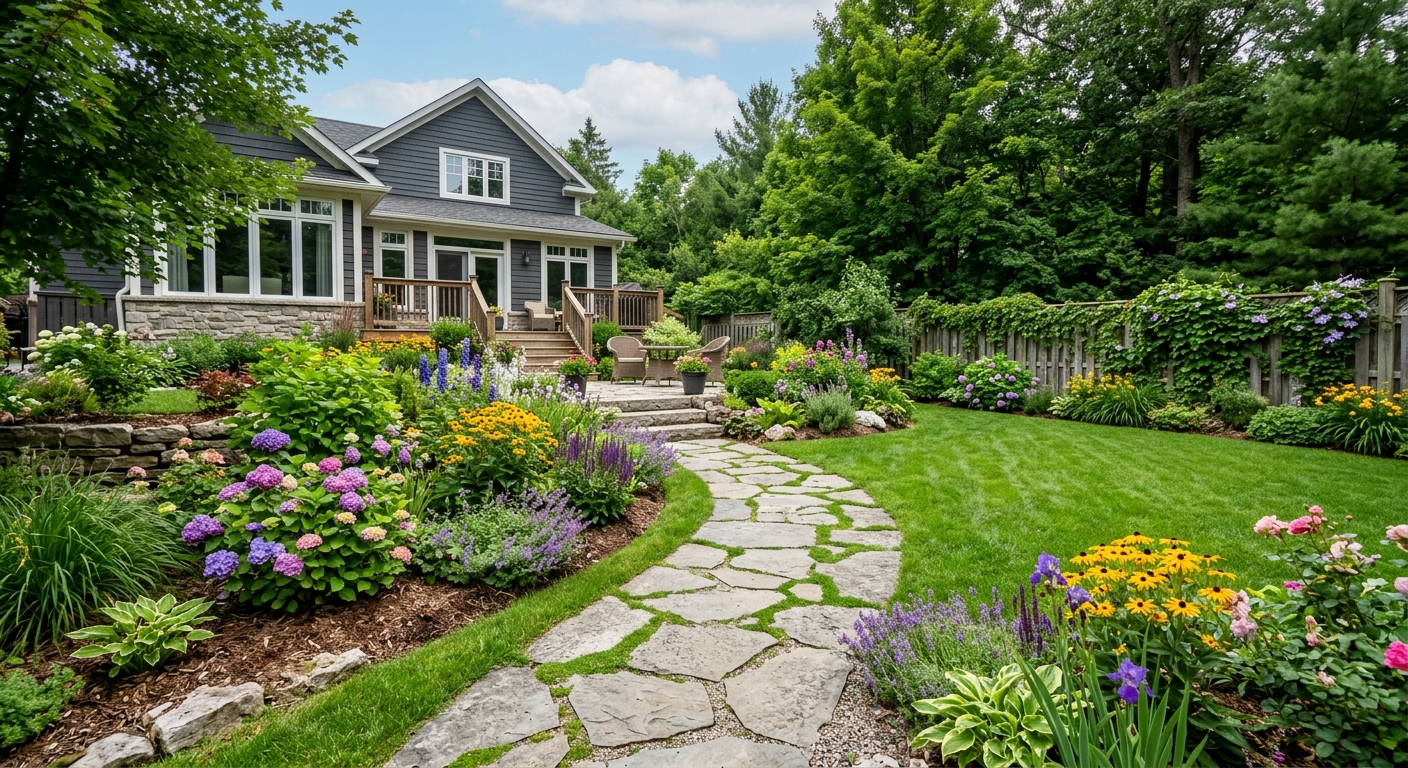
Landscaping options and costs in Campbell River
Campbell River homeowners often start planning their exterior upgrades with the same question: what will it cost to make the yard look better and stay easier to maintain? With single-detached houses making up 60.8% of dwellings, there’s typically enough space for real softscape and hardscape—raised beds, pathways, and low hedges that frame the home year-round. And because 71.8% of households are homeowners, many projects are planned as long-term improvements, especially when 40.0% of homes were built before 1981 and may need fresh grading, drainage, or foundation-facing landscaping.
On Vancouver Island and the Coast, mild coastal hardiness zones (often treated as Zone 7–9 in planning) and a longer installation window help crews work from early spring through late fall, which can reduce labour rush pricing compared with colder regions. That said, Campbell River still sees wet winters and frequent shoulder-season rains, so drainage design and base prep are real cost drivers—particularly on sloped lots common around Campbell River’s north end and in areas near neighbourhoods like Willow Point. When access is tight, foundations need protection, or you’re adding functional hardscape alongside planting, the budget usually moves toward the upper end of local price bands. Use the ranges below as a starting point, then we’ll compare what typically pushes each quote up or down.
| Service |
Description |
Season |
Price Range |
| Full landscape design and installation |
On-site assessment, conceptual design, planting plan, grading/drainage coordination, and installation of softscape and hardscape as scoped |
Apr–Nov |
$5,000–$40,000 |
| Sod installation (supply, grade, lay, roll) |
Light grading, soil preparation, sod delivery, laying pattern, edging, and rolling for good root-to-soil contact |
Apr–Jun, Aug–Sep |
$1,500–$8,000 |
| Lawn seeding (grade, seed, starter fertilizer) |
Soil raking/light grading, seed selection, starter fertilizer, and initial watering plan |
Apr–Jun, late Aug–Sep |
$900–$3,500 |
| Interlocking patio or walkway |
Excavation, compacted base (often granular), interlocking units, edging, and joint sand |
Apr–Nov |
$4,000–$18,000 |
| Retaining wall (interlocking block) |
Excavation to proper depth, compacted granular base, block installation, drainage backfill, and weep/drainage provisions as needed |
Apr–Nov |
$4,000–$60,000 |
| Tree and shrub planting |
Soil prep, amendments, staking where required, mulch, and installation of shrubs and trees within planned spacing |
Apr–Jun, Sep–Oct |
$800–$15,000 |
Prices are estimates only and vary by project scope, site access and material selection.
What affects the price of landscaping in Campbell River
Even when two neighbours ask for the “same” landscaping update, quotes in Campbell River can differ by 30–50% because the real work rarely matches on paper. Crews can be pricing different levels of design, different plant sizes (and tiers), and—most importantly—different grading, drainage, and access conditions. On Vancouver Island and the Coast, mild coastal conditions (and zones typically treated as 7–9) create a long working season, so labour availability is better than in short-window regions. However, site constraints still apply, and you’ll see bigger swings when walls, patios, and drainage systems are included.
Here’s how the broader climate comparison plays out in quotes. In Prairie-like zones (Zone 2–4), early spring and drought-stressed summers push contractors to use drought-tolerant, wind-hardy species and design irrigation efficiently—often under a shorter working season. In coastal BC (Zone 7–8), the lush palette is a plus, but heavy rain makes drainage a priority, and that can add cost through excavation, granular bases, and engineered-style drainage bed details. In the dry BC Interior, water restrictions shape irrigation design (often higher-quality drip and smart controllers), while Southern Ontario (Zone 5–6) tends to need summer irrigation during dry spells. Those different constraints help explain why landscaping can swing from a mid-range project budget to premium pricing.
Concrete examples in Campbell River: (1) Reworking a slope for safe drainage can move a “planting-only” concept into a full design and installation scope, commonly adding several thousand dollars within the $5,000–$40,000 design/installation band. (2) Replacing a simple lawn with sod can quickly add cost, since sod work often lands within the $1,500–$8,000 band depending on square footage. (3) If you’re planting around older homes (many built before 1981) you may need soil amendment and foundation-conscious grading; that can change topsoil volumes and disposal needs, and those line items show up quickly in the final total.
| Price Factor |
Why It Matters |
Cost Impact |
| Yard size in sq ft — the primary cost driver for softscape |
More area means more labour hours, soil volumes, plants/seed rates, and edging |
Small yards may stay near lower bands; larger yards often push toward mid-to-upper ranges |
| Grading and drainage work — slope corrections add significant cost |
Proper fall and drainage control prevent pooling, foundation moisture and patchy lawn |
Can add several thousand dollars when major regrading is required |
| Drainage bed or French drain installation |
Captures and redirects water; requires trenching, pipe, fabric, and backfill |
Often shifts the project closer to hardscape-heavy pricing |
| Plant material tier — native shrubs vs. ornamental vs. mature specimen trees |
Mature stock costs more and needs heavier handling/staking |
Can swing totals dramatically in the $800–$15,000 planting band |
| Hardscape vs. softscape ratio — walls and patios cost more per sq ft than lawn |
Stone base, compacted granular, and careful installation drive material and labour costs |
Patios and walls push budgets toward $4,000–$60,000 hardscaping ranges |
| Irrigation system design and installation |
Drip zones, timers, and trenching ensure efficient watering in exposed areas |
Can add meaningful cost but improves survival and reduces long-term rework |
| Soil amendment and topsoil required |
Improves structure for lawns and root growth for shrubs/trees |
Heavy amendment needs can increase delivery and disposal charges |
| Tree removal or stump grinding before new planting |
Impacts excavation planning and may require hauling |
Adds separate line items and can delay planting timelines |
Permits & regulations in British Columbia
In British Columbia, most backyard planting and typical softscape work (such as sodding, seeding, mulch, shrub borders, and installing garden beds) generally does not require a permit. Tree planting and routine landscaping maintenance are also typically permit-free. The common “permit landmines” are the structural items: retaining walls above a local threshold—often around 1.0 m (3.3 ft) in many municipalities—may require a building permit and sometimes engineered drawings, depending on height, location, and how the wall is designed to resist soil pressure.
Another area that can trigger approvals is grading. If your project changes lot grading in a way that affects how water flows toward a neighbouring property or toward storm sewer connections, the local permitting/approval process may apply. Also, before any digging for planting holes, drainage trenches, or wall footings, contractors and homeowners should ensure utility locates are completed.
To verify a contractor in Campbell River, ask for three documents and check them in order:
- BC licensing/registration (as applicable): confirm the contractor’s business details on the appropriate provincial registry listing for their trade.
- Liability insurance: request a current Certificate of Insurance naming you (or confirming they carry adequate limits for your job).
- WCB coverage (WorkSafeBC): ask for clearance or coverage documentation and verify it’s active for the period of the contract.
For permits, call the City of Campbell River planning/building counter (or check their online property guidance) with your proposed wall height, location on the lot, and any grading changes.
Planning a landscape that thrives in Campbell River's climate
In Campbell River, the winning landscape plan works with the local growing conditions—typically zone planning around Zone 7–9—rather than fighting wet winters, cool shoulder seasons, and the reality of foundation moisture risk on sloped yards. Start with plant selection: choose native and zone-appropriate evergreens, ornamental grasses, and perennials that are hardy in coastal conditions and tolerate periods of wet soil. This reduces how often you need to “babysit” winter protection and helps avoid replanting after soggy spells. Where you can, use groundcovers and layered borders (mulched shrubs plus perennials) so bare soil doesn’t stay exposed and muddy.
On lawn establishment, sod vs. seed is a trade-off. Sod gives instant visual results and faster coverage, but it’s often 3–4x more per sq ft than seeding because you’re paying for turf supply and installation labour. Seeding can be a smart budget choice for family areas, provided the grade is right and you can maintain moisture during establishment.
Drainage and grading are where Campbell River projects succeed or fail. Even when precipitation is consistent, you still want correct fall away from the house and away from low spots. For hardscapes like patios and retaining walls, base preparation matters: proper compacted layers and drainage provisions help the structure perform through freeze–thaw and winter saturation cycles. Finally, low-maintenance strategies—thicker mulch layers, durable edging, and rain-garden pockets where water collects—reduce annual upkeep without sacrificing curb appeal. If you’re in a water-restricted pinch zone, efficient drip irrigation (often better than overhead) and drought-tolerant planting zones help you meet expectations while keeping landscapes healthy.
For a dollar example: if a full planting refresh sits near the $800–$15,000 planting band, upgrading that to a sod-driven lawn can push you into the $1,500–$8,000 sod range quickly. If the goal is “instant curb appeal” and you can support watering during establishment, sod can be justified; if the goal is durable coverage at lower cost, seed plus correct grading usually wins.
| Element |
Climate Consideration |
Maintenance Level |
Price Band |
| Sod lawn installation |
Works best when soil temps support rooting; needs correct grade to prevent winter pooling |
Low after establishment; moderate early watering |
$1,500–$8,000 |
| Native perennial garden |
Coastal hardiness and better resilience in wet winters when soil drainage is adequate |
Low to moderate (seasonal pruning and occasional weeding) |
$2,000–$10,000 |
| Mulched shrub border |
Mulch buffers moisture swings and supports even root conditions in coastal seasons |
Low (mulch refresh and tidy-up once or twice per year) |
$1,500–$8,500 |
| Interlocking stone patio |
Needs proper base compaction and drainage so water doesn’t migrate toward the foundation |
Low (occasional joint sand top-up) |
$4,000–$18,000 |
| Retaining wall (block) |
Proper base depth and drainage backfill reduce movement through wet winters |
Low after install; periodic inspection recommended |
$4,000–$60,000 |
| Drip irrigation system |
Efficient watering for exposed areas; helps manage seasonal rainfall variability |
Low (annual checks and seasonal adjustments) |
$1,200–$6,000 |
How to choose a landscaping contractor in Campbell River
Choosing the right landscaping contractor in Campbell River starts with proof, not promises. For British Columbia jobs, verify licensing/registration where applicable, confirm liability insurance, and ensure WorkSafeBC coverage is active for their workers. Ask for documentation before you sign: request the Certificate of Insurance and check that coverage is current and appropriate for your scope (especially if heavy materials, excavation, or machinery are involved). For WorkSafeBC, ask for a clearance letter or proof of coverage that matches the contract period. If they can’t provide these, treat it as a serious red flag.
Next, get 2–3 itemised written quotes. You want a labour and materials breakdown—separating excavation/grading, base materials, drainage components, plant material (including sizes/species), and planting labour. Avoid quotes that only list a single “lump sum” number without quantities and exclusions. Read the scope for what’s not included: disposal/hauling, utility locates, permit responsibility, topsoil depth assumptions, and whether irrigation and drainage are engineered or “best effort.”
Warranty matters too. Ask for the workmanship warranty length, whether product warranties pass through to you, and if they are transferable to future homeowners (important for older housing stock and resale). Finally, payment schedules should protect you: never pay more than 10–15% upfront, and set a holdback to release once the job is complete and site clean-up is verified. Get a start date and completion estimate in writing, and make sure the contract includes weather-sensitive milestones (especially in Campbell River’s rainy seasons).
- Provide BC registration details (as applicable) and a contactable business address.
- Show current liability insurance (Certificate of Insurance) before work begins.
- Confirm WorkSafeBC coverage with a clearance letter/proof.
- Use an itemised quote with line items for excavation, base, drainage, labour, and plant sizes.
- Clarify what “grading” includes (target fall, topsoil depth, and compaction method).
- Ask who pays for disposal/hauling and whether brush/trees are included.
- Confirm whether utility locates are arranged before digging.
- State explicitly whether permits are required and who pulls them (retaining walls and grading may).
- Include warranty terms for workmanship and whether product warranties are included.
- Review payment schedule (limit upfront to 10–15%, holdback at completion).
- Request a written timeline and how rain delays are handled.
- Ask for photos or references from similar Campbell River sites (sloped yards, drainage issues).
Red flags specific to landscaping contractors in Campbell River: (1) they won’t provide insurance/WCB proof; (2) quotes that ignore drainage/grading but still promise a “no pooling” lawn; (3) no itemised quantities for stone base, topsoil, or plant sizes; (4) insisting you pay most of the cost upfront; and (5) vague timelines without a start/completion estimate.
Frequently asked questions — landscaping in Campbell River
Sod vs seed — which is better for a Campbell River lawn?
For Campbell River, both sod and seed can work, but “better” depends on your timeline and budget. Sod creates instant coverage and is often chosen when you want curb appeal quickly or you’re replacing existing turf that’s failing due to poor grade or winter pooling. Budget-wise, sod installation commonly lands in the $1,500–$8,000 range depending on square footage and preparation. Seeding is usually lower cost and can fit many yards, but you need correct grade and consistent moisture during establishment. In coastal BC conditions, drainage still matters: if water sits, neither sod nor seed performs well. If your yard has low spots, prioritize grading and soil improvement first, then decide sod versus seed based on your desired timeline and maintenance comfort.
How much does a retaining wall cost in Campbell River?
Retaining wall pricing in Campbell River varies mainly because retaining walls aren’t just “stacked blocks”—they require excavation, proper base depth, drainage backfill, and compaction to stay stable in wet seasons. For a block retaining wall, many projects land within the $4,000–$60,000 range depending on wall length, height, site access, and whether drainage is added. If the wall is near or above the local permit threshold (commonly around 1.0 m in many municipalities), permitting and possible engineering can push costs higher. Also, slopes and foundation-adjacent conditions often require extra groundwork. The best way to compare quotes is to ensure each one includes base construction and drainage provisions, not just the wall material.
When is the best time to landscape in Campbell River?
In Campbell River, the best time for most landscaping is from early spring through late fall, because coastal conditions provide a long workable season. Planting is often scheduled for spring (to get roots established before summer) and for early fall (when soil moisture supports growth). Turf work—especially sod—typically performs best when temperatures support rooting, often in spring or late summer/early fall. Hardscape like patios and block walls can generally be done from spring through fall, but weather still affects excavation and base prep after heavy rain. If your yard needs drainage or grading, plan early enough in the season to allow corrections and proper compaction before planting or sod goes in.
Do I need a permit for a retaining wall in British Columbia?
In British Columbia, many landscaping tasks don’t require permits, but retaining walls can. A retaining wall above a local height threshold—commonly around 1.0 m (3.3 ft) in many municipalities—may require a building permit and sometimes engineered drawings, depending on the wall’s height, location, and design. Changes to lot grading that affect drainage toward neighbouring properties or storm connections can also trigger approval requirements. Because requirements vary by location, the practical step is to tell your contractor the wall height and placement and ask them to confirm whether a permit is required in Campbell River before construction starts. Never skip utility locates: digging for wall footings and drainage should be planned with locates completed.
How do I improve drainage in my yard?
Improving drainage starts with diagnosing where the water goes—low spots, downspout discharge points, and whether water is migrating toward foundations. In Campbell River’s wetter winters, drainage problems are commonly addressed with correct grading (creating an appropriate slope/fall away from the home) plus a drainage bed or French drain where water concentrates. Expect a cost difference depending on whether it’s minor regrading versus trenching and pipe installation. If you’re also adding hardscape like a patio or a retaining wall, it’s smart to plan drainage at the same time so water doesn’t get trapped behind bases. To keep quotes comparable, ask contractors to specify how they’ll handle drainage, including base construction details and how they’ll backfill and compact around drainage components.
What is xeriscaping and does it suit Campbell River?
Xeriscaping is landscape planning that reduces water use through drought-tolerant species, efficient irrigation (often drip), and soil-focused design like mulch, groundcovers, and smart placement of plants. In Campbell River, xeriscaping can still work—especially in exposed south- or west-facing areas, windy corners, or spots with thin soil where lawns struggle. However, because coastal BC gets regular rainfall, you may not need fully “high-drought” plant palettes; instead, focus on resilient, hardy plants and good drainage, then use irrigation efficiency where it helps. If you’re comparing budgets, xeriscaping can lower ongoing watering costs, but it doesn’t automatically eliminate installation costs—planting and irrigation design still need to be done right. A well-designed native perennial garden or mulched shrub border is often a practical middle ground for British Columbia homeowners.