Landscaping options and costs in Harrison Hot Springs
Harrison Hot Springs homeowners often want a yard that looks great right away, but also performs through wet winters and cool, long-growing conditions. With 65.0% of local dwellings being single-detached homes and 81.4% of households owning their property, it’s common for residents to invest in patios, layered planting beds, and irrigation improvements that add usable space and curb appeal.
In the Lower Mainland–Southwest (mostly plant hardiness zones 7–8), contractors typically have more reliable working time than in prairie cities, so scheduling and installation can be steadier. That said, costs are still influenced by wet-season site access, hauling/disposal requirements, and the need for drainage and proper freeze–thaw protection under patios and retaining wall footings. Even though last spring frosts near the coast are usually early March to early April, structural work still needs a deeper base and compaction strategy to prevent frost heave and wall movement on sloped sites.
In Harrison Hot Springs, landscaping trade demand is especially noticeable around the lakefront and along main access corridors where homeowners prioritize low-maintenance landscaping, erosion control, and tidy seasonal colour. If you’re comparing estimates, it helps to start with the typical service price bands below, then match the scope to your yard size, soil conditions, and material choices.
| Service |
Description |
Season |
Price Range |
| Full landscape design and installation |
Site visit, concept + planting plan, grading/drainage approach, hardscape/softscape build-out, irrigation coordination, and finishing |
Mar–Nov (best); many jobs also stage in winter with controlled activities |
$12,000–$35,000 |
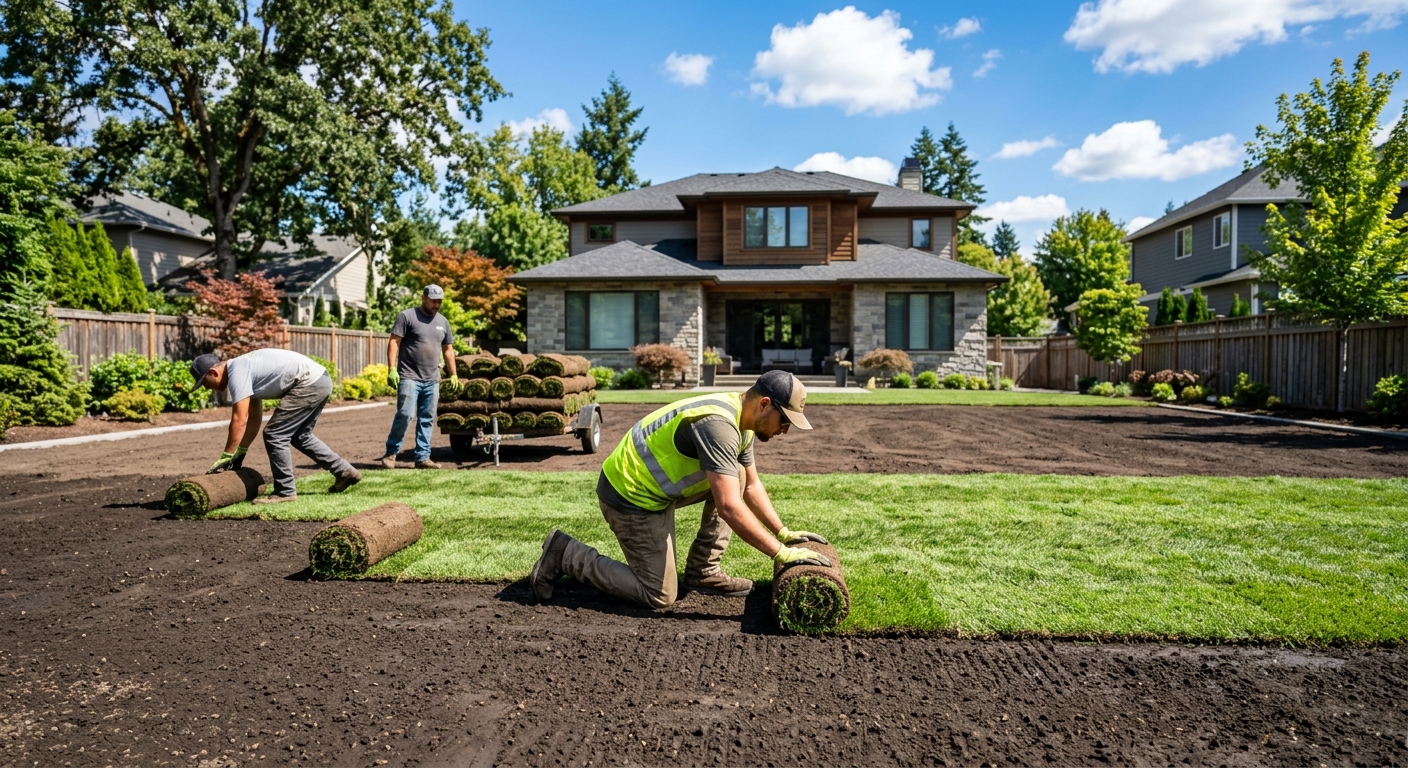
| Sod installation (supply, grade, lay, roll) |
Existing turf removal (if needed), fine grading, soil prep, sod supply, lay/roll, starter top-dressing where required |
Apr–Jun; late Aug–Sep for fall windows |
$2,500–$7,500 |
| Lawn seeding (grade, seed, starter fertilizer) |
Grade correction, seed selection, broadcast + light raking, starter fertilizer, light top-dressing for germination |
Mar–May; late Aug–Sep |
$2,000–$5,000 |
| Interlocking patio or walkway |
Excavation, base stone + compaction, edging, pavers/interlocking blocks, joint sand, final clean-up |
Apr–Nov (avoid saturated conditions during wettest weeks) |
$8,000–$28,000 |
| Retaining wall (interlocking block) |
Layout, excavation, base preparation, drainage layer + weep channels, block installation, backfill + compaction |
Apr–Nov |
$12,000–$55,000 |
| Tree and shrub planting |
Soil amendment, planting holes, staking (as needed), mulch, watering plan, and ongoing establishment care options |
Mar–Jun; Sep–Nov |
$1,500–$10,000 |
Prices are estimates only and vary by project scope, site access and material selection.
What affects the price of landscaping in Harrison Hot Springs
For the same overall goal—say, “a backyard refresh with a patio and new planting”—quotes in the Lower Mainland–Southwest can land 30–50% apart once you factor in soil conditions, grading needs, and how much labour is required to get a long-lasting result. In broad terms across British Columbia, contractors balance a longer coastal working season (zones 7–8) against higher material availability costs, equipment time, and the premium placed on drainage details that prevent long-term foundation and wall issues. Meanwhile, in prairie and colder regions (zone 2–4), frost depth and short frost-free windows can compress timelines and push clients toward drought-tolerant, low-maintenance planting—changing both labour hours and plant palette.
In Harrison Hot Springs specifically, coastal BC conditions allow lush, layered planting palettes and more forgiving establishment windows, but wet winters mean drainage and compaction can’t be skipped. A drainage plan for pooling on a sloped lot can raise costs even when the visible work looks “simple.” Conversely, the long growing season helps control ongoing maintenance costs, especially for perennials and broadleaf evergreens that thrive with minimal winter protection.
Two concrete examples: (1) If your patio base needs deeper excavation and extra base stone to address freeze–thaw and soft subgrade, you’ll see a jump toward the higher end of the interlocking patio band (for example, $8,000–$28,000 depending on area and base prep). (2) If you have older landscaping or homes built before 1981 (18.1% of local housing stock), you often encounter compacted soils, mismatched drainage patterns, or mature trees needing removal, which can push tree/shrub planting toward $1,500–$10,000 and add stump grinding.
| Price Factor |
Why It Matters |
Cost Impact |
| Yard size in sq ft — the primary cost driver for softscape |
More square footage means more soil, labour time, edging, mulch, and plant quantity |
Often the biggest swing—small changes in area can shift overall pricing by several thousand dollars |
| Grading and drainage work — slope corrections add significant cost |
Correcting grade protects foundations and prevents pooling that can damage plants and hardscape |
Can move a job toward the higher end of design/installation quotes (e.g., $12,000–$35,000) |
| Drainage bed or French drain installation |
Subsurface drainage handles wet-season saturation and reduces freeze–thaw stress in bases |
Typically adds material + excavation hours; higher when access is tight |
| Plant material tier — native shrubs vs. ornamental vs. mature specimen trees |
Specimens cost more upfront and require heavier equipment and stricter planting procedures |
Can double planting line-items compared to basic native shrub mixes |
| Hardscape vs. softscape ratio — walls and patios cost more per sq ft than lawn |
Pavers, block, base stone, labour density, and finishing details drive costs |
Shifting 200 sq ft from lawn to patio can account for a major portion of the difference between quotes |
| Irrigation system design and installation |
Drip zoning, backflow prevention requirements, and controller setup affect both water efficiency and reliability |
Can increase overall project cost while reducing long-term watering labour |
| Soil amendment and topsoil required |
Coastal soils can be variable; poor drainage and compacted layers need amendment for root health |
More hauling and labour when you need to rebuild topsoil depth |
| Tree removal or stump grinding before new planting |
Clearance work, debris disposal, and stump prep add labour and may affect nearby utilities |
Often a surprise add-on that pushes planting and grading budgets upward |
Permits & regulations in British Columbia
In British Columbia, most planting and softscape work—including planting holes, mulching, sodding, and typical garden bed installs—usually does not require a permit. However, retaining walls above a height threshold commonly require a building permit in many municipalities (often around 1.0 m / 3.3 ft, but the exact trigger can vary), and engineered drawings may be required for more complex or taller walls.
Also watch for approvals when you plan lot grading changes that can alter drainage patterns toward neighbouring properties or storm sewer connections. If your project includes significant re-contouring, swales, or new drainage outlets, your municipality may require review before work starts.
Before digging for planting holes or wall footings, always request utility locates to confirm where services run. This is especially important near driveways, sidewalks, and older properties where utility routing can be less predictable.
To verify a contractor’s standing for a Harrison Hot Springs landscaping project, do this in order: (1) ask for their British Columbia business licence/registration details (and contractor info) and confirm on the appropriate online registry; (2) request a certificate of insurance showing general liability coverage and confirm it’s current for the project dates; (3) ask for proof they carry the correct workplace coverage (commonly referenced as clearance letters for workers’ protection) and confirm the clearance is valid. If they can’t provide documents promptly, that’s a major red flag.
Planning a landscape that thrives in Harrison Hot Springs's climate
Designing for Harrison Hot Springs means working with a coastal, cool-wet climate rather than fighting it. The area sits mostly in plant hardiness zones 7–8, with last spring frosts typically early March to early April and first fall frost often not until November. That longer season supports a wider palette—think broadleaf evergreens, long-blooming perennials, and layered planting beds—so you can build curb appeal without constantly overwintering tender plants.
Start with plant selection: choose native and zone-appropriate species that handle cool winters and periodic heavy rain without demanding constant fuss. For turf, decide between sod and seed. Sod gives instant results and is excellent when you want a finished look fast, but it often costs about 3–4x more per square foot than seeding once you include supply and installation. If you’re on a budget or can tolerate a short “grow-in” period, seeding is usually the smarter value.
Next, prioritize drainage and grading. Lower Mainland–Southwest yards commonly see water pooling from downspouts, compacted soils, or subtle slope issues—so grading away from foundations, creating proper swales, and using mulch strategically can prevent plant losses. For hardscape, base preparation must account for freeze–thaw and the region’s wet winters; even mild climates still experience enough cycling to damage poorly compacted bases.
Low-maintenance strategies that fit this market include groundcovers, mulch-led shrub borders, and perennials that don’t require frequent replanting. If you want water-efficiency, consider rain-garden planting pockets or a xeriscape-inspired border that uses drought-tolerant selections—useful even though Harrison Hot Springs doesn’t face the same routine summer bans as the BC Interior.
For example, if a seeding lawn is roughly in the $2,000–$5,000 band but sod lands closer to $2,500–$7,500, choosing sod is justified when you need the yard usable immediately (events, pets, or fast turnaround for resale). Otherwise, seeding plus a smart irrigation setup often delivers better value.
| Element |
Climate Consideration |
Maintenance Level |
Price Band |
| Sod lawn installation |
Works well in coastal spring/fall windows; requires good drainage so roots don’t stay soggy |
Moderate during establishment, then lower once established |
$2,500–$7,500 |
| Native perennial garden |
Zone-appropriate plants handle cool winters and wet-season variability; mulch helps stabilize moisture |
Low to moderate (seasonal pruning, weed control first year) |
$1,800–$6,000 |
| Mulched shrub border |
Helps manage rainfall runoff and reduces winter splash; proper spacing supports airflow |
Low after establishment (top-ups and occasional reshaping) |
$1,200–$5,500 |
| Interlocking stone patio |
Base compaction and edge restraint are crucial through wet winters and freeze–thaw cycling |
Low (periodic joint sand and spot cleaning) |
$8,000–$28,000 |
| Retaining wall (block) |
Drainage layer and backfill compaction prevent water pressure build-up in heavy rains |
Low (inspection after first wet season) |
$12,000–$55,000 |
| Drip irrigation system |
Targets root zones efficiently; beneficial if water costs rise or restrictions tighten during dry spells |
Low (annual seasonal adjustments and controller checks) |
$1,500–$6,500 |
How to choose a landscaping contractor in Harrison Hot Springs
Choosing the right contractor in Harrison Hot Springs starts with proof. Ask for their British Columbia registration/licence information (as applicable), plus a certificate of insurance showing current general liability coverage for your project period. If workers will be on-site, request the contractor’s workers’ protection status (often provided via clearance letters or equivalent documentation). Don’t rely on “we’re insured” statements—request documents, check dates, and make sure the certificate covers the scope type for landscaping/hardscape work.
Next, get 2–3 itemised written quotes with a labour + materials breakdown. A good quote separates excavation, base stone, pavers/block, drainage components, soil/topsoil, and planting materials (including quantities and plant sizes). Confirm what’s included: permit pull costs (if required), disposal/haul-away, utility locate responsibility, and whether the contractor supplies edge restraints, joint sand, and soil amendments. For projects that affect drainage or involve retaining walls, clarity matters.
Warranty is another deciding factor: request a workmanship warranty length and whether it’s tied to labour only or includes materials issues. Also ask if product/manufacturer warranties are transferable to you.
Payment schedule matters too. Avoid large deposits—never pay more than 10–15% upfront. Use a holdback until the job is fully complete and reviewed.
Finally, insist on a start date and completion timeline in writing, plus weather contingencies for the wettest weeks. Landscaping can progress year-round on the coast with planning, but rain can delay excavation and base work.
- Verify business details and ask for a current certificate of insurance before signing.
- Request proof of workers’ coverage/clearance for the crew that will be on your site.
- Ensure the quote lists quantities (sq ft, linear feet, plant count, and sizes).
- Confirm excavation scope: base depth, compaction method, and drainage layers for patios/walls.
- Ask who schedules utility locates and whether it’s included in the quote.
- Check disposal/haul-away inclusion for topsoil, sod removal, and construction debris.
- Confirm irrigation scope: drip lines, zoning, controller/smart controller provisions, and runoff considerations.
- Review grading drawings or written grade targets so water sheds away from the house.
- Ask about soil amendment: what product, how much, and where it’s applied.
- Request a clear protection plan for existing trees, shrubs, and lawn edges during construction.
- Get a written workmanship warranty and what triggers it (inspection dates, remedial timeline).
- Use milestones tied to progress—especially for retaining wall drainage backfill and base readiness.
In Harrison Hot Springs, common red flags include: quotes that omit drainage details for a wall or patio base, contractors who won’t provide an insurance certificate on request, “allowance” numbers that are too vague for pavers/block and soil amendments, unclear disposal responsibilities, and a payment request that asks for more than 10–15% upfront before any measurable work starts.
Frequently asked questions — landscaping in Harrison Hot Springs
Do I need a permit for a retaining wall in British Columbia?
Often, yes—retaining walls above a local height threshold typically require a building permit in British Columbia, and some sites need engineered support depending on height, soil conditions, and proximity to property lines. Many municipalities commonly reference a trigger around 1.0 m (3.3 ft), but the exact rules can vary, especially when a wall is near a structure or changes drainage patterns. In Harrison Hot Springs, if your wall also involves re-grading, adding drainage outlets, or altering how water flows, approvals are more likely. The best approach is to ask your contractor to confirm whether permits are required before quoting and to include the permit process in the written scope. A well-planned block wall also depends on proper drainage layers, which—if done correctly—helps reduce future movement after wet seasons.
How do I improve drainage in my yard?
In Harrison Hot Springs and the wider Lower Mainland–Southwest, drainage problems usually come from subtle grade issues, compacted soils, downspout splash, or saturated areas that stay wet too long. Start with “surface first”: adjust grading so water sheds away from foundations, and make sure downspouts discharge to appropriate locations (not across a low spot). If water still pools, a drainage bed or French drain can help move water below the root zone. A proper drainage bed usually includes excavating to a suitable depth, adding clean stone, installing a wrapped drain where needed, and ensuring a safe outlet point. For hardscape projects, drainage work often affects patio or wall longevity. Budget-wise, drainage is commonly bundled into full design/installation scopes (often in the $12,000–$35,000 range), but smaller drainage corrections can still add noticeable line-items.
What is xeriscaping and does it suit Harrison Hot Springs?
Xeriscaping is a water-wise landscaping approach that reduces irrigation needs by using drought-tolerant plants, efficient watering methods (like drip), and soil/mulch strategies that retain moisture where it’s needed. In Harrison Hot Springs, you have a coastal advantage: winters are mild and wet, and the growing season is longer. That means you can blend xeriscape principles with lush coastal planting—using rain-garden pockets, mulch-led borders, and selective drought-tolerant species—without making the whole yard look like an arid desert. It’s especially useful if you want a design that stays attractive during occasional dry spells or rising water costs. For lawn areas, consider seeding or reducing lawn footprint if maintenance and watering labour feel high. Pairing beds with a drip system can be a smart compromise while keeping curb appeal. The goal is “efficient” rather than “zero-water,” and a good contractor will tailor plant choices to zones 7–8 conditions.
How do I plan a low-maintenance yard?
A low-maintenance yard in Harrison Hot Springs usually comes down to three things: plant selection, installation quality, and weed/soil management. Choose hardy, zone-appropriate plants (native perennial gardens and mulched shrub borders work well in this region) and avoid mixing tender species that need constant winter protection. Use mulch strategically to suppress weeds, moderate soil moisture, and protect planting crowns from wet-season splash. Design for easy upkeep: add groundcovers where lawn struggles, use proper spacing for airflow, and avoid over-complicated layouts that require constant trimming. On the turf side, sod gives fast results but costs more—often landing around $2,500–$7,500—while seeding can be a budget-friendly step with longer “grow-in” time. For hardscape, good base prep for patios and well-drained retaining wall systems reduce the chance of movement and repairs. Finally, a simple irrigation plan (often drip) can reduce labour during establishment and keep beds healthy.
How deep should a retaining-wall base be for local frost?
There isn’t one single depth that fits every retaining wall, because base requirements depend on wall height, block type, soil conditions, and local engineering guidance. Even though Harrison Hot Springs has mild winters (coastal zone 7–8), the region still experiences freeze–thaw cycling and wet-season saturation, so frost protection and proper compaction matter. In practice, contractors commonly excavate to a depth that creates a stable, well-compacted base with drainage layers (and that accounts for frost penetration risk at the site), rather than simply matching a “standard number” without context. If your wall is near a slope, foundation, or property line, the safest route is to have the contractor confirm the proposed base depth and drainage approach in writing—especially if a permit or engineered drawings are required. If you’re comparing quotes for a retaining wall—often in the $12,000–$55,000 band—ask specifically about excavation depth, base stone layers, and drainage provisions.
How much does professional landscape design cost?
Professional landscape design pricing varies based on whether you’re buying design-only services or full design-and-installation. For Harrison Hot Springs homeowners, the most common value approach is “design included” when you’re also building patios, retaining walls, and planting beds, because it aligns plant layout with the final grading and drainage plan. In many cases, full landscape design and installation sits in the broader $12,000–$35,000 range depending on scope, while many standalone installations (like irrigation plus planting, or a smaller patio) can fall into their own service bands. If you’re only doing design and you’re not ready to install, expect design to be quoted based on yard complexity, number of concept revisions, and whether a detailed planting plan and material list are included. The best way to compare is to ask for an itemised proposal and confirm what deliverables you get (concept, planting plan, hardscape layout, and budget guidance).