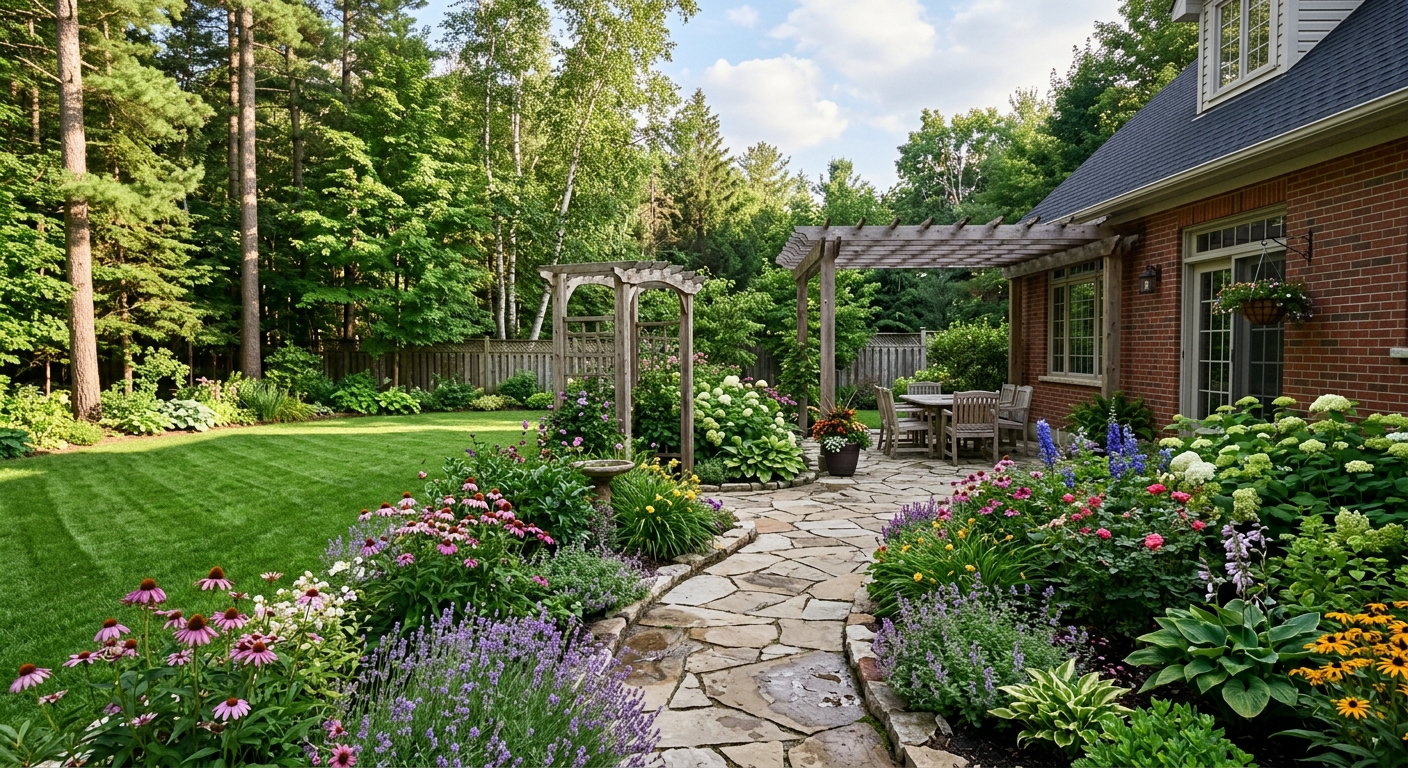
Landscaping options and costs in Tumbler Ridge
Tumbler Ridge is where landscaping is practical first and “fancy later”—and that’s a good thing for homeowners who want curb appeal that survives winter. With 69.4% of local dwellings being single-detached homes, most yards are large enough to justify real softscape and a few hardscape focal points, and the fact that 68.5% of households own gives many residents the motivation to invest in improvements that last. In the Northeast (Peace River-style) climate, most areas behave like Zone 2–3: only cold-hardy plants reliably make it, and you’re planning around a short frost-free window. That compression means fewer months to mobilize crews, do excavation, and complete planting before cold snaps—so labour and scheduling costs can run higher than milder parts of BC.
Projects are also shaped by freeze-thaw cycles. Bases for patios, walkways, pads, and especially retaining walls need to be engineered thicker, with drainage handled properly, which raises excavation and aggregate costs. In Tumbler Ridge, work is especially in demand along the busier residential pockets near the town’s core—where homeowners want durable drive/entry upgrades that look sharp year-round. The next step is comparing typical service packages so you can align your scope to your budget, and then decide where you want to spend (or save) without compromising performance.
| Service |
Description |
Season |
Price Range |
| Full landscape design and installation |
On-site measurements, concept + planting plan, grading/drainage direction, materials take-off, excavation, soil prep, planting, and hardscape where applicable |
Mid-late spring to early fall |
$8,000–$30,000 |
| Sod installation (supply, grade, lay, roll) |
Remove/grade existing surface, base topsoil/compaction, sod delivery, lay pattern, edging trim, starter fertilizer, initial watering plan |
Late spring through summer |
$3,000–$9,000 |
| Lawn seeding (grade, seed, starter fertilizer) |
Light regrade/loosen, add seedbed amendments, apply seed blend suited to cold climates, starter fertilizer, light raking/rolling, watering schedule |
May through early July |
$2,200–$6,500 |
| Interlocking patio or walkway |
Excavation, geotextile, base (typically thicker due to freeze-thaw), leveling sand, interlocking pavers, edge restraints, compacting, clean finishing |
June to September |
$6,000–$25,000 |
| Retaining wall (interlocking block) |
Layout + drainage considerations, block installation, base prep, geogrid/backfill (where needed), weeping/drainage layer, clean backfill |
June to September |
$8,000–$22,000 |
| Tree and shrub planting |
Zone-appropriate selection, planting holes, amendments, staking (if required), mulching, post-planting care plan |
Late spring to early fall |
$1,500–$8,000 |
Prices are estimates only and vary by project scope, site access and material selection.
What affects the price of landscaping in Tumbler Ridge
In Northeast British Columbia, quotes for the “same-looking” job can easily swing by 30–50% because contractors price around real site conditions, not just the visible finish. A backyard makeover with a patio, drainage adjustments, and cold-hardy planting can look similar on paper, but excavation depth, base build-up, drainage complexity, and plant sourcing change the total. Even within BC, the working window and plant palette are dramatically different: coastal BC (Zone 7–8) typically supports long planting seasons and lush options, while Peace River-style areas like Tumbler Ridge (Zone 2–3) require tough, wind-resistant, drought-tolerant species and careful frost-proof base work. Water restrictions in the dry BC interior also push many yards toward efficient drip zoning instead of high-volume spray.
Two practical examples from Tumbler Ridge: (1) If your home sits on older soil and you need proper drainage grading, a “simple” lawn or border project can turn into a French drain + deeper base prep situation, which raises costs from an average lawn band into harder-surface territory. (2) If your retaining wall base must extend below the local frost line to handle freeze-thaw, you’ll see the budget move quickly—often pushing the wall into the $6,000–$25,000 hardscaping band depending on length and engineering needs. On the softscape side, plant size matters too: replacing small shrubs with larger, established stock increases labour (larger holes, more amendments) and can move tree/shrub planting closer to the $1,500–$8,000 ceiling.
Finally, housing age affects what’s under the ground. With 18.3% of homes built before 1981, some yards have older drainage patterns, compaction, or buried debris that add time to prep—so your “square footage” estimate is only half the story.
| Price Factor |
Why It Matters |
Cost Impact |
| Yard size in sq ft |
Softscape is priced by area (topsoil, seed/sod, mulch) and hardscape by linear feet (edges, base depth) |
High—often the largest swing factor |
| Grading and drainage work |
Correcting slope to prevent pooling near foundations can require significant excavation and re-compaction |
High—commonly adds major labour/material |
| Drainage bed or French drain installation |
Freeze-thaw demands properly layered drainage rock and outlet routing away from structures |
Medium to high—can change the whole scope |
| Plant material tier |
Native shrubs vs. ornamental types vs. mature specimens differ in survival risk, sourcing cost, and planting time |
Medium—drives the higher end of planting budgets |
| Hardscape vs. softscape ratio |
Patios and walls typically require thicker base, restraints, and more on-site labour per sq ft than lawn |
High—shifts total cost quickly |
| Irrigation system design and installation |
Efficient drip zoning is preferred for water management; winterization adds details |
Medium—varies widely by zones and controller |
| Soil amendment and topsoil required |
Poor or compacted soils need amendments to support turf establishment and tree/shrub rooting |
Medium—delivery and coverage add up |
| Tree removal or stump grinding before new planting |
Access, root disruption, and disposal time affect labour and equipment availability |
Medium—can add to both timeline and budget |
Permits & regulations in British Columbia
In British Columbia, most routine landscaping—planting, sodding, and typical softscape work—usually does not require a permit. Where homeowners get tripped up is when they move soil in a way that changes drainage patterns or add heavier, structural features. For example, retaining walls above a height threshold (often 1.0 m (3.3 ft) in many municipalities) typically require a building permit, and some projects may need engineered drawings. Also, changes to lot grading that could direct water toward neighbouring properties or tie into storm sewer connections can require approvals to ensure drainage is managed safely.
Before any digging (planting holes, wall footings, or drainage trenches), call for utility locates so you don’t hit buried services. After that, verify local water-use and irrigation expectations. In the BC interior, drought conditions and water restrictions can affect how and when you run systems; a compliant irrigation plan is part of doing the job right.
For contractor verification in Tumbler Ridge, ask for three things before signing: (1) proof of the contractor’s British Columbia licensing/credentials (as applicable to the work scope), (2) liability insurance—request a certificate of insurance showing active coverage and the job’s location, and (3) WSIB/WCB clearance (or equivalent coverage documentation, depending on structure of the business and subcontracting). Then check the online registries and match the contractor’s legal name on the quote, insurance certificate, and clearance documents so there are no mismatches.
Planning a landscape that thrives in Tumbler Ridge's climate
Planning a landscape for Tumbler Ridge is about aligning plant choices and construction details to the area’s short growing season, cold winters, and freeze-thaw cycles. Start with plant selection: prioritize zone-appropriate, native or proven hardy species that handle wind and cold with minimal winter protection. In practice, that means designing for survival first—then for appearance—because replanting after a harsh winter is the most expensive “upgrade” you can make.
Sod vs. seed is another key decision. Sod gives instant green and quick erosion control, but in cold continental climates it’s also typically costlier to establish and transport. As a rule of thumb, sod can cost about 3–4x more per sq ft than seeding once you include prep and materials; it’s worth it when you need fast curb appeal or you’re trying to stabilize bare soil before fall. Seed is slower but can be an excellent value when you can commit to proper watering and timing.
Drainage and grading are critical here. Pooling water near foundations or soggy topsoil in freeze-thaw conditions leads to heaving, poor lawn performance, and plant stress. For hardscape, patio and walkway bases must be built thick enough to handle frost movement. Retaining walls especially need correct base prep and drainage layers so water doesn’t build up behind the blocks.
Low-maintenance design helps too: mulched shrub borders, groundcovers, and perennial groupings reduce annual upkeep while keeping texture and colour. Consider xeriscaping-style layouts (where plants are selected for low water needs) and, where appropriate, rain-garden principles using engineered grading and amended soils to manage runoff efficiently. For a quick budget reality check: upgrading a small front lawn to sod can push you into the $3,000–$9,000 range, while a seeded lawn plus a mulched border can deliver a similar “finished” look closer to the lower end of the $8,000–$30,000 full project band—without locking you into higher sod costs.
| Element |
Climate Consideration |
Maintenance Level |
Price Band |
| Sod lawn installation |
Requires tight timing for root establishment before early cold; benefits from proper base prep and freeze-thaw resilient grading |
Medium in the first season (watering + monitoring) |
$3,000–$9,000 |
| Native perennial garden |
Hardy perennials suited to Zone 2–3 reduce winter kill risk and bounce back quickly once thawed |
Low after establishment (mulch refresh, occasional weeding) |
$1,500–$6,500 |
| Mulched shrub border |
Mulch insulates roots during freeze-thaw; shrubs give structure against wind and long winter dryness |
Low (spring clean-up + mulch/top-up) |
$2,000–$7,500 |
| Interlocking stone patio |
Thicker base and correct drainage reduce heaving and edge movement through winter cycles |
Low (occasional joint sand/edge checks) |
$6,000–$25,000 |
| Retaining wall (block) |
Needs frost-aware base depth, backfill drainage, and good water management for long-term stability |
Low (visual inspections; keep weep paths clear) |
$8,000–$22,000 |
| Drip irrigation system |
Drip zoning matches water restrictions and dries faster, helping plants avoid excess moisture during shoulder seasons |
Medium (winterization + seasonal checks) |
$2,500–$9,000 |
How to choose a landscaping contractor in Tumbler Ridge
Choosing the right contractor in Tumbler Ridge starts with proof. For British Columbia, confirm the contractor’s licensing/credentials for the type of work they’re proposing (especially if they’re doing hardscaping, excavation, drainage components, or structural features), then request their liability insurance certificate—make sure it lists the correct legal name and shows coverage active for the project period. Next, verify WSIB/WCB coverage (or the business’s applicable workers’ compensation documentation). Ask them to provide a clearance letter where relevant, and ensure the clearance status matches the contractor you’re hiring (not a different affiliate).
Get 2–3 itemised written quotes rather than lump sums. You want a labour-and-material breakdown that clearly shows what you’re paying for: excavation hours, base aggregates, drainage rock, geotextile, pavers/blocks, topsoil, seed/sod, and hauling/disposal. Read the scope carefully: is permit pulling included (when required for retaining walls), who handles utility locate fees, and does the price include debris haul-away? Ask about disposal and site restoration so you’re not surprised after the fact.
On warranty, require two layers: workmanship warranty length for installation, and product/manufacturer warranty for materials (seed, sod, pavers/blocks). Clarify whether warranties are transferable if you sell the house. For payment schedule, a good rule is never paying more than 10–15% upfront, then holding back until the job is complete and clean-up is done. Finally, request a start date and completion estimate in writing; in the Northeast, delays are costly because your weather window closes quickly.
- Ask for proof of liability insurance with job-site address/location matching the quote.
- Confirm workers’ compensation clearance (WSIB/WCB documentation) before work starts.
- Verify licensing/credentials relevant to excavation, hardscaping, and any structural components.
- Require an itemised quote: labour hours, materials, and equipment line items.
- Ensure drainage scope is explicit (grading direction, drain type, and discharge point).
- Ask who pays for utility locates and whether the contractor marks the dig locations.
- Check if disposal/hauling is included for topsoil, rubble, and excess aggregate.
- Confirm base specifications (geotextile, thickness, and compaction approach) for patios/walls.
- Ask for plant lists or substitutions rules so you’re not left with random substitutions.
- Request a planting schedule tied to frost-safe timelines for Tumbler Ridge.
- Get warranty details in writing (workmanship and material) and whether it transfers.
- Agree on a payment schedule (max 10–15% upfront) with holdback until final sign-off.
Red flags I commonly see in Tumbler Ridge: missing insurance or mismatched certificate names, quotes that don’t specify drainage/base prep, “lump-sum only” pricing with no allowances, vague warranty language (or no warranty), and contractors who push for large upfront payments or won’t provide a written start/completion window.
Frequently asked questions — landscaping in Tumbler Ridge
Sod vs seed — which is better for a Tumbler Ridge lawn?
In Tumbler Ridge and the Northeast BC climate, both sod and seed can work, but they fit different goals. Sod is best when you need fast erosion control and instant curb appeal—especially if bare soil is exposed between spring thaw and summer heat. The trade-off is cost and logistics; sod commonly lands in the $3,000–$9,000 range depending on area and prep. Seed is usually more budget-friendly and can perform well when timed right (late spring to early July) and watered consistently until establishment. For many yards, a hybrid strategy works: seed the larger areas and use sod in high-traffic or erosion-prone zones. Ask your contractor for a cold-hardy seed blend and a clear watering schedule built for BC interior constraints.
How much does a retaining wall cost in Tumbler Ridge?
Retaining wall pricing in Tumbler Ridge depends mainly on length, wall height, and drainage/backfill requirements—plus how much excavation and base preparation is needed for frost movement. For typical interlocking block walls, homeowners often see total budgets that fall within the hardscaping bands, commonly around $6,000–$25,000 for many driveway, entry, or back-yard retaining projects. In practice, walls that require deeper base work, robust drainage, or more extensive grading can trend toward the upper end. If you’re replacing an old slope or improving drainage away from the house, you may also see additional costs for drainage layers (which are essential here because freeze-thaw cycles can destabilize poorly drained backfill).
When is the best time to landscape in Tumbler Ridge?
For most landscaping in Tumbler Ridge, plan around a short workable season: mid-late spring through early fall. Seeding is typically timed for May through early July so grass establishes before early cold. Planting of hardy trees and shrubs generally fits late spring through early fall, but weather swings matter—your contractor should avoid installing during heavy cold snaps or saturated ground. Hardscape and base work (patios, walkways, retaining wall excavation) is usually scheduled from June to September because compaction and drainage layers need stable conditions. If your contractor has flexibility to stage work—excavation first, then base and finishes—you’re more likely to complete the job before freeze settles in.
Do I need a permit for a retaining wall in British Columbia?
Often, yes—retaining walls above a local height threshold typically require a permit in British Columbia. While the exact threshold can vary by municipality, it’s commonly around 1.0 m (3.3 ft) and higher walls may also trigger additional requirements such as engineering drawings. For Tumbler Ridge homeowners, the safest approach is to ask your contractor to confirm whether your wall size triggers a permit and whether permit pulling is included in the quote (or handled by you). Also remember that grading changes affecting drainage direction can have approval implications. If you’re moving soil to improve runoff away from your foundation, document the planned drainage flow so the project is clear and compliant.
How do I improve drainage in my yard?
Good drainage in Tumbler Ridge usually comes down to correcting slope, managing runoff, and preventing water from sitting near foundations. The first step is a site assessment: where does water pool, where does it run in spring thaw, and how does freeze-thaw affect your surface? Common solutions include regrading, adding a drainage bed or French drain with properly layered rock, and routing discharge away from the house and neighbouring lots. If you’re building hardscape, drainage must be integrated into the base prep so pavers don’t heave. For lawn and planting, ensure topsoil depth and compaction are consistent—over-compacted areas hold water. Because BC interior water limits can be in effect during dry periods, efficient irrigation design (often drip zoning) can reduce unnecessary moisture.
What is xeriscaping and does it suit Tumbler Ridge?
Xeriscaping is a landscaping approach that uses water-wise design—choosing hardy plants, reducing turf area, and improving soil and mulch coverage so your yard needs less irrigation. In British Columbia’s Northeast climate (Zone 2–3, short frost-free season), it can suit many homes because it focuses on survival and efficient watering. Xeriscape-style layouts typically blend hardy perennials, mulched shrub borders, and groundcovers, plus drip irrigation where you truly need it. You can also incorporate rain-garden concepts by grading to capture and infiltrate runoff in controlled areas rather than letting it pool. It’s not “no-water landscaping”—it’s smart water use. If you currently have a large sod lawn, xeriscaping works best as a phased plan so you get curb appeal while you transition to lower-maintenance plantings.