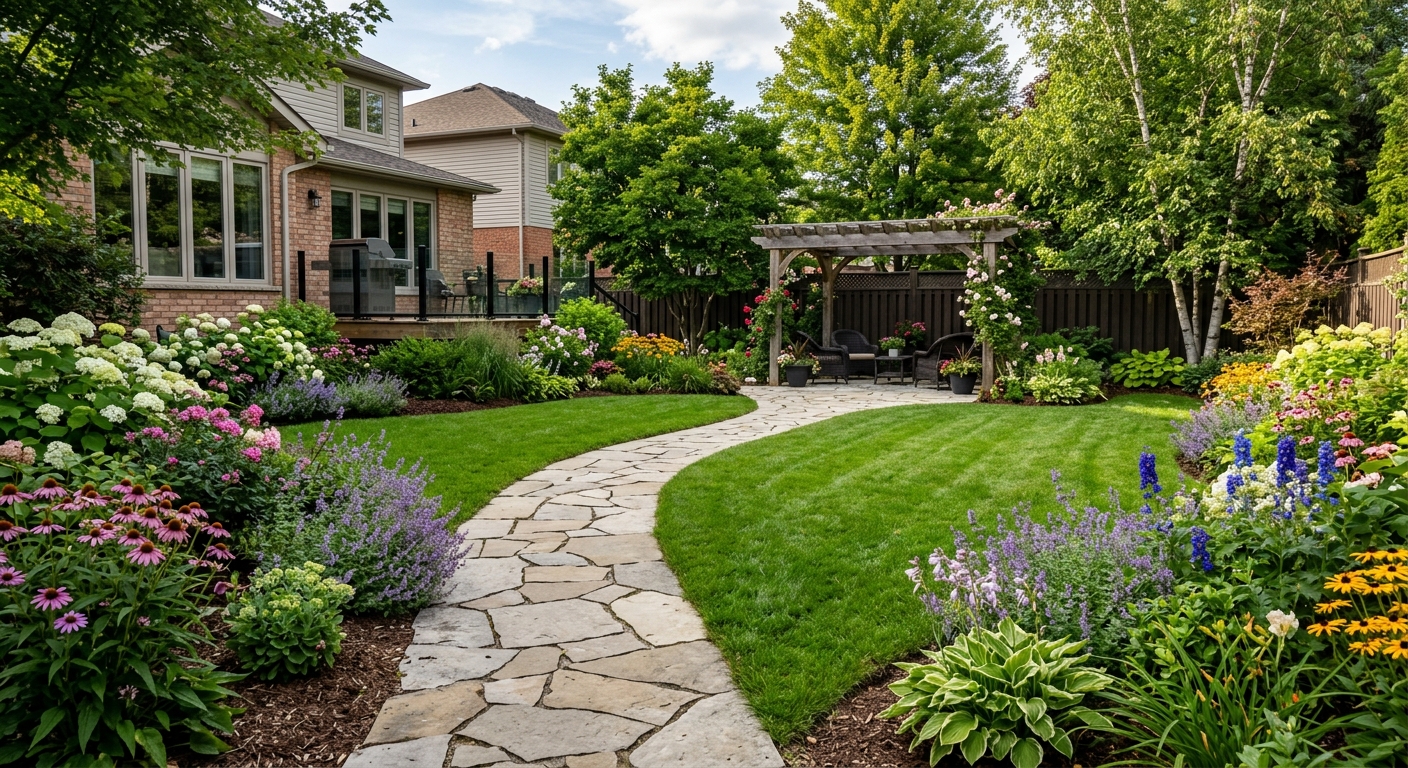
Landscaping options and costs in Banbury-Don Mills
Landscaping in Banbury-Don Mills is all about balancing curb appeal with what our soil and winter can actually handle. With a population of 27,695 (Statistics Canada, 2021 Census) concentrated across established neighbourhoods, you’ll often see homeowners prioritizing visible upgrades—front walkways, patios, and foundation-friendly drainage—because those areas get the most year-round attention. In practice, that demand tends to be strongest in older, mature built-up pockets close to transit corridors and established retail nodes, where lots are smaller and the yard space has to be functional, not just pretty. That homeowner mindset—plus Ontario’s active contractor market—can help keep pricing competitive, but it doesn’t eliminate the big cost drivers (excavation, base prep, and materials).
In the Toronto area (roughly hardiness zones 6a–7a), we design around winter lows near –23 to –18°C, plus repeated freeze–thaw cycles. Those cycles are a key reason concrete and stone projects often cost more than people expect: retaining walls, patios, and steps need deeper granular bases, proper geogrid/footing, and drainage so they don’t heave or settle. Availability also matters—when spring start dates tighten, crews spend longer on mobilization and the “good” planting window fills quickly, especially around summer.
If you’re comparing options, it helps to know what each scope typically includes before you request a quote—so the next table gives you a realistic cost range to anchor the conversation.
| Service |
Description |
Season |
Price Range |
| Full landscape design and installation |
Site assessment, concept + planting/hardscape plan, grading strategy, excavation, base prep, planting, and/or hardscape build-out |
Spring to early fall (most projects) |
$8,000–$40,000 |
| Sod installation (supply, grade, lay, roll) |
Topsoil/base leveling, weed control, sod supply and install, roll/compact, initial watering schedule |
Late spring to early fall |
$2,500–$8,000 |
| Lawn seeding (grade, seed, starter fertilizer) |
Light grading, seed + starter fertilizer, rake-in, mulch, first watering plan |
Spring (best) or early fall |
$1,800–$5,500 |
| Interlocking patio or walkway |
Excavation, compacted granular base, edging, geogrid where needed, stone installation, joint sand and finishing |
Spring to fall (weather-dependent) |
$6,000–$30,000 |
| Retaining wall (interlocking block) |
Wall layout, excavation, compacted base/footing, drainage gravel and weeping tile (where required), block installation |
Spring to early fall |
$6,000–$30,000 |
| Tree and shrub planting |
Soil prep, planting, staking where needed, mulch ring, initial watering instructions |
Spring and fall (root-establishing seasons) |
$800–$6,000 |
Prices are estimates only and vary by project scope, site access and material selection.
What affects the price of landscaping in Banbury-Don Mills
In Banbury-Don Mills and across the Toronto-area market, two quotes for what looks like the “same job” can still land 30–50% apart. The reason is usually hidden in scope and sub-scope: excavation depth, drainage corrections, how much topsoil/soil amendment is required, the quality of base materials for stonework, and the tier/size of plant material. When crews price labour, they factor mobilization time, hauling and disposal, and how long it takes to do proper granular compaction—especially in freeze–thaw country.
Climate matters because Ontario’s frost calendar and plant hardiness zones 6a–7a define both what grows and what you can install reliably. In Prairie regions (Zone 2–4), short seasons and colder winters push designs toward ultra-hardy, drought-tolerant species, and retaining-wall bases must reach deeper below the frost line. Coastal BC (Zone 7–8) often supports a longer planting palette, but heavy-rainfall drainage details can still add cost. In the dry BC interior, irrigation design is frequently constrained by water rules, which changes system components. In Southern Ontario (Zone 5–6), we have a moderate season, but summer dry spells still require thoughtful watering plans—often the difference between a thriving lawn and one that browns out after the first hot week.
Concrete local examples: if your yard is clay-prone and needs regrading to fix pooling, that “small” change can add significant machine time and haul-outs, pushing a typical lawn or walkway project upward within the $6,000–$30,000 band for hardscape-heavy scopes. If you’re upgrading from seeding to sod, the unit-cost jump often moves you into the higher portion of the $2,500–$8,000 lawn band because labour and material are front-loaded, but it can be justified when you need fast visual coverage or you’re replacing thin, patchy turf before a busy summer.
| Price Factor |
Why It Matters |
Cost Impact |
| Yard size in sq ft — the primary cost driver for softscape |
More area means more topsoil, seed/sod, edging, labour hours and materials |
Often drives the biggest jump within the same service tier |
| Grading and drainage work — slope corrections add significant cost |
Fixing water runoff affects excavation, disposal, and base depth |
Can raise a job by 10–30% when pooling/foundation risk exists |
| Drainage bed or French drain installation |
Proper outlets, gravel sizing and pipe layout require extra labour and materials |
Commonly increases hardscape/softscape project totals substantially |
| Plant material tier — native shrubs vs. ornamental vs. mature specimen trees |
Large, multi-stem, or specimen-sized plants cost far more and require better handling |
Can move the planting line item from the lower to upper end of the band |
| Hardscape vs. softscape ratio — walls and patios cost more per sq ft than lawn |
Stonework uses excavation, compacted base, and more labour-intensive finishing |
Shifts pricing toward the higher Toronto-area ranges |
| Irrigation system design and installation |
Heads, controller, trenching depth, and testing add both materials and labour |
Can significantly increase seasonal costs, especially on larger lawns |
| Soil amendment and topsoil required |
Clay-heavy yards may need imported topsoil and conditioners for root health |
Often increases trucking, spreading and disposal charges |
| Tree removal or stump grinding before new planting |
Undercut roots, debris disposal and grinding add specialized labour time |
May add a separate substantial charge before planting begins |
Permits & regulations in Ontario
For most homeowners in Ontario, planting, sodding and typical softscape work (like mulch, shrub beds, garden soil prep and seeding) generally does not require a permit. In Banbury-Don Mills, the permits usually come into play when you change structure or site drainage in a meaningful way.
Work that typically DOES require a permit: retaining walls above the common threshold of about 1.0 m (3.3 ft) (depending on local rules), and often when the wall is near a property boundary, slopes, or has implications for stability. In those cases, you may need a building permit and sometimes engineered drawings. Changes to lot grading that can affect how water drains toward neighbouring properties or storm sewer connections may also trigger approval requirements. And if your project involves significant excavation near services, you still need to comply with locating and safe-dig practices.
Step-by-step: how to verify your contractor is properly set up (Ontario): (1) Ask the contractor for their Ontario business information and confirm they’re registered/active through their public-facing listings or professional directories. (2) Request a Certificate of Insurance (general liability) showing coverage amounts and the certificate-holder name. (3) For workplaces, confirm they carry WSIB coverage where applicable, and ask for proof or clearance documentation. (4) Require any subtrades to provide their own insurance certificates. (5) Finally, call for utility locates before digging planting holes or any wall footings—this is essential for safe excavation and to avoid service strikes.
Planning a landscape that thrives in Banbury-Don Mills's climate
To plan a landscape that thrives in Banbury-Don Mills, you design with our frost realities and our zone 6a–7a growing conditions, not against them. Start with plant selection: use native and zone-appropriate shrubs and perennials that tolerate winter lows near –23 to –18°C and handle humid summers. When plants are suited to the local climate, you spend less on replacements and less time babying borderline species through freeze–thaw stress.
Next, compare sod vs. seed. Sod gives instant coverage, but it typically costs about 3–4x more per sq ft than seeding once you factor in supply and labour. A practical way to decide is to match your timeline: if you want a finished look for a summer event or to stabilize bare soil quickly, sod can be worth it. If you can wait and prioritize long-term cost efficiency, seeding can be the better value—especially for larger areas.
Drainage and grading are the “make-or-break” items in Toronto-area yards. Poor slopes create pooling that can damage foundations and stress turf and plant roots. For stonework and retaining walls, base preparation needs to be built for the frost line effects: proper excavation, compacted granular layers, and drainage layers help prevent heave and settlement.
Finally, go low-maintenance without going bland. Groundcovers, mulch rings, hardy perennials and smart spacing reduce annual upkeep. Consider rain-garden elements—especially downspout-directed swales or planted infiltration beds—to capture runoff on heavy-rain days while reducing irrigation demand.
For a dollar example: moving from seeding (often positioned lower in the lawn budget) toward sod (higher within the $2,500–$8,000 lawn band) is usually justified when you need immediate results and faster soil stabilization. If you’re flexible on timing, seeding can deliver long-term coverage for less, leaving more of your budget for drainage fixes or a well-prepped walkway.
| Element |
Climate Consideration |
Maintenance Level |
Price Band |
| Sod lawn installation |
Quick establishment before winter; still needs proper grading to avoid pooling |
Moderate (watering during establishment, occasional edging/top-dressing) |
$2,500–$8,000 |
| Native perennial garden |
Hardy to Ontario winters; better long-term resilience through freeze–thaw cycles |
Low to moderate (spring cleanup, light weeding in year one) |
$1,500–$6,000 |
| Mulched shrub border |
Mulch moderates soil temps and reduces winter heave stress on shallow roots |
Low (mulch refresh, minor pruning) |
$800–$4,500 |
| Interlocking stone patio |
Needs deep, compacted base to withstand frost and freeze–thaw expansion |
Low (periodic joint sand top-up) |
$6,000–$30,000 |
| Retaining wall (block) |
Drainage gravel + stable base prevents freeze–thaw movement and bulging |
Low (visual inspection after heavy winters) |
$6,000–$30,000 |
| Drip irrigation system |
Improves watering efficiency for perennials and reduces summer stress |
Moderate (seasonal checks, winter blowout if applicable) |
$1,200–$6,500 |
How to choose a landscaping contractor in Banbury-Don Mills
Choosing the right landscaping contractor in Banbury-Don Mills starts with proof, not promises. In Ontario, verify three things: (1) Ontario business/contractor registration (ask for their business name, address and public registration info), (2) liability insurance (request a current Certificate of Insurance and confirm it lists your property as the job site or has appropriate coverage), and (3) WSIB coverage where applicable. For subcontractors, make sure they also carry their own liability and WSIB documentation. Don’t accept a verbal “yes”—ask to see the certificate and clearance letter/confirmation as needed.
Next, ask for 2–3 itemised written quotes that break out labour and materials. A good quote separates excavation and disposal, base/gravel, geogrid where needed, stone supply, plant material tiers, topsoil/soil amendment, edging, drainage components, and (if included) irrigation line items. Read the exclusions: is permit work included (if required), is site cleanup part of the scope, and is waste hauling/disposal included? Clarify who supplies delivery materials and how access constraints (driveways, gates, overhead lines) affect the plan.
For warranty, insist on a workmanship warranty length and whether it’s transferable if you sell your home. Confirm what’s covered (settlement/cracking for stonework, plant replacement terms, and drainage performance). For payment, never pay more than 10–15% upfront; use a holdback until completion and final cleanup.
Finally, demand a written timeline: a start date, weather contingencies, and an estimated completion window—especially for stonework and sod/planting schedules.
- Check their Certificate of Insurance before work starts; confirm coverage is current.
- Request WSIB documentation/clearance where applicable for their crews.
- Ask for an itemised breakdown (labour, materials, equipment, disposal/hauling).
- Confirm whether excavation includes removal of unsuitable fill/clay and re-compaction.
- Make sure drainage scope is spelled out (French drain depth, outlet, or daylighting plan).
- Ask who supplies geogrid, base gravel, and edging, and whether it’s included in the price.
- Clarify plant sizes/species, quantities, and whether substitutions are allowed (and who approves them).
- Request explicit start and completion dates, plus weather stop/start rules.
- Confirm site access assumptions (long driveway, narrow side gate, parking restrictions).
- Ask for workmanship warranty terms in writing and what triggers a service visit.
- Use a payment schedule with a holdback; avoid large deposits.
- Verify cleanup and final grading/top dressing are included, not “on a best-effort basis.”
Red flags in Banbury-Don Mills include: quotes that omit drainage details yet price a retaining wall or walkway; refusing to provide itemised labour/material breakdown; asking for large deposits (well beyond 10–15%); no written start/completion timeline; and vague warranties that don’t specify workmanship coverage or how plant replacements are handled.
Frequently asked questions — landscaping in Banbury-Don Mills
Do I need a permit for a retaining wall in Ontario?
In Ontario, most typical planting and softscape work usually doesn’t require a permit, but retaining walls are different. As a rule of thumb many municipalities treat walls around 1.0 m (3.3 ft) and above as permit-triggering, and you may also need supporting documentation if the wall affects stability or nearby structures. For Banbury-Don Mills homeowners, the permit question often comes up when a wall is built on a slope, near a boundary, or designed to support changed grading. Before signing a contract, ask your contractor to confirm whether your retaining wall height and layout likely require a building permit, and whether they include the permit paperwork in the scope (or if you’re responsible). If you’re budgeting, retaining walls commonly fall into the $6,000–$30,000 band, and permits/engineering (when required) can add cost.
How do I improve drainage in my yard?
Drainage improvements start with understanding where water is coming from and where it needs to go. In Toronto-area neighbourhoods like Banbury-Don Mills, clay soils and fill can trap water, leading to pooling near foundations and soft areas in lawns. A good contractor will assess grading, downspout locations, and low spots, then propose a solution such as regrading, adding a drainage bed or French drain, or redirecting runoff to a safer outlet. The best results typically combine earthwork with proper base prep for any hardscape you’re building. If you’re also adding a patio or walkway, drainage beds integrated behind/below the structure often prevent future settlement. Budget-wise, drainage can push projects toward the higher end of typical hardscape ranges within $6,000–$30,000, depending on excavation depth and disposal.
What is xeriscaping and does it suit Banbury-Don Mills?
Xeriscaping is a water-wise landscaping approach that uses drought-tolerant plants, efficient irrigation (often drip), and soil practices that reduce evaporation. It can suit Banbury-Don Mills very well, even though we’re not in a drought-stricken region like some parts of BC interior. Southern Ontario still has summer dry spells, and targeting efficient watering helps keep established plants healthier while controlling costs. A good Banbury-Don Mills xeriscape often looks like “low-maintenance, not barren”: native perennials, mulched shrub borders, and groundcovers grouped for reduced competition and better moisture retention. You can also use rain gardens to manage runoff and reduce irrigation demand. If you add drip irrigation, expect that to be an extra line item within typical irrigation cost bands (commonly $1,200–$6,500), but it can reduce ongoing watering costs and improve plant survival after hot stretches.
How do I plan a low-maintenance yard?
A low-maintenance yard in Banbury-Don Mills is designed around fewer, tougher plant groupings and surfaces that don’t require constant repair. Start by choosing zone-appropriate plants for Ontario’s winter lows and freeze–thaw cycles, then layer mulch to suppress weeds and moderate soil temperature. For lawns, consider whether sod or seeding fits your timeline: sod offers faster coverage but typically costs more, while seeding is more budget-friendly for larger areas. Many homeowners also reduce upkeep by focusing on durable borders (mulch + hardy shrubs) rather than constantly reworking thin turf. If you’re investing in stonework, it’s often worth doing proper base preparation so patios and walkways stay level through winter movement. For reference, sod installation often lands around $2,500–$8,000, while hardscaping projects such as patios commonly fall within $6,000–$30,000, depending on area and drainage complexity. Spend smart and your yard will need less time each week.
How deep should a retaining-wall base be for local frost?
Retaining-wall base depth isn’t a single “universal” number—it depends on wall height, soil conditions, block type, and drainage needs. In Ontario, the key is to build a stable, well-compacted base and drainage system that can handle freeze–thaw movement over time, rather than relying on a shallow pad that can shift. Many properly constructed walls include excavation to remove unsuitable soil, a compacted granular base and, where needed, reinforced elements such as geogrid. The drainage gravel and any required weeping tile are also critical because water pressure behind a wall can worsen movement during winter thaw cycles. Because your soil and wall height matter most, the best next step is to have your contractor assess the site and confirm the design build-up depth in writing. If your project is in the $6,000–$30,000 retaining-wall band, that cost should reflect proper excavation, base build-up, and drainage—not just block placement.
How much does professional landscape design cost?
Professional landscape design in Ontario can vary based on how detailed the plan is and whether you’re combining design with installation. In the Banbury-Don Mills area, the broader “design + build” budget many homeowners plan for typically falls within the $8,000–$40,000 range, especially when the project includes grading, drainage changes, planting layouts, and stonework. If you’re only looking for concept design (basic layout and plant list) the cost may be lower, but installation-ready drawings—often needed for consistent stonework levels and planting spacing—usually cost more. The most important point is to ask for clarity: what deliverables are included (concepts, elevations, planting palette, hardscape notes), and whether the designer becomes responsible for revisions if you change materials. When quotes are comparable, a well-scoped plan helps avoid “surprise” excavation or drainage decisions later, which can otherwise push the job toward the high end of the budget.