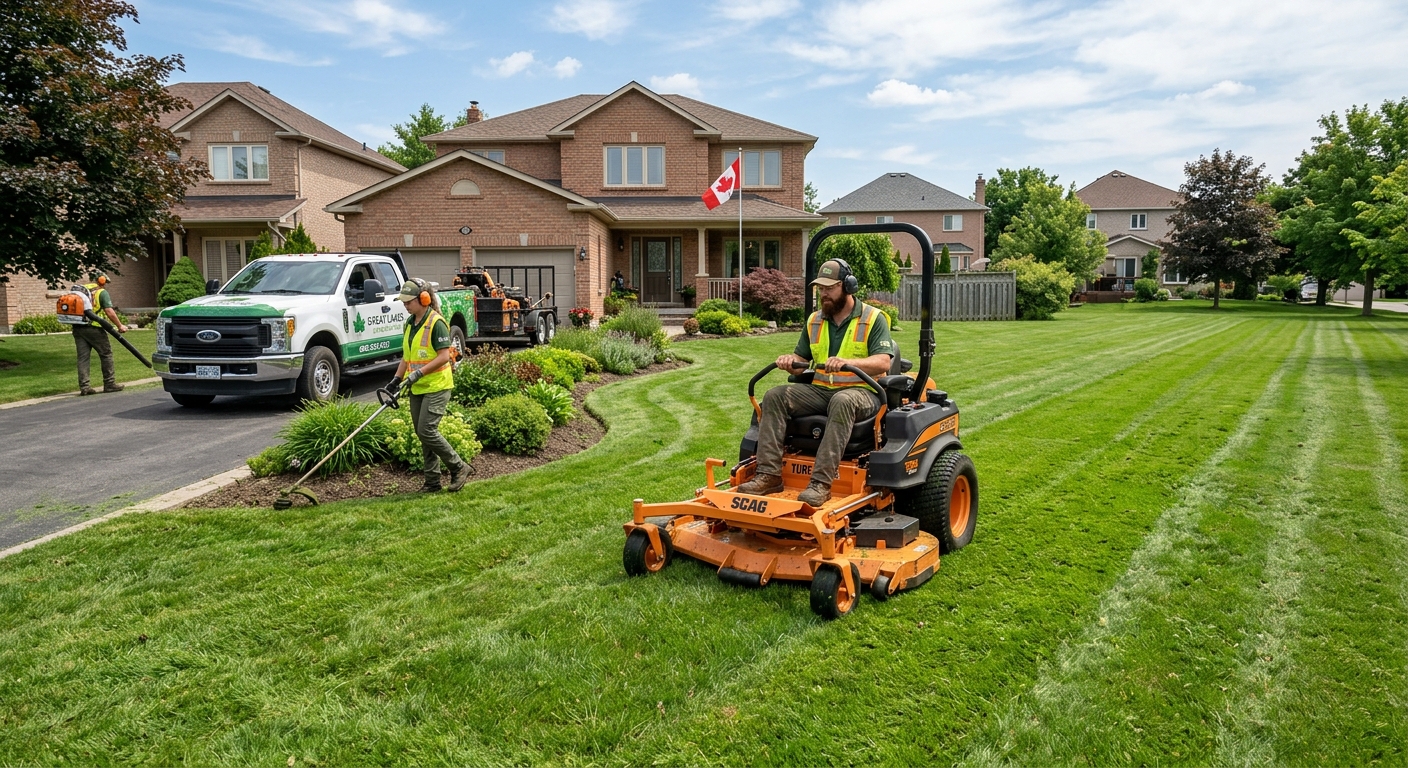
Landscaping options and costs in Brockville
Brockville homeowners usually start with one clear goal—better curb appeal, improved drainage, or a lawn that stays green—and then compare options side by side. In a city of 22,116 people (Statistics Canada, 2021 Census), many households have the yard space to invest: homeowner households make up 57.1% of households, and single-detached houses account for 47.5% of dwellings (Statistics Canada, 2021 Census). That ownership mix matters because more detached properties have the front-and-back access contractors need for grading, sod, and hardscape installs.
In Kingston–Pembroke, landscaping pricing reflects Ontario’s plant hardiness range (zone 5a–5b) and the need to build for winter freeze-thaw. While the frost-free growing window is roughly May–October, the ground is workable earlier only for certain prep work (like drainage and compacted bases). Homes built before 1981 are common—71.6%—so older lots often have irregular grades, mature trees, or original drainage patterns that we may need to correct, which can push labour and material quantities up.
Contractors are also balancing demand: during spring and early summer, crews book out quickly for sod, patio base prep, and shrub planting. In Brockville, it’s especially busy in the more established residential pockets around King Street East and the downtown corridor where access and mature landscaping influence how we phase work.
Use the table below as a budgeting baseline to compare common scope choices, then we can narrow it with a site visit and measurements.
| Service |
Description |
Season |
Price Range |
| Full landscape design and installation |
Site visit, layout and planting plan, grading/drainage notes, soil prep, planting, and selected hardscape or turf work |
May–October |
$4,000–$30,000 |
| Sod installation (supply, grade, lay, roll) |
Remove old turf, light grading, topsoil/soil amendment, sod install, rolling, and initial care |
Late April–June or early September |
$2,500–$8,000 |
| Lawn seeding (grade, seed, starter fertilizer) |
Minor grading, seed mix, starter fertilizer, light topdressing and establishment care |
April–early June or September |
$1,500–$5,000 |
| Interlocking patio or walkway |
Excavation, compacted granular base, geotextile, edging, interlocking stones, and joint sand |
May–October |
$6,000–$25,000 |
| Retaining wall (interlocking block) |
Block wall layout, proper granular base and drainage, geogrid where needed, cap/finishing |
May–October |
$8,000–$35,000 |
| Tree and shrub planting |
Soil improvement, planting, staking as needed, mulch rings, and a starter watering plan |
May–October |
$1,000–$8,000 |
Prices are estimates only and vary by project scope, site access and material selection.
What affects the price of landscaping in Brockville
In Kingston–Pembroke, two quotes for the “same” landscaping idea can swing by 30–50% because what we’re actually building is different once we account for yard measurements, soil conditions, and winter performance requirements. The labour market also tightens in May and June when crews want to install turf and hardscape before freeze-up. Even within Ontario, differences in site access, material availability, and how much excavation is required can change your cost dramatically.
Zone 5a–5b conditions (with pockets of 4b inland) define both plant availability and installation timing. Freeze-thaw cycling creates heaving risk, so retaining walls and patios need deep, well-compacted granular bases and drainage behind/under the structure. That’s one reason “retaining wall & hardscape” is priced more like a construction project than a simple makeover. In contrast, softer planting work can be phased more flexibly through the growing window (roughly May–October), which helps control costs.
Concrete examples from Brockville: (1) older lots—71.6% built before 1981—often have settled grades or drainage patterns that require additional grading and topsoil, adding both excavation time and disposal fees; (2) clay/loam soils can hold water, so a French drain bed or underdrain might be the difference between a $5,000–$35,000 retaining wall scope versus a cheaper surface fix that fails after the first few winters; (3) if you want sod, you’re paying for turf supply and installation “lift,” not just seed—sod installs often land in the $2,500–$8,000 band, while seeding usually budgets lower.
When homeowners are comparing budgets, it helps to match the quote to the real scope: base depth, drainage, soil amendments, and the size/count of plant material—not just the final look.
| Price Factor |
Why It Matters |
Cost Impact |
| Yard size in sq ft — the primary cost driver for softscape |
More area means more topsoil/seed or sod, more labour hours, and more mulch/soil improvement |
Can swing the total by 20–40% depending on turf and planting coverage |
| Grading and drainage work — slope corrections add significant cost |
We must direct runoff away from foundations and toward appropriate drainage paths |
Typically increases cost by 10–25% for moderate grade corrections |
| Drainage bed or French drain installation |
Prevents pooling and freeze damage by capturing and moving water |
Often adds thousands; commonly a 15–30% increase on hardscape projects |
| Plant material tier — native shrubs vs. ornamental vs. mature specimen trees |
Mature trees and specialty ornamentals cost more and may require extra labour/staking |
Can add 10–20% (or more) versus a native shrub-focused plan |
| Hardscape vs. softscape ratio — walls and patios cost more per sq ft than lawn |
Hardscape needs excavation, base layers, and compaction for winter durability |
Shifts budgets upward quickly; can double a plan compared to turf-only |
| Irrigation system design and installation |
Drip for beds and properly matched sprinkler heads help manage summer dry spells efficiently |
Usually adds a mid-range line item, often 5–15% of the project total |
| Soil amendment and topsoil required |
Clay/loam often needs improvement for rooting and to support stable turf and roots |
Commonly adds 5–20% depending on depth and haul distance |
| Tree removal or stump grinding before new planting |
Access, stump grinding depth, and disposal influence labour and scheduling |
Can add thousands; frequently a 10–25% increase |
Permits & regulations in Ontario
In Ontario, most planting, sodding, and typical softscape work (like seed, mulch, and shrub borders) generally does not require a permit. Where permits often come into play is for structures and grading: retaining walls above the common municipal threshold—often around 1.0 m (3.3 ft), depending on how the wall is measured and local definitions—may require a building permit and sometimes engineered drawings. If you’re changing lot grading in a way that affects drainage toward a neighbouring property or storm connection, approvals can also be triggered.
In Brockville, the practical steps are straightforward. First, plan for utility locates before any excavation—planting holes, trenching for French drains, and wall footings. Even “small” digs can hit buried services. Second, confirm whether any erosion/sediment control expectations apply during construction if you have exposed soil for more than a short period.
On licensing and contractor protection: ask for your contractor’s Ontario business/contractor registration where applicable, liability insurance, and WSIB/WCB clearance (or an equivalent proof of coverage/clearance). You can typically verify these by (1) checking the applicable online business registry entry, (2) reviewing the certificate of insurance you’re given (it should show active coverage and appropriate limits), and (3) requesting WSIB/WCB clearance documentation directly and confirming validity dates. Always use a written contract that matches the permit/scope decisions discussed on site.
Planning a landscape that thrives in Brockville's climate
To plan a yard that actually thrives in Brockville, design around zone 5a–5b hardiness, Ontario’s freeze-thaw cycles, and the fact that the ground and rainfall patterns are seasonal. That means choosing plants and systems that don’t just look good in summer—they survive winter wind, temperature swings, and spring thaw conditions.
1) Plant selection: favour native and zone-appropriate shrubs, perennials, and trees that are winter hardy and suited to local soils. They establish faster and usually need less labour for winter protection. 2) Sod vs. seed: sod gives instant visual payoff and erosion control, but it costs roughly 3–4 times more per sq ft than seeding once you compare material and installation labour. Sod is best where you need quick coverage; seeding is a smarter budget choice for larger areas that you can protect during establishment. 3) Drainage and grading: Kingston–Pembroke winters punish pooling water. Even if your lawn looks fine in August, saturated clay around foundations can lead to heaving or persistent dampness. 4) Hardscape base prep: patios and retaining blocks need a deep, compacted granular base so movement is controlled and drainage is continuous through the system. 5) Low-maintenance strategies: mulched shrub borders, groundcovers, and perennial “repeaters” reduce annual upkeep while staying attractive year-round.
If you want water-smart options, consider rain gardens in downspout/runoff areas and targeted drip irrigation for beds. Ontario doesn’t have the same mandatory drought restrictions as some drier regions, but summer dry spells still happen, and drip keeps watering efficient.
Example: upgrading from simple seeding to sod for a small front strip might cost an extra $2,000–$3,000, but it’s often justified if that strip is where erosion would occur or where you need fast curb appeal. If you’re building a broader turf area and can tolerate establishment, seeding is usually the better value.
| Element |
Climate Consideration |
Maintenance Level |
Price Band |
| Sod lawn installation |
Needs proper prep for freeze-thaw; ideal during late spring or early fall for rooting |
Medium (watering/establishment, then seasonal mowing) |
$2,500–$8,000 |
| Native perennial garden |
Winter-hardy varieties handle zone 5a–5b cold and spring temperature swings |
Low to medium (weeding in year one, then easier upkeep) |
$1,500–$6,000 |
| Mulched shrub border |
Mulch moderates soil temperature swings and helps retain moisture in summer dry spells |
Low (refresh mulch annually) |
$1,000–$4,500 |
| Interlocking stone patio |
Deep base and drainage prevent frost heave and pooling in spring melt |
Low (occasional weed control and joint sand checks) |
$6,000–$25,000 |
| Retaining wall (block) |
Proper granular backfill and weeping drainage handle water pressure and freeze-thaw |
Low (periodic visual checks) |
$8,000–$35,000 |
| Drip irrigation system |
Better match for Ontario bed watering and summer dry spells; reduces waste vs. sprinklers |
Medium (seasonal inspection and winter shutoff) |
$1,200–$5,500 |
How to choose a landscaping contractor in Brockville
Start by verifying credentials the way you would for any construction trade. In Ontario, ask for proof of liability insurance (certificate of insurance showing coverage dates and limits), and request your contractor’s WSIB/WCB clearance documentation—don’t rely on “we’re covered” statements. For licensing/registration, confirm the business standing through the appropriate online registries, then match the name on the contract to the information on their insurance/clearance paperwork.
Next, get 2–3 itemised written quotes that break labour and materials separately (not only a lump sum). A good quote should list what’s included: topsoil depth, base depth for patios, geotextile usage, drainage components, plant counts/sizes, and what disposal and hauling cover. Ask whether permit pulls are included (when required for retaining walls) and whether they’re responsible for any documentation. Also check warranty details: confirm the workmanship warranty length, whether product warranties apply to the plants/stone/labour, and if warranties are transferable to future homeowners.
On payment, keep it conservative: never pay more than 10–15% upfront. Use a holdback until key milestones are complete—especially drainage tie-ins, base compaction, and final cleanup. Finally, insist on a clear timeline: a written start date and a realistic completion estimate that accounts for weather delays common in southern Ontario spring and early fall.
- Ask for a site visit and a written measurement/area take-off (sq ft and linear ft).
- Confirm insurance certificate is current and matches the contracting entity on the contract.
- Request WSIB/WCB clearance (or equivalent proof) before work starts.
- Check that the quote lists base and drainage details for hardscape and retaining walls.
- Ensure disposal/hauling is explicitly included or excluded.
- Verify plant quantities and sizes (e.g., height/size at installation), not just “assorted shrubs.”
- Ask what topsoil/soil amendments are used and how deep they’re placed.
- Confirm erosion control steps if the yard will be disturbed for more than a day or two.
- Clarify irrigation responsibilities if sprinklers/drip are part of the scope.
- Review warranty terms in writing (workmanship vs product, and start/end dates).
- Use milestone-based payments; avoid large upfront payments.
- Confirm scheduling: when sod will be installed and what weather triggers delays.
Red flags in Brockville: a contractor who won’t provide insurance and WSIB/WCB clearance; quotes that skip drainage/base details for patios or retaining walls; “we’ll figure it out later” language about permits or grading; vague plant lists with no counts or sizes; and payment requests above 10–15% upfront with no milestone schedule.
Frequently asked questions — landscaping in Brockville
How much does a retaining wall cost in Brockville?
Retaining walls in Brockville typically land in the $8,000–$35,000 range depending on wall length, height, block selection, and—most importantly—how much drainage and base work is required for winter performance. Because Kingston–Pembroke soils can be clay/loam and we deal with freeze-thaw, walls need deep, well-compacted granular base and proper weeping/drainage behind the wall. Older lots built before 1981 often have settled grades, so we may need additional excavation and re-grading before we can build. If you keep the scope to a shorter block wall with minimal excavation, costs stay closer to the low end; longer runs, taller walls, and drainage improvements push toward the upper band.
When is the best time to landscape in Brockville?
For most landscaping in Brockville, the best window is May through October, because zone 5a–5b plants and turf need stable soil temperatures to root. Sod is usually best in late spring (after soil warms) or early fall when heat stress is lower; seeding also works well in spring and again in September. Hardscape and base prep can be done earlier in the season if the ground conditions allow compaction, but we avoid working on overly wet/clay soil to prevent long-term failures. If you’re planning a retaining wall, patio, or major drainage fix, aim for the earlier part of the window so we can complete backfill and drainage before heavy fall weather and before frost restricts excavation. For a full landscape install, booking early usually matters because crew availability tightens in June.
Do I need a permit for a retaining wall in Ontario?
In Ontario, retaining walls above the common local threshold—often around 1.0 m (3.3 ft), depending on how the measurement is defined—typically require a permit, and some cases may need engineered drawings. That said, exact triggers can vary by municipality and by the wall’s location and how it affects lot drainage. For Brockville homeowners, the safest approach is to ask the contractor to confirm whether your design crosses that threshold before work starts. Most planting and sod installation usually do not require permits, but changes to lot grading that affect drainage toward neighbours or storm connections can require approval. Your contractor should be clear on who pulls permits and when, and your contract should specify whether permit fees and drawings are included.
How do I improve drainage in my yard?
Drainage improvements in Brockville usually start with a simple assessment: where water flows during spring melt and after heavy rain, whether it pools near foundations, and how the yard slopes. If you’re dealing with persistent pooling, a French drain or drainage bed is often the most reliable fix because it captures water below the surface and routes it where it won’t damage structures. We also consider grading—small slope changes can be meaningful in freeze-thaw conditions, and proper swales help water move without saturating foundations. Many older lots (built before 1981) had different drainage assumptions, so we sometimes combine re-grading with underdrains before installing patios or block walls. An efficient next step is to ask for a drainage recommendation tied to your site plan and to ensure the hardscape base includes proper drainage.
What is xeriscaping and does it suit Brockville?
Xeriscaping is a landscaping approach that reduces watering by using drought-tolerant plants, mulches, and smart irrigation design. In Brockville, xeriscaping can be a great concept, but we tailor it to Ontario conditions: we still get winter freeze-thaw, and our precipitation is seasonal rather than year-round mild like coastal regions. That means we focus on winter-hardy perennials, native shrubs, thicker mulching, and drip irrigation for beds rather than “desert-style” plant palettes. It’s often especially useful along south- or west-facing slopes where soils dry faster, or where you want to limit lawn irrigation. If you’re comparing turf, sod installs typically fall into the $2,500–$8,000 band for many homeowners’ projects; switching part of the lawn to a mulched shrub border and perennial beds can reduce ongoing watering while maintaining curb appeal.
How do I plan a low-maintenance yard?
A low-maintenance yard in Brockville comes from planning for winter and for “year-one establishment,” then designing for reduced annual labour. Start with zone-appropriate, hardy plants and repeat plant groupings (so you’re not constantly babysitting weak spots). Use mulch in shrub and bed areas to suppress weeds and buffer soil temperature swings during freeze-thaw. Where you want instant coverage, sod can work—but for larger areas, seeding is often a more budget-friendly way to start; you can keep maintenance manageable with proper grading and a simple starter fertilizer plan. For drainage-heavy properties, solve the water issue first so plants don’t struggle and hardscapes don’t shift. If you want a single budget anchor, many full landscape installs land between $4,000–$30,000, and the biggest “maintenance payoff” usually comes from getting base prep and drainage right—before you add plants and mulch.