Landscaping options and costs in Erin
In Erin, Ontario, homeowners typically have a clear advantage when planning landscaping improvements: with single-detached homes making up 91.5% of dwellings and a 90.0% homeownership rate, there’s real incentive to invest in curb appeal, comfort, and long-term yard function. According to the 2021 Census, Erin’s population was 11,981, and that mix of families and long-term residents supports a steady demand for mid-range, full-service landscape work.
In the Kitchener–Waterloo–Barrie economic region, most projects run through a defined working window tied to Zone 5b–6a conditions. Winters are reliably cold, freeze–thaw cycles are part of daily reality, and that affects both what can be planted and how contractors schedule tasks like grading, base prep, and drainage. Material and labour availability is generally good compared with smaller Ontario towns, but it still peaks from mid-April through October, which is why quoting timelines can vary.
Retaining walls, patios, and regrading are especially in demand in neighbourhoods around central Erin and along established streets where driveways and foundations sit close to sloped lots. If your goal is a front-and-back refresh, contractors usually propose either a full design-and-install package or a phased approach to match budgets. The comparison table below summarizes common options and the typical price bands homeowners in Erin see.
| Service |
Description |
Season |
Price Range |
| Full landscape design and installation |
Site walk, layout plan, grading/drainage coordination, planting plan, soil prep, hardscape/softscape install as specified |
Mid-April to October (often scheduled in spring/fall) |
$8,000–$60,000 |
| Sod installation (supply, grade, lay, roll) |
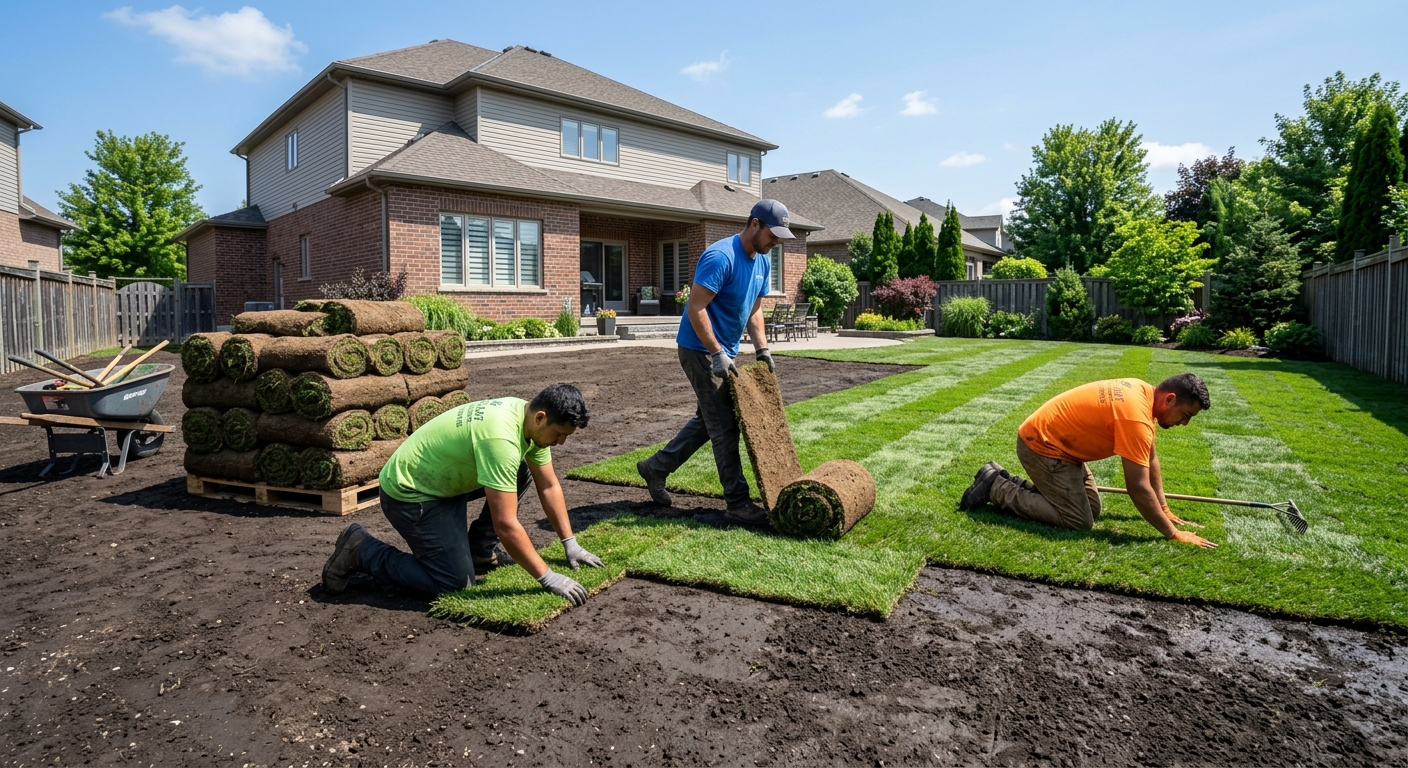
Remove existing, compact base, level, lay sod, roll, initial watering and edge finishing |
Late April to early June (and again in fall) |
$5–$10 per sq ft |
| Lawn seeding (grade, seed, starter fertilizer) |
Light grading, seed selection, starter fertilizer, straw/mulch, initial watering instructions |
Spring or late summer/early fall |
$3–$7 per sq ft |
| Interlocking patio or walkway |
Excavation, granular base, compaction, edging, interlocking stones, levelling and joint sand |
May to September (best when ground is workable) |
$12,000–$35,000 |
| Retaining wall (interlocking block) |
Trenching, reinforced/engineered base where required, wall blocks, drainage gravel and weeping setup |
May to September (depends on access and drainage conditions) |
$4,500–$18,000 |
| Tree and shrub planting |
Soil amendments, staking, mulching, planting layout, watering plan and protection |
Spring and fall planting windows |
$1,500–$12,000 |
Prices are estimates only and vary by project scope, site access and material selection.
What affects the price of landscaping in Erin
In the Kitchener–Waterloo–Barrie region, it’s common to see quotes for the “same” landscaping idea swing by 30–50%. The biggest reason is that scope rarely matches on the first estimate: one contractor includes deeper granular base and drainage grading, while another may price only visible surfaces. That difference is magnified by Erin’s Zone 5b–6a frost cycles, because frost heave punishes weak base prep and poor drainage. In practice, a patio or retaining wall that looks identical on day one can diverge sharply once you compare how far excavation goes, what compacted base depth is specified, and whether drainage is engineered in.
Plant hardiness and frost dates also control cost. You can’t just plant what survives elsewhere; we design around local winter survivability and freeze–thaw timing for establishment. This is why comparisons across Ontario versus Prairie provinces (Zone 2–4) don’t translate directly: Prairie projects may need more drought- and wind-hardy selections and stricter frost scheduling, while coastal BC (Zone 7–8) can plant more aggressively year-round but still spends heavily on drainage in wetter seasons. In Southern Ontario, including Erin, summer dry spells mean irrigation design often becomes a “necessary convenience,” not a luxury, even though we’re not under the extreme water-restriction styles sometimes seen in drier BC interior communities.
Concrete Erin examples: (1) If your property has older drainage patterns—common in homes built before 1981, when 58.2% of dwellings were constructed—contractors often must correct how water routes, which adds grading and sometimes a French drain. (2) Choosing sod instead of seeding can raise softscape spend quickly; sod typically costs about 3–4x per sq ft versus seeding, and that delta can justify itself when you need instant yard function.
| Price Factor |
Why It Matters |
Cost Impact |
| Yard size in sq ft — the primary cost driver for softscape |
More area means more topsoil/soil prep, more seed/sod/plant material, and more labour time |
Medium to high (can change total by 20%+) |
| Grading and drainage work — slope corrections add significant cost |
Fixing pooling or runoff paths requires excavation, re-compaction, and often reworking edges |
High (often the reason quotes differ 30–50%) |
| Drainage bed or French drain installation |
Helps move water away from foundations and prevents frost-related movement |
Medium to high ($1,500–$6,500 typical depending on extent) |
| Plant material tier — native shrubs vs. ornamental vs. mature specimen trees |
Mature plants cost more to source and require heavier handling and labour |
Medium to high (can add thousands quickly) |
| Hardscape vs. softscape ratio — walls and patios cost more per sq ft than lawn |
Interlocking and base prep use more material and machine time than turf/planting |
High if large areas are hardscape |
| Irrigation system design and installation |
Zoned heads, trenching depth, and controller setup affect materials and labour |
Medium (often $2,000–$7,500 depending on yard) |
| Soil amendment and topsoil required |
Compacted clay or poor soils need more amendments for root establishment |
Low to medium (can rise with poor baseline soil) |
| Tree removal or stump grinding before new planting |
Removal adds equipment time and disposal; roots can impact regrading |
Medium to high (commonly $800–$3,500+) |
Permits & regulations in Ontario
In Ontario, most planting, sodding, and typical softscape work generally does not require a permit. For Erin homeowners, that usually includes: soil amendments and topdressing, shrub and tree planting, mulching, seeding, sod installation, and standard walkway/patio construction. Retaining walls are where rules can change. As a practical guideline many municipalities use, retaining walls above a height threshold—commonly around 1.0 m (3.3 ft)—typically require a building permit and sometimes engineered drawings, particularly if there’s surcharge from driveways, fences, or grade changes.
Also consider grading approvals: if your project changes lot grading in a way that affects drainage toward neighbouring properties or ties into storm sewer connections, you may need approval before work starts. Before any digging for planting holes, footings, or drain lines, contractors should arrange utility locates so everyone is working safely.
To verify your contractor in Erin, Ontario, use a simple step-by-step check: (1) Licensing/registration: confirm the contractor is properly registered for the work they’re performing (and whether any specific trades are subcontracted). (2) Liability insurance: ask for a current Certificate of Insurance showing general liability limits; don’t rely on “it’s included in the quote.” (3) WSIB/WCB coverage: request proof that the contractor (and subs where applicable) has active coverage; a clearance letter or similar confirmation is typically provided. Finally, keep everything in writing—quote, insurance copy, and the agreed scope—so there’s no ambiguity about who’s responsible if issues arise.
Planning a landscape that thrives in Erin's climate
For Erin yards, the goal is to design with the frost calendar and Zone 5b–6a conditions instead of fighting them. Start with plant selection: choose hardy, zone-appropriate natives and proven Ontario cultivars that handle winter dieback and the freeze–thaw rhythm. In our market, it’s also smart to plan winter structure: shrubs and evergreen accents keep the yard looking composed while perennials re-emerge. For many households, irrigation is needed mainly during establishment and summer dry spells—so designs often use efficient zoned systems or drip for beds rather than heavy all-season sprinkling.
Sod versus seed is another key decision. Sod gives instant curb appeal and faster functional turf, but it typically costs about 3–4x per sq ft compared with seeding because you’re paying for the sod product and quicker, labour-intensive installation. That difference can be justified when you need immediate use (kids/pets, outdoor events) or when you’re replacing damaged areas. If you’re more flexible and the soil is workable, seeding can stretch your budget.
Drainage and grading are make-or-break in the Kitchener–Waterloo–Barrie region: prevent pooling near foundations and keep water moving away from patios and wall bases. Interlocking patios and retaining walls also require proper base preparation to the local frost conditions—deep, well-compacted granular base plus drainage materials helps reduce frost heave. For low-maintenance design, use mulched shrub borders, groundcovers, and layered perennials with tidy spacing, so you’re not fighting weeds every season.
To reduce water demand, consider rain-garden pockets or xeriscape-inspired planting with drought-tolerant selections. In Erin, the “low-water” win usually comes less from extreme drought tolerance and more from smart drainage capture, mulch depth, and targeted irrigation.
| Element |
Climate Consideration |
Maintenance Level |
Price Band |
| Sod lawn installation |
Best results when installed during workable spring/fall windows; roots must establish before hard freezes |
Medium (watering/monitoring during establishment) |
$5–$10 per sq ft |
| Native perennial garden |
Zone-appropriate plants improve winter survival and reduce repeated replanting after freeze–thaw cycles |
Low to medium (mulch and occasional weeding) |
$500–$3,500 |
| Mulched shrub border |
Mulch buffers temperature swings and helps roots cope with Ontario winters |
Low (refresh mulch and light pruning) |
$1,000–$6,000 |
| Interlocking stone patio |
Base depth and drainage must be built for frost to limit heave and settling |
Low (routine cleaning and joint sand top-ups) |
$12,000–$35,000 |
| Retaining wall (block) |
Proper gravel backfill and weeping setup prevent water pressure and reduce freeze–thaw damage |
Low (periodic inspection of drainage and joints) |
$4,500–$18,000 |
| Drip irrigation system |
Zoned, efficient watering supports bed establishment during summer dry spells |
Low (seasonal check and winter shut-down/bleed) |
$2,000–$7,500 |
How to choose a landscaping contractor in Erin
Choosing the right contractor in Erin, Ontario starts with confirming the paperwork—then aligning the quote to the real scope. First, verify Ontario licensing/registration for the type of work being performed (and for any sub-trades). Next, request current liability insurance and review the Certificate of Insurance: it should list coverage in force and include the ability to work at your address. Third, confirm WSIB/WCB coverage: ask for proof that the contractor (and subcontractors when used) has active clearance or equivalent confirmation. Don’t accept a verbal promise—ask for copies before the job starts.
Then get 2–3 itemised written quotes, with labour and materials broken down rather than a single lump sum. Make sure the scope includes key lines like base depths, compaction method, topsoil amendment type, drainage provisions, and whether disposal is included. Ask directly: is the permit pull included (where required for larger retaining walls or grading approvals)? Is material delivery included? What’s excluded (existing stone removal, root cutting, tree stump grinding, or utility marking costs)?
For warranty, distinguish workmanship versus product warranty. Ask how long labour is covered, whether plant replacement is included if winterkill occurs, and if product warranties are transferable. Payment schedules should be conservative: typically no more than 10–15% upfront, with holdback until substantial completion. Finally, insist on a start date and a completion estimate in writing, because weather in Zone 5b–6a can shift schedules.
- Ask for WSIB/WCB proof and confirm it’s active (not expired).
- Request a liability insurance Certificate and confirm coverage limits.
- Ensure the quote specifies base prep depth and compaction expectations for patios/walks.
- Confirm drainage details: French drain vs. grading-only, and where water will go.
- Get written clarity on what’s included/excluded for disposal and hauling.
- Verify whether permit pull is included for retaining walls above threshold height.
- Ask for a plant list with scientific names and sizes (e.g., 2.5” caliper vs. “small tree”).
- Require an irrigation design scope if installing controllers, zones, or drip lines.
- Confirm warranty terms: labour duration and what triggers replacement.
- Limit upfront payment to 10–15% and hold back until completion.
- Have them show the timeline as dates, not just “spring 2026.”
- Request a site access plan (fencing protection, driveway protection, and equipment staging).
In Erin, concrete red flags include: a quote that doesn’t specify base depth/compaction for interlocking work, refusing to provide WSIB/WCB and insurance documentation, using vague line items like “materials as needed,” asking for 50%+ upfront, and promising winter-proof planting without discussing Zone 5b–6a hardiness or winter protection.
Frequently asked questions — landscaping in Erin
What is the best grass type for a Erin lawn?
For lawns in Erin, Ontario (Zone 5b–6a conditions), homeowners usually do best with cool-season grass mixes because they tolerate our cold winters and regrow after early spring cutback. A common approach is fine fescue blended with Kentucky bluegrass: fine fescue handles shade and reduces watering demand, while bluegrass helps the lawn “knit” and recover after traffic. If you’re laying seed after winterkill or renovating thin spots, a contractor can tailor the blend to sun exposure and soil type. Budget-wise, if you’re considering sod, typical installed pricing often falls in the mid-range band of $5–$10 per sq ft, which is why many Erin properties start with seeding/repair first.
When should I aerate and overseed my lawn in Erin?
In Erin, the safest timing is spring after the ground thaws and dries enough to prevent rutting, or late summer into early fall when nights cool but the soil is still warm—this supports root establishment before the frost window tightens. Aerating helps because compacted lawns struggle with drainage and oxygen penetration, which matters in our freeze–thaw cycle where standing moisture can worsen stress. Overseeding should follow shortly after aeration so seed contacts soil. If you’re trying to speed the process, you may be tempted by sod, but it’s typically $5–$10 per sq ft installed; seeding is usually more budget-friendly and can be phased over a season.
What trees grow best in Erin's climate zone?
In Erin’s Ontario conditions, the best results come from trees that tolerate cold winters and reliable freeze–thaw cycles. Common, dependable options include serviceberry, littleleaf linden, and some varieties of white spruce for structure (with the right siting). For neighbourhoods with established lots and older soils, choose trees with proven local performance and plant them at the correct depth—too-deep planting is a frequent cause of decline. If you’re planning a front-yard upgrade, consider how much mature size you’ll get versus how close the tree is to sidewalks and foundations. Since tree and shrub planting projects can vary widely—from roughly $500 up to $15,000 depending on specimen size and quantity—an itemised quote is especially important so you know what you’re getting.
How much does sodding a yard cost in Erin?
Sodding costs in Erin typically depend on total lawn square footage, whether grading is needed, and access for delivery. As a rule of thumb, installed sod is often priced around the regional band of $5–$10 per sq ft, which can make sod a significant investment for larger areas. If your base is uneven or drainage is poor, the prep work can raise the quote—contractors may need extra topsoil, compaction, and regrading so the new turf doesn’t settle or fail. For many homeowners, a compromise is partial sodding in high-visibility areas (front entrance) and seeding elsewhere. That way you get quick results without paying the full sod premium across the entire yard.
How do I prevent weeds in my Erin garden?
Weed prevention in Erin starts with site prep and soil health, not just herbicides. Use a weed-suppressing layer where appropriate (landscape fabric only under certain conditions, like against gravel paths—always follow best practice), then focus on 2–3 inches of clean mulch in planting beds. Mulch reduces light to weed seeds, buffers soil temperature swings, and helps plants manage freeze–thaw stress. Planting density matters too: bare soil invites weeds, while properly spaced shrubs and groundcovers fill in over time. If you’re reworking an older yard—many Erin homes are older, with a large share built before 1981—soil may contain more weed seed or compacted clay, so grading and soil amendment can be part of a durable weed strategy. A typical planting project ranges widely (roughly $500–$15,000), but weed control improves when plants are selected for local conditions and placed correctly.
How do I design a low-water yard in Erin?
A low-water yard in Erin doesn’t mean “no watering,” especially during establishment, but it does mean watering smarter. Start by reducing the lawn footprint: keep turf where you truly need it, then shift the rest to native or zone-appropriate perennials, mulched shrub borders, and groundcovers. Design drainage so water stays available to plants instead of running off—this is especially important in our region where freeze–thaw and runoff patterns can stress roots. Where irrigation is warranted, install zoned systems (often drip for beds) and use rain sensors or weather-based controllers. If you’re budgeting, low-water designs can still include hardscape, but keep in mind patio/walk work can push higher totals—interlocking projects often sit in the $12,000–$35,000 band depending on size—so prioritise water-saving plantings first. For many yards, a full landscape design-and-install is priced across $8,000–$60,000 based on how complex drainage, planting, and irrigation become.