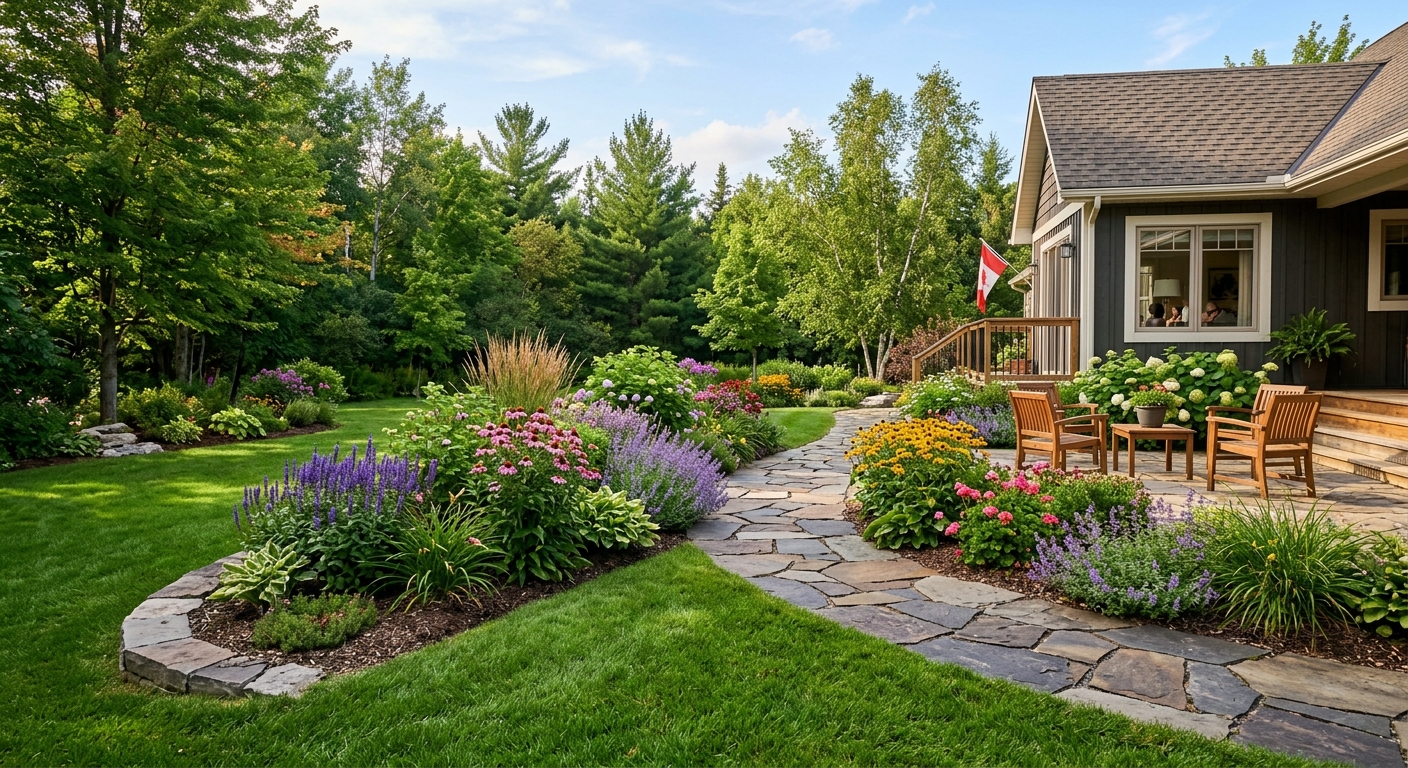
Landscaping options and costs in Forest Heights
Forest Heights, Ontario is a great place to invest in landscaping because the neighbourhood’s housing stock typically includes family-sized lots—many properties have room for both softscape (lawn, gardens) and hardscape (paths, patios, and sometimes retaining). With a population of 15,581 (Statistics Canada, 2021 Census), there’s also steady demand for contractor availability during the spring and fall install windows. In this area, landscaping improvements are a common way to add curb appeal and practical yard function, especially on older properties where drainage grading and soil quality may need a reset.
Toronto-area pricing is shaped by climate and soil: we’re usually in plant hardiness zones 6a–7a, with freeze–thaw cycles that can move patios, crack steps, and destabilize wall bases if they’re not installed on the right granular bedding and depths. Local clay and fill soils often mean more excavation, soil amendment, and sometimes subdrains—so even “similar” jobs can land at very different totals. Labour availability is another factor: the frost-free period largely runs May to October, so install crews book up fast, particularly around neighbourhood pockets like the residential streets near the Eldon/Forest Heights community area where walkways, patios, and regrading are common upgrades.
Below is a practical comparison of common landscaping services you’ll see in Forest Heights, including the typical season and price bands we use to anchor quotes before we refine design details and site conditions.
| Service |
Description |
Season |
Price Range |
| Full landscape design and installation |
Concept + layout, grading/drainage plan, plant + material selection, labour for softscape and hardscape |
Spring to early fall (with fall planting for many perennials) |
$8,000–$40,000 |
| Sod installation (supply, grade, lay, roll) |
Soil prep, base grading, sod supply, laying in sections, rolling, and initial watering guidance |
Late spring to early fall |
$2,500–$8,000 |
| Lawn seeding (grade, seed, starter fertilizer) |
Fine grading, seed + starter fertilizer application, light raking/rolling, maintenance watering schedule |
Spring (cooler weeks) and early fall |
$1,800–$6,000 |
| Interlocking patio or walkway |
Excavation, geotextile, granular base and bedding, paver placement, edging, jointing sand |
Spring to fall (best before late-season frosts) |
$6,000–$20,000 |
| Retaining wall (interlocking block) |
Block system, wall base prep, drainage fabric/gravel, compaction lifts, cap placement |
Spring to early fall |
$6,000–$30,000 |
| Tree and shrub planting |
Plant supply, hole excavation, amendment, placement, mulch ring, staking (as needed), first-season care plan |
Spring and fall (often best for establishment) |
$800–$6,000 |
Prices are estimates only and vary by project scope, site access and material selection.
What affects the price of landscaping in Forest Heights
In Forest Heights and across the broader Toronto market, you can see the same general landscaping scope come in anywhere from 30% to 50% apart. That’s usually not because two contractors “quote differently,” but because site conditions and design choices change what has to be built—and what must be done to keep everything stable through Ontario’s freeze–thaw cycles. In a typical GTA instalment window (May to October), demand for skilled crews also tightens labour pricing, while materials like hardscape base, pavers, and tree stock can fluctuate.
Start with climate and plant hardiness. In zones 6a–7a, we select woody plants and perennials that tolerate winter lows near –23 to –18°C and hot, often humid summers. Frost timing influences the working season and when we can safely pour bases or compact wall footings. Prairie regions (Zone 2–4) face shorter seasons and harsher winter swings, which often pushes designs toward ultra-hardy, drought-tolerant species and simpler palettes; it can also mean more urgency and scheduling complexity. Coastal BC (Zone 7–8) allows lush growth longer, but requires excellent drainage in heavy-rain sites. The dry BC interior and Alberta typically require irrigation/drip design and water-wise planting. Southern Ontario is more moderate, but summer dry spells still require a plan—especially if you’re installing sod or establishing new plant beds.
Concrete examples from Forest Heights: (1) If you have clay fill that holds water near your foundation, grading and drainage work can quickly move a mid-band project toward the higher end of design/installation pricing (e.g., pushing a full install beyond $8,000–$40,000). (2) A 12–18 in (30–45 cm) correction to meet slope requirements for a patio can add excavation and granular base depth, raising interlocking costs (often within $6,000–$20,000). (3) Mature trees or slow-to-establish shrubs—especially if you want faster visual impact—will increase tree/shrub planting totals.
| Price Factor |
Why It Matters |
Cost Impact |
| Yard size in sq ft — the primary cost driver for softscape |
More area increases labour time, soil prep volume, and materials (topsoil, seed/sod, mulch) |
Can swing totals dramatically; softscape is often the biggest line item |
| Grading and drainage work — slope corrections add significant cost |
Fixing low spots prevents pooling, foundation moisture, and washouts during storms |
Excavation + hauling + re-compaction often adds substantial labour |
| Drainage bed or French drain installation |
Subsurface water control protects walls, patios, and root zones |
Increases material (pipe, stone, fabric) and trenching time |
| Plant material tier — native shrubs vs. ornamental vs. mature specimen trees |
Size and sourcing affect establishment and curb impact |
Upgraded stock can raise costs quickly, especially for trees |
| Hardscape vs. softscape ratio — walls and patios cost more per sq ft than lawn |
Pavers/blocks require deeper base prep and careful compaction |
Higher hardscape percentages push projects into higher price bands |
| Irrigation system design and installation |
Proper head placement improves coverage and reduces water waste |
Adds components + trenching; cost rises with zones and controls |
| Soil amendment and topsoil required |
Clay and fill often need improved structure for roots |
More hauling and material increases cost; quality matters |
| Tree removal or stump grinding before new planting |
Access, stump size, and disposal affect workload |
Can add a separate crew day and additional equipment costs |
Permits & regulations in Ontario
In Ontario, most basic landscaping work like planting beds, sodding, seeding, mulching, and general softscape installation typically does not require a permit. The area where permits often enter the picture is when your landscaping becomes structural. Retaining walls above a commonly used local threshold (often around 1.0 m or 3.3 ft, depending on municipal requirements) usually require a building permit and sometimes engineered drawings. If you’re changing lot grading in a way that redirects runoff toward a neighbouring property or toward storm sewer connections, you may also need approval to ensure drainage is handled correctly.
Before any digging—whether for planting holes, footings, or a French drain—call for utility locates to mark buried services. That’s essential in Forest Heights where older utility runs can be hard to predict behind landscaping. If you’re adding irrigation, confirm water-use rules with Ontario/municipal guidance; while water restrictions are more commonly discussed in drought-prone regions, you still want a system design that prevents waste during hot, dry weeks.
To verify a contractor’s Ontario compliance, do three steps: (1) confirm professional licensing/registration where applicable through the relevant Ontario service/registry listings (or the contractor’s posted credentials); (2) ask for a current certificate of insurance showing liability coverage and request the expiry date; (3) request proof of coverage for WSIB (or the correct provincial coverage document where applicable). For retention walls and any permit-triggering work, request the permit documentation details in writing before the crew mobilizes.
Planning a landscape that thrives in Forest Heights's climate
Planning for Forest Heights is about designing with Ontario’s hardiness zone 6a–7a, managing our precipitation swings, and respecting the freeze–thaw cycle that moves water and soil. The goal is to build a yard that looks full early, stays stable through winter, and doesn’t turn into an annual repair project. First, plant selection: choose native and zone-appropriate species that handle –23 to –18°C winter lows with less special protection. Many homeowners get better results by mixing sturdy woody structure (shrubs and small trees) with perennials that tolerate humid summers and can be cut back in late fall.
Second, decide between sod and seed. Sod creates instant coverage, but in practice it costs about 3–4x more per sq ft than seeding once you factor in prep and installation labour. If you need “visual impact now”—for example, a front yard before a sale—sod can be justified. A good example: for a modest lawn area, seeding may fall into the lower end of the lawn costs (often $1,800–$6,000), while sod projects often sit higher (commonly $2,500–$8,000) because you’re paying for turf supply and faster installation.
Third, drainage and grading: Toronto-area clay and freeze–thaw make pooling a frequent cause of plant failure and foundation moisture. Use gentle slopes away from the house and consider a drainage bed or French drain where low areas form. Fourth, hardscape base preparation: patio and retaining wall bases must be built for the local frost line with proper granular compaction and drainage layers. For low maintenance, lean on groundcovers, mulch, and repeatable perennial groupings—reducing annual weeding and keeping beds tidy. Where watering needs are high, consider rain-garden pockets or xeriscape-inspired planting zones using drought-tolerant perennials, but still choose cold-hardy selections for Southern Ontario.
| Element |
Climate Consideration |
Maintenance Level |
Price Band |
| Sod lawn installation |
Best in late spring/early fall; establishment needs reliable watering in hot, humid weeks |
Medium (watering + first-season care) |
$2,500–$8,000 |
| Native perennial garden |
Zone-appropriate plants handle winter lows; humidity-tolerant choices reduce failures |
Low to medium (spring clean-up, occasional division) |
$800–$6,000 |
| Mulched shrub border |
Mulch buffers freeze–thaw on shallow roots and moderates summer soil moisture |
Low (weeding reduced; top-ups a couple times per year) |
$1,200–$7,500 |
| Interlocking stone patio |
Needs deep, compacted base and drainage to resist frost movement and water retention |
Low (periodic joint sand/inspection) |
$6,000–$20,000 |
| Retaining wall (block) |
Freeze–thaw control depends on proper base depth and drainage gravel behind the wall |
Low (monitoring for settlement and weep drainage) |
$6,000–$30,000 |
| Drip irrigation system |
Targets root zones and reduces waste during humid summers and dry spells |
Medium (season start-up checks) |
$1,500–$7,500 |
How to choose a landscaping contractor in Forest Heights
When you hire a landscaping contractor in Forest Heights, verify three things early: licensing/registration (where required), liability insurance, and WSIB/WCB coverage. Ask for (1) a current certificate of liability insurance and confirm it matches your project address; request proof of the policy being active for the job dates. (2) For coverage, request WSIB clearance/coverage information (or the correct provincial coverage documentation where applicable) and check the documents aren’t expired. (3) If you’re doing anything permit-triggering (often retaining walls), confirm how permits will be handled and that the permit process is part of the written scope.
Next, get 2–3 itemised quotes. You want a labour + materials breakdown, not a single lump sum, with line items for excavation, granular base, drainage components, plant quantities/sizes, and disposal. Read the scope carefully: what’s excluded (topsoil hauling, disposal fees, tree removal, irrigation tie-ins)? Is permit pull included where needed? Is any material substitution allowed without your approval?
For warranty, require a workmanship warranty length in writing and clarify whether product/manufacturer warranties apply to plants and hardscape materials. Ask if the warranty is transferable to future owners. Plan your payment schedule too: never pay more than 10–15% upfront; use holds until completion and final cleanup. Finally, insist on a start date and completion estimate in writing—Toronto-area crews can be booked out quickly during peak spring weather.
- Request proof of liability insurance and ensure it’s current for the project timeline.
- Ask for WSIB/WCB clearance documents before work begins.
- Confirm the exact start date and a realistic completion window in writing.
- Get an itemised quote with labour and materials (not a single number).
- Verify disposal/haul-away is included if excavation is required.
- Ask who provides and installs geotextile, base, and bedding layers for hardscape.
- Confirm drainage details: French drain vs. drainage bed, outlets, and slope direction.
- Check whether the contractor includes permit pull for retaining walls and grading approvals.
- Require plant quantities and sizes (e.g., 1.5 m shrubs vs. small liners).
- Ask for a planting warranty and replacement terms for failed stock.
- Make sure the payment schedule stays within 10–15% upfront with holdback to completion.
- Confirm cleanup standards at the end of each stage (sod/seeding especially).
Red flags to watch for: missing or expired insurance/coverage paperwork; quotes that don’t include drainage/grading responsibilities; a payment schedule demanding large upfront deposits; vague scopes that allow substitutions without your approval; and no written warranty terms for workmanship or plant replacement—these issues are common causes of disputes after freeze–thaw damage in Southern Ontario.
Frequently asked questions — landscaping in Forest Heights
Do I need a permit for a retaining wall in Ontario?
In Ontario, a permit is typically required for retaining walls once they exceed a local height threshold—commonly around 1.0 m (3.3 ft), but the exact requirement can vary by municipality. If your Forest Heights plan involves building-block walls, engineered details may be required depending on height and site conditions. If you’re changing lot grading near the wall, approvals may also be triggered because drainage must be directed safely. A key practical step: ask your contractor to confirm whether your wall height and design need a permit before any excavation begins. If it does, you should see the permit responsibilities written into the contract so the work isn’t stopped midstream. Budget-wise, many block wall projects fall around $6,000–$30,000, and permit/engineering can affect the final total.
How do I improve drainage in my yard?
Drainage improvements in Forest Heights usually start with simple observations: where water pools after rain, whether soil stays soggy for more than 24–48 hours, and how surface slopes run toward (or away from) your foundation. In Toronto’s climate, freeze–thaw can worsen weak drainage, so we look beyond the surface—especially with clay and fill soils. Common fixes include regrading the yard away from the house, adding a drainage bed or French drain, and correcting downspout discharge so it doesn’t saturate the same spots repeatedly. A good contractor will explain outlet locations and how they prevent water from being pushed toward neighbours’ properties. If your project also includes softscape, plan to allocate budget for base and soil amendment, which can shift the scope into the higher end of design/installation pricing around $8,000–$40,000.
What is xeriscaping and does it suit Forest Heights?
Xeriscaping is a landscaping approach that reduces water use by using drought-tolerant plants, efficient mulching, smart grouping (hydrozones), and sometimes drip irrigation. In Forest Heights (Southern Ontario), xeriscape principles can absolutely fit, but we don’t copy Prairie or arid-region designs without cold-hardy adjustments. Our hardiness range (zone 6a–7a) means plant selection must tolerate winter lows near –23 to –18°C. The best results often combine: cold-hardy perennials and shrubs, thick mulch layers to moderate moisture through summers and winter, and rain-garden style pockets to capture stormwater. You can also use drip where irrigation is needed to establish new beds after construction. If you’re thinking of reducing lawn size, that can help manage costs and water demand—sod installs typically run $2,500–$8,000, so replacing parts with planting beds can be a practical compromise.
How do I plan a low-maintenance yard?
A low-maintenance yard in Forest Heights is planned in layers: first, build stable drainage and soil conditions; then choose plants that are tough enough for Ontario winters and humid summers; finally, reduce annual weeding with mulch and groundcovers. For lawns, seeding can be lower-cost than sod and still work well when timed correctly—especially in spring or early fall—while sod can be used where you need immediate coverage. For beds, use a mix of native or zone-appropriate shrubs, perennials that don’t spread aggressively, and repeat plant groupings so maintenance is predictable. Mulching and edging are underrated: they keep beds looking sharp and reduce grass encroachment. If you’re investing in hardscape, interlocking patios with properly built bases tend to require less long-term attention. Budget planning matters too—many full landscape projects fall within $8,000–$40,000, but a smaller planting-focused scope around $800–$6,000 can still deliver major visual upgrades.
How deep should a retaining-wall base be for local frost?
For retaining walls in Ontario, the “right depth” isn’t one universal number—it depends on wall height, block system requirements, soil conditions, and drainage design—but the core principle is the same: the wall base and bedding must be built on stable compacted granular material and designed to resist frost movement. In practice, that usually means excavation to meet the manufacturer’s system specs, then building from the bottom up with proper geotextile, base stone, and compaction lifts—plus drainage gravel and a weeping strategy behind the wall. Toronto-area freeze–thaw cycles make it especially important that water doesn’t get trapped behind the wall, because saturation plus freezing can drive settlement. The best approach is to have a contractor show you the planned excavation depth, base materials, and drainage layers in writing before they start. If your wall triggers a permit, this documentation becomes even more important.
How much does professional landscape design cost?
Professional landscape design in Forest Heights can range widely depending on whether you want concept-only ideas or full design with drawings, plant palettes, and construction-ready details. As a practical budgeting anchor, many homeowners who move straight into a full landscape design and installation package find their total project pricing falls within $8,000–$40,000, because design time is tied to grading, drainage decisions, and material selections. For smaller projects—like a focused planting plan—costs may sit closer to the tree/shrub planting range (often $800–$6,000) when scope is limited. To avoid surprises, ask for an itemised quote that separates design work from construction labour and materials. Also confirm whether design includes a site walk, plant lists with sizes, and revisions. That clarity helps you compare bids fairly across the Forest Heights neighbourhood.