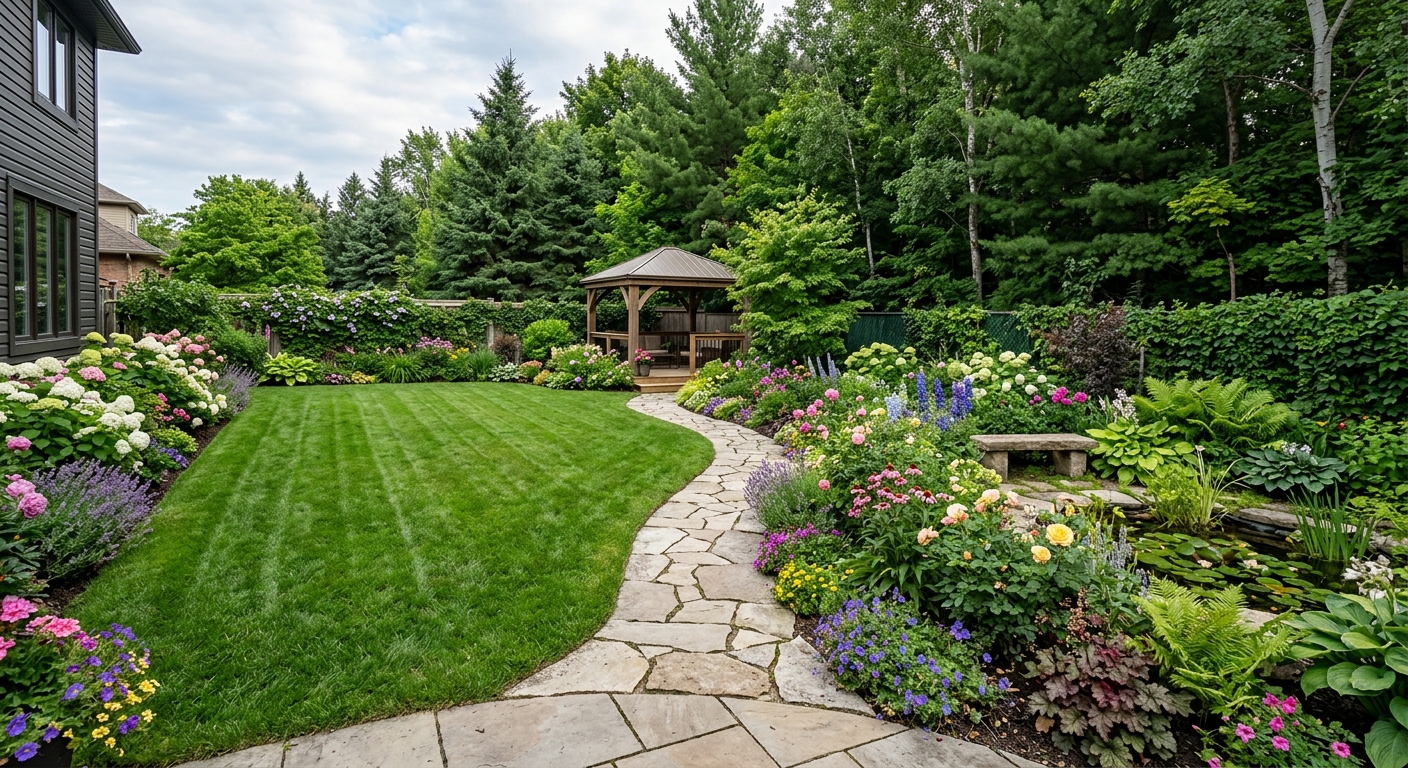
Landscaping options and costs in Innisfil
Innisfil homeowners often start with a simple goal—more curb appeal, better drainage, or an easy lawn—and then quickly discover the project’s budget can swing widely. That’s partly because Innisfil’s housing stock is dominated by single-detached homes (90.5% of dwellings), and with 13,460 homeowner households (85.7% of households own), many residents invest in upgrades that feel “permanent,” like patios, mature trees, and long-lasting planting beds. The local market also matters: in Innisfil and the broader Kitchener–Waterloo–Barrie area, Zone 5b–6a conditions bring defined spring and fall frost windows, which shape when contractors can safely grade, compact bases, and plant. Freeze–thaw cycles are a cost driver—especially for retaining walls, interlocking patios, and walkways that need deep, well-compacted granular bases and proper drainage to prevent frost heave.
Demand is especially strong in newer neighbourhood pockets and established residential areas along the commuter corridor, where properties with older landscaping are being refreshed for both function and resale. In practice, contractors schedule heavier structural work (grading, drainage, bases) in the warmer, drier months—often mid-April through October—then focus on plant installation once the frost risk has passed. Because labour availability and material pricing can fluctuate through the season, two quotes for the same yard layout can still land in different bands.
Below is a practical “starting point” comparison of common options in Innisfil, using the local price ranges contractors typically work within.
| Service |
Description |
Season |
Price Range |
| Full landscape design and installation |
Site assessment, concept + grading plan, plant palette, hardscape/softscape build-out, and project management |
Mid-April to October (full-service builds often staged) |
$8,000–$60,000 |
| Sod installation (supply, grade, lay, roll) |
Minor grading, soil prep, sod delivery + layout, rolling, start-up watering plan |
Late spring to early fall (after frost) |
$5–$10 |
| Lawn seeding (grade, seed, starter fertilizer) |
Topdressing/grade touch-ups, seed + starter fertilizer, light raking and watering plan |
Spring or early fall |
$2–$5 |
| Interlocking patio or walkway |
Excavation, deep base + compaction, geotextile, edging, pavers, setting sand, jointing |
Summer (best compaction window) |
$120–$300 |
| Retaining wall (interlocking block) |
Trenching, drainage gravel, weeping/behind-wall drainage provisions, block placement, backfill compaction |
Late spring to September |
$120–$300 |
| Tree and shrub planting |
Plant layout, soil prep, amendments, planting, mulch, and first-season care guidance |
Spring or fall (when soil is workable) |
$500–$15,000 |
Prices are estimates only and vary by project scope, site access and material selection.
What affects the price of landscaping in Innisfil
In the Kitchener–Waterloo–Barrie region, it’s common to see the same landscaping scope quoted 30–50% apart, even when homeowners describe the project similarly. The spread usually comes from grading complexity, drainage requirements, plant size and availability, and how deeply contractors must build for Ontario freeze–thaw. In sunnier, longer-season climates, crews can complete more in fewer weather windows; in Zone 5b–6a, Innisfil still has a practical planting season bracketed by spring and fall frost, so schedules tighten and “wait time” can add labour costs.
Hardiness zone also changes what you can plant and how you protect it over winter. In prairie regions (Zone 2–4), short growing seasons push homeowners toward drought- and wind-tolerant species, and soil-building work is often more extensive; retaining wall base depth must reach below the frost line to reduce heave. Coastal BC (Zone 7–8) supports lush palettes and longer growth, but construction still depends on drainage performance in heavier rain patterns; irrigation and subgrade preparation can cost more where soils stay wet. By contrast, Southern Ontario (Zone 5–6) like Innisfil offers a moderate growing season; you typically pay more for plants that can handle freeze–thaw and may need winter hardening, but you generally avoid the strict drought constraints seen in some interior BC communities.
Innisfil-specific examples that raise cost include: (1) replacing a failing lawn with sod after significant regrading—earthworks and compacted granular base prep can shift the job toward the $8,000–$60,000 full-service band; (2) installing an interlocking patio where the yard slopes toward a foundation—contractors must correct grades and build drainage layers, which increases the $120–$300 hardscape-per-project portion. Homes built before 1981 (34.6% of stock) often have older grading patterns, mature trees, or drainage that no longer matches today’s downspout and surface-water volumes, which can add excavation and soil amendment costs.
| Price Factor |
Why It Matters |
Cost Impact |
| Yard size in sq ft — the primary cost driver for softscape |
Larger areas need more labour, base prep, seed/sod, topsoil, and materials |
Softscape can scale quickly; lawn work may stay in the lower bands, while full builds grow into mid-range and above |
| Grading and drainage work — slope corrections add significant cost |
Proper slopes prevent pooling and protect foundations during freeze–thaw |
Can add major labour/equipment time, often the difference between a basic refresh and a full-service install |
| Drainage bed or French drain installation |
Intercepts groundwater and redirects water away from the house |
Material + trenching depth increase costs; more required footage usually means more cost |
| Plant material tier — native shrubs vs. ornamental vs. mature specimen trees |
Size, sourcing, and transplanting difficulty drive price |
From mid-range planting budgets into higher tiers when mature trees are included |
| Hardscape vs. softscape ratio — walls and patios cost more per sq ft than lawn |
Hardscape requires deep base construction and careful installation |
Shifts the project toward the $120–$300 style hardscape budget component, especially for patios/walkways |
| Irrigation system design and installation |
Zoned systems, heads, controllers, and rain sensors improve efficiency |
Adds design and electrical/plumbing elements; can move a lawn project into a more complete package |
| Soil amendment and topsoil required |
Replaces poor soils and supports rooting depth for lawns and perennials |
Can be modest for small touch-ups or substantial if rebuilding entire beds |
| Tree removal or stump grinding before new planting |
Roots and stumps affect excavation and future planting performance |
Often increases project duration and equipment costs, especially in established yards |
Permits & regulations in Ontario
In Ontario, most routine planting and softscape work—like sodding, seeding, mulching, and installing typical garden beds—generally does not require a permit. Homeowners commonly can hire a landscaping contractor to do soil prep and plant installation without pulling a permit. However, retaining walls can trigger approvals depending on height and how they’re built. In many municipalities, retaining walls above about 1.0 m (3.3 ft) typically require a building permit, and some projects may also need engineered drawings. Changes to lot grading that meaningfully alter drainage direction—especially toward neighbouring properties or storm sewer connections—can also require approval.
Before any digging (planting holes, trenching for drainage, or wall footings), ensure utility locates are completed. In practical terms, that means contractors should verify utility mark-outs and protect services so excavation doesn’t damage underground lines.
For verifying your contractor in Innisfil, Ontario, ask for three items and check them before signing: (1) Ontario licence/registration where applicable—confirm the contractor’s legal business information and trade credentials via the appropriate online listings; (2) Certificate of Insurance showing current liability coverage (often including the homeowner named as additional insured if offered); and (3) WSIB/WCB clearance letter (or equivalent proof of coverage/standing). Then match those documents to your quote’s contractor name—don’t rely on email signatures.
Planning a landscape that thrives in Innisfil's climate
To plan a yard that thrives in Innisfil, design around Zone 5b–6a realities: freeze–thaw, intermittent summer dry spells, and a frost calendar that limits safe construction and planting. Start with plant selection. Choose hardy, zone-appropriate species (and where possible, native plants) so they’re less dependent on heavy watering and survive winter temperature swings with minimal protection. In many Innisfil yards, a native perennial garden can look excellent with mulch and deep watering in establishment years, then settle into lower maintenance.
Next, decide between sod and seeding. Sod provides instant green cover and erosion control, but it’s typically about 3–4 times the cost per square foot compared with seeding when you include prep and labour. For example, if seeding is the most budget-friendly option at roughly $2–$5 per sq ft in typical pricing, sod at $5–$10 per sq ft can be justified when you need immediate use, want faster curb appeal, or are stabilizing disturbed soil before weeds take over.
Drainage and grading are make-or-break in the Kitchener–Waterloo–Barrie market. Build slopes so water moves away from foundations, and consider drainage beds or French drains where pooling shows up after rain. For patios, walkways, and retaining walls, base preparation must be deep, well-compacted, and built for frost. Good drainage layers behind and under hardscape reduce frost heave and long-term settling.
Finally, use low-maintenance strategies: groundcovers to suppress weeds, mulched shrub borders to maintain soil moisture, and perennials that return reliably. Xeriscaping and rain gardens can be a smart fit too—aim them for water where you can capture it, and pair them with drought-tolerant plantings to reduce annual watering effort without sacrificing curb appeal.
| Element |
Climate Consideration |
Maintenance Level |
Price Band |
| Sod lawn installation |
Root establishment matters around frost windows; needs good soil prep and watering plan |
Medium during first season, then lower once established |
$5–$10 |
| Native perennial garden |
Hardy plants handle freeze–thaw better; mulch helps stabilize soil through temperature swings |
Low to medium (weeding first year, then edging and occasional pruning) |
$2,000–$8,000 |
| Mulched shrub border |
Winter resilience improves with zone-appropriate shrubs; consistent mulch reduces freeze stress |
Low (spring cleanup, occasional shaping) |
$1,500–$6,500 |
| Interlocking stone patio |
Deep compacted base and drainage prevent frost heave and settling |
Low (seasonal brushing and joint care) |
$120–$300 |
| Retaining wall (block) |
Proper drainage gravel and backfill compaction reduce freeze–thaw movement |
Low (visual inspections after spring thaws) |
$120–$300 |
| Drip irrigation system |
Zoned irrigation supports summer dry spells without wasting water |
Medium to low (seasonal checks, winterization if applicable) |
$1,500–$6,000 |
How to choose a landscaping contractor in Innisfil
Choosing the right contractor in Innisfil is less about flashy photos and more about proof. Start with licensing and insurance: in Ontario, ask for (1) Ontario licence/registration credentials relevant to the work they’re doing, (2) liability insurance with an active policy date and coverage limits, and (3) WSIB/WCB clearance (or equivalent standing proof). How to check: request the documents up front, verify the contractor name matches the quote and invoice, and confirm the clearance letter is current rather than expired.
Next, require 2–3 itemised written quotes. Good quotes separate labour and materials, and they specify quantities (topsoil volume, excavation depth, paver area, number of plants by size). Avoid “one-line” lump sums that don’t show what’s included. Read the scope carefully: is disposal of excess soil included? Is erosion control included during grading? Is the permit pull included where required (for example, certain retaining wall projects)?
Warranty matters. Ask for the workmanship warranty length and whether product warranties transfer if you sell the home. For payment schedules, don’t pay more than 10–15% upfront; hold back a portion until key milestones are complete (subgrade approval, drainage inspection-ready work, and final clean-up). Finally, insist on a written timeline with a start date and estimated completion window—weather can affect planting, but it shouldn’t be vague.
- Provide a current Certificate of Insurance (liability) before work begins.
- Provide WSIB/WCB clearance letter that matches the quoted business name.
- Use an itemised quote: materials listed with quantities, not only totals.
- Confirm disposal included for sod/seed waste and excess soil.
- Spell out what’s excluded (tree removal? stump grinding? topsoil depth?).
- Confirm whether permits are required and who is responsible for pulling them.
- Ask for a workmanship warranty in writing and what it covers.
- Clarify if plant warranties are included (and survival terms, if offered).
- Review the base spec for patios/walkways (geotextile, base depth, compaction) to reduce frost issues.
- Confirm payment schedule: maximum 10–15% upfront, with holdback until completion.
- Get a written start date and completion estimate, plus how weather delays are handled.
- Ask who will be onsite and who your contact person is during construction.
Red flags to watch for in Innisfil: they won’t provide insurance/WSIB proof; the quote is not itemised (no quantities or disposal terms); they guarantee “no frost movement” without describing base/drainage build-up; they push for large upfront payments; or they skip utility locates and excavation safety planning.
Frequently asked questions — landscaping in Innisfil
Do I need a permit for a retaining wall in Ontario?
In Ontario, many landscaping tasks like planting and sodding typically do not require permits, but retaining walls can. In many Ontario municipalities, a retaining wall above roughly 1.0 m (3.3 ft) often requires a building permit, and some projects may need engineered drawings depending on the design and site conditions. Innisfil homeowners should also think about how the wall affects drainage and grading—if your plan changes how water moves toward neighbours or storm services, approval may be triggered. The best approach is to ask your contractor to confirm whether your specific wall height and plan require a permit, then include that responsibility in the contract. Getting the permit right can prevent expensive rebuilds after inspections.
How do I improve drainage in my yard?
Drainage fixes in Innisfil usually start with observation: where water pools after heavy rain, whether downspouts dump too close to the foundation, and how your yard slopes. Professional improvements often include regrading and adding a compacted drainage layer, plus a drainage bed or French drain to intercept water and move it safely away. Because freeze–thaw can amplify problems, drainage must be built to perform in winter, not just summer. If you’re considering a hardscape refresh, it’s smart to coordinate drainage at the same time—patios and walkways can trap water if the base and slopes aren’t correct. As a budget reference, drainage-heavy landscaping often sits in mid-range project bands like $8,000–$60,000 once you include grading and installation.
What is xeriscaping and does it suit Innisfil?
Xeriscaping is landscaping designed to reduce irrigation demand by using drought-tolerant plants, efficient soil preparation, mulch, and smart layout. It fits Innisfil well because the area has a defined frost window and can still see summer dry spells—especially when turf is stressed. That said, xeriscaping isn’t “no watering ever.” During establishment (first season for new plants), you still need reliable watering so roots grow deep enough to handle Ontario’s freeze–thaw. A practical approach is to combine native shrubs and perennials with mulch and groundcovers, then reserve irrigation (if you install it) for plants that need it most. For homeowners comparing options, sod is often the highest-cost way to “green up,” commonly priced around $5–$10 per sq ft, while xeriscape-style beds can deliver curb appeal with less ongoing water.
How do I plan a low-maintenance yard?
A low-maintenance yard in Innisfil comes from designing for repeatable growth: select zone-appropriate plants that survive Zone 5b–6a winters, then support them with good soil and mulch. Prioritize structure first—mulched shrub borders and hardy perennials—then add groundcovers to reduce weeds. Keep mowing simple by reducing lawn edges and choosing a lawn size that matches how you’ll actually use the yard. Drainage and grading also reduce maintenance because pooling and winter stress create plant failure and extra rework. Hardscape can lower upkeep too, but base prep must be built for frost to avoid settlement. If you’re building a complete plan, full-service design and installation commonly ranges like $8,000–$60,000, but you can also do targeted projects (like shrub borders and planting) using the lower ends of planting budgets while still achieving a clean look.
How deep should a retaining-wall base be for local frost?
For frost performance in Innisfil, the key is building the retaining wall base to a depth that supports stability below the frost-affected zone, using a properly engineered spec for your wall design. Contractors typically build deep, well-compacted granular bases and incorporate drainage gravel behind the wall to prevent water pressure and freeze-related movement. The exact depth depends on wall height, soil type, and block system details—so it’s not one universal number you can safely copy from a neighbour. If your wall is near or above the permit threshold, engineering guidance is especially important. When budgeting, remember that retaining walls are not just materials; they include excavation, compaction, and drainage layers—often landing in the $120–$300 style price component depending on scope and wall length.
How much does professional landscape design cost?
Professional landscape design cost in the Kitchener–Waterloo–Barrie region varies based on whether you want concept-only ideas or a full plan with drawings and a plant palette ready for installation. For many Innisfil homeowners, design is folded into a full-service build, so the overall project falls into broader bands commonly quoted as $8,000–$60,000 for design plus installation depending on how extensive the work is (grading, drainage, hardscape, and plant maturity). If you’re only looking for a layout and planting plan, you’ll often pay less than a full build, but you should expect a meaningful scope because it includes site measurements and a plan that respects Zone 5b–6a frost timing. The best way to estimate your specific design fee is to ask for an itemised quote with what the design deliverables include (plant list, quantities, and implementation notes).