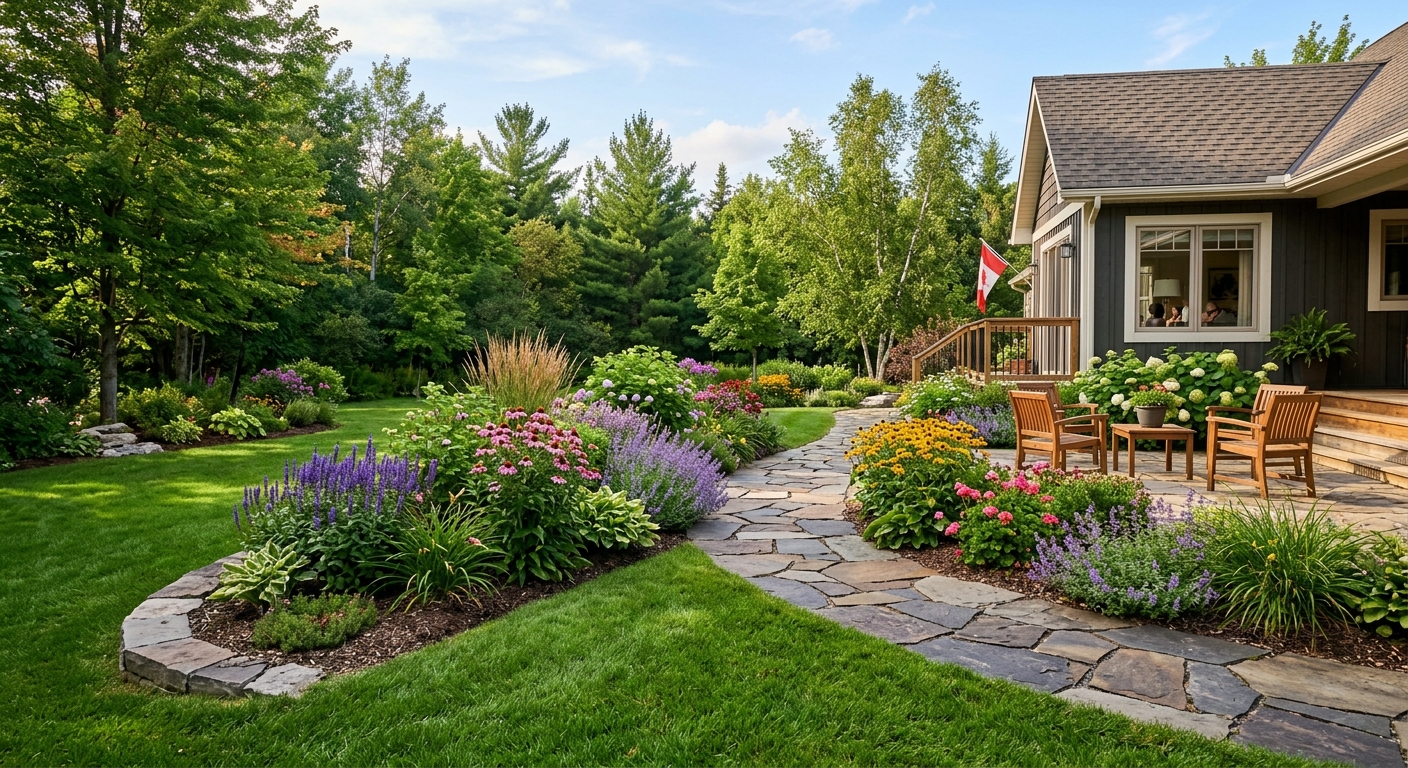
Landscaping options and costs in Norfolk County
In Norfolk County, homeowners typically have more yard space to work with than you’d see in denser cities, and that matters for both curb appeal and long-term property value. With 82.7% of dwellings being single-detached homes and 81.6% of households owning (Statistics Canada, 2021 Census), many families invest in upgrades like patios, mature shade trees, and well-built drainage—especially as lots mature from “starter gardens” into more established landscapes. In a Hamilton–Niagara Peninsula market, pricing is also shaped by the local working season and site conditions. Our plant hardiness zone (about 6b–7a) supports a broader plant palette than prairie regions, but winter wind, freeze–thaw, and heavy spring saturation still drive the need for proper base depth, drainage, and soil prep. Labour and excavation costs are influenced by mixed glacial soils, so two similar yards can come in very different once we account for removal, hauling, and aggregate quality. Demand tends to be especially strong around Simcoe and the nearby farming-settlement communities where older housing stock is common and front-yard curb appeal is a priority.
To help you compare apples-to-apples, here are the most common Norfolk County landscaping services and what budgets usually look like when contractors price them.
| Service |
Description |
Season |
Price Range |
| Full landscape design and installation |
Site walk, concept + grading/drainage plan, material selection, hardscape + softscape installation |
Spring to fall (typ. late April/early May to mid-October) |
$5,000–$50,000 |
| Sod installation (supply, grade, lay, roll) |
Minor grading, base/soil improvement as needed, sod supply, lay, roll, and starter watering plan |
Late spring to early fall |
$2,500–$6,500 |
| Lawn seeding (grade, seed, starter fertilizer) |
Light grading, seed selection, starter fertilizer, topdressing/loam where required |
Late spring or early fall |
$1,000–$3,500 |
| Interlocking patio or walkway |
Excavation, compacted base (typically granular levels), sand setting bed, border/finishing |
Spring to fall (weather-dependent) |
$6,500–$25,000 |
| Retaining wall (interlocking block) |
Block wall build with proper granular backfill and weeping/drainage details |
Spring to fall |
$8,000–$30,000 |
| Tree and shrub planting |
Soil amendments, planting, staking/tying where needed, mulch ring, first-season care guidance |
Spring to early fall (with watering attention) |
$600–$5,000 |
Prices are estimates only and vary by project scope, site access and material selection.
What affects the price of landscaping in Norfolk County
In Norfolk County (and across the Hamilton–Niagara Peninsula), it’s common to see quotes for the same “yard refresh” vary by 30–50%. The reason usually isn’t the contractor’s brand—it’s the hidden site variables: excavation quantity, drainage complexity, the quality of base aggregates, and how the scope handles frost-driven movement. In our plant hardiness range (about 6b–7a), the frost-free window is roughly late April/early May to mid-October, so installs depend on weather and how quickly ground dries for equipment access. For context, prairie regions (Zone 2–4) require more drought- and wind-tolerant selections and often need specialized approaches for short seasons, while coastal BC (Zone 7–8) can grow fast but still demands excellent drainage in heavy-rain areas. In Southern Ontario, we’re not usually under strict water rationing, but summer dry spells can raise irrigation needs—so “same layout, different plant survival plan” changes labour and materials.
Two concrete examples from Norfolk County jobs I see often: (1) A lawn conversion can look simple, but if your grade is flat and there’s spring pooling, grading + topsoil amendment can add significant cost—even if you only intended sod. (2) Interlocking patios and retaining walls must be built with base prep that accounts for freeze–thaw, which is why walls and patios can cost toward the upper end of the $40–$150 per square-foot style banding for wall/hardscape complexity. Housing age also matters: with 62.0% of homes built before 1981 (Statistics Canada, 2021 Census), older lots commonly have mature trees, older drainage patterns, and sometimes more buried surprises, so excavation and disposal can push projects from a mid-band lawn or planting job into full hardscape budgets. In planning terms, you’ll often move between the design/install band of about $5,000–$50,000 and the hardscape-focused budget that’s driven by retaining wall and patio scope.
| Price Factor |
Why It Matters |
Cost Impact |
| Yard size in sq ft — the primary cost driver for softscape |
More area means more excavation, materials, and installation time |
Can shift total price by several thousands, depending on scope |
| Grading and drainage work — slope corrections add significant cost |
Proper runoff reduces foundation risk and prevents lawn failure |
Commonly increases costs materially for “simple” refreshes |
| Drainage bed or French drain installation |
Addresses saturated soils and prevents freeze–thaw heave |
Often adds a noticeable mid-project cost increase |
| Plant material tier — native shrubs vs. ornamental vs. mature specimen trees |
Size at planting and availability affect labour, hauling, and aftercare |
Can move pricing from a few hundred to several thousand |
| Hardscape vs. softscape ratio — walls and patios cost more per sq ft than lawn |
Hardscape needs thicker base layers, compaction, and finer finishing |
Shifts budget toward the higher end of typical bands |
| Irrigation system design and installation |
Watering coverage improves establishment during summer dry spells |
Can add cost, but often reduces long-term plant losses |
| Soil amendment and topsoil required |
Clay-heavy or uneven soils may need import and conditioning |
Increases delivery/handling costs if material volumes are high |
| Tree removal or stump grinding before new planting |
Access, root mass, and disposal affect labour time and risk |
Can add substantial cost depending on the number and size |
Permits & regulations in Ontario
In Ontario, most landscaping work does not require a permit. Planting, sodding, and typical softscape installations (such as installing mulch beds, planting shrubs, and laying sod) generally fall under homeowner/private work and usually don’t trigger permits. Interlocking stone patios and walkways also typically do not need a permit in the way structural projects do, provided you’re not making major changes to drainage that affect neighbouring properties. Where permits often come into play is with retaining walls above a local height threshold (commonly around 1.0 m in many Ontario municipalities), especially if the wall has a structural role, requires engineered design, or impacts site stability. Changes to lot grading that affect how water drains—particularly if it changes drainage toward neighbouring properties or toward storm sewer connections—can also trigger approval requirements.
Before digging in Norfolk County, call for utility locates and keep your contractor’s locate ticket documentation on file. Utility marks are critical for planting holes and wall footings. For homeowner verification, start with three checks: (1) Ontario business licensing/contractor credentials where applicable (ask the contractor for their proof and check the relevant online registry if they’re required to be registered), (2) liability insurance—request a Certificate of Insurance naming you as additionally insured when appropriate, and (3) WSIB/WCB coverage—ask for clearance letters or proof of coverage and verify it’s active for the job start date. If a contractor can’t provide documents quickly, that’s a legitimate red flag before you sign anything.
Planning a landscape that thrives in Norfolk County's climate
Planning for Norfolk County is about working with our zone reality (about 6b–7a) and the seasonal rhythm of the Hamilton–Niagara Peninsula—late spring through mid-fall—rather than trying to force “instant” results that can fail after a winter freeze–thaw cycle. Start with plant selection: favour native and zone-appropriate species that tolerate our winter winds and spring saturation periods with minimal winter protection. For turf, compare sod versus seed: sod gives instant visual payoff, but it’s typically more expensive per square foot than seeding and depends heavily on how well the base is graded and how quickly you can water during establishment. In most Ontario yards, sod can cost roughly 3–4x per square foot versus seeding (especially when you factor in prep), but it’s often worth it where you need quick results—like a front yard before guests or a seasonal listing.
Next is drainage and grading. Pooling water is a common Norfolk County problem on older lots, and it affects everything: plant health, foundation moisture risk, and even hardscape longevity. For patios and retaining walls, base preparation must be built to manage frost movement—proper granular layers, compaction, and drainage backfill details are what keep interlocking stone from shifting. To reduce annual upkeep, use mulch, groundcovers, and perennial structure so you’re not constantly weeding. In dry spells, irrigation (drip for beds) can be targeted rather than wasteful, and a small rain garden or swale-style planting area can handle runoff in a controlled way—using plants that tolerate both wet and then drier conditions.
Example: if sod alone is pulling you toward the higher end of the lawn budgets, you may justify it when you’re rebuilding a small patch where bare soil would otherwise erode. For larger areas, seeding plus proper grading often represents better value and still looks full within a season or two.
| Element |
Climate Consideration |
Maintenance Level |
Price Band |
| Sod lawn installation |
Needs fast establishment in late spring/early fall; grade must shed water before freeze–thaw |
Medium-high during first growing season, then low |
$2,500–$6,500 |
| Native perennial garden |
Zone-appropriate plants handle winter cold and summer dry spells with less winter protection |
Low after establishment (weed suppression + periodic mulch top-ups) |
$1,500–$4,500 |
| Mulched shrub border |
Mulch moderates soil temperature swings and reduces moisture loss; helps reduce frost stress |
Low to medium (pruning and occasional replenishing) |
$900–$3,000 |
| Interlocking stone patio |
Base layers and drainage control prevent heaving and surface water pooling |
Low (seasonal cleaning and spot repairs) |
$6,500–$25,000 |
| Retaining wall (block) |
Backfill + weeping/drainage details manage freeze–thaw forces and soil pressure |
Low (inspections and keeping weep holes clear) |
$8,000–$30,000 |
| Drip irrigation system |
Targets watering during summer dry periods without oversaturating beds in spring |
Medium (seasonal adjustments + winter shutoff process) |
$1,200–$5,000 |
How to choose a landscaping contractor in Norfolk County
Choosing the right landscaping contractor in Norfolk County starts with verifying coverage and credentials before you talk price. First, ask for proof of Ontario business licensing/registration where applicable and confirm it matches the company you’re dealing with. Second, request liability insurance documentation (a current Certificate of Insurance) and ensure coverage is active for the project dates. Third, confirm WSIB/WCB coverage: ask for a clearance letter or proof of active coverage, and make sure it covers the specific work being performed. A reputable crew will provide documents without pressure and can explain what’s included in the quote.
When you request bids, get 2–3 itemised written quotes—ideally broken into labour and materials line items (excavation, base aggregates, stone/pavers, geotextile, plant material, soil amendments, and drainage components). Avoid a vague lump-sum that doesn’t specify scope. Read exclusions carefully: is debris/disposal included? Is permit pulling included if a retaining wall threshold is met? Who supplies bedding sand, base stone, and compaction equipment? Also confirm warranty terms: ask for the workmanship warranty length, whether product warranties apply to the installer’s workmanship or only to materials, and if warranties are transferable to future owners. Payment schedule matters too: never pay more than 10–15% upfront, and insist on a holdback until completion and cleanup. Finally, timelines should be in writing: start date, number of workdays, and a completion estimate based on weather and material lead times.
- Ask for insurance certificates before signing.
- Confirm WSIB/WCB clearance letter is current.
- Require a written scope with measurements (sq ft/linear ft) and grade/drainage notes.
- Use itemised pricing (materials vs labour).
- Clarify who does utility locates and who marks the site.
- Confirm disposal/hauling is included.
- Check base construction specs (geotextile, compacted layers, bedding sand).
- Verify drainage details for walls and patios (weep/drainage backfill).
- Ask for plant lists with quantities and sizes at install.
- Get warranty details in writing (workmanship + product).
- Limit deposits to 10–15% and hold funds for completion.
- Request a written schedule and weather contingency plan.
Red flags in Norfolk County include: (1) no proof of insurance or WSIB/WCB, (2) a quote that doesn’t specify drainage/base layers for patios and retaining walls, (3) vague plant substitutions (“we’ll use what’s available”) without agreed standards, (4) high upfront deposits beyond 15%, and (5) no written start date or completion estimate tied to weather windows.
Frequently asked questions — landscaping in Norfolk County
How do I plan a low-maintenance yard?
A low-maintenance yard in Norfolk County usually starts with reducing “annual tasks” like weeding, re-seeding, and redoing drainage. Begin by choosing zone-appropriate plants for our 6b–7a conditions, then group them by water needs so you can use targeted irrigation or none at all once established. Mulch-heavy borders, groundcovers, and properly spaced shrubs cut down weed pressure. For turf, consider seeding where you have time to let it thicken gradually, or sod only where you need fast results. Budget-wise, professional installation commonly lands in the broader landscaping band of about $5,000–$50,000 depending on scope, while simpler planting and refresh jobs can be far less if drainage and grading are minimal. If your lot has spring pooling, address grading or add a French drain before planting—otherwise maintenance becomes constant.
How deep should a retaining-wall base be for local frost?
For Norfolk County, the key isn’t a single “magic number” but building the base system so it’s below frost-affected movement and supported with properly compacted granular layers. In practice, we design retaining walls with excavation deep enough to achieve a stable base and then add the correct granular backfill and drainage features to manage freeze–thaw pressure. Because exact depth depends on wall height, soil type, and whether drainage weeping is used, your contractor should provide a wall section detail in the written plan. This is one reason quotes vary: a wall built with more excavation and drainage detailing will usually cost more, but it reduces the risk of settling and bulging over time. If you’re budgeting, retaining wall projects commonly fall within the $40–$150 per-unit-style cost bands described for hardscaping complexity, and a well-engineered base typically keeps you out of repair costs later.
How much does professional landscape design cost?
Professional landscape design pricing depends on how much engineering-like detail you need (grading and drainage plans) and whether you’re doing full build-out or concept-only ideas. In the Norfolk County market, design and installation together often sit within the larger band of $5,000–$50,000, especially when the scope includes hardscape, planting plans, and site preparation. If you’re already doing some work yourself, some contractors will separate design-only from installation, but you still need accurate measurements and drainage considerations. A helpful approach is to ask for an itemised quote that spells out what the design includes: site walk, concept plan, planting list, and—if needed—grading notes. With older Norfolk lots (many built before 1981), grading/drainage surprises are common, so design costs can rise once we confirm soil conditions and drainage patterns.
How do I compare landscaping quotes?
Compare quotes the way you’d compare building quotes: line-by-line, not by the final number. Ask for itemised labour and materials, including excavation quantities (or at least a clear depth/area description), base aggregate specs, geotextile usage, and drainage details for patios and retaining walls. For lawns, make sure the quote specifies whether it’s sod (supply, grade, lay, roll) or seeding (seed mix, grade, starter fertilizer, and topdressing if included). For example, sod installation budgets often land in the range of $2,500–$6,500 depending on area and prep, while seeding is commonly lower. Also confirm exclusions: permit pulling (if required), disposal/hauling, and whether irrigation is included. A quote that’s cheaper but omits drainage base prep or disposal is usually cheaper for a reason—and the savings can turn into future repairs.
How long does a landscaping project take in Norfolk County?
Project timelines in Norfolk County depend on weather, the scope, and material lead times, because our effective working season runs from about late April/early May to mid-October. Smaller jobs like shrub planting or mulch refreshes can take a day or two, while sod and seeding projects often require scheduling around soil moisture and temperature. Interlocking patios and retaining walls take longer because excavation, base compaction, and drainage/granular backfill must be built in sequence—often multiple visits. Full landscape design and installation can take weeks to a few months, largely due to coordination and curing/establishment periods. When you request an estimate, ask for a written start date and completion target and make sure the contract includes weather contingencies. A contractor who can’t provide a realistic schedule for Norfolk’s seasonal window is a risk, especially for work that depends on proper base prep and drying time.
What is the best grass type for a Norfolk County lawn?
For Norfolk County lawns, the “best” grass depends on whether you want a premium look (more intensive care) or a tough, dependable turf. In southern Ontario conditions, many homeowners use cool-season turf types that handle our winters and spring/fall growth. Seed mixtures often combine fine fescues and/or perennial rye depending on sun exposure and foot traffic. If you’re choosing between sod and seeding, sod can establish faster but still needs good grading and drainage so you don’t trap water during spring melt. A reliable approach is to match the mix to your yard: more shade needs shade-tolerant blends, and high-traffic areas benefit from resilient components. Pricing varies accordingly—if you go professional, sod installations commonly fall into the $2,500–$6,500 band for typical Norfolk refresh sizes, while seeding is often less for larger areas. Your contractor should recommend a seed type based on site conditions, not a one-size-fits-all blend.