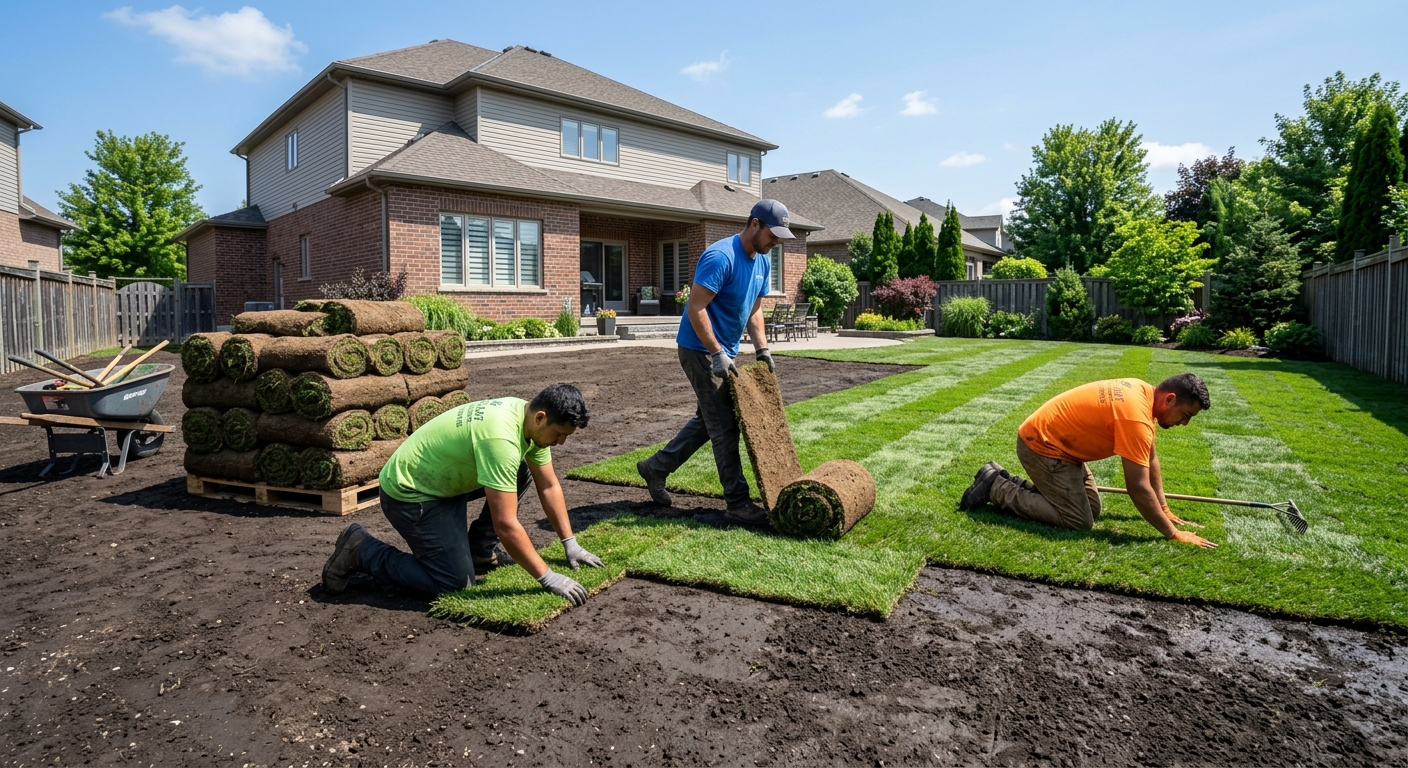
Landscaping options and costs in Quinte West
Quinte West is a great place to invest in curb appeal: with a built-in housing mix of mostly single-detached homes (76.1% of dwellings) and a homeowner base that’s ready to improve their property (14,220 homeowner households, representing 74.6% ownership), you’ll see a steady demand for everything from clean lawn edges to multi-year garden upgrades. That matters because contractors price work partly on how consistently they can schedule crews and material deliveries across the season.
In Kingston–Pembroke’s plant hardiness zones 5a–5b (with pockets of 4b), our frost-free window is roughly May–October, so most projects—especially excavation, sod, and planting—must be planned around freeze-thaw cycling and the need for stable ground. Retaining walls and patios also require deeper granular bases here than in milder climates to reduce heaving and settling. On the plus side, local yards in the Kingston corridor keep mulch, topsoil, and aggregates more affordable than larger, more competitive hubs.
Labour availability can swing from early spring to mid-summer when backlogs overlap with lawn installs. In neighbourhoods like Trenton and the East Northumberland corridor, we often get extra calls for driveway edging, interlocking walkways, and foundation-friendly drainage—work that gets prioritized when older homes (61.5% built before 1981) get refreshed with new grading and plantings.
Below is a practical comparison of common services so you can benchmark what to expect before you request an itemised quote.
| Service |
Description |
Season |
Price Range |
| Full landscape design and installation |
Site visit, concept-to-final plan, grading/drainage recommendations, soil prep, planting beds, lawn establishment, and hardscape where selected |
May–October (often phased across 1–2 seasons) |
$4,000–$30,000 |
| Sod installation (supply, grade, lay, roll) |
Light grading, soil conditioning, sod delivery/laying, rolling, and initial watering plan |
Mid-April–June and early September (weather dependent) |
$2,500–$8,000 |
| Lawn seeding (grade, seed, starter fertilizer) |
Fine grading, seed mix, starter fertiliser, light raking, and establishment care |
April–June and early fall |
$1,500–$5,500 |
| Interlocking patio or walkway |
Excavation, base (granular layers), leveling sand, pavers, edge restraints, compaction, and joint sand |
May–October |
$5,000–$35,000 |
| Retaining wall (interlocking block) |
Wall layout, excavation, compacted granular base, geotextile/backfill, block installation, and drainage layer |
May–October (freeze-thaw limits) |
$6,000–$28,000 |
| Tree and shrub planting |
Soil amendment, planting, staking (if needed), mulch ring, and watering-in guidance |
May–October (root establishment is key) |
$1,000–$8,000 |
Prices are estimates only and vary by project scope, site access and material selection.
What affects the price of landscaping in Quinte West
In Quinte West, two homeowners can receive quotes that differ by 30–50% for what looks like the same job because landscaping pricing is driven by yard complexity—not just the “finished look.” Crew time, excavation depth, how much soil correction is needed, and the quality tier of plants and hardscape materials can shift costs quickly across Ontario. For example, the same 40 m of edging can range widely depending on whether drainage is being improved, whether the base is over clay, and whether the design includes curves, steps, or removal of existing surfaces.
Climate and season shape labour hours and materials timing in Kingston–Pembroke. With zones 5a–5b and freeze-thaw cycling, we can’t treat grading lightly: retaining walls and patios need deep, well-compacted granular bases to limit heaving. The frost-free growing season (roughly May–October) also means a tighter window for planting and sod establishment compared with coastal regions, which can lead to higher demand in late spring. Unlike dry Prairie conditions, we typically have enough rainfall to support plant establishment, but summer dry spells still require efficient irrigation planning—drip in beds and well-matched sprinkler heads on lawns.
Here are concrete cost drivers we see often in Quinte West. First, older homes (61.5% built before 1981) frequently have settled grades near foundations, so we may add drainage beds or re-grade before planting—pushing a simple refresh up toward the $4,000–$30,000 full-scope band. Second, clay/loam sites can require more topsoil and soil amendment; the same planting plan might be modest at the $1,000–$8,000 planting tier if the existing soil is workable, but much more if we need structural fill and proper drainage. Third, slopes and downspout tie-ins can turn a walkway into a drainage-and-base project, not just a surface one.
| Price Factor |
Why It Matters |
Cost Impact |
| Yard size in sq ft — the primary cost driver for softscape |
More area means more soil, more seed/sod, more mulch, and longer labour hours |
Can change total costs by 20–60% depending on scope |
| Grading and drainage work — slope corrections add significant cost |
Freeze-thaw and clay soils punish poor drainage; correcting grades takes excavation and disposal |
Often increases project cost by 10–40% |
| Drainage bed or French drain installation |
Captures roof/water runoff and redirects moisture away from foundations and slopes |
Typical additions can range from modest to major (commonly several thousand dollars) |
| Plant material tier — native shrubs vs. ornamental vs. mature specimen trees |
Mature stock costs more to source and may require larger holes, staking, and careful handling |
Can swing costs by 15–50% on planting portions |
| Hardscape vs. softscape ratio — walls and patios cost more per sq ft than lawn |
Pavers and retaining walls require excavation, base layers, and compaction |
Shifts the project more toward the higher hardscaping bands |
| Irrigation system design and installation |
Drip lines and smart controllers improve establishment but add material and wiring/time |
Can add several hundred to a few thousand dollars depending on complexity |
| Soil amendment and topsoil required |
Clay/loam often needs improved structure to prevent pooling and support roots |
Frequently adds a noticeable line item, especially for new turf or raised beds |
| Tree removal or stump grinding before new planting |
Access, stump size, and disposal affect both labour and equipment time |
May add thousands depending on the site and number of trees |
Permits & regulations in Ontario
In Ontario, most landscaping work you’ll see in Quinte West doesn’t require a permit. Typically, planting, sodding, seeding, and most softscape projects (mulch, shrub borders, perennials, garden beds, and normal grade adjustments that don’t change drainage to a neighbour or service connection) are considered routine and can usually be done without a building permit.
Where permits can come into play is usually for retaining walls above the local threshold—commonly around 1.0 m (3.3 ft)—because higher walls may require a building permit and sometimes engineering details. Also, changes to lot grading that redirect drainage toward neighbouring properties or toward storm sewer connections may trigger municipal review.
Before any digging, arrange utility locates (Ontario One Call) so nobody hits buried services when contractors are setting up irrigation lines, planting holes, or wall footings.
To verify your contractor, follow a simple checklist: (1) confirm they carry the right Ontario licensing/registration for the scope they’re doing (ask what trade category applies and show the proof); (2) request a certificate of liability insurance naming you as an additional insured where appropriate; (3) confirm WSIB coverage (or applicable clearance documentation, depending on the worker situation). If the contractor can’t provide current documentation promptly, that’s a red flag.
Planning a landscape that thrives in Quinte West's climate
Designing for Quinte West’s climate means choosing plants and building methods that can handle winter wind, freeze-thaw cycling, and Ontario’s “moderate but seasonal” rainfall pattern. Kingston–Pembroke sits mainly in zones 5a–5b, so aim for zone-appropriate trees, shrubs, and perennials that don’t need heavy winter wrapping. When you match selection to the yard’s sun/shade and soil moisture, you reduce the need for constant corrections after storms.
Start with the basics. For turf, consider sod vs. seed: sod gives instant visual results and quicker erosion control, but it typically costs about 3–4x more per sq ft than seeding once you factor supply and labour. Seeding, by contrast, is budget-friendly and works well during spring and early fall windows, especially when you pair it with good soil contact and starter fertiliser.
Drainage and grading are non-negotiable in the Quinte West area. If water pools after rain, foundations can stay damp and roots can suffer—especially in clay/loam soils. For hardscape like patios and interlocking walks, base preparation must respect the local freeze line: deep granular layers, proper compaction, and well-placed edge restraints help prevent settlement.
For low maintenance, build structure first: mulch beds, groundcovers, and a repeatable backbone of hardy perennials reduce annual upkeep without sacrificing curb appeal. If you want a water-wise approach, consider rain-garden pockets in downspout flow paths and drip irrigation for beds. A simple dollar example: choosing a larger native perennial bed with mulch and drip can land in the $1,000–$8,000 planting tier, whereas replacing that same area with sod every couple of seasons (if you struggle with dry patches) can push you toward the $2,500–$8,000 turf band repeatedly.
| Element |
Climate Consideration |
Maintenance Level |
Price Band |
| Sod lawn installation |
Needs reliable establishment during May–June or early fall; winter-kill risk rises if laid on poor grade or compacted clay |
Medium (watering during establishment, mowing schedule set-up) |
$2,500–$8,000 |
| Native perennial garden |
Zone-appropriate plants handle winter lows and freeze-thaw; mulch buffers temperature swings |
Low to medium (spring cleanup, seasonal weeding) |
$1,500–$7,000 |
| Mulched shrub border |
Mulch moderates soil moisture and protects roots from winter wind and heaving |
Low (occasional mulch top-ups, pruning) |
$1,000–$6,000 |
| Interlocking stone patio |
Requires deep, compacted base to resist settlement from freeze-thaw and water |
Low (sweeping, joint sand refresh if needed) |
$5,000–$35,000 |
| Retaining wall (block) |
Needs drainage backfill and granular base below frost influence to limit frost-related movement |
Low (periodic inspection of drainage outlets and plant spacing) |
$6,000–$28,000 |
| Drip irrigation system |
Improves bed establishment through Ontario dry spells; design should match precipitation patterns and avoid runoff |
Medium (seasonal checks and winterisation) |
$800–$4,500 |
How to choose a landscaping contractor in Quinte West
Choosing the right contractor in Quinte West comes down to proof and process. First, verify coverage: ask for a certificate of liability insurance (current date, correct project scope, and limits that make sense for your property). Next, confirm WSIB/WCB coverage: you’re looking for documentation that shows the company is properly registered for worker coverage and that it’s active for the period of the job. Finally, verify licensing/registration that applies to the scope—especially if they’re doing hardscape excavation, grading, or specialised work that may fall under specific provincial requirements. If they can’t provide documentation quickly, or the info doesn’t match the business name on the quote, pause.
Get 2–3 itemised written quotes with labour and materials broken down (not just a lump sum). Make sure each line item states what’s included: topsoil/soil amendment type, drainage stone, geotextile, edging materials, paver thickness, and seed/sod variety where applicable. Confirm whether a permit is required and whether the contractor will pull it (for retaining walls that exceed local thresholds), and check whether disposal/hauling is included.
Warranty matters. Ask for the workmanship warranty length (how long they stand behind labour) and whether product warranties transfer to you for items like irrigation components or plant material. Payment schedules should be conservative: never pay more than 10–15% upfront; use a holdback until the job is complete and you’ve confirmed final grade, cleanup, and plant establishment instructions. Also request an agreed start date and completion timeline in writing.
- Ask for proof of liability insurance before signing anything; verify it’s current.
- Confirm WSIB/WCB status and request clearance/active documentation if applicable.
- Request itemised labour/materials (base layers, drainage stone, geotextile, soil amendments).
- Clarify disposal: include hauling away excavated material or stump removal debris?
- Verify plant list: botanical names, sizes (e.g., caliper/heights), and spacing.
- Confirm soil prep standards: how they test/assess drainage and how much amendment is added.
- For hardscape, specify base depth, stone grading, compaction method, and joint sand.
- Ask about drainage outlets and where downspout tie-ins discharge.
- Check irrigation details: drip versus spray, zone layout, controller type, and winterisation plan.
- Get warranty terms in writing for both workmanship and materials.
- Use a payment schedule with a holdback; avoid large upfront deposits.
- Confirm scheduling: start date, milestones, and what happens if weather delays planting/sod.
Red flags in Quinte West: vague scopes (“we’ll do landscaping as needed”); no proof of insurance/WSIB documentation; quotes that don’t specify base depth/drainage layers for patios or walls; requesting large upfront payments (well beyond 10–15%); and refusing to put the timeline and exclusions in writing.
Frequently asked questions — landscaping in Quinte West
What trees grow best in Quinte West's climate zone?
Quinte West is mainly in Kingston–Pembroke’s zone 5a–5b, so you’ll generally have the best success with winter-hardy trees that tolerate wind and freeze-thaw. In practical home yards, we often recommend species like serviceberry, spruce (for conifer structure), red maple varieties suited to the site, and littleleaf or similar lindens where conditions allow. For smaller spaces, consider upright ornamental trees that won’t outgrow the planting bed. Because many Quinte West neighbourhoods have older housing stock (61.5% built before 1981), pay extra attention to foundation distance, especially if you’re refreshing grades and adding drainage. A good contractor will pair tree spacing with your planned drainage flow and soil quality, not just plant a “pretty” specimen.
How much does sodding a yard cost in Quinte West?
Sod pricing in Quinte West typically falls within the local estimate band of $2,500–$8,000 depending on turf area, how much grading is required, and whether you need topsoil/top dressing for clay/loam sites. If your existing lawn has low spots or compacted areas, the cost increases because we’re not just laying sod—we’re building a better base so the new turf doesn’t heave or scalp in freeze-thaw. Timing also matters: mid-spring and early fall are usually best windows for establishment. If you want a budget option, seeding is often lower than sod, but you’ll trade immediate visual coverage for a longer establishment period. Ask for an itemised quote that includes grade correction and soil conditioning so you can compare like-for-like.
How do I prevent weeds in my Quinte West garden?
Weed prevention is mainly about controlling sunlight, improving soil structure, and reducing the “seed bank” in the ground. For Quinte West gardens, start with proper prep: remove persistent weeds and roots (not just tops), then correct drainage if water pools—wet beds tend to encourage weed pressure. Use a quality weed barrier only if your design supports it (and pair it with mulch), and then apply a thick mulch layer to suppress germination. Choosing native, zone-appropriate plants also helps because dense, healthy plants shade out weeds over time. A well-planned border built from shrubs, mulch rings, and perennials (instead of scattered bare soil) usually stays cleaner with less labour. If you’re quoted a full landscape refresh in the $4,000–$30,000 range, ask whether they’re including soil amendment, edging, and bed foundation prep—those steps directly affect weed control results.
How do I design a low-water yard in Quinte West?
Even in Ontario (not a desert climate), you can design a “low-water” yard by reducing how much irrigation you apply and improving how the soil holds moisture. In Quinte West, our freeze-thaw and seasonal dry spells mean the yard needs structure: mulch to moderate soil temperature and evaporation, groundcovers and perennials that form a tight canopy, and drip irrigation targeted to beds (rather than watering the whole lawn). Consider a rain-garden or a planted swale where downspouts discharge so water soaks in where it’s useful. For turf, seed or sod strategically only where it makes sense, and keep lawn areas manageable. If you’re doing irrigation, design it around matched precipitation and zone control, so it doesn’t run off the slope. Many homeowners find the best balance by investing in planting and soil preparation (often $1,000–$8,000 for planting tiers) rather than replacing everything with sod.
How do I find a licensed landscaper in Quinte West?
Start by requesting documentation before you sign: a certificate of liability insurance and proof of WSIB/WCB coverage for workers. For licensing/registration, ask what trade/registration applies to the scope they’re proposing (especially for hardscape excavation/grading and any work that might require permit coordination). Then confirm the contractor is using the correct business name on the quote and insurance documents. Next, compare quotes that are itemised: labour and materials breakdown, disposal included or not, and any permit pull responsibilities clearly stated. A reputable contractor should also provide a workmanship warranty and a realistic timeline. If you want to double-check at the source, many Ontario credentials and clearance details can be verified online through provincial business/clearance registries and by reviewing the certificate dates. Don’t skip this—Quinte West properties often involve clay/grade concerns, and you want a contractor who can prove coverage before digging.
How much does landscaping cost in Quinte West?
Landscaping costs in Quinte West usually vary by yard size, drainage work, and how much hardscape you add. As a realistic benchmark, many projects land within the $4,000–$30,000 range when homeowners want full design and installation (grading recommendations, soil prep, planting beds, and selected hardscape). Smaller jobs like tree and shrub planting commonly sit in the $1,000–$8,000 band, while patios and walkways can move higher because they need deeper base preparation to resist frost-related movement. Sod and lawn work is often quoted in the $2,500–$8,000 range depending on area and how much grading is needed. For older properties (61.5% built before 1981), drainage corrections can be the key cost driver—so always ask whether the quote includes re-grading and proper drainage bed work.