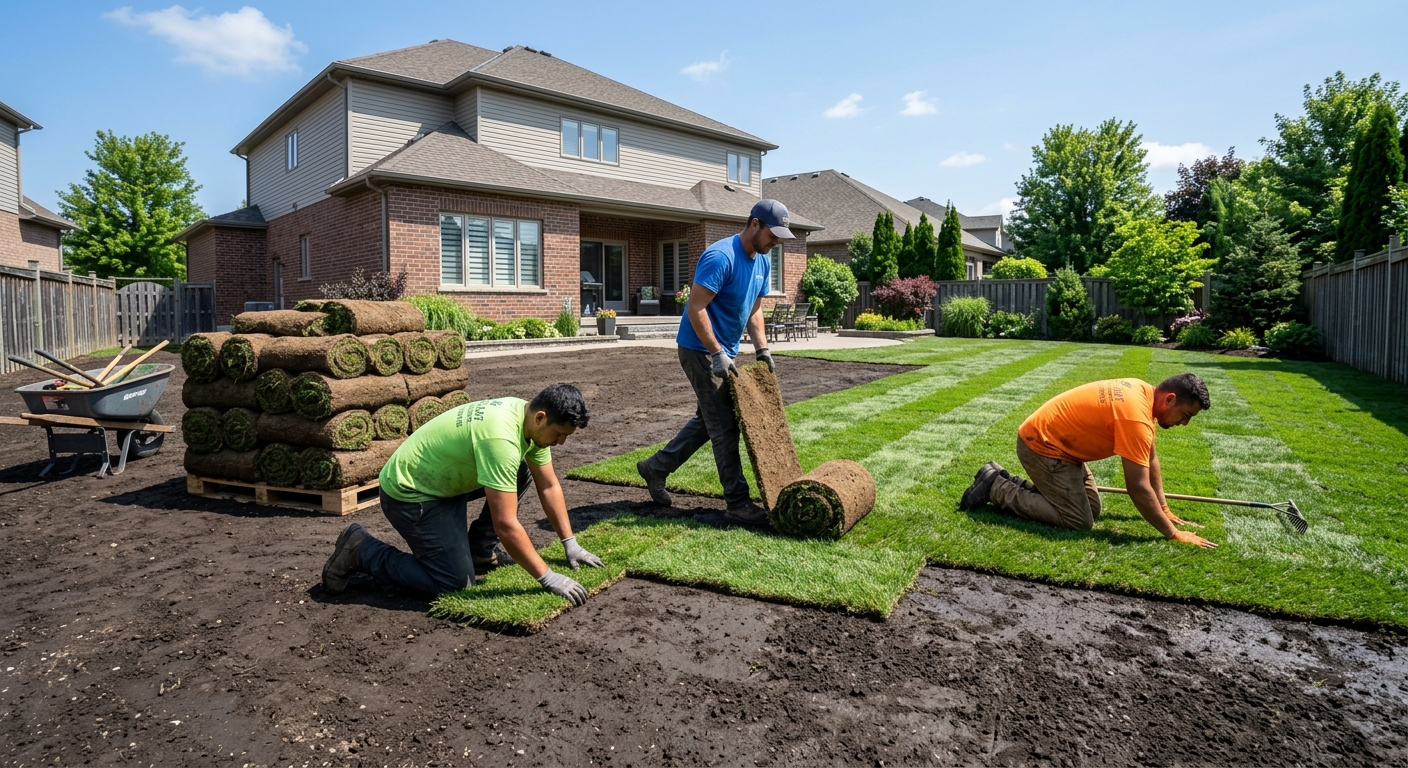
Landscaping options and costs in Tillsonburg
Tillsonburg homeowners usually have the best results when they match their landscape plan to how London-area properties are set up: with 18,615 people and a high rate of homeowner households (70.8% of households own, Statistics Canada, 2021 Census), it’s common to invest in long-lasting upgrades rather than quick cosmetic fixes. That matters because Tillsonburg has a lot of single-detached homes (67.7% of dwellings), and detached yards typically need both hardscape for year-round use and softscape that can handle shoulder-season frosts.
In the London economic region, we work in plant hardiness zones 5b–6a, where last frost is usually in early May and first frost is mid-October. Practically, most installations are planned around a roughly five-month main working season, so pricing reflects scheduling, hauling/disposal windows, and labour availability—especially in spring when grading and base prep are in high demand. Soil and weather also play a role: clay soils and freeze-thaw cycles push us to design deeper, well-drained bases for patios and retaining walls (often 12–18 inches compacted base) to reduce heaving and settlement.
Contractors tend to be most in demand in established pockets like the north end around Broadway Street West and nearby residential areas, where older properties (nearly half of homes built before 1981) often need drainage corrections and foundation-edge work. With that in mind, the table below compares typical service options and what you can expect to budget.
| Service |
Description |
Season |
Price Range |
| Full landscape design and installation |
Site walk, design plan, materials selection, grading/drainage coordination, planting and/or hardscape build-out |
Spring to early fall (planting in-season) |
$5,000–$30,000 |
| Sod installation (supply, grade, lay, roll) |
Minor grading/levelling, soil prep, sod supply and installation, rolling and initial watering guidance |
Late spring to early fall |
$2,500–$8,000 |
| Lawn seeding (grade, seed, starter fertilizer) |
Topdressing where needed, seed blend, starter fertilizer, light rake and rolling (for consistent germination) |
Early spring or fall overseeding windows |
$1,500–$5,500 |
| Interlocking patio or walkway |
Excavation, compacted base, edging, interlocking stone or block pavers, jointing and cleanup |
Spring to fall |
$4,500–$18,000 |
| Retaining wall (interlocking block) |
Footings/gravel base, block system install, geotextile and drainage layer, backfill and finishing |
Spring to fall |
$6,500–$35,000 |
| Tree and shrub planting |
Plant layout, digging, amendments, staking where required, mulching and first-season care advice |
Spring and early fall |
$800–$6,000 |
Prices are estimates only and vary by project scope, site access and material selection.
What affects the price of landscaping in Tillsonburg
In Tillsonburg and across London-area Ontario, two homeowners can receive quotes for the “same” job and still see a 30–50% difference once site conditions and build level are included. That’s because landscaping pricing isn’t just about square footage—it’s labour intensity, excavation, disposal, and whether the crew needs to solve drainage and soil issues before plants or pavers can perform long-term.
Season and climate are also real cost drivers here. In zones 5b–6a, the frost calendar limits when crews can excavate, set base material, and complete seeding/sod reliably. Frost and freeze-thaw cycles can also raise base depth requirements for patios and retaining walls, which is why work that stays within your natural slope can cost less than work that needs cut-and-fill. Prairie regions (zones 2–4) face a shorter growing window and more wind/dryness risk, so they often add drought-tolerant species and tougher soil amendment plans; coastal BC (zones 7–8) can plant longer, but heavy-rain areas increase drainage design time and materials. In our part of Ontario, the season is moderate with summer dry spells, so irrigation design still matters even when water restrictions are usually lighter than in the dry BC interior.
Concrete examples in Tillsonburg: (1) Adding 12–18 inches of compacted, well-drained base under an interlocking patio commonly shifts the job into the mid-to-high portion of the $4,500–$18,000 band versus a “thin base” approach that will settle. (2) If your yard has clay and low spots, a French drain or drainage bed can change a simple planting job from the $800–$6,000 planting band into a full-scope build because extra excavation and clean stone are required.
Housing age influences costs too. With 49.3% of homes built before 1981 (Statistics Canada, 2021 Census), you’ll often see older grading, buried downspouts, and uneven lawn transitions—meaning more subgrade corrections and more labour. Those site fixes are the difference between “looks good this year” and “stays solid for years.”
| Price Factor |
Why It Matters |
Cost Impact |
| Yard size in sq ft — the primary cost driver for softscape |
More area increases topsoil, grading passes, seeding/sod quantity, mulch, and maintenance labour |
Can swing costs by hundreds to several thousands |
| Grading and drainage work — slope corrections add significant cost |
Correct slopes prevent pooling against foundations and reduce frost heave movement |
Often one of the largest hidden increases (commonly +20% to +40%) |
| Drainage bed or French drain installation |
Clay soils and downspout runoff need controlled flow paths |
Frequently pushes projects into higher hardscape/retaining scopes (+$2,000 to +$8,000) |
| Plant material tier — native shrubs vs. ornamental vs. mature specimen trees |
Mature specimens and premium cultivars cost more and require better soil prep |
Mature-tree installs can add $800+ to $3,000+ |
| Hardscape vs. softscape ratio — walls and patios cost more per sq ft than lawn |
Pavers and block walls require excavation, base layers, and longer installation time |
Shifts budgets toward the $4,000–$35,000 retaining/hardscape band |
| Irrigation system design and installation |
Proper zoning and coverage reduce waste and winter stress risk (winterization planning) |
Can add a few thousand depending on zones and controls |
| Soil amendment and topsoil required |
Clay soils often need structure and drainage improvement to support turf and roots |
May add $1,000–$5,000 depending on volume and hauling |
| Tree removal or stump grinding before new planting |
Stump remnants affect grades, planting pits, and drainage flows |
Commonly +$500 to +$2,500 per issue |
Permits & regulations in Ontario
In Ontario, most landscaping—planting trees and shrubs, sodding, reseeding, and typical softscape work like mulch and border edging—does not require a permit. The permit conversation usually starts when you move larger quantities of earth or build structures that can affect neighbours, drainage, or safety.
Work that typically DOES require a permit: retaining walls above a common height threshold (often 1.0 m / 3.3 ft in many municipalities) usually require a building permit and sometimes engineered drawings. Also, changes to lot grading that alter drainage patterns toward neighbouring properties or storm sewer connections may trigger approval requirements. And any project that includes new irrigation infrastructure tied to water may need to align with local water-use bylaw requirements or utility guidelines.
Work that typically does NOT require a permit: tree and shrub planting, sod/seed installation, adding mulch beds, and most walkway/patio projects that are within normal residential scope (still subject to setbacks and good drainage design).
Step-by-step for Tillsonburg homeowners: (1) call or use the Ontario one-call process to get utility locates before digging any planting holes, trenching, or wall footings; (2) request the contractor’s liability insurance certificate and confirm they carry WSIB coverage (or WCB equivalent) as required for workers; (3) verify the contractor’s Ontario licensing/registry details through the relevant online registry for their trade; and (4) if a retaining wall or major grading change is planned, ask the contractor whether they will pull permits and provide permit numbers/approvals before construction.
Planning a landscape that thrives in Tillsonburg's climate
To make a landscape thrive in Tillsonburg, plan around zone 5b–6a hardiness, spring thaw timing, and the freeze-thaw cycles that can stress both roots and hardscape bases. In this London-region climate, your best results come from working with the yard’s drainage and frost behaviour rather than relying on “more fertilizer” or thinner base material.
Plant selection: choose native and zone-appropriate species that can handle cold winters and early frosts. This usually reduces winter protection and helps avoid repeated replanting. Sod vs. seed: sod gives instant coverage, but it’s typically 3–4 times more per sq ft than seeding once you factor in labour and delivery. Drainage and grading: in Southern Ontario’s clay-heavy conditions, pooling leads to turf thinning and foundation-edge moisture. We often grade so runoff moves away from the house and build drainage beds where necessary. Hardscape base preparation: for patios and retaining walls, we build to the local frost line logic—deeper, well-compacted, well-drained bases to reduce heaving and settlement. Low-maintenance design: use mulch, groundcovers, perennials, and structured shrub borders so your yard looks full without weekly labour.
Where it makes sense, consider a rain garden in low spots to capture roof downspout runoff and reduce stress on lawn areas. In practical cost terms: if you have a small patch that must look good fast for a spring event, spending toward a sod install may be justified. For example, budgeting closer to the $2,500–$8,000 sod range can be worth it versus seeding in the $1,500–$5,500 band when immediate curb appeal is important. For long-term value on bigger areas, seed-and-topdress often performs well when timed to early spring or fall.
| Element |
Climate Consideration |
Maintenance Level |
Price Band |
| Sod lawn installation |
Needs reliable moisture during root establishment before summer and before fall cold sets in |
Low short-term, higher watering attention in the first 2–4 weeks |
$2,500–$8,000 |
| Native perennial garden |
More resilient to Tillsonburg winters and spring temperature swings when planted correctly |
Medium (mulch refresh and light spring cleanup) |
$800–$6,000 |
| Mulched shrub border |
Mulch moderates soil temperature and supports stable moisture through frost cycles |
Low (occasional weed control and top-up) |
$1,200–$7,500 |
| Interlocking stone patio |
Requires proper base depth and drainage to prevent frost heave and rocking |
Low (sweeping, occasional joint topping) |
$4,500–$18,000 |
| Retaining wall (block) |
Clay soils demand drainage layers and compaction to handle freeze-thaw movement |
Low to medium (periodic inspection of weep holes and vegetation) |
$6,500–$35,000 |
| Drip irrigation system |
Better water targeting for perennials; winterization planning protects lines and valves |
Low after installation (check timers/zones seasonally) |
$2,000–$9,000 |
How to choose a landscaping contractor in Tillsonburg
Choosing the right contractor in Tillsonburg starts with verifying they can legally and safely perform residential landscaping. For Ontario work, ask for their liability insurance certificate—confirm it lists your address as the certificate holder where applicable—and check they have the required worker coverage (WSIB/WCB) for their crew. Then verify the company and the individuals involved through the appropriate Ontario online licensing/registry resources for their trade and operating name.
Next, request 2–3 itemised written quotes. “Itemised” matters: you want labour and materials broken out by scope (excavation, base materials, pavers/block, plants, soil amendments, disposal, edging, geotextile, and any drainage work). A lump-sum quote without breakdown is harder to compare if one contractor is substituting cheaper stone, thinner base depth, or smaller plant sizes.
Read the scope line-by-line for what’s excluded. Questions to ask: Is permitting included if you’re doing a retaining wall that may exceed the height threshold? Is waste disposal included or billed separately? Who handles winterization for irrigation lines? Finally, confirm warranties: workmanship warranty length, manufacturer warranties for products, and whether warranties transfer to you if you sell the home.
For payment, don’t pay more than 10–15% upfront. Use a holdback until the job is complete and you’ve confirmed the final grade, drainage function, plant spacing, and cleanup.
- Verify contractor identification and business details (operating name matches quote/invoice).
- Ask for liability insurance certificate and confirm adequate limits for excavation/paving.
- Confirm WSIB/WCB coverage for workers before work starts.
- Require an Ontario-issued licensing/registry check appropriate to the work scope (and trade).
- Get an itemised quote with labour + materials + equipment time, not just a total.
- Confirm base depth and drainage layers for patios/retaining walls (clay and frost matter here).
- Ask what topsoil amendments/soil structure mix is included (and whether it’s tested or specified).
- Clarify disposal/haul-away: included or extra cost with tipping fees.
- Confirm permit responsibility for retaining walls and major grading changes.
- Ask for plant sizing at install (e.g., caliper/height) and the quantity count.
- Set a written schedule: start date and estimated completion date.
- Confirm warranty terms and whether they are in writing in the contract.
Concrete red flags I see in Tillsonburg: contractors who won’t provide insurance/WSIB paperwork, quotes that don’t specify base depth or drainage layers for pavers/walls, vague scopes that exclude disposal and permit responsibility without explanation, pressure to take large upfront deposits, and “bait-and-switch” plant substitutions (different species/sizes) after you’ve approved the layout.
Frequently asked questions — landscaping in Tillsonburg
How much does professional landscape design cost?
In Tillsonburg and the London area, many homeowners budget within the broader “design & installation” range of $5,000–$30,000, because design often bundles with the build. If you’re doing design-only, pricing varies based on whether you need a full site plan (grading/drainage notes), planting layout, hardscape layout, and a materials palette. Since Tillsonburg has a lot of older housing stock and clay-influenced drainage challenges (49.3% of homes built before 1981, Statistics Canada, 2021 Census), good design typically includes drainage considerations so your patio/wall doesn’t heave after freeze-thaw cycles. Ask for an itemised proposal that separates design time from build costs so you can compare quotes fairly.
How do I compare landscaping quotes?
Compare Tillsonburg landscaping quotes by scope, not just the total price. Start by checking whether each quote includes the same base prep and drainage details—especially for interlocking patios and retaining walls where deeper, well-drained bases are critical in zones 5b–6a. Next, verify plant counts and sizes (and whether they’re native/zone-appropriate or “comparable” substitutions). Make sure sod/seed items specify grade prep and topsoil/amendments, because poor grading costs you later. Use the known budget bands as a sanity check: for example, a full sod job may land in the $2,500–$8,000 range, while a planting-only phase often clusters around $800–$6,000. If one quote is dramatically lower, it may be skipping drainage work or base depth.
How long does a landscaping project take in Tillsonburg?
Project length in Tillsonburg depends mainly on excavation scope, drainage corrections, and the seasonal window. With last frost typically in early May and first frost around mid-October, most crews plan installations around a roughly five-month main working season in London-area zones 5b–6a. A small planting and mulch refresh may take a day or two, while an interlocking patio or walkway can take several days because it includes excavation, base compaction, stone laying, edging, and jointing. Retaining walls usually take longer due to footings/base layers, drainage components, and backfill compaction. If irrigation is included, add time for layout, trenching, and testing. Ask the contractor for a written start date and completion estimate, and confirm whether any permit work (if required) is built into the timeline.
What is the best grass type for a Tillsonburg lawn?
For most Tillsonburg lawns, homeowners do best with cool-season turfgrass blends designed for Southern Ontario—grasses that stay productive in spring and fall and handle winter dormancy well. Since you’ll face summer dry spells and freeze-thaw winters, the goal is a blend that recovers after stress and tolerates mowing and foot traffic. Many professionals also recommend choosing drought-tolerant varieties and building healthy soil first (topdressing and amendments where needed) because clay can hold moisture differently than loam. If you’re deciding between sod and seeding, sod gives faster results, but it’s usually more expensive and requires careful early watering during establishment. Typical budgets for sod installation sit around $2,500–$8,000 depending on area and prep.
When should I aerate and overseed my lawn in Tillsonburg?
In Tillsonburg, plan aeration and overseeding around periods when the grass can grow and repair before cold weather. Common timing is spring after the lawn is actively growing and the soil isn’t too wet, or fall overseeding shortly enough that seedlings establish before first frost (often mid-October). Aeration helps relieve compaction and improves seed-to-soil contact—especially useful on clay-influenced lawns that can form a dense mat. If your lawn is very thin or patchy, you may get better results starting with grading/topdressing and then seeding. If you’re budgeting, seeding projects with grade, seed, and starter fertilizer often fall around $1,500–$5,500 depending on area and prep. A contractor can also tailor a plan based on your lawn’s condition, sun exposure, and foot traffic.
What trees grow best in Tillsonburg's climate zone?
For Tillsonburg (zones 5b–6a), trees that generally do well are cold-hardy, disease-resistant, and suited to Ontario’s freeze-thaw cycles and clay-prone soils when planted with proper drainage. Many homeowners choose varieties such as serviceberry, Amelanchier species, small ornamental cherries, and certain maples depending on sun and site conditions; larger shade trees are selected based on mature size so they don’t conflict with driveways, sidewalks, or overhead lines. Proper planting depth, soil amendment, and watering plan matter as much as species selection in our area’s spring timing and fall frost. Because home yards are often part of the long-term ownership plan—70.8% of households own (Statistics Canada, 2021 Census)—it’s smart to invest in right-sizing trees. If a site needs drainage correction first, that can influence overall planting scope and budget (often $800–$6,000 for planting work, plus any drainage work).