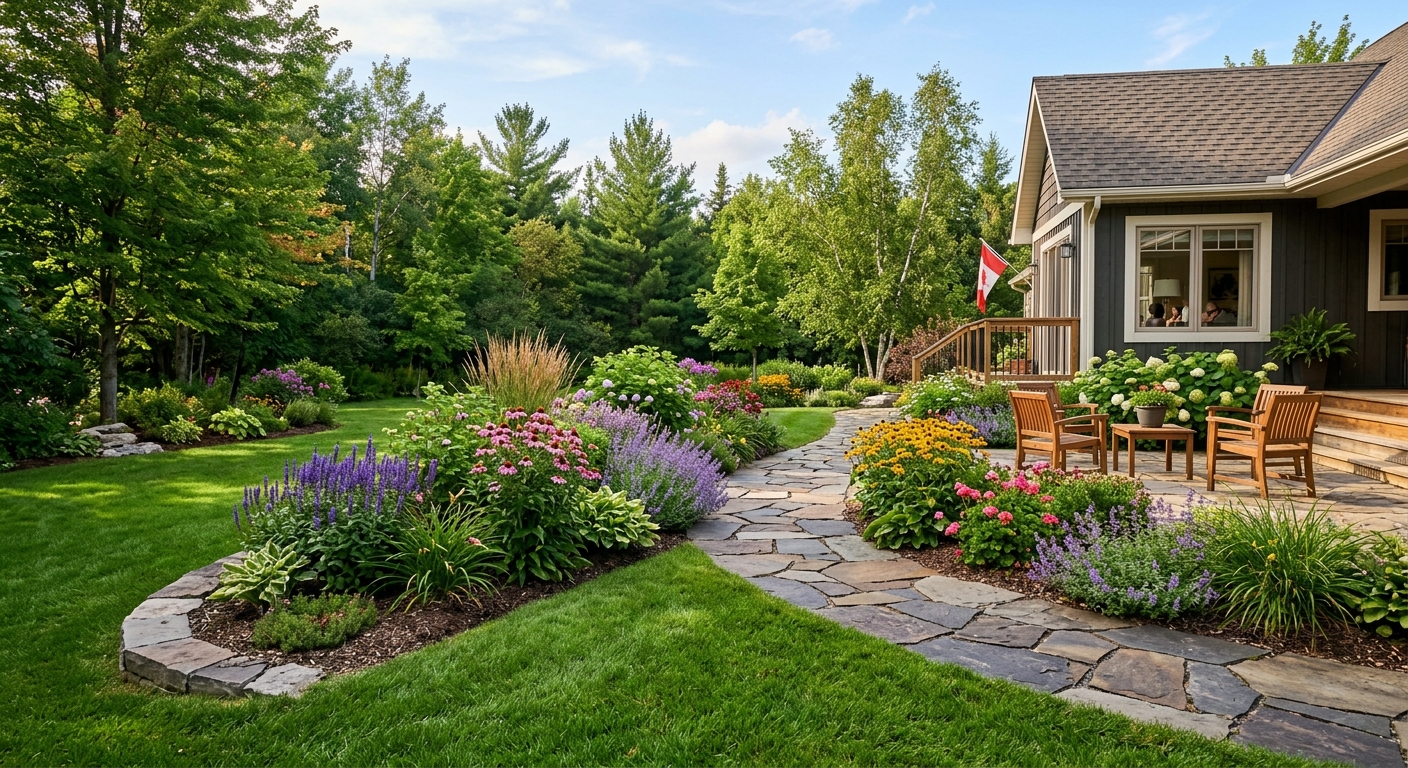
Landscaping options and costs in Calgary
Calgary is a great city to invest in landscaping, especially for homeowners with the kind of yard space that comes with single-detached homes—55.0% of Calgary dwellings. With 68.8% of households owning, many owners are willing to upgrade their curb appeal and outdoor living, but they also want pricing that reflects how hard our winters and freeze–thaw cycles are on materials. In practice, that’s why Calgary quotes can feel “structurally heavier” than what some people expect: patios, walkways, and retaining walls need deep, well-compacted bases and dependable drainage to prevent frost heaving and settlement.
Prairie plant hardiness zones 3–4 mean we can’t just copy long-growing-season designs from milder regions. Costs are influenced by what survives our late-spring frosts and early fall cold snaps, plus the labour required to prep soil and build reliable irrigation that won’t fail when temperatures swing. You also see demand spike in northwest and established communities like Panorama Hills and Symons Valley, where family lots and active renovations drive repeat work for contractors.
Below are common landscaping packages and typical Calgary price bands so you can compare proposals like-for-like. Use this table as your baseline, then match the scope to your yard size, access, grading needs, and material choices.
| Service |
Description |
Season |
Price Range |
| Full landscape design and installation |
Site visit, concept + layout, grading plan, hardscape, planting, and irrigation (as required) |
May–September |
$12,000–$50,000 |
| Sod installation (supply, grade, lay, roll) |
Soil prep, grading for slope, sod delivery + installation, top-dress where needed |
May–August |
$2,500–$6,000 |
| Lawn seeding (grade, seed, starter fertilizer) |
Light grading, seed + starter fertilizer, rake-in and roll; includes initial watering guidance |
April–June (or late summer to early fall) |
$1,500–$3,500 |
| Interlocking patio or walkway |
Excavation, compacted base, edging, interlocking stones, jointing and clean-up |
May–September |
$8,000–$30,000 |
| Retaining wall (interlocking block) |
Wall layout, excavation, drainage/gravel zone, base engineering (as needed), block installation |
May–September |
$10,000–$40,000 |
| Tree and shrub planting |
Soil improvement, planting pits, mulch, staking where required, and initial watering plan |
May–June and September |
$800–$15,000 |
Prices are estimates only and vary by project scope, site access and material selection.
What affects the price of landscaping in Calgary
In Calgary and across southern Alberta, the same “basic” landscaping idea can come in 30–50% apart because quotes reflect real differences in site conditions, labour time, and how much structural prep is needed—not just the visible plants or pavers. Calgary sits in Prairie zones 3–4 with late frosts and early cold snaps, so contractors often have to stage work, protect materials, and focus on systems that can survive harsh freeze–thaw cycles. Retaining wall base preparation also must extend deep and be well-compacted to reduce heaving risk, which is labour-intensive and can add material costs quickly.
To put that in perspective, coastal BC (zone 7–8) can support a longer growing season and broader planting palettes, which may lower seasonal urgency but still requires excellent drainage in heavy-rain periods. Meanwhile, the dry interior part of BC drives drip irrigation and soil improvement for water efficiency—design work that also affects cost. Southern Ontario (zone 5–6) generally has a longer frost-free period than Calgary, but still needs irrigation planning during summer dry spells.
Two common Calgary examples: if your lot slopes toward a foundation, we may need extra grading and sub-drainage, which tends to push projects toward the higher end of the retaining walls & hardscaping bands. If you’re improving an older yard—note that 35.2% of Calgary homes were built before 1981—there’s frequently deeper root growth, mature vegetation to manage, and outdated drainage patterns, which can add excavation time before we even install sod or seed. If you’re comparing turf options, sod installation typically lands closer to the mid-to-upper range, while seeding can reduce cost—often by thousands—if soil prep is straightforward.
| Price Factor |
Why It Matters |
Cost Impact |
| Yard size in sq ft — the primary cost driver for softscape |
More square footage increases excavation, soil amendments, and labour time |
Large yards can move you from the low end to the upper end of $1,500–$6,000 sod/seeding bands |
| Grading and drainage work — slope corrections add significant cost |
Fixing pooling or redirecting runoff away from the foundation requires rework depth and compaction |
Often adds substantial cost before planting; can be a 20%+ driver on hardscape-heavy projects |
| Drainage bed or French drain installation |
Freeze–thaw makes trapped water risky; proper drainage protects bases and structures |
Can shift a project toward mid five-figures in full installations |
| Plant material tier — native shrubs vs. ornamental vs. mature specimen trees |
Calgary pricing reflects hardiness, container size, and establishment success |
Mature specimens and premium ornamentals can add thousands to the $800–$15,000 planting band |
| Hardscape vs. softscape ratio — walls and patios cost more per sq ft than lawn |
Stone, block, base materials, and compaction time raise cost |
Patios and walls often push total budgets into the $8,000–$40,000 hardscaping band |
| Irrigation system design and installation |
Zoned heads, controller programming, and freeze-safe components prevent winter damage |
Can add significant line-item cost, especially for multi-zone beds and lawn |
| Soil amendment and topsoil required |
Calgary soils can be compact and low in organic content; amendments support root development |
Costs rise fast with larger excavation volumes and delivery fees |
| Tree removal or stump grinding before new planting |
Clearing impacts access, disposal, and timelines for base prep |
May add multiple days of work; can be the difference between a few thousand and mid five-figures |
Permits & regulations in Alberta
For most typical Calgary backyard landscaping, you generally don’t need permits—especially for planting, sodding, seeding, and most softscape work. However, certain structural changes can trigger requirements. In Alberta municipalities, retaining walls above the height threshold—typically around 1.0 m (3.3 ft)—often require a building permit, and some projects may also call for engineered drawings depending on height, condition of the soil, and proximity to property lines.
Also pay attention to grading: changes to lot grading that affect drainage (for example, redirecting runoff toward a neighbouring property or storm sewer connection) may require approval. Before anyone digs for planting holes or wall footings, ensure utility locates are completed. That’s a safety and compliance step that prevents accidental damage to underground services.
How to verify your contractor’s credentials in Calgary:
- Check the contractor’s Alberta licence status through the appropriate provincial registry channels (ask the contractor for their licence number).
- Request a certificate of insurance—make sure it shows general liability coverage and that it’s current.
- Ask for proof of coverage for workers (WSIB/WCB) and confirm it matches the work scope and dates.
- Look for a written clearance letter where applicable and verify dates line up with your scheduled start.
- Confirm permit responsibility in writing: who pulls permits, who pays, and what happens if approvals delay the timeline.
Finally, while water-by-law enforcement varies by season and jurisdiction, confirm irrigation rules and drought-related restrictions if your project includes automated watering.
Planning a landscape that thrives in Calgary's climate
Planning for Calgary starts with working with our hardiness zone 3–4 realities and our freeze–thaw schedule, not fighting it. Choose plants that are winter-hardy and drought-tolerant, and use wind-protective design where possible (strategic shrubs, fences, and mulched beds). This matters because late-spring frosts can stress tender growth, and early fall cold snaps can shorten how much a new planting has time to establish.
For turf, you have two main routes: sod for instant results or seeding for a lower upfront cost. Sod is typically 3–4x more per sq ft than seeding because you’re paying for production, delivery, and installation labour. That can be worth it if you need the yard looking finished for a specific event or if soil prep is already ready to support strong rooting. If you’re working on a budget, seeding paired with proper grade correction and top-dressing can be a smarter move—especially when drainage is already stable.
Drainage and grading are the make-or-break items in Calgary. Pooling water near foundations increases risk of moisture issues, while poor compaction under patios and walkways can cause heaving. That’s why any hardscape should be built on deep, well-compacted bases, with proper slope to direct water away. For retaining walls, we also design gravel and drainage zones to manage water pressure.
To keep maintenance low, build “repeatable success” into the yard: mulch ringed beds, groundcovers, perennials that return reliably, and evergreen structure. Consider xeriscape-style plantings and rain-garden features to slow and filter runoff—reducing irrigation demand while improving curb appeal.
Example: if a new lawn area could cost around $2,500–$6,000 for sod, seeding might come in closer to $1,500–$3,500 once grading is corrected. If your base is already sound, that difference can be justified; if the base needs heavy drainage rework, the best “savings” often comes from solving drainage first.
| Element |
Climate Consideration |
Maintenance Level |
Price Band |
| Sod lawn installation |
Strong establishment window; freeze risk if laid too late, and proper grading is critical |
Low–moderate during first season (watering + light care) |
$2,500–$6,000 |
| Native perennial garden |
Hardy perennials tolerate zone 3–4 winters and reduce watering needs once established |
Low after first year (mulch refresh, seasonal trimming) |
$3,000–$10,000 |
| Mulched shrub border |
Mulch protects roots from freeze–thaw and helps manage moisture in semi-arid conditions |
Low (weeding control and occasional pruning) |
$2,000–$8,000 |
| Interlocking stone patio |
Needs a deep, compacted base to prevent heaving during extreme temperature swings |
Low (occasional joint re-sanding/inspection) |
$8,000–$30,000 |
| Retaining wall (block) |
Drainage behind the wall and proper base depth are essential to avoid movement |
Low (routine inspection of drainage outlets and joints) |
$10,000–$40,000 |
| Drip irrigation system |
Zoned, freeze-protected design supports drought-tolerant beds without overwatering |
Moderate initially (tuning zones; winter shut-down) |
$2,000–$8,000 |
How to choose a landscaping contractor in Calgary
Choosing the right contractor in Calgary is mostly about proof: proof they can do the work, and proof they’re set up to protect you. Start with licensing and insurance. Ask for their Alberta licence details (or the licence number) and confirm it’s valid for the scope of landscaping/hardscaping you’re hiring for. Then request a current certificate of insurance showing general liability (and confirm coverage is active during your project dates). For worker protection, ask for WSIB/WCB coverage proof—don’t accept “we’re insured” without paperwork. If they won’t provide documents, that’s a major warning.
Next, get 2–3 itemised written quotes. You want a breakdown that separates labour and materials (excavation/base prep, drainage, stone/block supply, planting material tiers, irrigation components, delivery/disposal). A good quote clearly lists what’s included and what’s excluded: permit pulls (if required), disposal of sod/soil, topsoil allowance, and whether irrigation tie-ins are included.
Warranty matters. Ask for the workmanship warranty length, and whether the product manufacturer warranty is included for pavers, blocks, and irrigation components. Also ask if warranties are transferable to future homeowners.
On payment, avoid large upfront deposits. For most reputable jobs, never pay more than about 10–15% upfront, and hold a reasonable holdback until completion and final grading/cleanup.
Finally, request a written timeline: proposed start date, weather-based contingencies (especially in Calgary’s shoulder season), and an estimated completion date.
- Provide licence number, insurance certificate, and WSIB/WCB proof before signing.
- Use itemised estimates, not vague “allowances” for major cost items.
- Confirm who pulls permits for retaining walls where required.
- Specify base depth and compaction methods for patios/walkways.
- Clarify drainage solutions (French drain vs. grading only) where pooling exists.
- Ask for an irrigation plan that includes zoned heads and freeze-safe design.
- Confirm sod/seed type and expected coverage rate.
- List plant sizes and whether substitutions are allowed (and priced).
- Include disposal/haul-away for sod, debris, and excess soil.
- Request start/finish dates in writing plus weather contingency language.
- Check that crews and subcontractors are covered under WSIB/WCB.
- Verify warranty terms in writing before payment milestones.
Red flags in Calgary include: (1) quoting with no insurance/WSIB documentation, (2) vague scope like “grading included” without describing drainage work, (3) offering big discounts for cash with no written contract, (4) skipping base prep details for patios or walkways, and (5) promising an early fall planting deadline without acknowledging frost risk and establishment time.
Frequently asked questions — landscaping in Calgary
What plants thrive in Calgary's climate zone?
In Calgary (Prairie hardiness zones 3–4), the best-performing plants are cold-hardy, wind-tolerant, and not overly dependent on summer humidity. Homeowners typically do well with reliable structural evergreens and hardy perennials, along with shrubs that can handle freeze–thaw and dry spells. A smart approach is to prioritize native and region-appropriate varieties, then group plants by exposure: full sun spots can handle drought-tolerant options, while protected areas near fences or patios can support slightly more delicate choices. If your yard has slope or exposed wind, plan wind protection with denser shrubs and use mulch to steady soil temperatures. In many Calgary renovations, we build beds around proven performers first, then add seasonal colour so you get curb appeal without fighting winter survival. (Statistics Canada, 2021 Census)
Sod vs seed — which is better for a Calgary lawn?
For Calgary lawns, sod gives faster visual results and generally establishes more predictably when installed during the right warm window. But it costs more—often landing in the $2,500–$6,000 range for typical projects once grade prep is included. Seeding can be the better value in $1,500–$3,500 territory, especially if your grading is already correct and drainage isn’t pooling. The key is base preparation: if the soil is compacted or uneven, neither sod nor seed will perform well. Calgary’s freeze–thaw cycle also means you should plan timing carefully so roots establish before cold snaps. If you’re starting from bare soil with drainage corrections underway, we often recommend solving grading and compaction first, then choosing sod for speed or seeding for budget.
How much does a retaining wall cost in Calgary?
Retaining wall pricing in Calgary usually depends on height, length, site access, and how much drainage and base preparation is needed. Many block wall projects land in the $10,000–$40,000 range for common residential sizes, with higher costs where excavation is challenging or where we need added drainage behind the wall. Freeze–thaw makes proper base depth and compaction non-negotiable, and drainage layers (gravel zones and weep-style solutions) are what protect the wall long-term. If you’re seeing water runoff, your costs may be higher because we have to build it to manage water pressure—not just stack blocks. Also, older lots and established yards can require more groundwork before the first block goes in, which can push costs toward the upper end.
When is the best time to landscape in Calgary?
In Calgary, the practical window for full hardscape and planting work is typically May through September. Spring is great for grading, drainage, patios, walkways, and most mid-season planting, but late-spring frosts mean we time tender planting carefully. For sod and seeding, warm soil and consistent establishment are crucial; sod is commonly installed during the warmest months, while seeding can work in spring or late summer/early fall when temperatures are still supportive. Retaining wall work is also usually scheduled in the warmer window so the base can be properly compacted and set. If you want a low-risk plan, we schedule groundwork first (base prep and drainage), then follow with hardscape, then planting—so the plants don’t get stressed by heavy construction traffic. (Statistics Canada, 2021 Census)
Do I need a permit for a retaining wall in Alberta?
In Alberta, most basic landscaping work (like planting and softscape) doesn’t require a permit, but retaining walls can. In many Calgary-area situations, retaining walls above a typical threshold—commonly around 1.0 m (3.3 ft)—require a building permit, and some projects may require engineered drawings based on conditions. Grading changes that can affect drainage direction toward neighbouring properties or storm connections may also trigger approval needs. The best move is to ask your contractor to confirm whether your wall height and placement likely fall under permit requirements before work starts. Your quote should state who is responsible for pulling permits, because the approval timeline can affect your start date. Always also ensure utility locates are done before digging for wall footings.
How do I improve drainage in my yard?
Drainage improvements in Calgary usually start with diagnosis: where does water collect, what’s the slope, and does runoff travel toward your foundation? If you have pooling, the fix is often a combination of regrading and targeted subsurface work, such as a drainage bed or French drain, installed with proper slope and materials designed to handle freeze–thaw. Surface solutions like reworking downspout discharge routes and ensuring the yard slopes away from the house can help, but they must be paired with good base preparation under hardscape to prevent heaving. If your downspouts or eaves are directing water into a low spot, adjust the discharge route first, then address soil compaction. A well-built drainage plan protects both landscaping and the home, and it’s a frequent reason costs move toward the mid-to-upper end of full project budgets in Calgary.