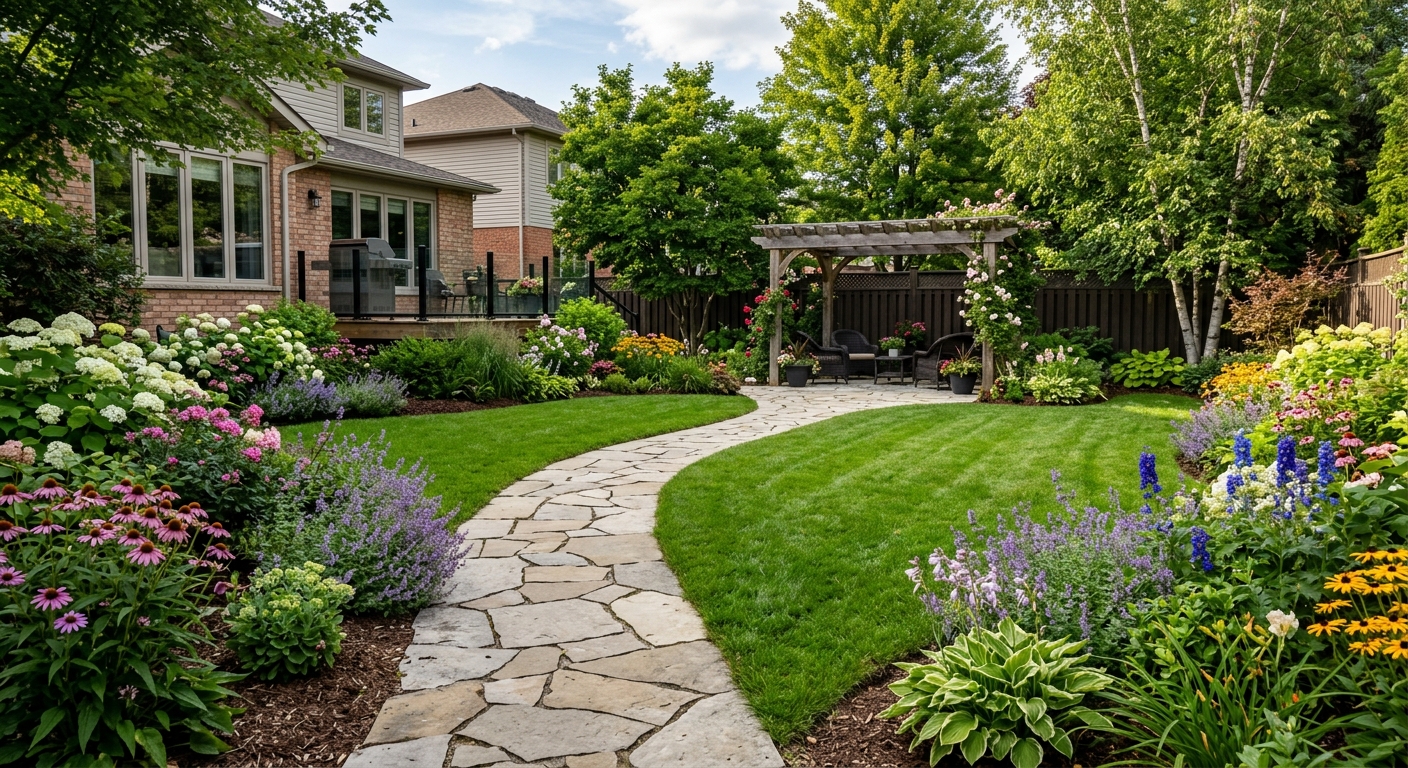
Landscaping options and costs in Calmar
Calmar is a small Alberta community, and that matters: most homes here are single-detached, with 77.7% of dwellings falling into that category (Statistics Canada, 2021 Census), so you’ll typically have yard space to improve curb appeal, add functional hardscape, and create zones for kids, pets and entertaining. It also helps that many households are homeowners—740 homeowner households, with 80.9% owning their home—so landscape upgrades are a long-term investment rather than a short-term change (Statistics Canada, 2021 Census). That long-horizon mindset is exactly why Edmonton-region landscaping demand can peak strongly in neighbourhoods like Calmar’s newer residential areas near the town’s east and west edges, where lots are being developed and yards are being built from the ground up.
Cost in the Edmonton region is shaped by a short prairie growing season, frequent freeze-thaw cycles, and generally drier summers. Those conditions affect both plant selection and installation scheduling, and they also influence contractor availability—spring and early summer are busier, while late fall work usually focuses on hardscape and “ready-to-plant” prep rather than new sod or tender planting. For example, full landscape design and installation often bundles grading, soil prep, drainage considerations and material choice—so two projects that sound similar can still land far apart once you account for access, hauling, and how much hardscape or irrigation is included.
To help you compare apples-to-apples, here are typical price bands for common landscaping services in Calmar, Alberta—then you can map your scope to the closest line item.
| Service |
Description |
Season |
Price Range |
| Full landscape design and installation |
On-site consultation, concept layout, grading/soil plan, plant palette, hardscape + softscape coordination, install supervision |
Late spring to early fall |
$8,000–$45,000 |
| Sod installation (supply, grade, lay, roll) |
Base prep, soil amendments, grading, sod delivery and installation, rolling and initial watering plan |
May to August (best window) |
$3,000–$8,000 |
| Lawn seeding (grade, seed, starter fertilizer) |
Minor grading, seed selection, starter fertiliser, seeding and light raking; establishment watering guidance |
April to June or late summer (overseeding window) |
$1,600–$5,500 |
| Interlocking patio or walkway |
Excavation, base and bedding, interlocking stone, compaction, edging, finishing and clean-up |
Late spring to early fall |
$6,500–$18,000 |
| Retaining wall (interlocking block) |
Wall layout, proper drainage and weeping system, block installation, base prep and compaction |
Late spring to early fall |
$45–$120 |
| Tree and shrub planting |
Planting holes, amendments, staking (as needed), mulching, initial soak/establishment plan |
Spring or early fall |
$500–$5,000 |
Prices are estimates only and vary by project scope, site access and material selection.
What affects the price of landscaping in Calmar
In Calmar and the broader Edmonton region, it’s common to see quotes for the “same job” land 30–50% apart. The reason usually isn’t the contractor’s ambition—it’s the hidden variables: yard size, grading complexity, soil condition, drainage needs, how much hauling is required, and whether the plan includes irrigation and a hardscape base designed for freeze-thaw movement. Even a modest redesign can shift cost because prairie freeze-thaw puts extra importance on engineered-style base prep and drainage routing.
Prairie growing conditions also affect timing and what’s included. In Alberta’s hardiness-focused approach (zone considerations matter, especially for wind exposure and winter burn), contractors often choose drought-tolerant, winter-hardy species. That affects both material costs and labour time for installation and protection. Retaining walls specifically require correct base depth below the frost line and a proper drainage layer—if that’s simplified, the wall may move as the ground expands and contracts. By contrast, coastal BC (Zone 7–8) typically supports longer growth, but they still need careful drainage in heavy rainfall areas; likewise, water-smart irrigation planning there is driven by restrictions during dry interior periods. In Southern Ontario (Zone 5–6), the season is often more forgiving, though summer dry spells still require irrigation planning.
In Calmar, two concrete examples that raise cost: (1) heavy re-grading for a backyard that slopes toward the house can add significant labour and haul-away, especially if downspouts and storm connections need to be rerouted; and (2) sod installation on poor soil can require deeper amendments and base corrections to avoid washouts. If your plan is mostly softscape, pricing usually sits closer to the sod/seed bands (for example, sod often lands in the $3,000–$8,000 range), while design-heavy projects that include grading, drainage and multiple materials tend to track the broader full landscape band of $8,000–$45,000.
| Price Factor |
Why It Matters |
Cost Impact |
| Yard size in sq ft — the primary cost driver for softscape |
More area means more topsoil/seed/sod, more labour, and more establishment watering requirements |
Large projects can move you from “starter” to full-crew pricing |
| Grading and drainage work — slope corrections add significant cost |
Small changes in pitch can prevent pooling near foundations and reduce winter heaving risk |
Often one of the biggest variances between quotes |
| Drainage bed or French drain installation |
Interiors often need below-grade solutions to move water away from walls and patios |
Can add substantial material and excavation time |
| Plant material tier — native shrubs vs. ornamental vs. mature specimen trees |
Mature specimens cost more and require bigger root balls, staking, and careful handling |
“Budget palette” vs “feature trees” can swing the total quickly |
| Hardscape vs. softscape ratio — walls and patios cost more per sq ft than lawn |
Hardscape needs excavation, base, compaction, and edging |
Projects heavy in stone and block typically outcost lawn-only upgrades |
| Irrigation system design and installation |
Zones, heads, trenching depth, backflow protection, and controller set-up drive scope |
Adds cost but improves establishment reliability |
| Soil amendment and topsoil required |
Poor or compacted soil forces extra material and conditioning for roots to establish |
Can be minor or a full “make good” correction |
| Tree removal or stump grinding before new planting |
Root mass and stumps complicate grading and reduce planting-ready area |
Often a separate line item with noticeable price swings |
Permits & regulations in Alberta
In Alberta, most planting and typical softscape work—like sodding, lawn seeding, planting shrubs/trees, mulching, and installing garden beds—usually does not require a permit. The bigger permitting topics tend to show up with hardscape, grading, and drainage tie-ins. For example, retaining walls above a height threshold—commonly around 1.0 m (3.3 ft) in many municipalities—may require a building permit and sometimes engineered drawings depending on height, soil conditions and impact to adjacent property. Also, changes to lot grading that could alter surface drainage toward a neighbour or connect into a storm sewer system may trigger approval steps.
Before any digging for planting holes or wall footings, request utility locates. Even small excavations can hit buried lines, and locates are a safety expectation for contractors and homeowners alike. In terms of irrigation and water-use bylaws: in Alberta communities (including the Edmonton region), rules typically focus on outdoor water use during restricted periods—so it’s smart to confirm your town’s guidance before installing automatic irrigation.
For Calmar homeowners, verify a contractor’s paperwork step-by-step: (1) check the Alberta business/labour licensing information online (and confirm the company address and active status); (2) ask for a current certificate of insurance naming you as an additional insured if applicable, and confirm liability limits; (3) request proof of coverage for worker-related protections (commonly WSIB/WCB clearance or account status, depending on the contractor’s situation); and (4) keep copies of everything with your quote package. If the contractor can’t provide documentation quickly, that’s usually a budgeting risk.
Planning a landscape that thrives in Calmar's climate
Planning in Calmar means working with the realities of Alberta’s cold winters, freeze-thaw cycles, and summer moisture stress—not against them. Start with plant selection for your hardiness zone and local conditions: favour native and zone-appropriate shrubs and perennials that can handle wind exposure, winter burn, and the “establishment dip” after planting. Next, decide between sod and seed. Sod gives instant curb appeal and a quicker visual result, but in Edmonton conditions it’s generally more expensive and establishment watering has to be managed carefully in the first weeks. Seeding is usually more budget-friendly, but you’ll accept slower coverage and more early-season monitoring.
Drainage and grading are critical in Edmonton-region basements and foundations too—pooling water that freezes and thaws can damage turf, and it can also keep soil too wet around beds and patios. For hardscape like patios and retaining walls, proper base preparation (including attention to frost-depth considerations) prevents shifting. Low-maintenance design does well here when you use groundcovers, mulched borders, perennials with staggered bloom, and a limited “repeat” plant palette rather than dozens of one-off specimens. Xeriscape and rain-garden approaches can also fit Calmar when you use drought-tolerant plants and design a site that can absorb or direct water efficiently (for example, directing downspout runoff to a swale/rain-garden area rather than letting it soak near foundations).
Is the price difference justified? Often, yes. For example, if you’re comparing sod lawn installation (commonly in the $3,000–$8,000 range) versus seeding, sod can be worth it when you need rapid coverage for a family yard and can commit to establishment watering. But if your priority is long-term resilience and budget control, seeding plus smart drainage grading may deliver the better value per year.
| Element |
Climate Consideration |
Maintenance Level |
Price Band |
| Sod lawn installation |
Short growing season—requires tight establishment watering and good base prep for freeze-thaw durability |
Medium (early watering + monitoring) |
$3,000–$8,000 |
| Native perennial garden |
Drought-tolerant plants handle prairie summer stress and winter cold more reliably than fragile ornamentals |
Low to medium (weeding first year, then mulch + occasional trimming) |
$2,000–$7,500 |
| Mulched shrub border |
Mulch reduces moisture loss, buffers temperature swings, and supports winter protection for roots |
Low (spring tidy-up, mulch refresh) |
$1,500–$6,000 |
| Interlocking stone patio |
Freeze-thaw requires a properly compacted base and drainage so the stone doesn’t shift |
Low (occasional cleaning, joint sand maintenance as needed) |
$6,500–$18,000 |
| Retaining wall (block) |
Needs base depth attention and behind-wall drainage to avoid movement from expansion/contraction |
Low (periodic inspection) |
$45–$120 |
| Drip irrigation system |
Water-wise delivery supports drought-tolerant establishment with less waste than broad sprinkler coverage |
Medium (seasonal checkups, winterization) |
$1,500–$6,500 |
How to choose a landscaping contractor in Calmar
Choosing the right contractor in Calmar starts with proof, not promises. First, verify Alberta business licensing and make sure the company is insured. Ask for a certificate of insurance and confirm liability coverage; if you’re doing hardscape near walkways/driveways, enough coverage matters for jobsite risks. Next, confirm worker coverage status (commonly WSIB/WCB). A reputable contractor will provide clearance/coverage documentation on request and won’t treat it as “too personal.”
Then get 2–3 itemised written quotes—not lump sums. You want a labour + materials breakdown that shows excavation, base materials, hauling/disposal, drainage components, edging, stone type, plant quantities/sizes, and any irrigation hardware. Read the scope carefully: what’s excluded (topsoil replacement, disposal fees, tree removal, stump grinding, utility locates, engineering/permits)? Is permit pulling included if required for a retaining wall above the threshold? Where will waste go?
Warranty matters in Alberta’s freeze-thaw climate. Ask for a workmanship warranty length and whether it’s tied to the installed materials and base prep. Confirm the product/manufacturer warranty separately (plants and hardscape materials can have different terms) and whether it’s transferable to the next owner.
For payment schedule, don’t pay more than 10–15% upfront. Hold back a portion until final grading, cleanup, and “touch-up” planting/sod establishment steps are complete. Get the timeline in writing: a start date and a realistic completion estimate, including weather contingency for spring and fall.
- Ask for project references in the Edmonton region, especially similar-sized yards and hardscape.
- Require a site visit and written measurements (sq ft, wall length, patio size).
- Confirm drainage scope in writing (swales/French drains) when grading is involved.
- Get a base build-up description for patios/walls (materials + compaction steps).
- Verify the plant list: species, sizes, and spacing—no “allowance” vagueness.
- Ask how they handle winter protection and pruning timing for Alberta conditions.
- Confirm irrigation winterization responsibilities if you install automatic systems.
- Check that disposal/hauling is included or explicitly excluded.
- Make sure utility locates are included before digging.
- Request a warranty statement in the contract and understand the claim process.
- Ensure payment milestones match completion checkpoints (not calendar dates only).
- Confirm who provides replacement plant material if something fails after installation.
Red flags in Calmar include: quotes that don’t explain base prep for patios or retaining walls; “one-price-fits-all” proposals that ignore drainage; skipping written scopes or leaving disposal and utility locates unclear; asking for high upfront payments (well above 10–15%); and refusing to share insurance/coverage documentation or providing outdated certificates.
Frequently asked questions — landscaping in Calmar
When is the best time to landscape in Calmar?
For Calmar and the Edmonton region, the best window is typically late spring through early fall. Sod and most turf work perform best when soil temperatures and daytime conditions allow consistent establishment watering—generally May to August. Seeding can be done in spring or sometimes late summer, depending on moisture and timing. Tree, shrub and perennial planting also tends to work well in spring and early fall, when plants experience less heat stress and have time to establish before winter. Freeze-thaw cycles mean winter-ready grading and base prep should be planned early enough that drainage is correct before deep cold sets in. If you’re budgeting, many homeowners schedule full landscape installs during the busier late-spring period so crews can build a proper drainage/base before plants go in.
Do I need a permit for a retaining wall in Alberta?
In Alberta, planting and typical softscape work generally don’t require a permit, but retaining walls are a different story. A retaining wall above a common height threshold—often around 1.0 m (3.3 ft) depending on municipal rules—may need a building permit and sometimes engineered input. In Calmar, you should confirm requirements with the town and your contractor’s proposed wall height and drainage design, because the goal is to ensure structural safety and correct storm/drainage behaviour. If the project includes grading changes that affect drainage toward neighbouring properties or storm connections, approvals can also come into play. A good contractor will tell you upfront whether permit work is expected and whether they include permit pulling in their scope.
How do I improve drainage in my yard?
Drainage improvements start with identifying where water goes during a heavy rain or spring melt—pooling near a foundation, soggy lawn edges, or wet spots that linger. In the Edmonton region, correcting drainage is especially important because freeze-thaw can worsen soil movement and keep areas too wet for turf. Common fixes include re-grading to direct water away from the house, adding a drainage bed, and installing a French drain where water collects. If downspouts are discharging to low spots, redirecting them into a properly designed swale or rain-garden area can help. For a practical budget reference, many homeowners pair drainage work with hardscape or planting; full landscape design and installation often falls into the $8,000–$45,000 band depending on excavation and drainage scope.
What is xeriscaping and does it suit Calmar?
Xeriscaping is a landscaping approach that reduces water use by choosing drought-tolerant plants and improving how water is delivered and absorbed. In Calmar, it suits many yards because summers can be moisture-stressed and the growing season is shorter, so plants benefit from being selected for resilience. Xeriscaping doesn’t mean “no green”—it means using the right palette, mulch, and smart layout. Options include groundcovers, hardy perennials, mulched shrub borders, and drip irrigation (where appropriate) to target water at root zones. Some homeowners also add rain-garden features or swales to capture and manage runoff. If your yard is going to be watered during establishment anyway, combining xeriscape planting with efficient irrigation can reduce long-term watering while still delivering strong curb appeal.
How do I plan a low-maintenance yard?
A low-maintenance yard in Calmar comes from planning for fewer “problem areas” and repeating plants that thrive locally. Start by improving drainage and soil quality so turf and beds don’t struggle year after year. Then build around mulch and hardy planting: mulched shrub borders, native perennial gardens, and groundcovers typically reduce weeding and watering compared with high-spec, moisture-hungry ornamentals. Hardscape can also lower ongoing labour—e.g., a well-built interlocking patio or walkway reduces muddy traffic zones and makes mowing and trimming easier around edges. If you’re comparing costs, sod lawn installation is often in the $3,000–$8,000 range, but a seeding approach with good grading can be a cost-effective way to get a durable lawn. The key is aligning plant choice with Edmonton-region freeze-thaw and moisture stress so upkeep stays predictable.
How deep should a retaining-wall base be for local frost?
For retaining walls in Alberta, the correct base depth is determined by site conditions, wall height, and freeze-thaw performance requirements—not a one-size number. The general principle is that the wall’s base and drainage system must be built so it won’t shift when the ground expands and contracts during winter cycles. In practice, contractors design the base to extend below the frost-affected zone and ensure proper compaction of aggregates, with drainage behind the wall (often including a proper weeping system and free-draining backfill) so water doesn’t build up and freeze. Because retaining walls can become a permit-related item above a common threshold (often around 1.0 m), it’s smart to ask your contractor for their proposed base build-up details and—where required—engineered guidance. This is one area where “cheap” prep frequently costs more later.