Landscaping options and costs in Canon Ridge
In Canon Ridge, Alberta, homeowners typically start with a practical goal: make the yard look better, but also handle Alberta’s hard freeze–thaw cycles without settling, heaving, or drainage failures. With a small community population of 2,019 (Statistics Canada, 2021 Census), contractor capacity can feel more “opportunity-driven,” so booking early—especially for May to July—is often the difference between getting a planned installation versus waiting for a later crew window. Many yards in the Calgary area sit beside single-detached homes, which means there’s usually enough space to justify full redesigns, not just touch-ups. That combination—yard space and the incentive to invest—pushes most major projects into the design-and-install category.
In Prairie plant hardiness zones 3–4, late-spring frosts and early fall cold snaps shape what can be planted and when. Freeze–thaw makes base prep and drainage a primary cost driver for patios, walkways, and retaining walls; shallow bases or poor compaction often create failure that costs more to fix. Labour availability also influences pricing because comprehensive projects across the Calgary region (including Cochrane, Airdrie, Okotoks, and Rocky View) commonly bundle grading, hardscape, planting, and irrigation. If you’re considering an interlocking patio and a shrub refresh in a windy pocket of Canon Ridge, you’ll often see quotes cluster in the mid to higher part of the listed bands once drainage and soil amendment are included.
Below is a realistic “apples-to-apples” starting point so you can compare what different proposals actually include. Use this table as your baseline, then read the scope line-by-line before you choose a contractor.
| Service |
Description |
Season |
Price Range |
| Full landscape design and installation |
Site walk, concept + planting plan, grading/drainage adjustments, topsoil/soil amendments, hardscape elements, irrigation (if needed), and installation |
May to September (best window) |
$8,000–$30,000 |
| Sod installation (supply, grade, lay, roll) |
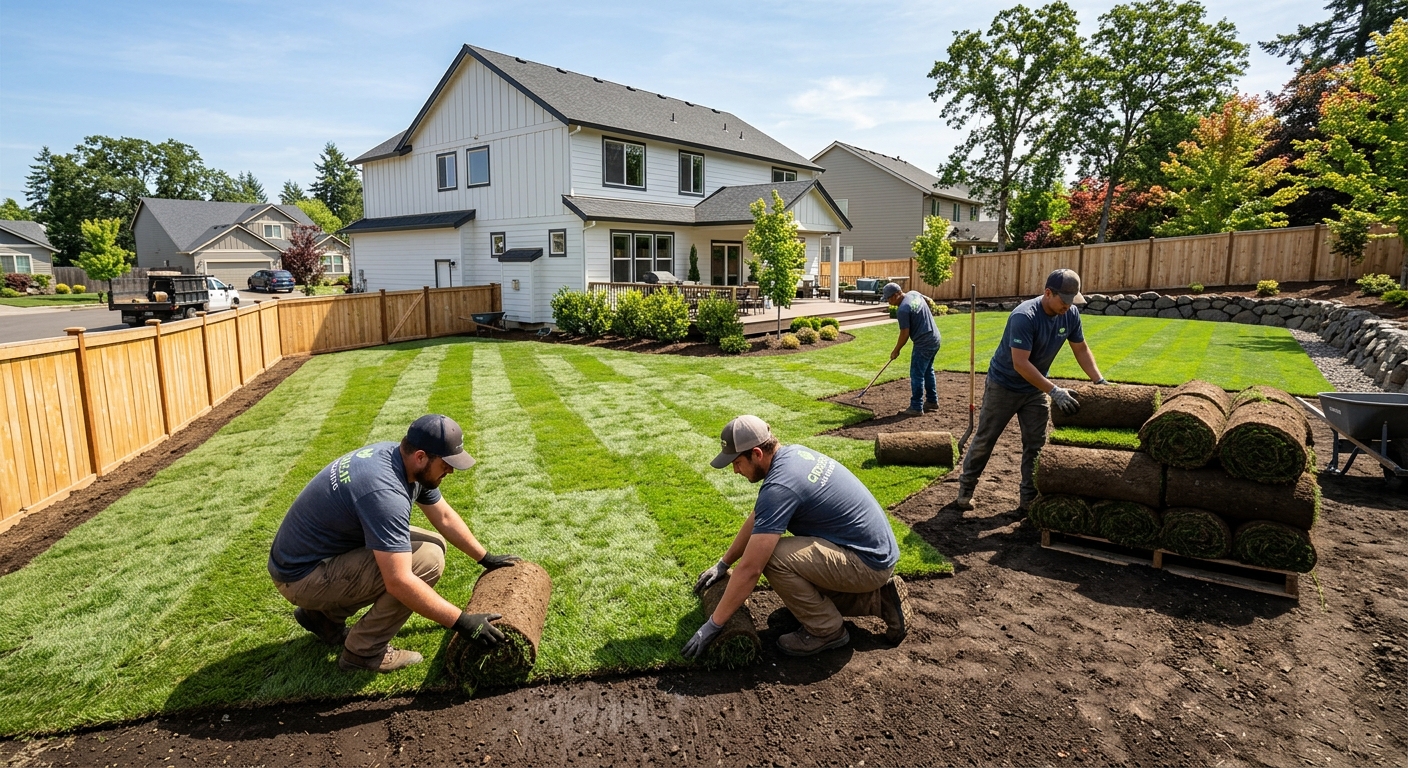
Site prep, minor grading for smoothness, base topsoil, turf supply, sod lay, rolling and initial watering plan |
Late April to early June; August to mid-September |
$2,500–$6,000 |
| Lawn seeding (grade, seed, starter fertilizer) |
Light grade corrections, seed bed prep, seeding, starter fertilizer, mulch/blanket (where specified) |
Early May and late August (frost-risk planning required) |
$1,500–$3,500 |
| Interlocking patio or walkway |
Excavation, deep compacted base, geotextile, sand bedding, stone setting, edging, and joint sand |
May to September |
$8,000–$28,000 |
| Retaining wall (interlocking block) |
Excavation to required depth, compacted granular base, drainage gravel + weeping system (as needed), block installation, backfill and seeding plan |
May to September (footing work needs workable ground) |
$12,000–$40,000 |
| Tree and shrub planting |
Soil amendments, plant supply (native/cold-hardy), planting, staking (if required), mulch ring, and first-season care guidance |
May to June; early fall planting when soil is workable |
$1,200–$7,500 |
Prices are estimates only and vary by project scope, site access and material selection.
What affects the price of landscaping in Canon Ridge
In Canon Ridge and the wider Calgary market, the same “basic” landscaping request can swing 30–50% between quotes because the work that protects your investment—grading depth, drainage layers, soil conditioning, and the right plant material for Zone 3–4—often gets underestimated. Contractors may also price labour differently depending on crew size and how many other jobs they’re stacking in the same week. In practice, labour commonly represents about 40–60% of a full landscape project, so crew scheduling and equipment access matter.
Zone 3–4 conditions also tighten the calendar. Late-spring frosts and early fall cold snaps limit planting windows, and freeze–thaw cycles are severe, which means retaining walls, patios, and walkways need deep, well-compacted bases to reduce heaving. That drives cost up when the project requires excavation for drainage and proper base depths. Calgary’s semi-arid climate—often with irrigation limits—pushes homeowners toward drought-tolerant plants and efficient zoned irrigation rather than high-water turf. In coastal BC (Zone 7–8), long growing seasons allow richer palettes, but heavy-rain drainage detailing can be just as critical; interior BC also often pushes drip systems. Southern Ontario’s Zone 5–6 season is typically longer, but summer dry spells still require watering planning.
Two concrete examples from yards around Canon Ridge: (1) If your downspouts or surface grading sends water toward the foundation, a contractor may add a drainage bed or French drain—often shifting the job from a mid-range patio to a higher interlocking scope within the $8,000–$28,000 band for hardscape when excavation and base layers expand. (2) If you choose mature trees or premium ornamental shrubs, a planting-only job can move from the $1,200–$7,500 planting range to the upper end due to plant size, hauling, and staking materials. Older housing stock also affects cost: if buried services or compacted subgrade are present, soil amendment and base repair can add thousands compared with a newer, untouched lawn.
| Price Factor |
Why It Matters |
Cost Impact |
| Yard size in sq ft — the primary cost driver for softscape |
More area means more excavation, topsoil, seed/sod, mulch, and plant count; it also increases labour hours and equipment time |
Large yards often move a project 20–40% upward in total |
| Grading and drainage work — slope corrections add significant cost |
Correcting slope and directing runoff protects foundations and prevents pooling, but requires excavation depth and hauling |
Can add several thousand depending on the cut/fill volume |
| Drainage bed or French drain installation |
Proper underdrainage needs perforated pipe, gravel, geotextile, and outlets that won’t freeze or back up |
Often one of the biggest “scope multipliers” in Calgary |
| Plant material tier — native shrubs vs. ornamental vs. mature specimen trees |
Hardy natives cost less per unit and establish faster; mature specimens cost more but can reduce “time to curb appeal” |
Can shift a planting budget by $2,000–$8,000+ |
| Hardscape vs. softscape ratio — walls and patios cost more per sq ft than lawn |
Patios and walkways require deep bases and compaction; walls need drainage detailing and structural considerations |
High hardscape projects commonly dominate the mid-to-upper bands |
| Irrigation system design and installation |
Zone-based watering and controllers reduce waste, but add design time and trenching costs |
Usually increases the total, especially when run distances are long |
| Soil amendment and topsoil required |
Compacted or sandy soils benefit from amendments for rooting; thin topsoil forces plants to struggle in dry spells |
Can add thousands when hauled in quantities are large |
| Tree removal or stump grinding before new planting |
Removal is equipment- and disposal-heavy, and it can open up additional grading needs |
May add a noticeable line-item even before you plant |
Permits & regulations in Alberta
In Alberta, many typical landscaping tasks—including planting beds, sodding, and most softscape work—generally do not require a permit. Most homeowners in and around Canon Ridge can usually proceed with things like mulch installs, shrub and tree planting, lawn seeding, and interlocking stone work without pulling a permit, as long as the work doesn’t meaningfully change drainage toward neighbouring properties or connect into storm infrastructure. However, retaining walls are the most common “permit trigger.” As a rule of thumb used in many municipalities, retaining walls above a threshold—often 1.0 m (3.3 ft)—require a building permit and sometimes engineered drawings depending on height, soil conditions, and design.
Step-by-step, here’s how to verify what matters for your specific project in Canon Ridge: (1) Confirm the wall height and the exact location and footprint; ask the contractor whether their scope includes permit pulling. (2) Before any digging for planting holes, irrigation trenches, or wall footings, request utility locates so crews don’t hit buried services. (3) Ask your contractor to explain how they’ll handle runoff and whether the final grading maintains drainage away from foundations. (4) While watering rules are often stricter during dry periods in the broader region, Alberta homeowners should still confirm local water-use bylaws with their contractor and municipality, particularly if irrigation is being added or upgraded.
For licensing and coverage: verify the contractor’s Alberta licence (when applicable to their trade category) through their business information and online listings, review a current certificate of liability insurance naming you as the certificate holder (or adding as required by your agreement), and confirm WCB/WSIB clearance where relevant for their workforce. Don’t accept verbal confirmation—ask for documents at quote stage.
Planning a landscape that thrives in Canon Ridge's climate
Planning for Canon Ridge’s climate means working with Prairie hardiness zone 3–4 realities: cold winters, wind, periodic drought, and freeze–thaw that punishes weak base preparation. Start with plant selection. Choose zone-appropriate, cold-hardy species and prioritize native or locally proven shrubs and perennials that recover well after winter stress. If you’re tempted to plant “pretty but borderline” varieties, you’ll pay for replanting sooner than you expect.
Sod versus seed is another decision tied to Calgary timing. Sod gives instant coverage and helps erosion control, but it’s typically more expensive per square foot than seeding. As a budget reality check, if you’re looking at lawn conversion, sod projects often land in the $2,500–$6,000 range for typical residential areas, while seeding projects commonly start around $1,500–$3,500. That extra cost can be justified when you need fast curb appeal, want quicker stabilization before winter, or have heavy foot traffic. If you can wait a season and keep the seed bed consistently moist early on, seeding usually stretches your dollars.
Drainage and grading are non-negotiable in Calgary. Pools near foundations, thaw flows, and downspout runoff can lead to foundation moisture—so plan for correct slope, and consider underdrains where needed. For patios and retaining walls, base preparation must reach below frost-impacted conditions with proper compaction and drainage gravel. Finally, design for low maintenance: mulch, groundcovers, and well-spaced perennials reduce annual upkeep. In Calgary’s water context, a xeriscape-inspired layout—stone accents, drought-tolerant plants, and zoned drip irrigation—can deliver strong curb appeal without chasing the hose every week.
| Element |
Climate Consideration |
Maintenance Level |
Price Band |
| Sod lawn installation |
Requires careful timing to avoid late-frost damage and proper watering during establishment; freeze–thaw makes base leveling critical |
Medium (watering plan + first-season monitoring) |
$2,500–$6,000 |
| Native perennial garden |
Zone-appropriate plants handle winter dieback and spring flush better; drought tolerance reduces irrigation demand |
Low to Medium (weeding first year, then light upkeep) |
$1,200–$5,500 |
| Mulched shrub border |
Wind and sun can dry borders; mulch stabilizes soil moisture and moderates temperature swings |
Low (spring cleanup and occasional top-ups) |
$1,000–$4,000 |
| Interlocking stone patio |
Severe freeze–thaw means a deep, well-compacted base and correct drainage away from the house |
Low (occasional joint sand refresh) |
$8,000–$28,000 |
| Retaining wall (block) |
Requires proper base depth and drainage layers to prevent frost heaving and water pressure build-up |
Low (inspection after first thaw seasons) |
$12,000–$40,000 |
| Drip irrigation system |
Efficient water delivery supports drought-tolerant planting in zone-appropriate beds; helps meet practical watering limits during dry periods |
Low (seasonal checks + controller updates) |
$2,000–$7,500 |
How to choose a landscaping contractor in Canon Ridge
Choosing a contractor in Canon Ridge is about verifying coverage, getting clear scope, and paying in a way that protects you if something goes wrong. Start with Alberta licensing and proof of insurance. Ask for their liability insurance certificate (current, with your address or you named as certificate holder if your contract requires it) and confirm WCB/WCB clearance for their workers where relevant—don’t rely on screenshots shown after the job starts. How to check: (1) verify the business details and any applicable registration through official online listings, (2) review the certificate of insurance expiry dates and policy details, and (3) request a clearance letter or equivalent documentation before work begins.
Next, get 2–3 itemised written quotes that separate labour and materials. You want line items like excavation quantities, base materials, geotextile, drainage gravel and pipe (if included), plant supply size, and irrigation components—not one lump sum. Read exclusions carefully: Ask whether disposal/haul-away is included, whether utility locates are arranged, and whether topsoil/top dressing is included to a specified depth. If permits are required for a retaining wall above the common 1.0 m threshold, confirm who pulls the permit and whether costs are included.
Warranty matters in freeze–thaw conditions. Ask for (a) workmanship warranty length for grading, base prep, and hardscape installation, (b) manufacturer/product warranties on irrigation components and materials, and (c) whether the warranty transfers to you as the homeowner. For payment, never pay more than 10–15% upfront. Use a holdback until key milestones are complete, such as inspection-ready grading, hardscape base verification, and final planting. Finally, insist on a start date and completion estimate in writing so you can coordinate winter access needs and lawn establishment timing.
- Confirm their Alberta business details match the quote and contract signatory.
- Request certificate of liability insurance and verify expiry dates before work starts.
- Ask for WCB/WCB clearance documentation for their crew, not just for the owner.
- Get 2–3 itemised quotes with labour and materials split line-by-line.
- Demand a written scope: excavation depth, base layers, and compaction method for patios/walls.
- Verify drainage plan details (outlets, slopes, underdrains) in writing.
- Confirm disposal/haul-away is included for soil and debris.
- Clarify topsoil depth, soil amendment type, and who supplies them.
- Ask whether utility locates are arranged and who pays.
- Check warranty terms for workmanship and products; ask if warranties transfer to you.
- Use a payment schedule with small upfront payment (10–15%) and holdback until completion.
- Get start date and a realistic completion window based on frost and weather risk.
Red flags in Canon Ridge include: (1) quotes that don’t mention base depth/compaction and drainage layers for patios or retaining walls, (2) “we always do it the same way” answers when your yard has grading issues, (3) refusing to provide proof of insurance or WCB/WCB clearance, (4) a payment request for a large deposit (beyond 10–15%) without a signed milestone schedule, and (5) no written scope or warranty language for workmanship—especially important given Alberta freeze–thaw.
Frequently asked questions — landscaping in Canon Ridge
How do I design a low-water yard in Canon Ridge?
For a low-water yard in Canon Ridge, design around Zone 3–4 plant hardiness first: choose drought-tolerant, cold-hardy shrubs and perennials that don’t require constant summer watering. Then reduce water-demand areas—replace high-water turf with mulched beds, groundcovers, and stone features. In practice, many Calgary-area homeowners also add a zoned irrigation plan using smart controllers and drip lines for beds while keeping any remaining lawn watered efficiently. If you’re starting from scratch, compare seeding budgets versus sod: seeding often comes in around $1,500–$3,500, while sod is typically higher at about $2,500–$6,000. That cost difference can be worthwhile if you need fast coverage, but for low-water designs, seeding or smaller sod zones can reduce long-term watering.
How do I find a licensed landscaper in Canon Ridge?
In Alberta, you’ll want to confirm two things: (1) applicable licensing/registration for the contractor’s trade category and business, and (2) coverage documentation that protects you. Ask the contractor for their current liability insurance certificate (verify dates and scope) and any WCB/WCB clearance documentation for their workers, then keep copies with your contract. To find qualified local pros, start by requesting references from Calgary-area installs and checking that their quote includes itemised base prep, drainage, and plant lists. When you receive proposals, compare them side-by-side: for example, a patio quote should describe the deep compacted base and drainage away from the home, not just “stone and labour.” For scope alignment, ask what permit handling is included if you’re considering a retaining wall above the common 1.0 m threshold.
How much does landscaping cost in Canon Ridge?
Landscaping costs in Canon Ridge typically land in the mid five figures when you combine grading, hardscape, planting, and irrigation—especially because freeze–thaw in Prairie zones requires proper bases and drainage layers. For budgeting, use the common bands: a full design and installation often starts in the $8,000–$30,000 range depending on site work and what’s included, while planting-only refreshes may fall around $1,200–$7,500. If you’re focused on turf, sod installation commonly sits around $2,500–$6,000 and seeding around $1,500–$3,500. Your final number depends heavily on yard size, how much grading/drainage is needed, and whether a retaining wall is involved. Given the weather window, it’s smart to plan early for May to September.
What plants thrive in Canon Ridge's climate zone?
Canon Ridge sits in Prairie hardiness zone 3–4, so the best performers are cold-hardy and wind-tough plants that tolerate drought between watering cycles. Your contractor should prioritize zone-appropriate species and often recommends natives or locally proven cultivars because they establish faster and are less likely to winter-kill. In landscaping designs, many Alberta homeowners pair hardy shrubs (for structure) with perennials and ornamental grasses (for texture) and then use mulch to stabilize soil temperatures. If irrigation is limited, you’ll get the best results from plants designed for semi-arid conditions. For best winter survival, choose plants that your contractor can supply in sizes proven for Alberta sites, and ensure planting timing aligns with frost-risk planning. Your plan should also include wind protection where the yard gets exposed.
Sod vs seed — which is better for a Canon Ridge lawn?
Sod and seed both work in Canon Ridge, but the “better” option depends on your timeline, how you’ll maintain establishment, and how much lawn area you’re covering. Sod is faster for visual results and can help stabilize soil quickly, which matters if you have erosion or foot traffic. However, it’s usually higher cost—often in the $2,500–$6,000 range—because it includes sod supply and more intensive installation. Seeding is typically less expensive, often around $1,500–$3,500, and it can be a strong option if you can manage early watering and patience while it establishes. In Alberta’s shorter season, seeding timing is critical to reduce frost risk. Many homeowners also blend approaches: sod for smaller high-use areas and seeding for the rest to balance cost.
How much does a retaining wall cost in Canon Ridge?
Retaining wall pricing in Canon Ridge commonly depends on height, length, required base depth, and drainage detailing—because freeze–thaw and water pressure make those layers essential. For a typical interlocking block retaining wall installation, expect a budget around $12,000–$40,000 in Alberta’s Calgary market. If the wall needs significant grading correction, underdrains, or excavation to reach the proper foundation depth, costs rise quickly. Permits can also apply: as a rule of thumb, walls above about 1.0 m (3.3 ft) in many municipalities usually require a building permit and sometimes engineering depending on conditions. Ask your contractor to itemise excavation, drainage gravel/weeping system, block supply, and backfill so you can compare quotes fairly.