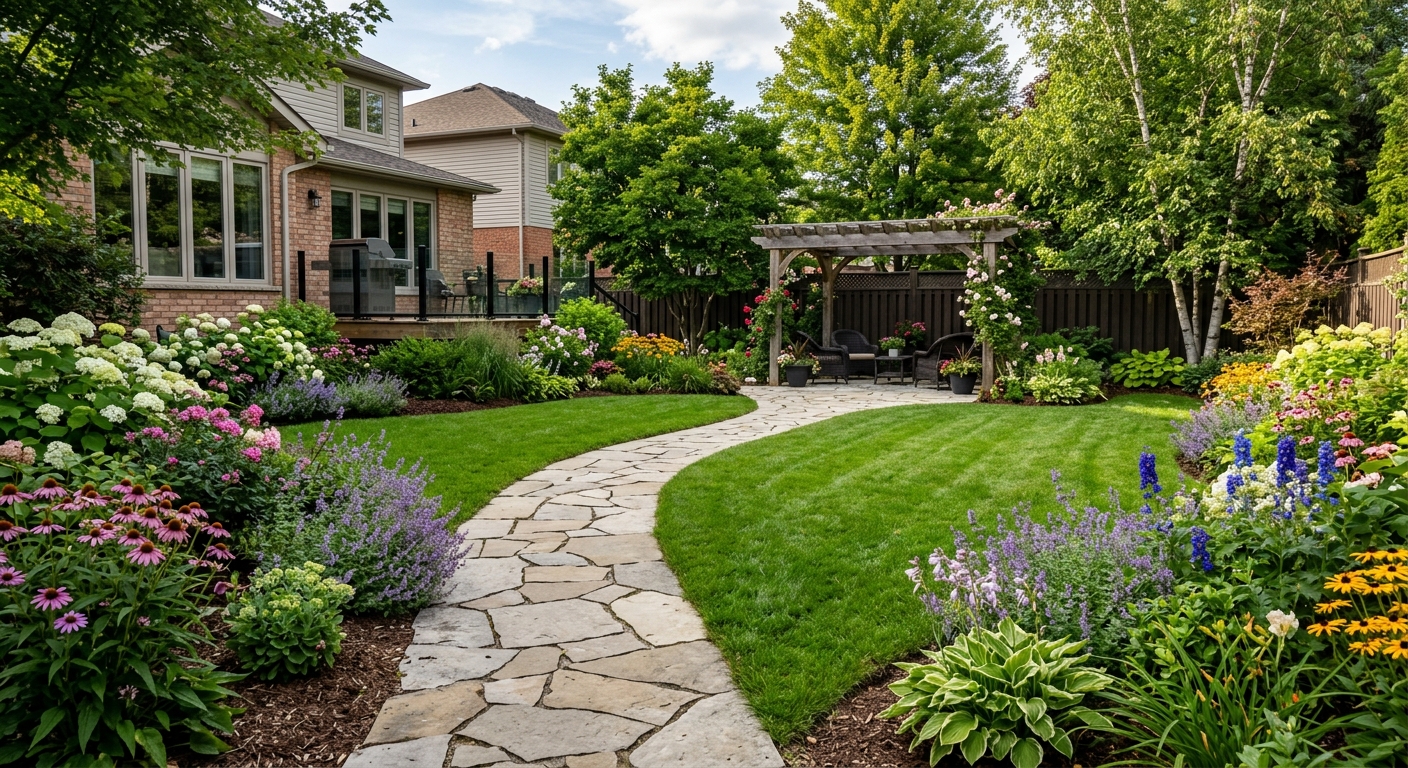
Landscaping options and costs in Deer Run
In Deer Run, Alberta, homeowners typically choose between softscape-first upgrades (lawn, planting, irrigation) and hardscape-driven makeovers (patios, walkways, retaining walls). With a population of 4,910 (Statistics Canada, 2021 Census), the area is community-sized rather than metro-fast, so contractor availability can vary week to week—especially in spring. Deer Run also has a housing mix where detached properties are common enough that many yards are built to expand: each detached lot tends to have the space and incentive to invest in upgrades that hold curb appeal through chinooks, hail, and intense UV.
Calgary and the surrounding Calgary economic region sit in Prairie plant hardiness zones 3–4, with late-spring frosts and early fall cold snaps. That climate compresses the working window and makes base preparation more important, because freeze–thaw cycles are severe. As a result, costs can swing based on access, grading depth, and how much drainage correction is needed before you install sod, patios, or retaining walls. On top of that, comprehensive projects often land in the mid five-figure range when grading, hardscape, planting, and irrigation are all included, which matches what many homeowners want after buying a newer or aging home and deciding they don’t want “band-aids.” Demand is especially strong around family-oriented pockets like Deer Run Estates, where yards get focused attention for school-season curb appeal.
Below is a practical comparison of common landscaping packages so you can align expectations before you book a site visit and move into a more detailed scope.
| Service |
Description |
Season |
Price Range |
| Full landscape design and installation |
On-site design, grading/drainage plan, hardscape + softscape coordination, soil amendments, planting, and irrigation (as required) |
Late spring to early fall (best results before hard freezes) |
$9,500–$32,000 |
| Sod installation (supply, grade, lay, roll) |
Minor to moderate grading, base prep, topsoil/seedbed conditioning as needed, sod supply and installation |
May to mid-September |
$1,800–$5,800 |
| Lawn seeding (grade, seed, starter fertilizer) |
Grading and raking, seed mix, starter fertilizer, light erosion control where required |
Spring and early fall |
$1,500–$3,900 |
| Interlocking patio or walkway |
Excavation, deep compacted base, edging, interlocking stone installation, jointing and clean-up |
Late spring to early fall |
$8,000–$28,000 |
| Retaining wall (interlocking block) |
Terrace/block wall layout, excavation and compaction, proper drainage layer/weep provisions, backfill and finish grading |
Late spring to early fall |
$11,000–$35,000 |
| Tree and shrub planting |
Plant layout, soil prep, fertilizer/soil conditioner, staking (if needed), and mulch rings/finishing |
Spring and fall planting windows |
$900–$13,500 |
Prices are estimates only and vary by project scope, site access and material selection.
What affects the price of landscaping in Deer Run
In Deer Run and the wider Calgary area, even “the same” landscaping job can come in 30–50% apart because contractors price for risk: hidden grading issues, the depth needed for freeze protection, and how much labour is required for hauling and compacting. Calgary’s building lots can vary dramatically in how quickly water drains, how steep the grade is, and how close you are to sidewalks, fences, or mature trees. That’s why lawn + planting quotes can diverge—base prep and soil correction are often underestimated until someone measures elevations on site.
Prairie plant hardiness zones 3–4 are a big driver. Late-spring frosts and early fall cold snaps limit the working window, so crews may need to complete drainage and base tasks fast to avoid damage from early freezes. Keeping retaining walls, patios, and walkways stable through severe freeze–thaw cycles also means base preparation must reach below the frost line with deep, well-compacted material and proper drainage. If you want a drought-tolerant planting approach for Calgary’s semi-arid conditions, you’ll also lean toward cold-hardy, wind-tolerant species—often with more planning time (so cost can rise even when plant material per shrub isn’t expensive).
Concrete examples from Deer Run: (1) A simple sod lawn can jump from mid-$1,500s to closer to $5,000+ when the contractor has to remove dead turf, re-grade, and improve drainage to prevent pooling after spring melt. (2) Adding a retaining wall where the site grade is steep typically pushes you into the $11,000–$35,000 band because the project requires excavation, deep compacted base, and a drainage layer—not just block placement. (3) If your yard needs soil amendment to support healthy roots before summer heat and chinook drying winds, you may see higher softscape costs alongside lower long-term replacement costs.
Finally, housing age plays a role: older properties often have settled soil or outdated drainage patterns, and correcting that can add thousands. When homeowners start from scratch and want design + installation, many land in the mid five-figure range—consistent with Calgary-wide project scopes that include grading, hardscape, planting, and irrigation.
| Price Factor |
Why It Matters |
Cost Impact |
| Yard size in sq ft — the primary cost driver for softscape |
More area means more topsoil amendments, labour time, mulch, and plant mass (or turf materials) |
Can shift total cost by several thousand dollars on the same “style” of yard |
| Grading and drainage work — slope corrections add significant cost |
Fixing pooling near foundations or walkways reduces future heaving and washouts |
Often adds a major portion of the budget on full installs |
| Drainage bed or French drain installation |
Freeze–thaw durability depends on moving water away from base materials |
Can add thousands depending on length and outlet complexity |
| Plant material tier — native shrubs vs. ornamental vs. mature specimen trees |
Specimens cost more upfront and can require additional staking/handling and bigger soil volumes |
Small planting jobs can double when you move into mature trees |
| Hardscape vs. softscape ratio — walls and patios cost more per sq ft than lawn |
Excavation, base depth, and compacted aggregate drive most hardscape pricing |
Often pushes projects into higher bands fast (patios/walls vs seeding) |
| Irrigation system design and installation |
Zoned systems and efficient controllers prevent overwatering and reduce failures |
Can be a mid-project line item, especially with drip + smart zoning |
| Soil amendment and topsoil required |
Quality soil supports root establishment through winter and summer stress |
Frequent on older lots; costs rise with import volume |
| Tree removal or stump grinding before new planting |
Removal adds time, disposal, and affects how planting beds are re-laid |
Common add-on that can move a planting budget by several hundred to thousands |
Permits & regulations in Alberta
In Alberta, most routine landscaping work—like planting beds, sodding, seeding, mulch installs, and general softscape grading—typically does not require a permit. Where homeowners should pay close attention is retaining wall height and drainage-related changes. In many municipalities, retaining walls above a height threshold (often 1.0 m / 3.3 ft) generally require a building permit and, in some cases, engineering drawings. If you’re planning a wall that’s meant to hold back more soil or sits closer to property lines, it’s even more important to confirm the requirement before digging.
Another area that can trigger approval is lot grading that changes drainage direction toward neighbouring properties or existing stormwater connections. If your plan includes rerouting surface runoff, deep drainage works, or major re-contouring, ask your contractor to outline exactly what they’ll do and whether any municipal approval is needed.
Always call for utility locates before digging planting holes, trenching for drainage, or excavating wall footings—this is essential for safety and to avoid utility damage. Also confirm local watering and water-use bylaws. Even though Deer Run is in Alberta (not the BC interior), drought restrictions and irrigation scheduling expectations can still apply during dry periods; smart controllers and zoned irrigation are usually the practical solution.
Homeowners in Deer Run can verify a contractor step by step: (1) ask for their Alberta business info and confirm the trade/registration status as applicable; (2) request a current certificate of liability insurance and confirm it covers landscaping/hardscape work; (3) confirm WSIB/WCB coverage where required for their workforce; and (4) request a clearance letter when appropriate. Don’t rely on verbal assurances—ask to see the documents before work begins.
Planning a landscape that thrives in Deer Run's climate
A yard that thrives in Deer Run starts by working with the Prairie climate—especially the frost pattern, wind exposure, and freeze–thaw cycles—rather than fighting it. Deer Run sits in Calgary’s Prairie zones (about 3–4), so your plant palette needs cold-hardy, drought-tolerant choices and a layout that reduces wind drying. I like to design with three goals: (1) plants that survive Alberta winters without constant replacement; (2) drainage that keeps foundation edges and hardscape bases dry enough to prevent heaving; and (3) an efficient irrigation approach so summer heat doesn’t stress new growth.
Sod vs. seed is a common decision point. Sod gives instant coverage but costs about 3–4 times more per sq ft than seeding because it includes supply and installation logistics. In contrast, seeding is slower but can be more budget-friendly when your grading is correct. If your lawn area is limited and you want immediate curb appeal, sod can still make sense—especially if drainage issues are resolved first. For example, a seeding approach might land near $1,500–$3,900 for typical backyard areas, while sod installed commonly runs around $1,800–$5,800, with the higher end often tied to re-grading and prep.
Drainage and grading are critical in Calgary, because pooling after snowmelt or heavy rain accelerates frost heaving under patios and walkway edges. For hardscape, proper base preparation to withstand the frost line and deep compaction are non-negotiable. Finally, low-maintenance design reduces annual upkeep without losing curb appeal: mulch, groundcovers, and perennials do the heavy lifting, while shrubs create year-round structure. Consider xeriscaping elements like layered rock + drought-tolerant perennials, or a rain-garden style swale that captures runoff—then pair it with zoned drip irrigation where you actually need it.
| Element |
Climate Consideration |
Maintenance Level |
Price Band |
| Sod lawn installation |
Needs reliable watering during establishment, then tolerates summer heat if roots establish before cold snaps |
Medium (watering schedule and occasional patching in first season) |
$1,800–$5,800 |
| Native perennial garden |
Better winter survival and wind tolerance; fewer failures after freeze–thaw when planted with quality soil and mulch |
Low to medium (spring cleanup + seasonal weeding) |
$2,500–$9,500 |
| Mulched shrub border |
Mulch buffers temperature swings at soil level and improves moisture retention |
Low (pruning once established, weed control during establishment year) |
$1,800–$7,200 |
| Interlocking stone patio |
Requires deep, well-compacted base and drainage to resist heaving |
Low (occasional joint maintenance) |
$8,000–$28,000 |
| Retaining wall (block) |
Must include drainage layer/backfill for freeze–thaw durability and soil pressure control |
Low (inspection and keeping drainage clear) |
$11,000–$35,000 |
| Drip irrigation system |
Zoned drip matches Calgary’s drought patterns and reduces waste vs. traditional spray |
Medium (seasonal checks, filter maintenance, winterization) |
$1,200–$6,500 |
How to choose a landscaping contractor in Deer Run
Choosing the right contractor matters in Deer Run because freeze–thaw performance is built during the base prep and planting details—not after the fact. Start with Alberta coverage verification. Ask for (1) proof of liability insurance (certificate of insurance showing the coverage amount and effective dates); (2) evidence they carry the correct WSIB/WCB coverage for their workers; and (3) their business registration details. If they can’t provide documents quickly, that’s a warning sign. When you review the paperwork, make sure the policy is current, the work type is covered, and the certificate lists your address/jobsite where applicable.
Next, request 2–3 itemised written quotes with a clear breakdown of labour and materials. A strong quote separates line items such as excavation, base aggregate supply, compaction, drainage additions (if any), stone/brick pricing, soil/topsoil delivery, mulch, and plant material. Avoid lump-sum-only quotes unless the scope is fully described and the exclusions are clearly listed.
Read the scope carefully: What’s excluded? Is disposal included for sod remnants and excavated material? Is utility locates included? Is a permit pull included if the project involves a retaining wall above the usual threshold? Confirm warranty terms in writing—workmanship warranty length, product/manufacturer warranty (and whether it transfers if you sell the home), and what “warranty service” actually includes.
On payment schedule, never pay more than 10–15% upfront. Use a holdback until the job is complete and deficiencies are corrected. Finally, get a written timeline with a start date and a realistic completion estimate based on typical working conditions in Calgary-area weather.
- Ask for Alberta insurance certificates before scheduling excavation.
- Confirm WSIB/WCB coverage documentation for any crew doing the work.
- Require itemised labour/material quotes (no vague “misc.” lines).
- Insist on written scope for grading, drainage, and base depth for hardscape.
- Confirm whether disposal/hauling is included for sod removal and excavation.
- Verify that utility locates are ordered before digging.
- Ask who provides topsoil/soil amendment and what spec/quality is used.
- Check whether irrigation is included, and if so, request a zoning plan.
- Get the plant list (species, size, and quantity), not just “shrubs.”
- Confirm installation timing windows for planting and sod/seed.
- Review warranty: workmanship length and product warranty specifics.
- Use a payment schedule with a holdback until walk-through completion.
In Deer Run, four to five concrete red flags: (1) a quote that skips grading/drainage details but proposes hardscape anyway; (2) refusal to provide insurance/WSIB/WCB proof; (3) no written base prep specification (depth/compaction) for patios or retaining walls; (4) requesting heavy upfront payment beyond 10–15%; and (5) vague scope language like “permit as needed” with no clear responsibility for permit pulling.
Frequently asked questions — landscaping in Deer Run
What is xeriscaping and does it suit Deer Run?
Xeriscaping is a landscape approach that reduces water use through plant selection, soil improvement, and smart irrigation design. In Deer Run and the Calgary region (zones 3–4), it’s a strong fit because summers can be dry and wind-drying, and freeze–thaw makes long-term soil health important. Instead of high-water turf, xeriscaping uses drought-tolerant, cold-hardy plants, mulch, and in many cases drip irrigation with zoned control. When properly designed, it can also look lush in spring and structure the yard year-round. If you’re comparing options, many homeowners still choose a small sod “entry band” for instant curb appeal, while the rest becomes low-water planting, which can help manage costs within typical ranges like $1,800–$5,800 for sod installations depending on prep.
How do I plan a low-maintenance yard?
Start by planning for Edmonton-style “busy season” reality of Alberta—short planting windows, cold snaps, and freeze–thaw demands—so you’re not constantly redoing poor drainage. In Deer Run, low maintenance usually means: fewer plant varieties with proven hardiness, mulch to reduce weeds, groundcovers instead of bare soil, and a drainage-first layout so you aren’t constantly patching where water sits. Consider a native perennial garden or mulched shrub border for durable structure, then add hardscape where you want clean, dependable edges (patios/walkways). If turf is desired, seed where you can maintain it during establishment and reserve sod for key visual areas. A typical “softscape-forward” planting scope can land near $900–$13,500 depending on quantities and whether irrigation is included.
How deep should a retaining-wall base be for local frost?
For retaining walls in the Calgary/Deer Run area, the key is that the wall base and backfill system must be built to withstand severe freeze–thaw cycles and soil pressure. Practically, this means your contractor should excavate to stable material, then place a properly sized and compacted base aggregate layer and install a drainage layer behind the wall (often with weep provisions) so water doesn’t build up and freeze. There isn’t one universal depth number that fits every wall height and soil condition, because frost depth, soil type, and wall height influence the required build-up and engineering details. That said, experienced contractors plan base prep to go below the frost-affected zone and to reach well-compacted material, which is why detailed grading and compaction steps strongly affect cost and performance. If your wall is near the permit threshold, confirm engineering requirements in advance.
How much does professional landscape design cost?
Professional landscape design in the Calgary area is often bundled into installation packages, especially for comprehensive projects. Where design is quoted separately, many homeowners still end up paying a portion of design costs that’s applied toward installation if you proceed—so the value shows up as planning efficiency (better layouts, correct plant choices, and fewer change orders). In Deer Run, design matters because prairie climates demand cold-hardy, drought-tolerant selections and careful drainage/grading decisions. When design and installation are combined, the total project budget commonly fits within the landscape design & installation range of $9,500–$32,000, depending on hardscape scope, irrigation, grading depth, and plant quantities.
How do I compare landscaping quotes?
To compare quotes in Deer Run, don’t just look at the total. Compare the scope line by line: what’s included in excavation and disposal, how base prep is described for patios/walls, whether drainage upgrades are part of the plan, and whether irrigation design (including zoning and controller) is included or excluded. A good quote lists materials with quantities and specs—stone thickness, aggregate type, soil amendments/topsoil, and plant sizes—so you can verify you’re getting comparable work. Also check timing: in Prairie zones 3–4, installing too late in fall or without proper freeze protection can lead to failure. If one quote claims sod for a similar lawn area but skips re-grading or drainage, it may look cheaper upfront but cost more later. Use realistic price anchors like the sod range $1,800–$5,800 and planting range $900–$13,500 to test whether the quote details make sense.
How long does a landscaping project take in Deer Run?
Project duration in Deer Run depends on the number of crews, how much excavation is needed, and how much planting and base work must be done within the workable season. In Calgary’s Prairie climate, the goal is to complete base and drainage work before weather turns sharply colder, because freeze–thaw can disrupt improperly finished surfaces. As a rule of thumb, planting-only projects may take days, while hardscape projects are longer because excavation, deep compaction, base checks, and curing/jointing steps all take time. Full landscape design and installation projects that include grading, interlocking stone, retaining walls, planting, and irrigation can take several weeks to a few months depending on material lead times and weather windows. If permits are required for larger retaining walls, add time for municipal review and scheduling. Ask your contractor for a written start date, interim milestones, and completion estimate.