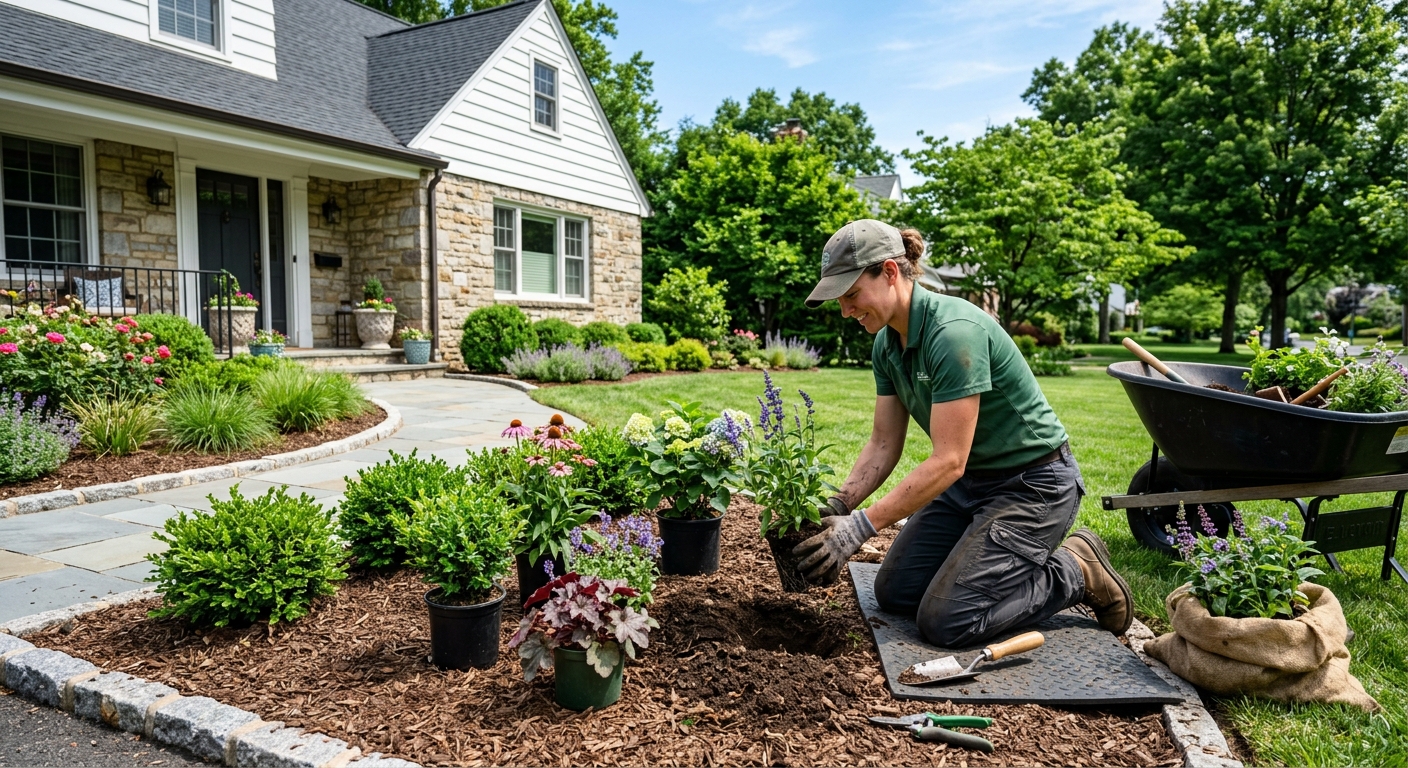
Landscaping options and costs in St. Albert
Landscaping in St. Albert usually starts with what you’re trying to fix or improve—curb appeal, drainage, usable lawn space, or a backyard that actually works in summer. With 68,232 residents (Statistics Canada, 2021 Census) and 82.9% of households owning their homes, many homeowners in established neighbourhoods invest once, then expect the yard to look good for years. St. Albert also has a housing mix dominated by single-detached homes (70.4% of dwellings), so there’s often room for softscape, trees, and multi-stage hardscaping.
Pricing and timelines here are driven by the Edmonton-area climate: a short prairie growing season, freeze-thaw cycles, and periodic dry spells during establishment. That combination affects labour availability (contractors concentrate work in spring and early fall) and increases the importance of proper base preparation, drainage, and plant selection. Projects that require significant grading, haul-away, or engineered drainage detailing take longer and cost more because they’re less forgiving when winter freeze approaches.
Demand is especially steady around older, mature areas and long-established family communities—many homeowners in places like Riel/Plamondon-style suburban corridors (and comparable St. Albert neighbourhoods with larger lots and older landscapes) upgrade tired lawns, add retaining features, and replace plants that struggled in past winter seasons. With that context in mind, the table below shows typical scope-based options and price ranges you’ll see from local firms.
| Service |
Description |
Season |
Price Range |
| Full landscape design and installation |
Site assessment, layout, plant palette, grading/drainage concept (if needed), hardscape/softscape build-out and finish |
Late spring to early fall |
$8,000–$45,000 |
| Sod installation (supply, grade, lay, roll) |
Remove/prepare top layer, rough grade and compact, soil amendments as needed, sod supply and installation, first watering plan |
May to September |
$3,000–$8,000 |
| Lawn seeding (grade, seed, starter fertilizer) |
Fine grading, seed blend, starter fertiliser and mulch blanket where appropriate, light rolling and watering guidance |
Early spring or early fall |
$1,800–$6,000 |
| Interlocking patio or walkway |
Excavation, base (crushed gravel) and compaction, edge restraints, interlock/pavers, jointing sand, cleanup |
Late spring to fall |
$6,000–$28,000 |
| Retaining wall (interlocking block) |
Layout and setback, excavation, geogrid/base build, wall blocks, drainage layer (weep holes/aggregate), backfill and finish |
Late spring to fall (weather-dependent) |
$45–$120 |
| Tree and shrub planting |
Soil prep, planting holes, amendments, staking where needed, mulch ring, initial watering schedule and staking adjustments |
Spring and early fall |
$500–$5,000 |
Prices are estimates only and vary by project scope, site access and material selection.
What affects the price of landscaping in St. Albert
In St. Albert and the wider Edmonton region, it’s common to see quotes for the “same” landscaping idea come in 30–50% apart. The reason isn’t just branding or overhead—it’s scope, site conditions, and how thoroughly the contractor prices the hard parts: grading, soil correction, drainage, hauling, and the base-building work that protects everything through freeze-thaw. Local market demand also shifts labour availability during short prairie work windows, which can tighten scheduling and raise crew-day rates.
Hardiness and timing affect both what you can install and when work is practical. Prairie conditions (commonly aligned with a Zone 2–4 approach) mean a short growing season and exposure to winter lows plus drying wind. That pushes contractors toward drought-tolerant, wind-hardy plant palettes and requires careful planting dates so roots establish before ground freeze. For retaining walls and other structural hardscape, base depth typically needs to extend below the frost line conceptually, and drainage has to be detailed so water doesn’t freeze behind the wall. By contrast, coastal BC (Zone 7–8) supports a longer growing season and more lush plant choices, but typically demands strong drainage planning in heavier rainfall areas; similarly, southern Ontario (Zone 5–6) has a more moderate season and often a different irrigation demand pattern during summer dry spells.
Two practical St. Albert examples: (1) a simple interlocking walkway can stay closer to the lower end of the hardscape band when the base is already uniform, but it jumps toward the upper end when you need significant excavation and haul-away. (2) sod may be budgeted near the lower end of the $3,000–$8,000 range for a modest lawn, but if you need regrading, additional topsoil and soil amendments, the job starts to overlap the “full project” reality in the $8,000–$45,000 design/install band.
| Price Factor |
Why It Matters |
Cost Impact |
| Yard size in sq ft — the primary cost driver for softscape |
More area increases materials, prep time, and labour hours; softscape is usually priced by coverage and site condition. |
Low to high impact (often the biggest variable) |
| Grading and drainage work — slope corrections add significant cost |
Proper surface slopes direct water away from foundations; fixing low spots and recontouring is labour-intensive. |
Can add substantial cost, especially on uneven lots |
| Drainage bed or French drain installation |
Interior moisture issues and pooling require aggregate trenches, perforated pipe, and outlet detailing. |
Moderate to very high (complex sites) |
| Plant material tier — native shrubs vs. ornamental vs. mature specimen trees |
Hardier native/region-appropriate plants cost less and establish faster; large caliper trees cost more and may need additional labour. |
Moderate to high depending on specimen sizing |
| Hardscape vs. softscape ratio — walls and patios cost more per sq ft than lawn |
Excavation, base, compaction, and pavers/blocks typically cost more than seeding or mulch installs. |
Often shifts a job upward quickly |
| Irrigation system design and installation |
Efficient zoning and winter-safe components increase upfront cost but protect plant establishment in prairie drought cycles. |
Moderate to high |
| Soil amendment and topsoil required |
Poor native soils may need organic amendments and quality topsoil to support turf and root development. |
Low to high based on soil testing and haul volume |
| Tree removal or stump grinding before new planting |
Access, stump size, disposal, and risk controls drive labour and equipment time. |
Moderate to very high (site-dependent) |
Permits & regulations in Alberta
In Alberta, most backyard planting and typical softscape work—like sodding, seeding, mulch installs, and planting trees and shrubs—usually does not require a permit. Retaining wall projects are different: walls above a common height threshold (typically around 1.0 m (3.3 ft) in many municipalities) often trigger a building permit, and in some cases engineered drawings. Because the details can vary by location and design, the safest approach in St. Albert is to ask the contractor to confirm whether a permit is required for your specific wall height and build type before work begins.
Also note that changing lot grading can be regulated when it affects drainage direction toward neighbouring properties or storm sewer connections. Even if the work looks “landscaping-only,” contractors may need approval when the plan changes how water flows after rainfall and melt. Before any digging for planting holes or wall footings, confirm utility locates (for example, via 811) to avoid damaging buried services.
For irrigation, don’t assume “everyone does it the same way.” Confirm applicable water-use rules for Alberta communities and follow drought-smart scheduling—especially during dry periods. Finally, verify your contractor: check their Alberta business and licensing details online (where applicable), request a current certificate of insurance naming you/your property (or providing liability coverage), and ask for their WCB/WSIB clearance information for workers on site. A legitimate company should provide documentation quickly and in writing.
Planning a landscape that thrives in St. Albert's climate
Planning a landscape for St. Albert is about working with the local growing season and frost behaviour rather than fighting it. Most yards here experience freeze-thaw cycles, so drainage and base preparation need to protect both plants and structures. Start with plant selection: choose zone-appropriate, region-tested trees, shrubs, and perennials that can handle prairie winter conditions and summer moisture stress. Drought-tolerant species and practical winter protection (mulch, windbreak placement, and correct spacing) reduce spring failures.
Sod vs. seeding is another key decision. Sod gives instant coverage and a quick “finished look,” but it generally costs far more per sq ft than seeding and still needs consistent establishment watering. In Edmonton-area terms, it’s common to see sod budgets land in the $3,000–$8,000 band depending on lawn size and soil prep; seeding budgets can be noticeably lower when grading is straightforward. If you need a lawn quickly for a family schedule, the cost can be justified—especially on front lawns where curb appeal matters immediately. If your timeline is flexible (early spring or early fall), seeding can deliver strong results at lower total cost with the right seed blend and care.
Don’t overlook drainage and grading. Pooling near foundations is expensive later—standing water can harm turf and encourage foundation moisture. For hardscape, base prep and edges matter for frost stability; patios and walkway bases must be compacted correctly so the surface doesn’t heave. For low-maintenance design, lean on groundcovers, mulched shrub borders, and hardy perennials that don’t require constant replanting. Xeriscape-style planting and rain-garden concepts can also help manage runoff and reduce ongoing watering, which fits the drier prairie stretch you’ll feel during establishment.
Example: If sod is coming in near the middle of the $3,000–$8,000 range for a small front lawn, spending an extra amount on grading and a drainage-friendly subgrade can prevent recurring “squishy spots.” That’s usually money well spent versus repeatedly resodding the same area.
| Element |
Climate Consideration |
Maintenance Level |
Price Band |
| Sod lawn installation |
Needs establishment watering; freeze-thaw stability depends on base prep and compaction. |
Medium (first season focused) |
$3,000–$8,000 |
| Native perennial garden |
Region-appropriate plants handle winter and dry stretches with less winter protection. |
Low to medium |
$1,500–$6,000 |
| Mulched shrub border |
Mulch helps regulate soil temperature and moisture during freeze-thaw cycles and summer heat. |
Low |
$1,200–$5,000 |
| Interlocking stone patio |
Base thickness and slope are critical to prevent heaving and water pooling. |
Low |
$6,000–$28,000 |
| Retaining wall (block) |
Proper drainage behind the wall reduces freeze pressure; base depth supports frost stability. |
Low |
$45–$120 |
| Drip irrigation system |
Efficient water delivery supports drought-tolerant plants; seasonally manage/hibernate for winter. |
Medium (annual checkups) |
$2,000–$10,000 |
How to choose a landscaping contractor in St. Albert
Choosing a contractor in St. Albert comes down to proof and process, not just the price on the first page. Start with Alberta compliance and safety documentation. Ask for their liability insurance certificate and review that it’s current, covers the work being done, and is appropriate for the scope (especially if they’re building hardscape or operating equipment). For worker coverage, ask for their WSIB/WCB clearance (or equivalent proof) and confirm it applies to the crew that will actually be on your property. A reputable company will provide these quickly—don’t accept “we’ll get it later.”
Next, get 2–3 itemised written quotes rather than one lump sum. You want a labour + materials breakdown and clear quantities—how many sq ft of sod, how many tonnes of gravel, what base depth, what soil amendments, what irrigation components, and whether disposal is included. Read the scope carefully: is the permit pull included where required (often for retaining walls above the height threshold) or is it your responsibility? Confirm what’s excluded: tree removal, topsoil delivery, utility locates, snow management during installation windows, and cleanup at completion.
Warranty matters too. Ask for the workmanship warranty length, the manufacturer warranty terms for products, and whether warranties are transferable if you sell the home. For payment, never pay more than about 10–15% upfront; use a holdback until the job is fully complete and final touches are done. Finally, insist on a written timeline with a start date and completion estimate—weather can affect Edmonton-area work, but you should still get a clear plan.
- Ask for Alberta licensing/business details and confirm the company name matches the quote and invoices.
- Request a current certificate of liability insurance before signing.
- Get WSIB/WCB clearance proof for workers who will be on your site.
- Require itemised pricing: quantities, unit rates, and what’s included in each line.
- Confirm disposal/haul-away: soil, sod waste, stump grind debris, and old pavers.
- For hardscape, require base build details (type of gravel, compaction approach, thickness).
- For retaining walls, confirm drainage layer specs (weep holes/aggregate) and wall setback.
- Ask who handles utility locates (and that they’ll dig only after locates are marked).
- Get a written start date, target completion date, and how delays will be communicated.
- Clarify watering/establishment guidance for sod and new plantings.
- Ask about warranty coverage for workmanship and product/manufacturer guarantees.
- Use a payment schedule with a small initial deposit and holdback until final walkthrough.
Red flags in St. Albert include: (1) a quote that’s only a lump sum with no quantities or base specs, (2) refusing to provide insurance or WSIB/WCB clearance, (3) promising work without a written schedule or not acknowledging freeze-thaw timing, (4) skipping drainage details behind walls or bluffing on permits where walls exceed typical thresholds, and (5) asking for a large upfront payment well beyond 10–15%.
Frequently asked questions — landscaping in St. Albert
What is xeriscaping and does it suit St. Albert?
Xeriscaping is a design approach that uses drought-tolerant plants, efficient irrigation (often drip), mulch, and smart grading to reduce water use—without sacrificing curb appeal. In St. Albert (Edmonton region), it suits many yards because summer moisture can be inconsistent and prairie winds can dry plantings out during establishment. Start with hardy, zone-appropriate species, then group plants by watering needs so you don’t overwater everything. If you’re budgeting, xeriscaping can sometimes lower long-term maintenance, though installation still depends on hardscape and soil prep. For reference, if you’re comparing options, a full design and installation often lands in the $8,000–$45,000 band, while targeted planting and mulch borders can be much smaller-ticket in the $500–$5,000 planting range.
How do I plan a low-maintenance yard?
A low-maintenance yard in St. Albert is planned around three ideas: fewer plant types that match the climate, stronger foundations for drainage, and surfaces that don’t need constant rework. Choose plants that are winter-tolerant and drought-tolerant, then use mulch and groundcovers to suppress weeds and stabilize soil temperature through freeze-thaw. For turf, decide early whether you want sod (instant results, typically $3,000–$8,000 depending on area and prep) or seeding (usually lower cost, but it needs time and consistent watering). Low-maintenance also means addressing drainage: pooling areas often lead to recurring patching and extra labour. Finally, simplify hardscape patterns and ensure proper base preparation so patios and walkways don’t heave as the ground expands and contracts.
How deep should a retaining-wall base be for local frost?
For St. Albert and the Edmonton region, retaining walls must be built on a stable, well-drained base that accounts for freeze-thaw movement. The exact depth depends on wall height, soil conditions, and the engineering spec for your block system, so there isn’t one universal “magic number” you should rely on. That said, contractors commonly design footings/base depths to extend below the frost-affected zone (conceptually “below frost line”) and to include compacted granular layers plus drainage behind the wall. This is also where permits can come in: walls above a typical ~1.0 m threshold in many municipalities often require a building permit and sometimes engineered drawings. Ask your contractor for their base/build section details and how they handle drainage to prevent freeze pressure behind the wall.
How much does professional landscape design cost?
Professional landscape design costs vary based on whether you’re getting a simple layout plan or a full design-to-install package with detailed plant schedules and construction-ready drawings. In the St. Albert/Edmonton market, homeowners often see integrated design & installation budgets in the $8,000–$45,000 range, especially when grading, drainage, and hardscape are included. If your project is mainly softscape refresh (planting, mulch, small borders), costs can fall closer to the $500–$5,000 tree and garden planting band plus additional labour. If you want a clearer comparison, ask for itemised quote line items: design scope, revisions, and what’s included before installation begins. A good contractor will explain how their design choices match local freeze-thaw conditions and prairie moisture stress, not just aesthetics.
How do I compare landscaping quotes?
To compare landscaping quotes in St. Albert, force like-for-like scope. Ask each contractor to provide itemised quantities and unit rates (sq ft of sod, tonnes of gravel, base thickness, number of plants by size, irrigation components if included) rather than comparing only total price. Confirm what’s included: disposal/haul-away, soil amendments/topsoil, permit pull (where required), utility locates, and cleanup. Check workmanship details: hardscape should specify base prep and compaction; retaining walls should specify drainage layers behind the wall. Don’t ignore payment terms and warranty length—these can signal whether the contractor will stand behind freeze-thaw performance and settlement over time. If one quote is much lower than the others, it may be cutting drainage or base-building specs that protect your investment.
How long does a landscaping project take in St. Albert?
Timelines in St. Albert depend on season, weather, and scope, because freeze-thaw cycles and a short prairie growing window limit when certain tasks can be done well. Most sod and planting work is planned for late spring through summer, while early fall can work for planting depending on soil conditions and weather. A small planting and mulch refresh might be done in days, while a larger full design and installation with grading/drainage and hardscape can take several weeks including prep, base work, materials lead times, and curing/settling periods for turf and stone. If your project includes interlocking patios or retaining walls, construction time typically increases because of excavation, base compaction, and drainage detailing. Your contractor should provide a written start date and completion estimate and explain weather contingencies.