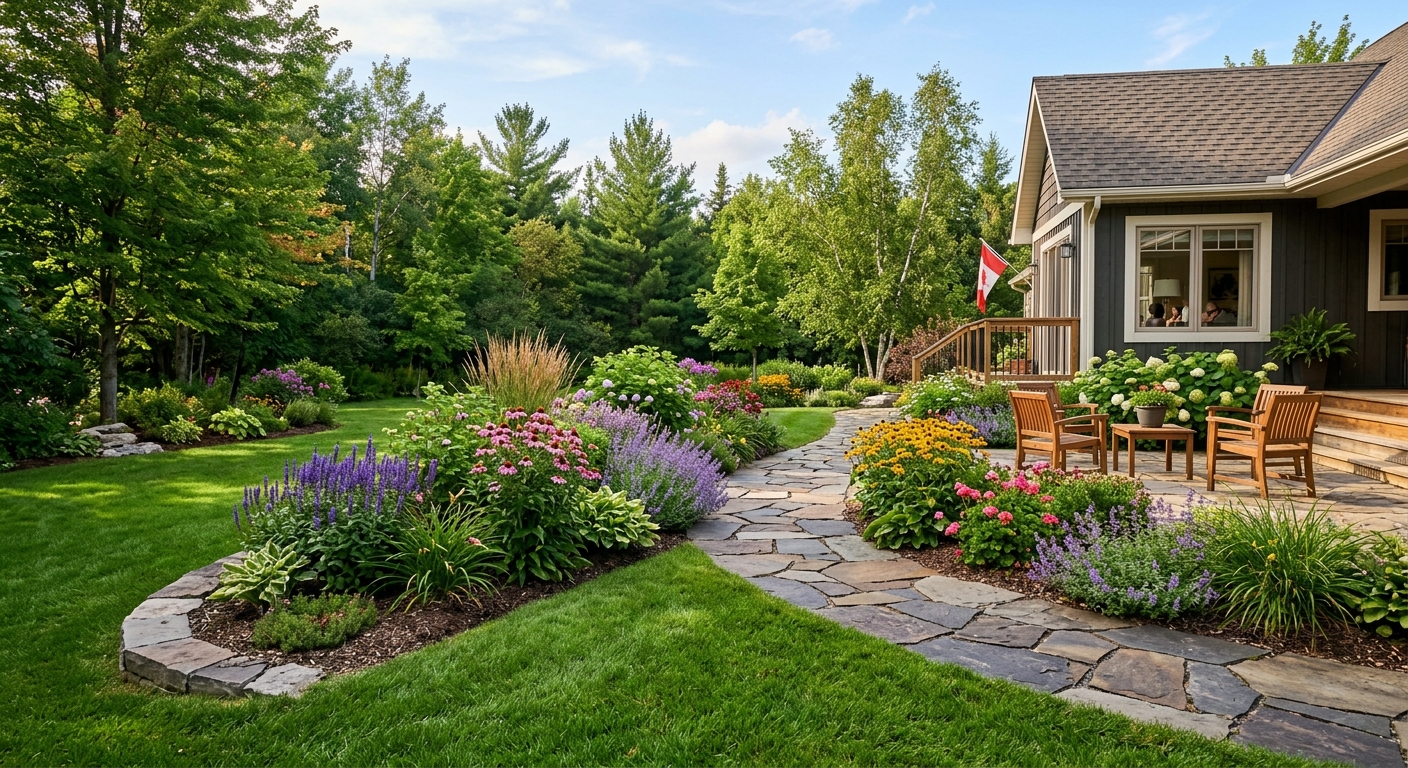
Landscaping options and costs in Delbrook
Delbrook homeowners often start with a simple question—what will landscaping cost? With Delbrook’s smaller local population of 2,497 residents (Statistics Canada, 2021 Census), most neighbourhood-scale projects are relationship-driven: contractors schedule jobs carefully because crews can be spread across the Lower Mainland–Southwest, not just one street at a time. It also helps that detached homes are common in the broader area, and detached properties typically have more yard space and a bigger “return” motive for improvements, which supports higher demand for layered planting, patios, and privacy screening.
In the Lower Mainland–Southwest (plant hardiness zones 7–8), mild, wet winters and long, cool summers create a longer working and growing season than many parts of Canada. That means you can often complete softscape sooner and achieve better rooting for new plants. Costs still reflect real site work: heavy rainfall events increase the need for proper grading and drainage to prevent pooling near foundations, and structural work must still account for freeze–thaw cycles so retaining walls and bases don’t shift.
In Delbrook, demand is especially strong around the Capilano area and other hillside-adjacent pockets where slopes and foundation moisture management drive the scope. If you’re comparing options, use the following price ranges as a starting point before you request itemised quotes for your exact lot conditions.
| Service |
Description |
Season |
Price Range |
| Full landscape design and installation |
Site visit, layout, planting plan, hardscape/softscape build, and supervision |
Mar–Nov (most common), softscape often possible off-season |
$5,000–$50,000 |
| Sod installation (supply, grade, lay, roll) |
Soil prep, grading, sod delivery, installation, rolling, initial watering guidance |
Apr–Oct (best rooting); protected installs may extend slightly |
$2,000–$8,000 |
| Lawn seeding (grade, seed, starter fertilizer) |
Top-dressing/grade correction, seed selection, starter fertilizer, light raking |
Mar–Jun and Aug–Sep |
$1,500–$5,500 |
| Interlocking patio or walkway |
Excavation, base and compaction, leveling, pavers, edging, sealing (optional) |
Apr–Nov (structural work prefers drier weeks) |
$8,000–$35,000 |
| Retaining wall (interlocking block) |
Wall layout, block and caps, drainage/gravel behind, base preparation |
Apr–Nov |
$12,000–$65,000 |
| Tree and shrub planting |
Planting holes, amendments, staking (as needed), mulch rings, watering plan |
Mar–Nov; container plants often allow flexibility |
$1,200–$14,000 |
Prices are estimates only and vary by project scope, site access and material selection.
What affects the price of landscaping in Delbrook
The same landscaping job can come in 30–50% apart in Lower Mainland–Southwest compared with other parts of British Columbia because the “hidden” variables drive labour and materials. Quote differences often come down to soil conditions, drainage complexity, the labour hours needed for access (tight gates, slope work, or hauling), and how much design/adjustment time the crew builds into the estimate. In practice, two contractors may both price “a patio and planting,” but one may include drainage correction and soil amendments while the other assumes existing grades are fine.
Local climate and season planning matter, too. Delbrook sits in plant hardiness zones 7–8 with early spring frosts that are typically in the March to early April window near the coast, and first fall frost often not until November. That long runway supports lush palettes, but it doesn’t eliminate the need to work efficiently around wet periods. If a site needs freeze–thaw-ready hardscape base prep, retaining-wall costs trend toward the higher end of the $10,000–$80,000 band because base depth, proper drainage gravel, and compaction are labour-intensive. Meanwhile, softscape costs may look “lower” if you can seed and build layers of perennials that establish quickly in mild conditions.
Concrete examples from Delbrook: (1) a slight slope that drains toward the foundation can add grading and drainage bedding, pushing a simple refresh toward design-and-install ranges such as $5,000–$50,000; (2) installing mature specimens (larger caliper trees or big boxed shrubs) adds procurement and handling costs; (3) yards with poor soil structure often require topsoil and compost amendments to support new sod or seeding.
| Price Factor |
Why It Matters |
Cost Impact |
| Yard size in sq ft — the primary cost driver for softscape |
More area means more soil prep, seed/sod, mulch, and labour hours |
Often the biggest swing; can shift the job by $2,000–$15,000+ |
| Grading and drainage work — slope corrections add significant cost |
Correcting slopes prevents pooling and foundation moisture |
Commonly adds $1,500–$10,000+ depending on earthworks |
| Drainage bed or French drain installation |
Addresses downspout/low-spot saturation and slow-draining soils |
Often adds $2,500–$12,000+ |
| Plant material tier — native shrubs vs. ornamental vs. mature specimen trees |
Plant size and source affect both material price and transplant labour |
Can add $1,000–$8,000+ over “standard” planting |
| Hardscape vs. softscape ratio — walls and patios cost more per sq ft than lawn |
Pavers, base, labour and finishing are typically higher-cost than seeding |
Shifts the overall budget up quickly—often by $5,000–$25,000+ |
| Irrigation system design and installation |
Smart controllers/drip reduce water waste and support even establishment |
Typical add-on $1,500–$7,500+ |
| Soil amendment and topsoil required |
Improves rooting and helps sod/seed establish; compensates for compacted soils |
Often adds $500–$6,000+ |
| Tree removal or stump grinding before new planting |
Stump grinding clears planting space and prevents future root issues |
Can add $800–$6,000 depending on size/haul distance |
Permits & regulations in British Columbia
In British Columbia, most planting, sodding and day-to-day softscape work typically does not require a permit. That usually includes tasks like installing sod, seeding, planting shrubs and trees, and placing mulch and groundcover. Many homeowners also schedule stone borders, walkway improvements, and garden edging without permits as long as you aren’t changing major drainage patterns.
Where permits do come up is with structural retaining walls and any work that could impact drainage and neighbouring flow. Retaining walls above a height threshold—commonly 1.0 m (3.3 ft) in many municipalities—often require a building permit, and sometimes engineered drawings depending on design and soil conditions. Also, if you change lot grading in a way that redirects stormwater toward neighbouring properties or storm sewer connections, approval may be required.
Before digging planting holes, drain lines, or wall footings, call for utility locates to avoid hitting gas, power, or telecom lines. For irrigation, confirm water-use bylaws and any restrictions that may apply; even though Delbrook isn’t as water-scarce as the BC Interior, municipalities still expect efficient watering practices.
To verify your contractor in Delbrook/BC, follow these steps: (1) confirm their business licence/registration information and trade eligibility via provincial/online registries; (2) ask for a current certificate of insurance showing liability coverage; (3) confirm workplace coverage documentation (WSIB/WCB) if employees are involved—request proof rather than verbal reassurance; (4) obtain a clearance letter or equivalent confirmation if they subcontract and your contract requires it. Then match the named contractor/legal entity on the quote to the insurance certificate.
Planning a landscape that thrives in Delbrook's climate
To design a landscape that thrives in Delbrook, the goal is to work with the coast’s zone 7–8 conditions and the reality of frequent wet weather—rather than building a yard that depends on constant correction. Start with plant selection: choose zone-appropriate, preferably native or proven coastal varieties that can handle cool winters and damp seasons without constant winter protection. That reduces watering needs and lowers the odds of repeated replanting. For the lawn, decide early between sod and seed—sod gives instant curb appeal, but in budget comparisons it often costs about 3–4x more per sq ft than seeding once you include prep and installation labour.
Next, prioritise drainage and grading. In the Lower Mainland–Southwest, it’s common for sites to hold water after heavy rains, so plan gentle slopes away from foundations and consider a drainage bed or French drain where downspouts or low spots saturate soil. For patios and retaining walls, base preparation must account for freeze–thaw cycles: even if frost is shorter-lived near the coast, proper depth, compaction, and drainage gravel help prevent heaving and wall movement on sloped properties.
Low-maintenance design is where homeowners win long-term. Use mulch rings and groundcovers to limit weeds, and build layered perennial beds that return every year with less replanting. If you want to reduce summer irrigation pressure, consider a rain-garden or xeriscape-style planting (not desert rubble—more like drought-tolerant coastal plantings) in areas that can handle occasional dry spells.
Dollar example: if you’re choosing between seeding and sod for a medium lawn section, you might be deciding around the lawn installation bands of roughly $2,000–$8,000 for sod versus lower seeding budgets (often near the bottom of $5,000–$50,000 overall project budgets when paired with other work). Seeding is the better fit if you can wait a season; sod is justified when you need immediate results for a sale or when you’re replacing failing turf and want faster establishment.
| Element |
Climate Consideration |
Maintenance Level |
Price Band |
| Sod lawn installation |
Best rooting during mild spring to early fall; wet winters require good drainage prep |
Medium during establishment, then lower after it knits |
$2,000–$8,000 |
| Native perennial garden |
Zone-appropriate layering supports winter resilience in coastal moisture |
Low to medium (weeding first year, then mostly tidy-up) |
$1,500–$7,500 |
| Mulched shrub border |
Mulch improves soil moisture stability and buffers cold snaps |
Low (annual mulch top-up, occasional pruning) |
$1,800–$9,000 |
| Interlocking stone patio |
Base must manage freeze–thaw and rainfall drainage to avoid settling |
Low (sweep/cleaning, occasional re-leveling if needed) |
$8,000–$35,000 |
| Retaining wall (block) |
Heavier rainfall and sloped sites need drainage behind the wall |
Low (inspect drainage outlets and joints) |
$12,000–$65,000 |
| Drip irrigation system |
Smart scheduling helps manage coastal rain variability and efficient watering |
Low (seasonal checks and filter maintenance) |
$1,500–$7,500 |
How to choose a landscaping contractor in Delbrook
Choosing the right contractor is the fastest way to control costs and avoid rework in Delbrook. Start with British Columbia verification. Ask for their business registration details and confirm they’re properly set up to contract in BC. Request proof of liability insurance (certificate of insurance) and make sure the certificate lists the correct legal business name. If they’ll use employees, verify workplace coverage (WSIB/WCB documentation) rather than accepting a “we’re covered” statement. For higher-risk work like retaining walls, tree removals, or any excavation, I like to see clear documentation that matches the scope.
Next, get 2–3 itemised written quotes. A good quote breaks labour and materials separately (e.g., excavation and base, block and caps, planting stock, compost/topsoil, irrigation components). Avoid lump sums where possible, especially for drainage, slopes, and hardscape bases. Read the scope carefully: what’s excluded? Common exclusions include disposal/haul-away, utility locate fees, site protection, and extra drainage repairs. Clarify whether permits are included (where required), and whether the contractor handles utility locates or you do.
Warranty matters for both workmanship and product. Ask for the workmanship warranty length and what it covers (settling, improper compaction, drainage faults). Also confirm whether plant material warranties exist and if product warranties are transferable to you.
Payment schedule: never pay more than 10–15% upfront. Hold back payment until the job is complete and deficiencies are corrected. Finally, timeline: require a written start date and completion estimate, acknowledging that heavy rainfall weeks can affect excavation and base work.
- Confirm their BC business details match the quote paperwork and the invoicing entity.
- Request a certificate of liability insurance and verify coverage limits.
- Verify workplace coverage documentation (WSIB/WCB) if employees are used.
- Ensure the quote is itemised: labour vs materials, and includes quantities.
- Ask who is paying for utility locates and whether they’re scheduled before digging.
- Confirm disposal/haul-away of soil/debris is included or clearly excluded.
- Check grading and drainage scope: are swales, outlets, or French drains included?
- Ask about base preparation specs for patios/walkways/retaining walls (depth/compaction).
- Get a plant list with sizes (e.g., container size/caliper) and spacing—not “allowance” only.
- Review watering/establishment responsibilities (daily/weekly schedule for the first season).
- Clarify warranty terms in writing for workmanship and any materials.
- Use a payment schedule with a holdback and a punch-list close-out process.
Red flags I see in Delbrook include: quotes with no drainage/grading explanation despite known slope or pooling; vague “allowances” for plants or base materials that change after start; no insurance/warranty paperwork provided up front; requiring large deposits beyond 10–15%; and a schedule that’s missing start/completion dates in writing.
Frequently asked questions — landscaping in Delbrook
What is xeriscaping and does it suit Delbrook?
Xeriscaping is a landscape approach that reduces water use by using drought-tolerant plants, efficient irrigation (often drip), and soil practices like compost and mulch. In Delbrook and the Lower Mainland–Southwest (zones 7–8), it usually doesn’t mean “no watering ever”—it’s more about choosing plants that can handle occasional dry spells and municipal watering limits without losing your yard. Because winters are mild and wet and your first fall frost often doesn’t arrive until November, many homeowners get good results from a mixed strategy: water-demanding areas get a smart controller and proper drainage, while border beds use tougher plantings. If your quotes include sod in the neighborhood of $2,000–$8,000, xeriscape-style beds can be an offset that lowers ongoing maintenance while keeping curb appeal.
How do I plan a low-maintenance yard?
A low-maintenance yard plan in British Columbia starts with soil and drainage, because repeatedly fixing wet spots costs more than designing them correctly once. I recommend: (1) grade away from the foundation to reduce pooling; (2) use mulch/groundcovers to suppress weeds; (3) choose zone-appropriate plants that don’t require constant replanting; and (4) group plants by water needs so irrigation can be simple. For lawn, decide if sod or seeding fits your timeline—sod gives instant results but is pricier, while seeding is often a smarter choice if you can wait through establishment. If you’re budgeting for full design and installation, many Delbrook projects fall somewhere within the broader range of $5,000–$50,000, and the best value comes when the plan reduces “future labour” like frequent weeding, edging, and redoing drainage.
How deep should a retaining-wall base be for local frost?
For retaining walls in Delbrook, base depth depends on wall height, soil type, and engineering requirements. Even though coastal BC has milder winters than much of Canada, freeze–thaw cycles still affect soils—especially on sloped sites where water infiltrates and then expands during cold spells. As a practical contractor rule, we don’t guess: we excavate to the required founding depth and build a compacted base with drainage gravel behind the wall so water doesn’t build pressure. For walls near or above the typical 1.0 m (3.3 ft) threshold, permits and sometimes engineered drawings are required in many municipalities, and those documents will specify footing/base requirements. When you compare quotes, ask whether the estimate includes proper base depth, compaction, and a drainage system behind the wall—not just the blocks themselves, since that’s what prevents movement.
How much does professional landscape design cost?
Professional landscape design in the Lower Mainland is commonly bundled with installation, but it can also be quoted separately depending on scope. For homeowners in Delbrook, the “all-in” budget often clusters within the broad landscape design & installation band of $5,000–$50,000, especially when the design includes grading/drainage coordination, a planting plan, and at least one hardscape feature like an interlocking patio or retaining wall. If you’re doing only planting refresh without major earthworks, design costs can be smaller, but you still want a plan that accounts for your site’s slope and drainage. A good design quote should show what you’re getting: layout drawings, plant list with sizes, and clear assumptions for soil and watering. When quotes look “close,” ask whether they include grading/drainage recommendations or treat them as exclusions.
How do I compare landscaping quotes?
To compare landscaping quotes in Delbrook (and across British Columbia), don’t compare only the bottom line—compare the scope and assumptions. Start by ensuring each quote includes: site prep/grading approach, drainage details, topsoil/compost quantities (or allowances), plant sizes, and irrigation provisions if requested. Check what’s excluded: disposal/haul-away, utility locates, permit pull where needed, and any additional drainage corrections. For hardscape, confirm base prep specs and compaction, because that’s what affects long-term settling. For instance, if one quote lists a retaining wall within a budget like $10,000–$80,000 but doesn’t mention drainage gravel behind the wall, it’s missing the critical part of the system. Finally, verify the contractor’s insurance and workplace coverage, and make sure the contract includes warranty terms and a realistic timeline for installation.
How long does a landscaping project take in Delbrook?
Project duration in Delbrook depends on weather windows, access, and how complex the work is. Softscape planting can often move relatively quickly in the mild stretch between early spring and early fall, but wet periods can delay excavation and base work. A typical planting-only job might be completed in a few days, while a full redesign with grading, drainage, patio installation, and new planting can take several weeks. Hardscape projects like interlocking patios or retaining walls generally require time for excavation, base compaction, drainage installation, block/paver placement, and curing/settling considerations. In Lower Mainland–Southwest conditions (zone 7–8), crews can work more months of the year than colder regions, but we still schedule around heavy-rain weeks. When you request your timeline, ask for a written start date and completion estimate, and clarify whether the schedule accounts for inspection/permit steps if required.