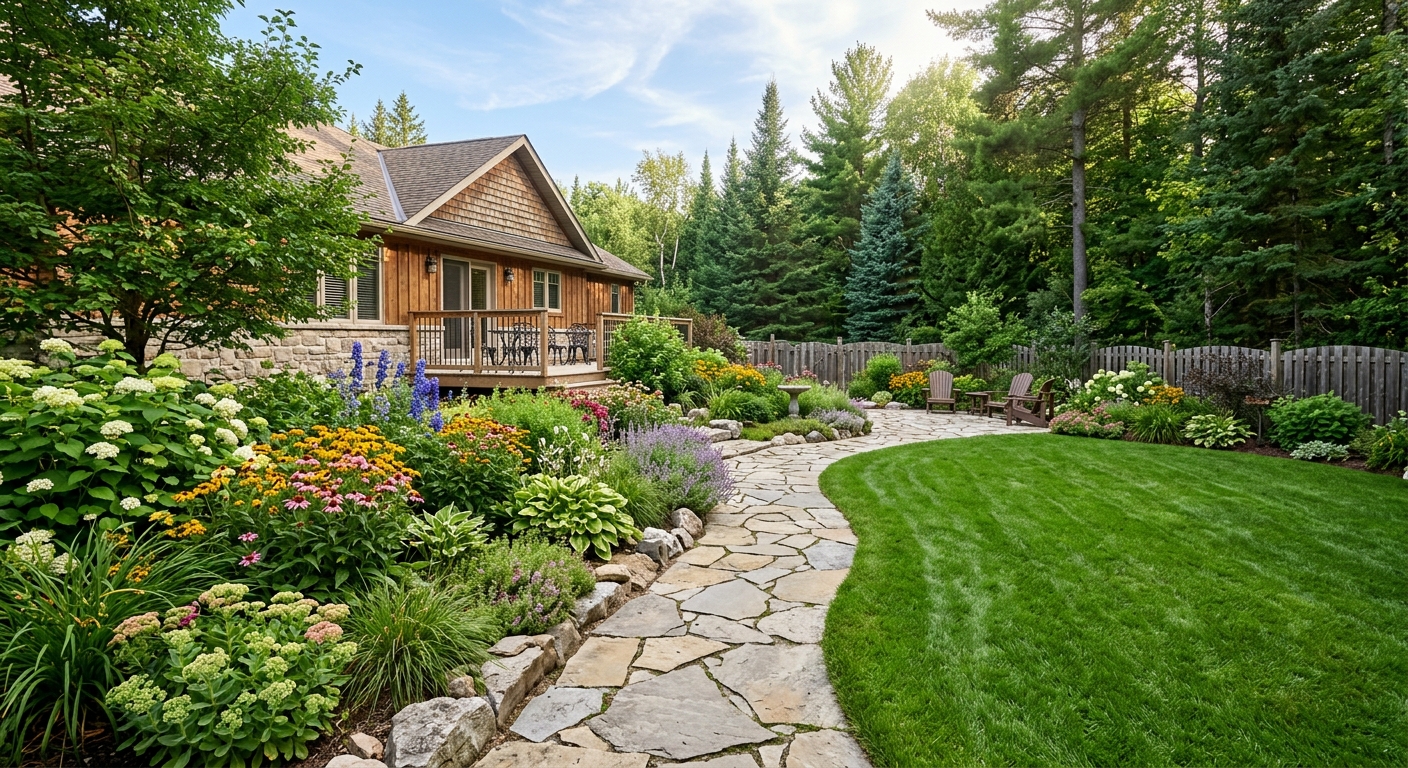
Landscaping options and costs in East Newton North
In East Newton North, British Columbia, homeowners typically tackle their landscape in a few common ways—starting with a full yard refresh, adding a new lawn, or upgrading key hardscape features like walkways and retaining walls. With 7,336 residents in the area (Statistics Canada, 2021 Census), there’s a steady demand for contractor time, and you’ll notice crews ramp up around the wetter spring windows when soil is workable and plants are entering growth. East Newton North also has lots of single-detached housing stock, which often means there’s enough yard space to justify layered planting, paths, and drainage improvements rather than doing only “curb touch-ups.”
Cost in the Lower Mainland–Southwest is shaped by a long growing season in plant hardiness zones 7–8, with last spring frosts often running early March to early April near the coast and first fall frost frequently landing in November. That extended window helps contractors spread work out and support more lush, layered designs—but it also increases competition for trades (designers, irrigation techs, and hardscape crews), which can move pricing upward. Meanwhile, wet winters and freeze–thaw cycles still matter for patios and retaining walls: bases must be dug properly, compacted, and drained to reduce frost heave and wall movement on the kind of sloped lots you often see in Greater Surrey.
If you’re comparing approaches, use the table below as your starting point—then refine the numbers with an itemised quote for your exact yard area, site access, and material choices.
| Service |
Description |
Season |
Price Range |
| Full landscape design and installation |
On-site layout, planting plan, soil prep, grading/drainage (if needed), sod/seed, and hardscape/planting execution |
Year-round (softscape best spring–fall; hardest in wetest winter weeks) |
$5,000–$50,000 |
| Sod installation (supply, grade, lay, roll) |
Remove old turf, fine-grade, amend/prepare soil as needed, lay sod, roll and initial care |
Spring to early fall (avoid the coldest wet spells) |
$2,500–$8,000 |
| Lawn seeding (grade, seed, starter fertilizer) |
Light grading, seed selection, starter fertilizer, raking, watering plan guidance |
Late spring to early summer; some fall seeding |
$2,000–$5,500 |
| Interlocking patio or walkway |
Excavate, compact base, edge restraints, sand bedding, pavers/stone, and cleanup |
Spring–fall (best when drainage isn’t saturated) |
$10,000–$35,000 |
| Retaining wall (interlocking block) |
Wall layout, block/stone system, base drainage, backfill, and compaction |
Spring–fall (structural work depends on site conditions) |
$15,000–$80,000 |
| Tree and shrub planting |
Soil amendments, planting holes, mulch ring/bedding, staking if required, and establishment care |
Spring–fall (avoid frozen ground and saturated days) |
$1,000–$15,000 |
Prices are estimates only and vary by project scope, site access and material selection.
What affects the price of landscaping in East Newton North
If you receive multiple quotes in East Newton North for the same “headline” project—say, a lawn replacement plus a small patio—you can still see 30–50% differences between contractors across the Lower Mainland–Southwest. The main reasons aren’t just profit margins: the working hours available in zone 7–8 conditions, how deep crews excavate for proper drainage and freeze–thaw protection, and the material tier chosen (native vs. ornamental vs. mature specimens) all change the real labour and equipment time. In contrast, Prairie regions (zones 2–4) usually compress scheduling into shorter growing seasons and push clients toward drought- and wind-tolerant planting, while retaining walls require excavation to below deeper frost considerations—often increasing base and material demands. Coastal BC generally supports a lush palette and longer planting windows, but heavy rainfall means drainage details are non-negotiable. And in the dry BC interior and Alberta, water restrictions can reshape irrigation design; in Southern Ontario (zone 5–6), summer dry spells often drive different watering needs than coastal Surrey.
Concrete examples from local sites: (1) On a sloped lot near Grandview Heights / Newton, grading plus compaction for wall footings can add several thousand dollars, because drainage layers and backfill quality must be controlled. (2) If your contractor budgets sod on a 2,000 sq ft lawn, you’re usually closer to the higher end of the lawn range, while seeding can be the lower-cost pathway; a typical small “lawn refresh” might land in the $2,000–$8,000 bands depending on whether you go sod versus seed and how much grading is required. (3) If you upgrade to a larger tree-and-shrub mix—especially container-grown or larger caliper stock—the tree planting line can quickly move toward the $1,000–$15,000 range.
| Price Factor |
Why It Matters |
Cost Impact |
| Yard size in sq ft — the primary cost driver for softscape |
More square footage means more labour hours for soil prep, planting, and cleanup |
Often the biggest lever; can swing total cost by 20–60% |
| Grading and drainage work — slope corrections add significant cost |
Correcting run-off direction and creating proper slopes prevents pooling and foundation moisture |
Commonly adds $2,000–$15,000 depending on site complexity |
| Drainage bed or French drain installation |
Lowering high water tables requires trenches, perforated pipe, stone, and outlet planning |
Can add a mid-to-high four-figure amount for a typical front yard |
| Plant material tier — native shrubs vs. ornamental vs. mature specimen trees |
Larger stock costs more and may require extra labour for planting, staking, and transport |
May shift planting budgets by 2–4x for the same “number of plants” |
| Hardscape vs. softscape ratio — walls and patios cost more per sq ft than lawn |
Pavers/blocks need excavation, base material, compaction, and precise finishing |
More patio/wall area pushes you toward the upper hardscaping bands |
| Irrigation system design and installation |
Drip layouts and smart controllers cost money upfront but improve plant survival and efficiency |
Often adds thousands, depending on zones and backflow requirements |
| Soil amendment and topsoil required |
Lower-quality soil needs compost/topsoil and sometimes re-structuring for drainage |
Can add $500–$6,000+ based on haul distance and depth |
| Tree removal or stump grinding before new planting |
Access issues and disposal increase time and equipment requirements |
Often changes the budget by several hundred to several thousand dollars |
Permits & regulations in British Columbia
In British Columbia, most landscaping activities—like planting new shrubs and trees, installing sod, and doing most softscape work—typically do not require a permit. Your usual “no permit” scope includes: digging planting holes, mulching and topdressing, laying sod or seed, building garden borders, and installing standard drip irrigation (where plumbing connections and backflow rules are followed).
Where permits often do come into play is with structural changes and lot grading. Retaining walls above a height threshold—commonly around 1.0 m (3.3 ft) in many municipalities—may require a building permit and sometimes engineered drawings. Also, changes to lot grading that affect how water drains toward neighbouring properties or toward storm sewer connections can trigger approval requirements. Because East Newton North sits in a dense urban area, keep in mind that drainage direction and outlet locations are scrutinized.
Before any digging (whether planting holes or wall footings), call for utility locates so you don’t hit buried services. Finally, confirm local irrigation and water-use bylaws. Even though East Newton North doesn’t face the same routine drought restrictions as the BC Interior, regulations and rising water costs still encourage efficient irrigation—especially drip and smart controllers.
How to verify a contractor’s standing in BC: (1) check their licence/credentials through the appropriate BC registry or contractor listing online; (2) request a current certificate of insurance and verify liability limits match the scope; (3) ask for confirmation of WSIB/WCB coverage status (or an exemption letter if applicable) and ensure the paperwork dates are current. If anything is missing or inconsistent, treat it as a quote-quality red flag and ask again before work begins.
Planning a landscape that thrives in East Newton North's climate
Planning for East Newton North means designing for plant hardiness zone 7–8, frequent wet weather, and a frost calendar that often supports long establishment windows. Rather than fighting the climate, focus on four basics: pick the right plants, manage water responsibly, prepare drainage, and build hardscape bases to handle freeze–thaw cycles. In practice, that means using zone-appropriate trees and shrubs, grouping plants by water needs, and choosing groundcovers and perennials that can handle cool, damp shoulder seasons without constant intervention.
For lawn, compare sod versus seed with real budgeting. Sod gives instant cover and immediate erosion control, but it costs roughly 3–4 times more per sq ft than seeding once you include removal, soil prep, and labour. Example: if you’re refreshing a 500 sq ft lawn area, seeding might land closer to the lower end of the lawn bands, while sod frequently pushes you toward the higher end of the $2,000–$8,000 ranges depending on grading and topsoil requirements. So, sod is justified when you need fast curb impact or have bare soil erosion risk; otherwise, seed can be the better value.
Drainage and grading are critical in the Lower Mainland–Southwest. Make sure downspouts and yard run-off are directed away from foundations with gentle slopes and, where required, a drainage bed. For patios and retaining walls, excavate and compact the base properly and respect local frost/seasonal movement: good drainage beneath pavers and walls is what prevents settlement and wall movement. Finally, low-maintenance strategies—mulch rings, groundcovers, and layered perennials—reduce annual upkeep while keeping the yard looking intentional year-round. Rain-garden pockets or infiltration-friendly planting strips can also help manage heavy rainfall without turning your yard into a muddy mess.
| Element |
Climate Consideration |
Maintenance Level |
Price Band |
| Sod lawn installation |
Establishment benefits from long coastal growing season, but wet winters require proper drainage and rolling/edge sealing |
Moderate short-term (watering/monitoring first weeks), then low |
$2,500–$8,000 |
| Native perennial garden |
Zone-appropriate plants tolerate cool damp periods with less winter protection once established |
Low after first year (mulch top-ups and light weeding) |
$3,000–$10,000 |
| Mulched shrub border |
Mulch helps stabilize soil moisture during wet-to-dry swings and reduces weeds in shoulder seasons |
Low (seasonal prune and mulch refresh) |
$2,000–$8,500 |
| Interlocking stone patio |
Freeze–thaw cycle management via compacted base and proper drainage keeps surface stable |
Low (occasional leveling inspection and joint material top-ups) |
$10,000–$35,000 |
| Retaining wall (block) |
Backfill compaction and drainage prevent hydrostatic pressure and frost-related movement |
Low (visual checks after heavy storms) |
$15,000–$80,000 |
| Drip irrigation system |
Efficient water delivery suits efficient use during occasional water-cost periods and helps establish planting through cool summers |
Low (controller checks, occasional emitter maintenance) |
$1,500–$7,000 |
How to choose a landscaping contractor in East Newton North
Choosing the right contractor in East Newton North starts with verification, not just a good-looking Instagram portfolio. In British Columbia, you should confirm the company is properly licensed/registered for the work they’re proposing, and you must see current proof of liability insurance. For coverage, ask whether they carry WSBC/WCB (workers’ compensation) coverage or provide an exemption/confirmation letter if the situation applies. Then check the dates on the certificate of insurance and confirm the insured entity name matches the company submitting the quote. If the contractor can’t produce documents quickly, move on.
Next, get 2–3 itemised written quotes with a clear labour + materials breakdown. “Lump sum” is fine for very small projects, but for patios, retaining walls, or full landscape installs, you want line items: excavation, base materials, drainage layers, disposal, compaction, edging, planting quantities, and irrigation components (if included). Read the scope carefully: what’s excluded (topsoil depth, number of trees/shrubs, disposal of removed turf), is the permit pull included if required, and is watering/setup care part of the install?
Warranty matters too. Ask for the workmanship warranty length and whether manufacturer warranties apply to plants and components; also ask if the warranty is transferable if you sell the home. Keep payment practical: never pay more than 10–15% upfront. Use a holdback until key milestones are complete, with a final walkthrough for acceptance. Finally, require a start date and completion estimate in writing—especially because Lower Mainland–Southwest winters can delay structural work on saturated days.
- Ask for proof of liability insurance and confirm coverage is current.
- Request WSBC/WCB coverage confirmation (or correct exemption paperwork).
- Get the contractor’s licensing/registration details and verify them online.
- Demand an itemised quote (labour, materials, disposal, drainage, base prep).
- Confirm whether excavation includes hauling away old soil/sod and what “disposal” covers.
- Verify grading intent: slope targets, run-off direction, and drainage outlet plan.
- For walls/patios, confirm base depth, compaction approach, and drainage layer design.
- Clarify irrigation scope: drip vs sprinklers, number of zones, and controller type.
- Ask for plant lists with sizes (e.g., 2 gal / 3 gal / balled and burlapped) and quantities.
- Confirm mulch type, topsoil amendment, and minimum soil depth for planting beds.
- Review warranty terms for workmanship and plants; ask if it transfers to a new owner.
- Set payment schedule: 10–15% max deposit, then milestone payments with a holdback.
In East Newton North, common red flags include: quoting a major job without a site visit; refusing to provide insurance/coverage documents; vague scope language like “all-in” without quantities or depths; changing the plan midstream with no written change order; and asking for a large upfront payment (well beyond 10–15%) before any work starts.
Frequently asked questions — landscaping in East Newton North
How do I design a low-water yard in East Newton North?
For East Newton North, “low-water” doesn’t mean zero watering—it means matching plants to zone 7–8 and building a soil and irrigation plan that reduces waste. Start with drainage and soil health: add compost and use mulch to cut evaporation during the drier stretches, then group plants by water needs (hydrozones) instead of watering everything the same way. Choose native and zone-appropriate shrubs/perennials that tolerate cool damp periods once established, and consider groundcovers that shade soil. Where you need irrigation, drip is usually the efficient choice, especially with a smart controller. If you’re comparing budgets, efficient planting can help you avoid the highest-cost lawn approach—e.g., seeding can be a lower-cost path than sod, while maintaining curb appeal. (Statistics Canada, 2021 Census) notes steady local population levels; that means reliable contractor availability, but also competitive pricing, so get an itemised irrigation and planting plan to control costs.
How do I find a licensed landscaper in East Newton North?
Begin by asking any contractor in East Newton North, British Columbia for their proof of licensing/registration appropriate to their trade, plus current liability insurance. Then ask specifically about workers’ compensation coverage: in BC, you’ll want to see WSBC/WCB coverage confirmation (or correct exemption/clearance paperwork where applicable). Request the certificate of insurance and confirm the legal company name matches the quote and invoice. Next, check that their quote is itemised (not just a single line total) so you can verify they’re planning proper excavation, base prep, and drainage where needed. You should also confirm they understand local site realities like freeze–thaw impacts on hardscape bases and drainage direction on sloped yards. When you’re comparing bids, use scope clarity as your filter: a competent, licensed contractor can explain what they’re including—permit pull if required, disposal, and installation dates—without pushing you to make a large upfront payment.
How much does landscaping cost in East Newton North?
In East Newton North, landscaping costs typically vary widely by how much work you need done and what’s included in the scope. As a practical guide, full landscape design and installation commonly starts around $5,000–$50,000 when you’re combining softscape and hardscape with grading/drainage and a planting plan. For lawn work, sod installation often lands in the $2,500–$8,000 range depending on yard size and soil prep, while seeding can be lower if minimal grading is required. Retaining walls and larger patios are usually a bigger budget item, with retaining walls often ranging up to $15,000–$80,000 depending on height, base requirements, and drainage/backfill details. Local population density and demand can influence scheduling and pricing—there are enough homeowners in the area (Statistics Canada, 2021 Census) to keep crews busy—so competitive, itemised quotes help you avoid overpaying for work you don’t need.
What plants thrive in East Newton North's climate zone?
East Newton North falls in a coastal zone suitable for many plants in hardiness zones 7–8, which is why you can create lush, layered gardens without as much winter protection as colder provinces. Thrive-ready picks typically include broadleaf evergreens and long-blooming perennials that handle cool, damp seasons once established, plus shrubs that tolerate wet winters provided drainage is correct. The key is not only plant hardiness—it’s how your site holds water. If you have heavy clay or a low spot, you’ll want plants that can handle “wet feet” only where drainage is managed, or you’ll build a drainage bed/rain-garden pocket. For a low-water design, use native and zone-appropriate shrubs/perennials and mulch to reduce evaporation during drier stretches. If you’re planning around a lawn edge or foundation planting, layering matters: groundcovers reduce bare soil (less weed pressure), and perennials fill the mid-layer while shrubs provide structure. Your contractor should propose specific sizes and quantities so you can compare quotes fairly.
Sod vs seed — which is better for a East Newton North lawn?
For East Newton North, sod vs seed mainly comes down to speed, budget, and how much grading/soil improvement you need. Sod gives you instant coverage and can help with erosion control right away, which is helpful if you’re dealing with slopes or bare soil areas near driveways. However, sod is usually more expensive than seeding—often about 3–4 times higher per sq ft once you include preparation and installation. If you’re cost-sensitive and your soil just needs light grading, seeding is often the smarter value and can land within the lower lawn bands (commonly $2,000–$5,500 for smaller refreshes depending on site conditions). If your goal is quick curb appeal for an upcoming event or you can’t tolerate bare ground, sod is easier to justify. Whichever you choose, insist on correct grading, starter fertiliser as part of the plan (especially for seeding), and a simple watering/establishment schedule suitable for the coastal wet-to-dry swings.
How much does a retaining wall cost in East Newton North?
Retaining wall pricing in East Newton North commonly depends on wall height, length, access for equipment, and—most importantly—drainage and base construction designed to handle freeze–thaw movement. In this region, even though winter isn’t as harsh as colder provinces, heavy rain and seasonal temperature swings can still cause settlement or wall pressure if backfill and drainage aren’t done correctly. For typical block retaining walls, budgets often range up to $15,000–$80,000 based on complexity, which can include excavation depth, proper compacted backfill, and drainage layer requirements. If the wall is over roughly 1.0 m in many municipalities, you may need a building permit and possibly engineered drawings, which can add time and cost. Ask for an itemised quote that includes base prep and drainage provisions—then compare wall systems on equal footing rather than just comparing total price.