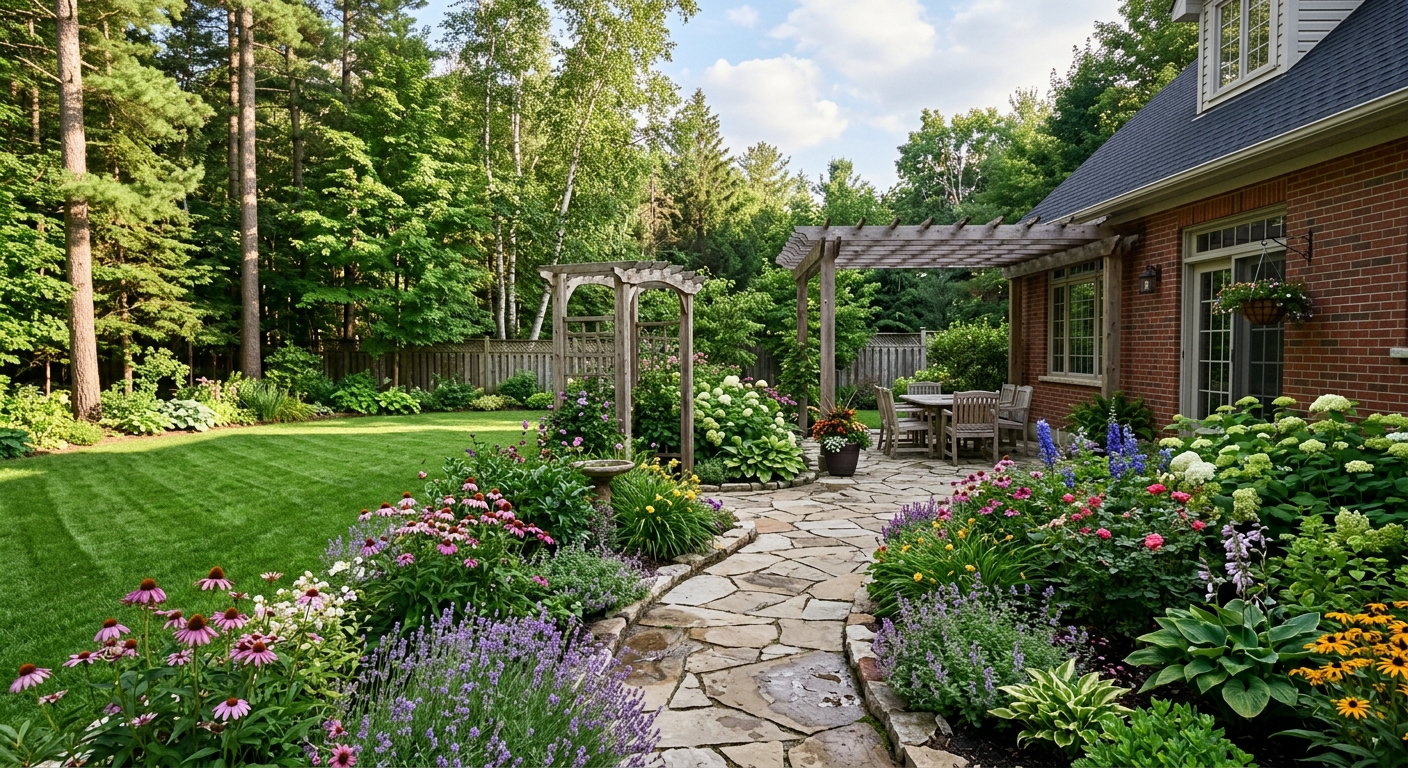
Landscaping options and costs in Surrey
Landscaping costs in Surrey vary widely because the city is large (population 568,322 per the Statistics Canada, 2021 Census) and many homes have established yards—especially single-detached neighbourhood pockets where homeowners are more likely to invest in long-term improvements. In Surrey, homeowner households are about 69.5% of households (Statistics Canada, 2021 Census), which typically translates into more frequent landscape upgrades rather than short-term fixes.
In the Lower Mainland–Southwest (plant hardiness zones 7–8), mild winters and an extended working season help contractors stay productive. With last spring frost often falling in early March through early April near the coast—and first fall frost often not until November—there’s more flexibility for planting and softscape work than in colder Prairie markets. That said, wet winter weeks can slow equipment access, and structural builds like patios and retaining walls must be designed around freeze–thaw cycles and drainage to prevent frost heave and future wall movement on sloped sites.
Trade demand is especially strong around North Surrey and areas of Fleetwood where many properties include larger lots and mature trees. For many homeowners, the fastest way to budget is to compare common project types side-by-side, so you can match the scope to the season and the right mix of softscape and hardscape.
| Service |
Description |
Season |
Price Range |
| Full landscape design and installation |
Site walk, concept + layout, planting plan, grading notes, irrigation considerations, then installation of beds, lawn/groundcovers, and selected hardscape |
Year-round (best weather: spring to fall) |
$5,000–$50,000 |
| Sod installation (supply, grade, lay, roll) |
Soil prep, grading for drainage, delivery, sod lay pattern, rolling and initial watering plan |
Late spring to early fall |
$2,000–$8,000 |
| Lawn seeding (grade, seed, starter fertilizer) |
Topdressing, seed selection, starter fertilizer and light soil cover; establishment watering guidance |
Spring and early fall |
$900–$3,500 |
| Interlocking patio or walkway |
Excavation, base compaction, geotextile, leveling sand, pavers, edge restraints, and proper drainage slope |
Dry weather windows (spring to fall) |
$8,000–$35,000 |
| Retaining wall (interlocking block) |
Block system, drainage gravel, weep holes/behind-wall drainage as needed, base prep and leveling |
Spring to fall |
$10,000–$80,000 |
| Tree and shrub planting |
Soil amendments, planting holes, staking/watering plan, and maintenance period guidance |
Spring to fall |
$1,000–$15,000 |
Prices are estimates only and vary by project scope, site access and material selection.
What affects the price of landscaping in Surrey
Even for the “same” landscaping job, quotes in the Lower Mainland–Southwest can differ by 30–50% once contractors price real-world variables. The biggest drivers are what can be installed during the available working season (planting vs. hardscape timing), how much prep is needed for drainage and compaction, and how difficult the site is to access and protect. In coastal BC (Surrey, zones 7–8), you usually get a longer growing window, which supports lush designs—but the heavy winter rain means drainage work is often not optional. In contrast, Prairie regions (often zones 2–4) face short frost-free windows and harsher winters, so projects lean toward drought-tolerant, low-maintenance selections, and structural base requirements can be more conservative due to deeper frost. Southern Ontario (zone 5–6) has a moderate season, but summer dry spells can increase irrigation and reseeding costs.
Here are concrete Surrey examples where cost moves up or down. First, if your yard requires regrading to correct slope or direct water away from the foundation, that prep can add thousands—because crews may need additional excavation, imported topsoil, and re-compaction before any turf or beds go in. Second, heavy-rain sites that need a drainage bed or French drain will add labour and pipe/gravel materials; this is a common reason a design that starts near the lower end of the $5,000–$50,000 band becomes a mid-to-upper scope build. Third, soil amendment and the plant tier matter: native shrubs typically cost less than ornamental varieties, and larger specimen trees (with ball size and staking requirements) can move a $1,000–$15,000 planting plan upward quickly.
Lastly, housing age affects expectations. With 19.6% of homes built before 1981 (Statistics Canada, 2021 Census), some older lots have mature trees, older drainage patterns, and settled grades that need correction—so “nice curb appeal” can become “curb appeal plus drainage fixes,” which impacts overall cost.
| Price Factor |
Why It Matters |
Cost Impact |
| Yard size in sq ft — the primary cost driver for softscape |
More square footage means more excavation, soil, labour time, and plant/sod material |
Typically the largest variable; can swing total cost by several thousand dollars |
| Grading and drainage work — slope corrections add significant cost |
Surrey’s winter rainfall requires positive drainage away from foundations and property lines |
Commonly adds substantial labour and imported soil/rock; can shift a quote by 20%+ |
| Drainage bed or French drain installation |
Pipe, gravel, geotextile, and tie-ins are required when water pools or soils stay saturated |
Material + labour increases; can add thousands depending on length and complexity |
| Plant material tier — native shrubs vs. ornamental vs. mature specimen trees |
Smaller nursery stock is easier to install; mature trees require larger pits, backfill, and often staking |
Can double plant-line cost even when overall design stays similar |
| Hardscape vs. softscape ratio — walls and patios cost more per sq ft than lawn |
Base prep, compaction, pavers/blocks, and labour-intensive finishing drive costs |
Hardscape-heavy plans often move from mid-range to upper-range budgets |
| Irrigation system design and installation |
Drip vs. spray zoning, controller placement, trench depth, and layout affect labour and parts |
Usually adds meaningful cost, but prevents watering mistakes and plant loss |
| Soil amendment and topsoil required |
Compacted soils and clay-heavy areas need amendments to support roots and drainage |
Imported material delivery and labour can increase total cost quickly |
| Tree removal or stump grinding before new planting |
Requires equipment, time, and disposal planning; roots can affect excavation depth |
Can materially change the schedule and budget, especially on larger lots |
Permits & regulations in British Columbia
In British Columbia, most typical landscaping work—like planting new shrubs and trees, sodding, and most softscape installations—generally does not require a building permit. That includes things such as groundcover beds, mulching, and installing new garden edging at normal heights. However, retaining walls above a municipal threshold typically require a building permit, and many projects also need engineered drawings depending on height, location, and the site conditions.
In Surrey, a homeowner should expect that permit-triggering work often includes: (1) retaining walls above the commonly used 1.0 m (3.3 ft) height threshold (varies by municipality and circumstances), and (2) significant changes to lot grading where drainage direction changes toward neighbouring properties or storm connections. If your plan affects how water flows, it’s worth confirming approvals before excavation.
Before anyone digs, require utility locates. A reputable contractor will do this because planting holes, trenching for drains, and any wall footings can hit buried services. Also confirm irrigation and water-use bylaw requirements—especially if your landscaping includes an irrigation upgrade or if you’re planning a new lawn in a water-sensitive climate period.
To verify a contractor’s qualifications in Surrey: (1) check their BC licence/registration online using the appropriate provincial contractor registry; (2) request a current certificate of liability insurance and ensure coverage limits match the job; and (3) ask for proof of coverage for workers’ compensation (WSIB/WCB coverage where applicable) and a clearance letter or equivalent proof. Review these documents before work starts, not after.
Planning a landscape that thrives in Surrey's climate
In Surrey (Lower Mainland–Southwest, zones 7–8), the goal is to work with our wet winters, mild conditions, and longer cool-season growth rather than forcing plants to survive in poor drainage. Start with plant selection: choose zone-appropriate, often native or well-adapted species that handle damp winters and are resilient through occasional summer dry spells. In practice, this usually means broadleaf evergreens for structure, long-blooming perennials for colour, and shrubs chosen for their ability to root confidently in local soils.
On turf, decide between sod and seeding based on timeline and budget. Sod gives instant visual results and better immediate erosion control, but it costs about 3–4x more per square foot than seeding. If you need a yard looking “done” quickly (for example, before a spring event), sod can be justified; if you can wait for establishment, seeding is typically the better value.
Drainage and grading are non-negotiable in Surrey. Even with a great planting palette, pooling water can lead to root rot, mossy lawns, and foundation moisture concerns. For hardscape, patio and retaining-wall base preparation must account for freeze–thaw cycles: proper excavation depth, compacted base layers, and drainage layers reduce the risk of movement. Low-maintenance design strategies—mulch layers, groundcovers, and perennial repeat plants—also cut annual upkeep while keeping curb appeal consistent.
If water efficiency is a priority, consider rain-garden style beds (where feasible) and drip irrigation for planted areas rather than watering entire lawns. For example, choosing a mixed perennial bed with mulch and drip can be less expensive than over-seeding a problem lawn area repeatedly—especially after regrading and correcting drainage once.
| Element |
Climate Consideration |
Maintenance Level |
Price Band |
| Sod lawn installation |
Best when soil is workable in spring/early fall; needs correct grading to avoid winter saturation |
Medium (initial watering/monitoring until established) |
$2,000–$8,000 |
| Native perennial garden |
Performs well in zones 7–8 with proper spacing and mulch to moderate soil moisture |
Low to medium (seasonal pruning and light weeding) |
$3,000–$12,000 |
| Mulched shrub border |
Mulch helps manage winter wetness and summer cooling; choose shrubs tolerant of coastal conditions |
Low (top-up mulch 1–2x/year) |
$1,500–$7,500 |
| Interlocking stone patio |
Base prep and drainage slope protect against movement during freeze–thaw cycles |
Low (occasional cleaning; check joint sand) |
$8,000–$35,000 |
| Retaining wall (block) |
Behind-wall drainage and deep, stable base reduce frost-heave and washout risk |
Low (periodic inspection of drainage) |
$10,000–$80,000 |
| Drip irrigation system |
Targeted watering supports plant survival during dry stretches while reducing waste |
Low (seasonal adjustments and controller checks) |
$1,200–$6,500 |
How to choose a landscaping contractor in Surrey
Choosing a Surrey contractor is mainly about verification and clarity. First, confirm British Columbia licensing/registration status (as applicable to your contractor and scope), and ask for a current certificate of liability insurance. For workers’ safety coverage, request proof of workers’ compensation coverage (WSIB/WCB—depending on the contractor’s coverage structure) and ensure it aligns with the crew size and job type. Don’t accept “it’s in progress”—the right certificates should be current before work begins.
Next, get 2–3 itemised written quotes that separate labour and materials. You want line items for excavation/grading, topsoil and amendments, drainage components, planting stock sizes, and any irrigation components (pipe, fittings, controller/sensors). Ask if permit work is included for retaining walls above the typical 1.0 m threshold and whether the contractor pulls permits and schedules inspections when required.
Read the scope for exclusions: disposal/haul-away, protected tree handling, temporary fencing, and what happens if unsuitable soil is discovered during excavation. Ask about warranty details—workmanship warranty length, product/manufacturer warranty terms, and whether warranties transfer if you sell the property. Payment schedule matters: never pay more than 10–15% upfront; hold back the remainder until key milestones (base prep, drainage completion, final planting/cleanup) are finished. Finally, insist on a timeline with start date and completion estimate in writing so you can plan around Surrey’s weather windows.
- Ask for a Surrey site visit and a documented site plan/measurements, not a guess over photos.
- Confirm licensing/registration status (as applicable) before signing.
- Verify liability insurance certificate is current and matches the project scope.
- Request proof of workers’ compensation coverage and a clearance letter/equivalent.
- Use itemised quotes: labour, materials, quantities, and unit rates.
- Check what’s included for drainage (French drains/weep holes/topsoil depth).
- Confirm disposal/haul-away and any tipping fees are included or clearly excluded.
- Require a written schedule with weather contingencies.
- Ask for a workmanship warranty period and what it covers (settlement, heaving, plant replacements).
- Request product/manufacturer warranty details for major materials (pavers/blocks, plants if applicable).
- Confirm payment milestones (10–15% max upfront; holdback until completion).
- Get a final walkthrough/close-out checklist in writing.
In Surrey, red flags include: (1) quotes that are not itemised (just a single lump sum), (2) vague drainage promises like “we’ll fix it” without explaining grades, bases, or materials, (3) refusing to provide insurance/coverage proof, (4) starting without utility locates, and (5) asking for large upfront payments that exceed 10–15%.
Frequently asked questions — landscaping in Surrey
What is xeriscaping and does it suit Surrey?
Xeriscaping is a water-wise landscaping approach that reduces irrigation demand by using drought-tolerant plants, efficient irrigation (often drip), and soil improvements like mulch and compost. In Surrey and the wider Lower Mainland–Southwest (zones 7–8), it absolutely can work, but it’s best used strategically—because our winters bring heavy rain and the main water challenge is often summer dry stretches rather than year-round drought. Instead of “zero grass everywhere,” many homeowners succeed with partial lawn, native perennial beds, and groundcovers in areas that would otherwise be difficult to water evenly. If you’re planning a full yard update, a mixed design can land anywhere from $5,000–$50,000 depending on hardscape and irrigation; going xeriscape-style can help keep ongoing maintenance lower after the initial setup. A good contractor will also confirm drainage so rain doesn’t pool around new beds.
How do I plan a low-maintenance yard?
A low-maintenance yard in Surrey usually comes from three choices: plant the right species for our coastal climate, design for drainage, and simplify upkeep through repeat planting. Start by prioritizing well-rooted shrubs and perennial groups, then use mulch to suppress weeds and moderate soil moisture. If your site has pooling areas or winter saturation, correct grading and consider a drainage bed before you plant—because even “easy” plants fail in consistently wet spots. For turf, consider whether sod or seeding fits your timeline; sod can be higher cost up front, while seeding is cheaper but needs more establishment attention. Many projects remain within the $1,000–$15,000 band when the scope is planting-focused, but adding interlocking patios and retaining walls can push you toward the $10,000–$80,000 hardscape range.
How deep should a retaining-wall base be for local frost?
For retaining walls in Surrey, base depth needs to be engineered around stability, drainage, and local freeze–thaw conditions—not just a single “magic number.” While coastal BC typically has milder winters than many other regions, freeze–thaw cycles still happen, and improper base prep can lead to settlement or frost-related movement. Practically, contractors should excavate to a firm, stable base and install the wall system on properly compacted granular layers designed for drainage. The wall’s manufacturer specifications and the site conditions (soil type, wall height, wall length, and whether there’s groundwater) control the final structure depth. If your wall is at or above the common 1.0 m (3.3 ft) height threshold, expect permit requirements and potentially engineered drawings depending on the municipality and soil conditions. Always ask your contractor to explain how they’ll handle behind-wall drainage (weeps, gravel, and geotextile) because that is often as important as “how deep.”
How much does professional landscape design cost?
Professional landscape design can range based on how detailed the plan is and whether it includes installation coordination. For many homeowners in Surrey, a complete design-and-install approach is priced as a package within the $5,000–$50,000 band, depending on yard size, the number of areas (front/side/back), and how much hardscape is included. If you’re starting with a simpler scope—like a planting plan only—cost may fall closer to the tree and shrub planting band ($1,000–$15,000) when it’s mostly procurement and installation. The best way to budget is to request an itemised quote that separates design labour from construction labour and materials. That also lets you decide whether you want concept-level ideas first, then move to a full build once you like the layout. Given Surrey’s long growing season, design that considers drainage and plant massing can reduce rework and replace costs later.
How do I compare landscaping quotes?
To compare landscaping quotes in Surrey, don’t just look at the total price—compare what’s included. Start by requesting itemised breakdowns: labour, quantities, topsoil depth, soil amendments, plant sizes/species tiers, drainage components, and disposal/haul-away. For hardscape, check base prep details (excavation depth, geotextile, compacted base layers, and edge restraints). For sod or lawns, confirm grading and any starter fertilizer requirements. Also verify warranty terms for workmanship and materials. If any quote includes retaining walls, confirm whether permit work is included when the wall height is around the typical 1.0 m (3.3 ft) threshold. Finally, check contractor credibility: current liability insurance, workers’ compensation coverage proof, and clear start/end dates. A quote that looks “cheap” may exclude drainage correction, which can quickly raise costs—or lead to plant loss.
How long does a landscaping project take in Surrey?
Project length in Surrey depends on scope, weather access, and how much site prep is needed. Because the Lower Mainland–Southwest climate supports longer working and growing seasons (with spring frost often in early March to early April near the coast and fall frost commonly not until November), many softscape projects can progress for much of the year. Still, wet winter weeks can limit equipment access and delay compaction or base work. Typical timelines: planting-focused upgrades may take a few days to a couple of weeks depending on plant count and staging; sod installations often take shorter once the grade is ready; patios and walkway builds can take longer because of excavation, base compaction, and curing/finishing steps; and retaining walls often require careful base prep and drainage installation, which extends timelines. If you’re budgeting around the $5,000–$50,000 range for a full design-and-install, plan for schedule variations and ask the contractor for written weather contingencies.