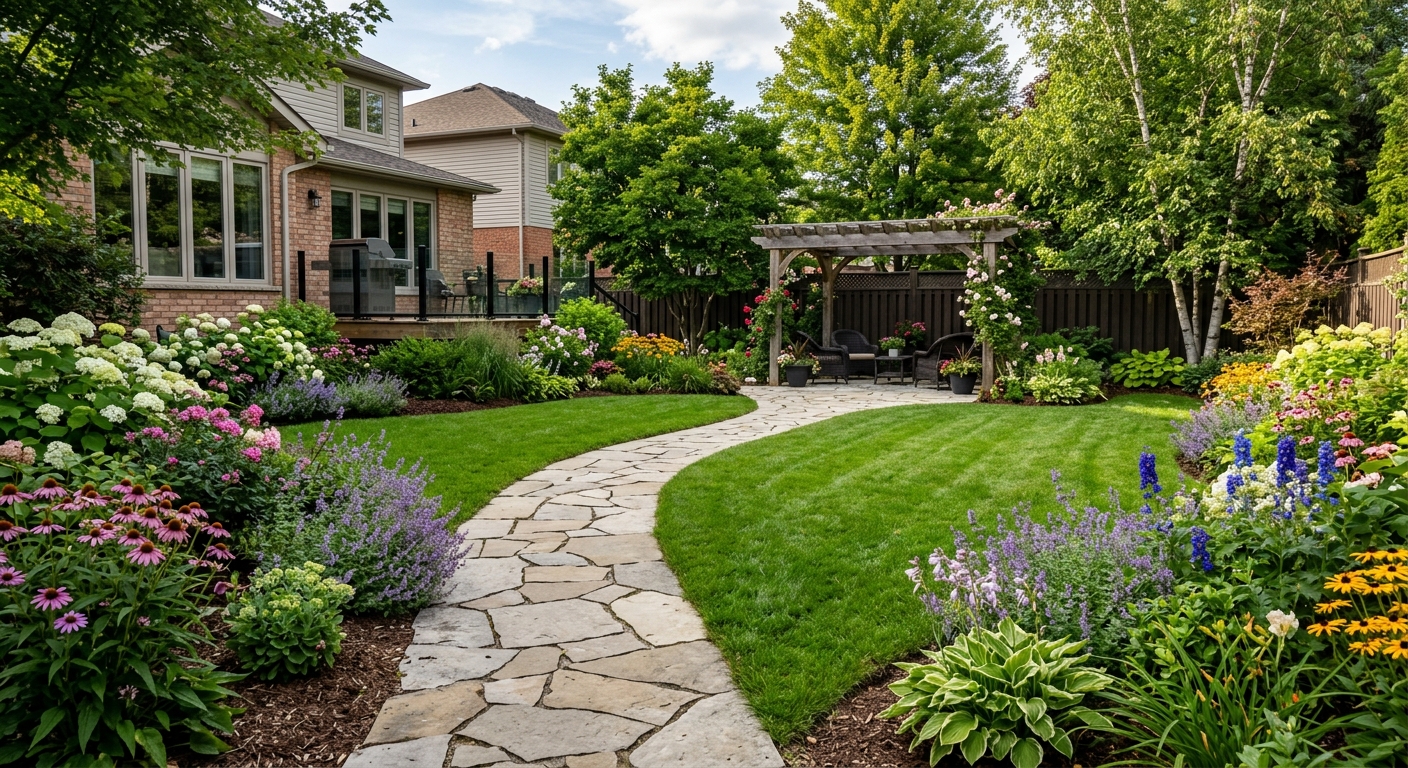
Landscaping options and costs in Kamloops
Landscaping in Kamloops can look dramatically different from one neighbourhood to the next because the yard size, home style, and how much maintenance the homeowner wants all vary. With 50.3% of dwellings being single-detached homes, many properties here have enough space to justify real softscape projects—beds, turf, patios, and even multi-zone sprinkler or drip irrigation. Also, about 27,960 households own their homes (Statistics Canada, 2021 Census), which usually means homeowners are more willing to invest in longer-lasting drainage, soil build-up, and mature planting that performs through the dry Interior summers and winter freeze–thaw cycles.
In the Thompson–Okanagan (about zone 5–6), costs are shaped by the shorter, more seasonal planting window: most installation work is concentrated in spring and fall, while summer tends to shift toward maintenance and irrigation upgrades. Contractors also plan for occasional deep cold snaps, and that drives heavier bases, proper drainage, and frost-resilient installation under patios, steps, and retaining structures. Another cost driver is that Kamloops is active for trades in areas like Aberdeen and North Shore, where infill and yard renovations are common and scheduling can tighten.
Below are common price ranges homeowners see in Kamloops for typical landscape scopes, followed by design and material choices that can move a project up or down.
| Service |
Description |
Season |
Price Range |
| Full landscape design and installation |
Site visit, concept and layout, drainage/grading plan (if required), planting plan, material selection, installation of hardscape and softscape |
Spring or fall (most projects); summer mainly add-ons/irrigation |
$8,000–$40,000 |
| Sod installation (supply, grade, lay, roll) |
Minor grading, soil prep, sod supply, installation and rolling, initial watering plan |
Late spring to early fall |
$6–$14 |
| Lawn seeding (grade, seed, starter fertilizer) |
Final grade smoothing, seed selection, starter fertilizer and light raking, first-season maintenance plan |
Spring or early fall |
$2–$6 |
| Interlocking patio or walkway |
Excavation, compacted base, edging, pavers, jointing sand, basic drainage considerations at slab edges |
Spring to fall |
$80–$220 |
| Retaining wall (interlocking block) |
Block wall with proper base/drainage, backfill and weeping provisions, alignment and level checks |
Spring to fall (avoid wet, unstable subgrades) |
$80–$220 |
| Tree and shrub planting |
Soil amendments, planting holes, staking (if needed), mulch rings, first watering setup |
Spring or fall for best root establishment |
$250–$8,000 |
Prices are estimates only and vary by project scope, site access and material selection.
What affects the price of landscaping in Kamloops
In Kamloops, two quotes for the same “look” can differ by 30–50% because Thompson–Okanagan work is strongly influenced by what’s happening underground—drainage, soil type, grading complexity, and frost protection—not just visible landscaping. In general, BC Interior projects often price higher than you’d expect from a simple lawn and beds because crews spend more time preparing bases and making irrigation efficient under water restrictions and dry summers. By contrast, coastal BC can have a longer, wetter growing season and different base conditions, while prairie regions often require different plant choices and more aggressive drought and wind resilience. In Southern Ontario (often cited around zone 5–6), the working season is usually more predictable than the BC Interior, though summer dry spells still require irrigation planning.
Plant hardiness zone and frost dates directly change both what can be planted and how long contractors can safely prepare and install. Here in zone 5–6, freeze–thaw cycles push the need for deeper, well-compacted bases under patios and step structures, and that’s a real reason a wall or walkway can land in the $80–$220 range per square-foot equivalent in some scopes. Soil and grading also matter: homes built before 1981 are common in the area (50.8% of homes are older, Statistics Canada, 2021 Census), and older yards frequently have compacted subgrade, unknown drainage paths, or mature trees that require extra protection work—each can add hours before any “green” material is installed.
Concrete examples from Kamloops: (1) a steep front slope that needs retaining block and a drain backfill often costs much more than flat-bed planting; (2) adding a drip system with a smart controller and proper zone layout can be worth it compared with running temporary sprinklers—especially during drought periods, because it prevents waste and reduces call-backs. When homeowners compare a full project budget in the $8,000–$40,000 band, the biggest differences usually come from drainage scope, irrigation design, and whether the plan includes soil amendments and proper base prep.
| Price Factor |
Why It Matters |
Cost Impact |
| Yard size in sq ft — the primary cost driver for softscape |
More area means more topsoil, more labour hours, and more materials (seed, sod, mulch, plants) |
Often the largest variable; can shift total by 20–60% |
| Grading and drainage work — slope corrections add significant cost |
Proper pitch keeps water away from foundations and prevents pooling during spring melt and storms |
Can add major machine time and disposal costs; commonly 10–30%+ of a softscape budget |
| Drainage bed or French drain installation |
Interior BC soils can be variable; drains protect under patios, steps, and retaining walls |
Frequently increases costs substantially; particularly where trenching is longer/deeper |
| Plant material tier — native shrubs vs. ornamental vs. mature specimen trees |
Size at install and sourcing affect both purchase price and planting labour/time |
Mature specimens can multiply the plant portion of the budget |
| Hardscape vs. softscape ratio — walls and patios cost more per sq ft than lawn |
Blocks, pavers, base stone, compaction, and labour are heavier and more equipment-dependent |
Total can swing quickly from “lawn + beds” into a hardscape-dominant spend |
| Irrigation system design and installation |
Dry summers and water metering push efficient design (drip, micro-sprays, smart controllers) |
Can add mid-project cost, but reduces waste and maintenance |
| Soil amendment and topsoil required |
Low-quality or compacted soil needs amendment and correct depth for root zone performance |
Often noticeable in older properties; increases material haul and labour |
| Tree removal or stump grinding before new planting |
Root disturbance, hauling, and access constraints can add time and equipment |
Can add several days of work or require separate crew scheduling |
Permits & regulations in British Columbia
In British Columbia, most planting, sodding, and typical softscape work generally does not require a permit. That typically includes: installing shrubs and trees, adding mulch and groundcovers, seeding or sodding, and building standard garden beds that don’t change drainage in a way that affects neighbouring properties. Homeowners in Kamloops usually also can proceed without permits for routine walkway/patio work when it’s not altering lot grading in a regulated way.
Work that can require a permit often includes retaining walls above the municipal height threshold (commonly around 1.0 m in many municipalities, though you must confirm locally), and any engineered requirements for walls that need more than standard block installation. Also, changes to lot grading that redirect drainage toward a neighbour or toward storm sewer connections may trigger approval requirements. Before any digging for planting holes, utility trenches, or wall footings, confirm utility locates with the proper “call before you dig” service to avoid hitting buried services.
To verify a contractor in BC, homeowners should ask for (1) their business registration and any applicable trade licences (where required), (2) proof of liability insurance, and (3) evidence of worker coverage—WSIB/WCB coverage where applicable in BC operations. Practical steps: check the contractor’s online business presence, request a current certificate of insurance that matches the project address, and ask for a clearance letter or proof of coverage. If they can’t provide documents quickly or won’t show you itemised scope, that’s a warning sign.
Planning a landscape that thrives in Kamloops's climate
Planning for Kamloops means designing around zone 5–6 conditions—winter cold snaps, spring thaw, and hot, dry summers—so your yard doesn’t rely on constant rescue watering or repeated replanting. Start with plant selection: choose native and zone-appropriate species that handle Interior winters with less winter protection, and pair them with drought-tolerant choices for summer. In the Thompson–Okanagan, well-chosen plants and correct spacing reduce competition for water and improve survival after dry spells.
Next, decide between sod and seed. Sod gives instant curb appeal and faster coverage, but it’s more expensive and still depends on proper grading and watering establishment. In most Kamloops projects, sod commonly costs about 3–4 times more per square-foot than seeding once you compare supply and install. A practical example: if you need 500 sq ft of front lawn, seeding might fit a budget around the low end of $6–$14 per project line items versus sod installation ranges that typically land closer to the higher labour/material costs—yet sod can be justified when you want the yard usable immediately or you’re renovating right before a sale.
Drainage and grading are non-negotiable. Ensure water sheds away from the foundation and doesn’t pool in low spots. For hardscape—patios, steps, and retaining walls—proper base preparation matters at frost depth for freeze–thaw resistance; a thin base can heave over time. Finally, low-maintenance strategies like mulched shrub borders, groundcovers, and perennials reduce annual upkeep. Xeriscape or rain-garden elements—designed with efficient drainage pathways and drip irrigation—can help you meet water expectations in the dry Interior while keeping the yard attractive.
| Element |
Climate Consideration |
Maintenance Level |
Price Band |
| Sod lawn installation |
Needs establishment watering during hot, dry weeks and a well-prepared grade to avoid bare spots |
Medium (watering, first-season monitoring, weed control) |
$6–$14 |
| Native perennial garden |
Better winter hardiness and less water demand when planted in correct sun/shade spots |
Low to medium (spring cleanup, occasional dividing) |
$250–$8,000 |
| Mulched shrub border |
Mulch moderates soil temperature and reduces summer evaporation; select shrubs for zone 5–6 |
Low (weeding reduced, top-up mulch yearly) |
$2,000–$10,000 |
| Interlocking stone patio |
Requires compacted base and proper edge restraint to handle freeze–thaw movement |
Low (periodic joint sand top-up) |
$80–$220 |
| Retaining wall (block) |
Needs proper base depth and drainage backfill to prevent hydrostatic pressure |
Low (inspection after winter for any shifts) |
$80–$220 |
| Drip irrigation system |
Efficient water delivery during hot, dry Interior summers; supports drought-tolerant planting |
Low (seasonal adjustments, filter checks) |
$1,200–$6,500 |
How to choose a landscaping contractor in Kamloops
Choosing a contractor in Kamloops comes down to proof, clarity, and how well they protect your property from common Interior problems like drainage failure and freeze–thaw movement. Start by verifying British Columbia licensing where applicable, then request three documents: (1) liability insurance certificate naming you (or confirming coverage for the jobsite address), (2) worker coverage—WSIB/WCB evidence where required for their workforce, and (3) any trade-specific licence information if their scope includes electrical components (for irrigation controllers, timers, or lighting systems). Ask to see the documents before signing.
Next, get 2–3 itemised written quotes rather than one lump sum. A strong quote breaks labour and materials out (base stone, block/paver materials, soil/topsoil, mulch, plants, irrigation components), and it clearly lists exclusions. Check for basics: is permit pulling included where needed (for example, retaining wall heights that require approval)? Is disposal included for over-excavation and old material removal? Who handles utility locates and trenching access? A well-prepared contractor will show an approach for drainage and frost-resilient bases.
Look at warranty: confirm the workmanship warranty length, whether product warranties apply to the installed materials, and whether any warranty is transferable if you sell the property. For payment schedule, never pay more than 10–15% upfront; hold back a portion until completion and final grading/cleanup are verified. Finally, require a start date and an estimated completion timeline in writing.
- Request proof of liability insurance with your project address listed or clearly described
- Ask for evidence of worker coverage (WSIB/WCB) for their crew
- Confirm any retaining wall permit responsibility in the written scope
- Insist on utility locates before digging (planting holes, trenches, and wall footings)
- Get a detailed, itemised quote: labour hours, materials, and equipment fees separated
- Verify grading and drainage plan details (where water goes and how it’s controlled)
- Confirm base build-up specs for patios/walkways (depth, compaction method, bedding layer)
- Ask what plant warranty or replacement policy is included for installed trees/shrubs
- Confirm irrigation design: drip zones, controller type, and winter shut-down plan
- Read the exclusions list carefully (haul-away, stump grinding, soil amendment, repairs)
- Require a written schedule: start date, phases, and completion estimate
- Use a payment schedule with a holdback until final inspection and cleanup
Red flags I see in Kamloops: (1) contractors who only provide a one-page estimate with no drainage/base details; (2) refusing to show insurance and coverage documents; (3) claiming they “never need permits” when a wall height or grading change may trigger approval; (4) asking for large upfront payments beyond 10–15% before any measurable work begins; and (5) vague warranty language or no written scope for irrigation and drainage responsibilities.
Frequently asked questions — landscaping in Kamloops
What is xeriscaping and does it suit Kamloops?
Xeriscaping is landscaping designed to reduce irrigation by using drought-tolerant plants, smart layout, efficient irrigation (often drip), and soil improvements like mulch and amendment. In Kamloops and the Thompson–Okanagan (zone 5–6), it suits many yards because summers are hot and dry and Interior water use is closely managed. It’s also a good fit for the common Kamloops housing mix—many single-detached properties have enough space to create layered planting beds and micro-zones that can be watered differently. For budgeting, many homeowners start with a planting plan and mulch in the $250–$8,000 range, then add drip later if they want a more “set-and-forget” system. The key is good drainage and realistic plant placement—xeriscape still needs correct grading so water doesn’t pool near foundations during spring melt.
How do I plan a low-maintenance yard?
A low-maintenance yard in British Columbia’s Interior is planned in layers: first fix drainage and grading, then choose plants that match sun/shade and mature size, and finally simplify upkeep with mulch and durable groundcovers. For Kamloops, I recommend starting with a shrub border and perennials that don’t need frequent replanting after dry spells, then adding mulch to reduce weeds and evaporation. If you’re balancing cost, note that lawn upgrades can be expensive—sod installation often sits in the $6–$14 per project line item range depending on area and prep, while seeding is usually less. Hardscape should be done right once: a properly built patio or walkway (often priced in the $80–$220 range) can reduce recurring repairs and mud tracking for years. The best low-maintenance plan includes drip irrigation for beds and a seasonal watering schedule tied to establishment and winter shutoff.
How deep should a retaining-wall base be for local frost?
For retaining walls in Kamloops, the right base depth depends on wall height, block system, soil conditions, and whether drainage backfill and weeping provisions are installed correctly. While the exact spec must match the wall design, the underlying principle is that your base and compacted drainage layers must resist freeze–thaw heaving and shoulder loads. This is why a “standard” depth isn’t safe to assume from another town’s job—Interior soils and winter temperature swings can behave differently across neighbourhoods. In practical terms, contractors typically excavate to stable subgrade, install a compacted granular base and drainage components, and then build in layers with compaction checks. If your wall exceeds common thresholds (often around 1.0 m in many municipalities), expect additional permit and sometimes engineered requirements. Always ask for written base-build details and drainage provisions before signing—those are the details that prevent movement after winter.
How much does professional landscape design cost?
Professional landscape design in Kamloops is often priced within the broader “design & installation” project budget rather than as a standalone fee, especially when the contractor is going to build the plan. For many homeowners, the total project lands in a range like $8,000–$40,000 when design, installation, and the necessary base prep are included. If you’re only doing a concept layout (and not a full installation), your costs can be less, but you still want the design to address grading, drainage, plant spacing, and irrigation zoning for Thompson–Okanagan conditions. Note that many homes are older (50.8% built before 1981, Statistics Canada, 2021 Census), and older yards sometimes require more design attention for drainage fixes and soil amendment, which can affect design scope. The best way to compare is to ask for a written scope: what drawings you’ll get, whether it includes a planting list, and whether irrigation and drainage are included in the plan.
How do I compare landscaping quotes?
Compare quotes by looking past the final number and checking the details that drive quality and long-term performance. In Kamloops, the “cheap” option often omits drainage/grading, uses thin bases under patios, or provides fewer plant replacements. Ask each contractor for an itemised breakdown: labour, materials, base stone, soil amendment/topsoil, disposal, and irrigation components if included. Confirm whether permits are included if required (for example, retaining walls above common height thresholds) and whether utility locates are part of the process. Also compare warranties: workmanship coverage, manufacturer warranties for plants/products, and whether terms are transferable. For pricing context, you may see turf work in ranges like $6–$14 (sod installation line items) and hardscape options in the $80–$220 range depending on scope. A good quote reads like a checklist—clear inclusions and exclusions—so you’re comparing apples to apples, not marketing.
How long does a landscaping project take in Kamloops?
Project duration in Kamloops usually depends on the season, site conditions, and how much hardscape/drainage is included. Most planting and installation work is concentrated in spring and fall due to temperatures and plant establishment needs in zone 5–6. A small refresh—mulch, a shrub border, or a short planting run—can often be completed in a day or two, while full landscape installs with grading and drainage may take multiple days to a few weeks. If the scope includes a patio/walkway or retaining wall (where base prep and compaction are critical), timeline can extend because excavation, base build-up, drainage materials, and then surface installation must follow proper sequencing. Irrigation adds time too, especially if you’re adding drip zones and a smart controller configuration. When comparing quotes, insist on a written start date and completion estimate. In older yards (many homes built before 1981), unexpected soil compaction or hidden drainage issues can add time and should be addressed in the quote’s scope.