Landscaping options and costs in Lynn Canyon
Lynn Canyon is a North Shore community where homeowners often want landscaping that looks mature quickly but also holds up to the Lower Mainland’s wet winters and long, cool growing season. With a local population of 2,155 (Statistics Canada, 2021 Census), demand is steady for upgrades around family homes—especially detached neighbourhoods where there’s room for layered planting beds, walkways, and patios. In the Lower Mainland–Southwest (plant hardiness zones 7–8), the working window is much longer than in Prairie provinces, so many projects can be scheduled across spring through fall, with only the wettest winter weeks slowing things down.
That longer season can lower some costs (more efficient scheduling and reduced weather delays), but coastal soils and drainage needs can raise others—particularly if your site slopes or if downspouts and yard grading need correction before sod or hardscape goes in. Structural items like retaining walls and patios also need a proper freeze–thaw foundation design to prevent movement on sloped lots common in areas near Lynn Valley Village and the Lynn Canyon Conservation area.
Contractor availability and material choices also drive pricing variance: a lush, evergreen-and-perennial palette can cost more than a simpler border, while drainage upgrades and irrigation design can significantly affect the total. Below is a practical comparison of common services and typical Lynn Canyon pricing bands, to help you translate quotes into scope.
| Service |
Description |
Season |
Price Range |
| Full landscape design and installation |
Site assessment, concept + planting plan, grading/drainage coordination, supply + labour for softscape and/or hardscape |
Spring–Fall (softscape can be near year-round; weather dependent) |
$5,000–$50,000 |
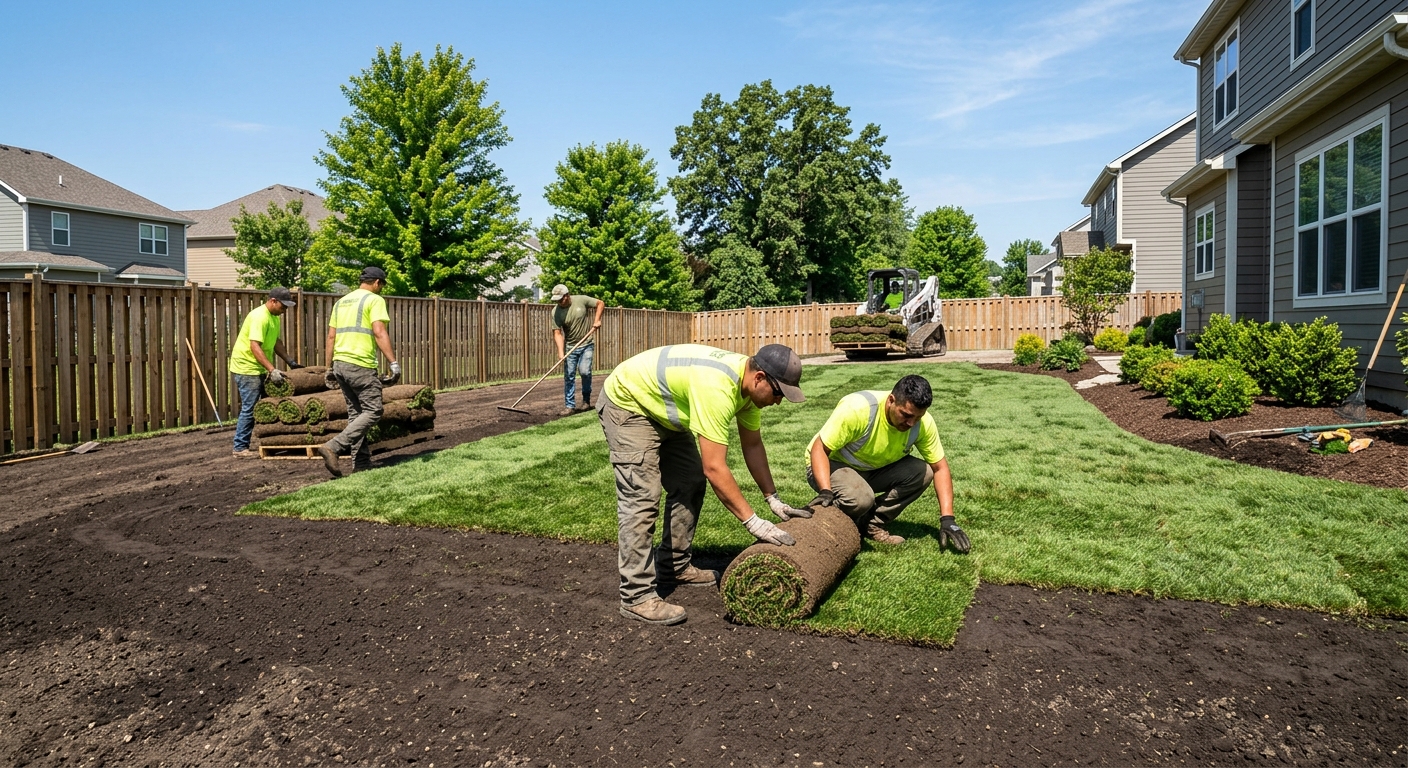
| Sod installation (supply, grade, lay, roll) |
Soil prep, base raking/levelling, sod delivery, lay pattern, rolling, starter fertilizer |
Late March–June, and Sept–Oct (avoid extreme wet weeks) |
$2,500–$8,000 |
| Lawn seeding (grade, seed, starter fertilizer) |
Grading touch-ups, seed mix, starter fertilizer, light cover, initial watering guidance |
April–June, Sept (best germination conditions) |
$2,000–$6,000 |
| Interlocking patio or walkway |
Excavation, compacted base, levelling sand, pavers/stone, edge restraints, simple drainage provisions |
Spring–Fall (base prep quality matters for freeze–thaw) |
$10,000–$45,000 |
| Retaining wall (interlocking block) |
Layout, excavation, compacted granular base/footing, block installation, drainage stone + weep options |
Spring–Fall |
$15,000–$80,000 |
| Tree and shrub planting |
Plant supply, planting holes, soil amendment, staking/support as needed, mulch + initial watering plan |
Spring–Early summer, Sept–Oct |
$1,000–$15,000 |
Prices are estimates only and vary by project scope, site access and material selection.
What affects the price of landscaping in Lynn Canyon
In Lynn Canyon and across the Lower Mainland–Southwest, quotes for the “same-looking” landscaping job can swing by 30–50% depending on scope details and how the contractor prices risk (access, drainage, and long-term performance). Two homeowners may both want a patio and shrubs, but one yard might need major grading and drainage corrections before planting or interlocking can be installed properly. In British Columbia’s coastal zone (7–8), the growing season is longer and plant palettes are richer, yet heavy rainfall and typically high groundwater concerns mean drainage work and sub-base preparation still matter.
Why the variance compared with other provinces? Plant hardiness zones and frost dates define both what grows and what the working season allows. Prairie regions (Zones 2–4) often require drought-tolerant, wind-hardy species and must respect a shorter frost-free window; retaining-wall bases are dug below the frost line, which can push excavation costs. Coastal BC allows a lush, layered planting plan, but it demands excellent drainage in heavy-rainfall areas. The dry BC interior and Alberta may also affect irrigation design due to water restrictions, while Southern Ontario (Zone 5–6) typically needs irrigation planning for summer dry spells.
In Lynn Canyon specifically, costs can rise if your yard is sloped and needs grading corrections, because contractor time and disposal increase. If you’re adding a small retaining wall plus soil reinforcement, that can move your project from a mid-range planting scope toward the higher end of the retaining-wall bands (for example, interlocking block projects often start around $15,000 and can reach into the $80,000 range). Conversely, a straightforward tree and shrub planting project without major drainage work usually stays closer to the $1,000–$15,000 band.
As a rule of thumb, older housing stock often has established drainage patterns (and sometimes outdated downspout routes) that must be reviewed. Correcting these issues can add a few thousand dollars, but it prevents future pooling and foundation moisture problems—saving money long-term.
| Price Factor |
Why It Matters |
Cost Impact |
| Yard size in sq ft — the primary cost driver for softscape |
More area means more soil prep, mulch, seed/sod, and labour hours |
Small lawns often range in the lower thousands; larger projects can jump into full-install pricing |
| Grading and drainage work — slope corrections add significant cost |
Correct grading prevents pooling and keeps water moving away from the house |
Can add several thousand dollars depending on how much soil movement is required |
| Drainage bed or French drain installation |
Helps manage saturated soils and downspout runoff |
Often meaningfully increases costs, especially with tie-ins to existing drainage |
| Plant material tier — native shrubs vs. ornamental vs. mature specimen trees |
Size, sourcing, and warranty expectations affect supply cost |
Switching to mature specimens can multiply material pricing |
| Hardscape vs. softscape ratio — walls and patios cost more per sq ft than lawn |
Excavation, base layers, and compaction are labour-intensive |
Adding a patio or wall usually moves budgets from lawn bands toward hardscape bands |
| Irrigation system design and installation |
Drip and smart controllers improve efficiency and reduce long-term watering issues |
Can add thousands, but prevents plant loss and avoids water waste |
| Soil amendment and topsoil required |
Coastal soils can be compacted or poorly draining; amendments improve rooting |
Increases material and delivery/disposal costs |
| Tree removal or stump grinding before new planting |
Clearing affects access, timeline, and often requires extra crews/tools |
Can be a major add-on depending on stump size and debris haul-away needs |
Permits & regulations in British Columbia
In British Columbia, most typical landscaping activities—planting new shrubs and trees, sodding, and most softscape work—usually do not require a permit. That said, retaining walls are where regulations can come up. In many municipalities, retaining walls above a height threshold—commonly around 1.0 m (3.3 ft)—may require a building permit and sometimes engineered drawings, especially on sloped or drainage-sensitive sites.
Also pay attention to grading. If your plan changes lot grading in a way that redirects drainage toward a neighbouring property or affects how water reaches storm sewer connections, approval requirements can be triggered. Before any digging, confirm utility locates: call to have buried services marked so you don’t hit lines when installing drainage, irrigation, or wall footings.
For irrigation, check the local water-use bylaws. Even though Lynn Canyon is in a coastal area, conservation rules can still tighten during drought conditions across BC, and municipalities may require efficient systems (like drip where appropriate).
To verify a British Columbia contractor before work starts, do three checks: (1) licence/registration status—look up the contractor in the appropriate online registry for their trade; (2) liability insurance—ask for a current certificate of insurance showing adequate coverage for the project scope; and (3) work coverage—confirm whether they have WCB coverage (or their appropriate equivalent for workers) and keep paperwork on file. A reputable contractor will provide documents promptly and in writing.
Planning a landscape that thrives in Lynn Canyon's climate
For Lynn Canyon yards, planning “with” the climate means choosing plants and site details that handle zone-appropriate growth, frequent rainfall, and periodic freeze–thaw cycles that can still stress structures. Because Lynn Canyon sits in hardiness zones 7–8, you can grow a broader range of broadleaf evergreens and long-blooming perennials than colder regions. That said, the Lower Mainland–Southwest climate is not a reason to skip drainage and soil prep—pooling water and foundation moisture can still damage lawns and plants over time.
Start with plant selection: use native or zone-appropriate species and layer them so you’re not relying on delicate plants that need winter protection. For lawn establishment, sod gives instant curb appeal but costs more: sod installation often lands in the $2,500–$8,000 range, while seeding is commonly less. In most Lynn Canyon projects, the “instant” payoff is worth it when you’re renovating a small front entry and need the yard to look finished for an event—or when erosion control is urgent. For larger lawns, seeding usually justifies the lower upfront cost, provided you can manage early watering.
Drainage and grading are essential. Correct slopes, manage downspout runoff, and plan for a drainage bed or French drain where soils stay saturated. For hardscape, build bases with proper compaction and frost-aware depth so patios and walkways don’t heave. Finally, aim for low maintenance: mulch, groundcovers, and repeatable perennial borders can reduce weeding and seasonal labour without sacrificing a layered, “designed” look.
If you want to reduce irrigation reliance, consider rain-garden features or targeted drainage swales that capture roof water and redirect it into planting beds. The upfront grading can cost more, but it can prevent long-term lawn decline and reduce watering burden during dry stretches.
| Element |
Climate Consideration |
Maintenance Level |
Price Band |
| Sod lawn installation |
Needs consistent moisture during establishment; avoid the wettest winter weeks and plan for spring/fall roots |
Low after establishment; moderate during the first 4–8 weeks |
$2,500–$8,000 |
| Native perennial garden |
Zones 7–8 supports evergreen structure with resilient blooms; good drainage helps prevent root rot |
Low to medium (weeding in year one, then reduced) |
$3,000–$12,000 |
| Mulched shrub border |
Mulch buffers cool, wet winters; helps moderate soil temperatures during freeze–thaw |
Low (spring refresh and occasional pruning) |
$2,000–$9,000 |
| Interlocking stone patio |
Base preparation prevents frost heave; coastal precipitation requires solid drainage planning |
Low (routine sweeping; occasional joint sand/top-up) |
$10,000–$45,000 |
| Retaining wall (block) |
Drainage stone/weep details manage saturated soils and reduce wall movement risk |
Low (periodic inspections if settlement is a concern) |
$15,000–$80,000 |
| Drip irrigation system |
Efficiency matters for long-term watering; drip supports plant health during any restriction periods |
Medium initially; low after setup |
$2,000–$10,000 |
How to choose a landscaping contractor in Lynn Canyon
Choosing the right contractor in Lynn Canyon starts with proof, not promises. In British Columbia, verify the contractor’s trade licence/registration for their scope and ask for a current certificate of liability insurance. If workers will be on site, confirm work coverage requirements for their employees through the appropriate Canadian system (in practice, you want to see documentation that covers workplace injury and worker protection). Don’t accept “we’re covered” unless you see paperwork.
Next, request 2–3 itemised written quotes. You want labour and materials broken down by task—demo, excavation, base material, drainage components, planting supply, irrigation parts, delivery and disposal—rather than a single lump sum. Ask explicitly what’s included: is permit pulling included (if needed for a retaining wall), is debris haul-away included, and is topsoil/topdressing specified? Also confirm materials: sod type, seed mix, block brand/size, and tree/shrub sizes (e.g., in-container or balled-and-burlapped) because “similar” substitutions can shift the outcome.
Warranty matters too. Request a workmanship warranty length and whether it covers specific issues like settling, drainage failure, or plant establishment. Clarify product/manufacturer warranties for irrigation components and plants, and whether those warranties are transferable to you as the homeowner.
For payment, keep it controlled: never pay more than 10–15% upfront. Hold back a portion until completion and final cleanup. Get the timeline and start date in writing, including an estimated completion window that reflects typical Lower Mainland weather and curing times for base and sod establishment.
- Ask for BC licensing/registration and confirm it matches the work they’ll perform.
- Collect certificate of liability insurance before any work starts.
- Confirm workplace coverage documentation for workers and subcontractors.
- Use itemised quotes (labour, materials, equipment, disposal) instead of one-line totals.
- Verify plant sizes and quantities on the proposal (tagged counts, not “allowances”).
- Confirm sod/seed specifications (variety, thickness/coverage, starter fertilizer included?).
- Check drainage scope: grading plan, drainage bed/French drain details, and tie-in points.
- For walls/patios, ask about compaction methods and base depth assumptions.
- Clarify whether permits are included for retaining walls above the typical height threshold.
- Confirm irrigation design details: drip vs rotor zones, controller type, and smart-controller options.
- Review warranty terms in writing (workmanship vs product warranty; what triggers a claim?).
- Set a payment schedule with a meaningful holdback until final walkthrough and cleanup.
Red flags in Lynn Canyon include: (1) quotes that omit drainage and only describe “good soil”; (2) refusing to provide insurance/licence paperwork; (3) vague allowances like “$2,000 for plants” without a planting list; (4) requiring large upfront deposits beyond 10–15%; and (5) starting without a written scope, timeline, and disposal/cleanup plan.
Frequently asked questions — landscaping in Lynn Canyon
How do I plan a low-maintenance yard?
A low-maintenance yard in Lynn Canyon usually starts with reducing the amount of lawn and concentrating effort where it matters: layered planting beds, mulch, and repeatable plantings. Aim for zone-appropriate shrubs and perennials (zones 7–8) so winter performance is reliable with less replanting. Use a drainage-first approach—grading and soil amendment prevent “forever mud,” which is what creates ongoing upkeep. If you’re deciding between turf options, seeding is often the more budget-friendly route, while sod provides instant results but usually costs more (for example, sod projects often land in the $2,500–$8,000 range depending on size). Finally, consider drip irrigation on beds and a smart controller, so watering is efficient even during any conservation periods.
How deep should a retaining-wall base be for local frost?
For Lynn Canyon, the key is designing for freeze–thaw and drainage, not just a single “magic depth.” Coastal BC can still experience winter freezing and expansion cycles, so proper excavation, compacted granular base, and drainage stone behind the wall are critical to prevent settlement and wall movement. The exact base depth should be determined by the wall height, soil conditions, and engineering requirements (and permits may apply above typical thresholds). In practice, contractors commonly dig deeper than shallow landscaping bases and use a compacted footing/granular structure so water can drain safely. The best way to confirm the right depth is to ask for the wall build-up details in writing, including compaction expectations and drainage provisions.
How much does professional landscape design cost?
In the Lower Mainland–Southwest, professional landscape design is often bundled with installation, and budgets for design + installation commonly fall in the $5,000–$50,000 range depending on how much hardscape, drainage, and planting work is included. If you hire design only, many contractors structure it as a smaller fee that’s credited toward installation, but pricing varies by scope and number of revisions. For Lynn Canyon homeowners, design costs tend to rise when there’s a need for grading/drainage corrections, irrigation planning, or a multi-zone planting palette that performs across seasons. If your quote is only slightly different from a “simpler” plan, compare whether it includes drainage review, irrigation layout, and an itemised planting plan—not just renderings.
How do I compare landscaping quotes?
Compare Lynn Canyon quotes like an accountant. First, ensure they’re apples-to-apples: yard dimensions, scope boundaries (front vs backyard, full removal vs partial), and whether grading/drainage is included. Second, look for itemised line items—labour, materials, excavation, base aggregates, drainage components, and disposal—rather than a single lump sum. Third, check specifications: sod thickness and variety, seed mix, block brand/type, and plant sizes/quantities. Fourth, confirm whether permits are included if your retaining wall is above the typical height threshold. Finally, compare timeline and warranty: a cheaper quote that misses drainage and base prep often costs more later through settlement repairs and plant failures.
How long does a landscaping project take in Lynn Canyon?
In British Columbia’s Lower Mainland–Southwest, the long growing season usually helps, but weather and drainage complexity still matter. Softscape-only projects can move faster because installation is straightforward during spring and fall windows. Sod installation often takes a short burst of site work plus establishment time; seeding takes longer to look “finished” because germination and mowing cycles develop over weeks. Patios and retaining walls depend on excavation, base build-up, compaction, and sometimes curing/inspection steps, so timelines are longer—especially if there’s drainage work. In practice, many residential projects fall into a range of days for planting upgrades to several weeks for combined drainage, walls, and patios. Your contractor should provide a start date and completion estimate in writing, accounting for rain days and curing.
What is the best grass type for a Lynn Canyon lawn?
For Lynn Canyon lawns, the “best” grass type depends on sun exposure and your watering/maintenance habits, but the goal is a grass that handles cool, moist coastal conditions and temporary wet periods without turning patchy. Many homeowners choose cool-season turf grasses because they perform well in the Lower Mainland–Southwest climate and recover better after spring establishment. If you’re starting fresh, seed mix selection (variety blend) matters as much as brand—ask your contractor what mix they use for your yard’s light level (full sun vs partial shade) and whether starter fertilizer is included. If you’re comparing costs, seeding is typically less expensive than sod, while sod often brings faster visual payoff (sod projects commonly fall within the $2,500–$8,000 band depending on area). A proper grade for drainage is what usually determines whether any grass succeeds.