Landscaping options and costs in Burns Lake
Burns Lake homeowners usually start with a practical question: “What can I afford that actually holds up here?” With about 64.2% of dwellings being single-detached houses, many properties have enough yard space to invest in both softscape (lawn/planting) and hardscape (paths, patios, retaining). At the same time, many homes were built before 1981, and older yards often need re-grading, drainage fixes, or foundation-edge improvements before new landscaping can succeed (Statistics Canada, 2021 Census). In the Nechako region, landscaping costs are shaped by a shorter install window—frost can linger and return—and by a climate that demands cold-tolerant, wind-resistant plantings rather than “lush coast-style” palettes. Freeze–thaw cycling also means more rigorous base prep and drainage for patios, walkways, and wall footings, which increases labour and materials. Contractor availability can tighten in spring and early summer, because crews are also juggling lawn work, plant deliveries, and subgrade repairs that must be done when soils are workable. In Burns Lake, this trade is especially busy around the Lakes District area and along corridors where many yards back onto wooded lots.
Below is a realistic comparison of common options so you can frame your budget before requesting detailed, itemised quotes.
| Service |
Description |
Season |
Price Range |
| Full landscape design and installation |
Site assessment, grading/drainage plan, plant palette, soil prep, planting, hardscape add-ons (as applicable), cleanup |
Late spring through early fall (weather dependent) |
$8,000–$60,000 |
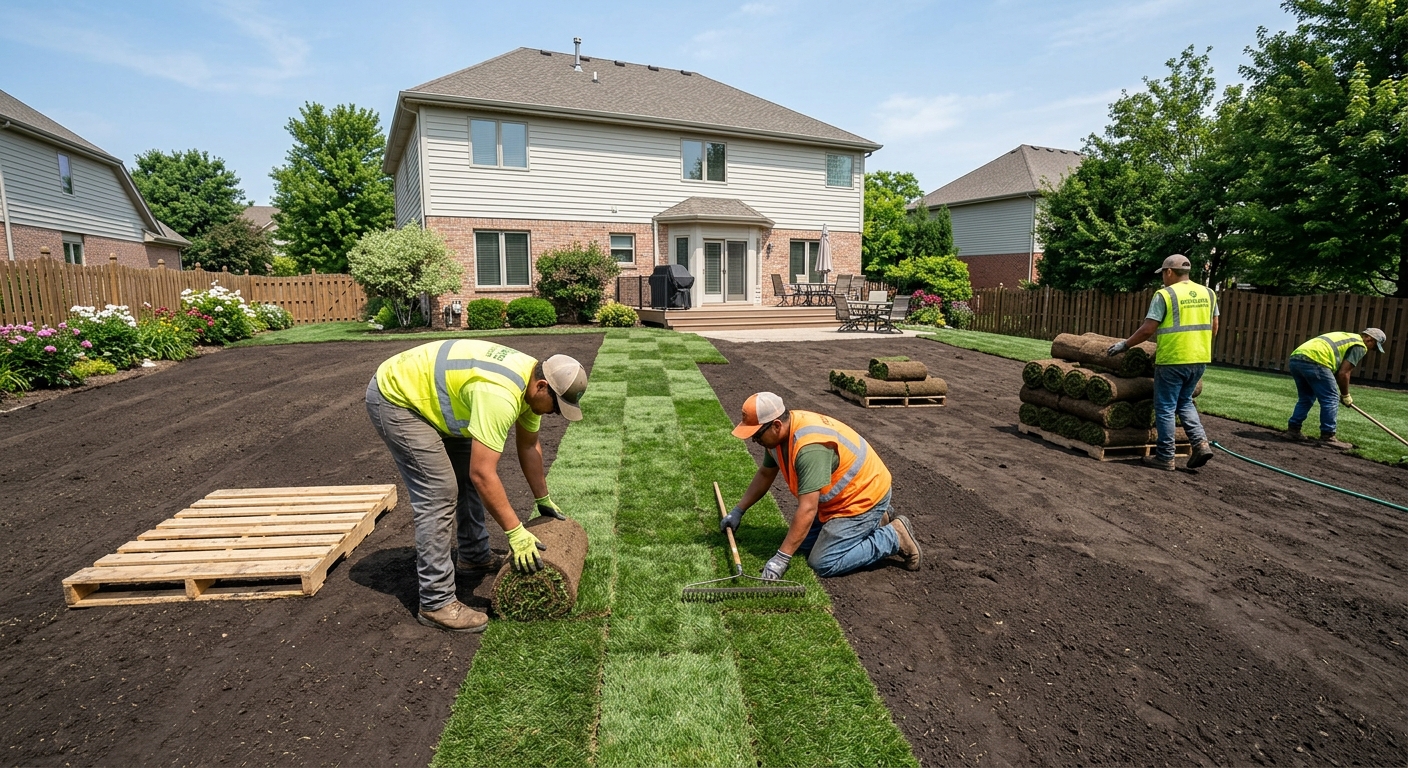
| Sod installation (supply, grade, lay, roll) |
Remove old turf (if needed), grade to finish level, add topsoil/compaction layer, lay sod, roll and water-in |
Best from mid-May to early September |
$2,000–$9,000 |
| Lawn seeding (grade, seed, starter fertilizer) |
Light re-grade, seed blend suited to shade/sun, starter fertiliser, light mulch, first watering schedule |
Late spring and early fall (cooler, damp conditions help) |
$1,000–$3,500 |
| Interlocking patio or walkway |
Excavate, compacted base, edging, interlocking pavers, proper drainage slope, jointing sand |
Mid-summer (when base conditions are stable) |
$3,000–$18,000 |
| Retaining wall (interlocking block) |
Block system, deeper base for frost stability, drainage gravel/weep provisions where needed, backfill |
Summer to early fall |
$4,500–$12,500 |
| Tree and shrub planting |
Soil loosening, amendments, staking (as needed), winter protection approach, mulching and establishment plan |
Spring and early fall |
$1,000–$7,500 |
Prices are estimates only and vary by project scope, site access and material selection.
What affects the price of landscaping in Burns Lake
In the Nechako region, two quotes for the same “look” can differ by 30–50% because the climate changes what must be built under the surface. Burns Lake sits around plant hardiness zones roughly 3–4, and that means we design around prolonged winter lows, deep frost, and a working season that’s shorter than coastal BC. A prairie-style frost calendar drives up the cost of anything that touches soil stability: retaining wall bases must reach below the frost line, and patio/walk foundations often need deeper, better-compacted granular layers to resist heaving. Water restrictions and drier spells in the interior also influence irrigation design—efficient drip systems and soil improvement are commonly prioritized over high-volume spray layouts. In coastal BC (Zone 7–8), contractors can install a wider range of plants through a longer growing season, but they must still manage drainage carefully in heavier rainfall areas, so drainage components still matter. Southern Ontario (Zone 5–6) typically has a moderate season but can require more summer irrigation during dry stretches.
Concrete examples from Burns Lake: (1) A yard that’s settled or built on older fill often needs extra grading and topsoil removal/addition—when the job is large, that can push you from a lawn-only budget closer to the lower end of full landscape design and installation pricing (from the $8,000–$60,000 band). (2) If you add an interlocking walkway plus proper drainage slope, the hardscape base prep can be a major driver; that’s why walkway projects sometimes land in the higher part of the $3,000–$18,000 range. (3) Tree work can swing based on caliper size and whether any removal or stump grinding is required before planting—especially common when homes were built before 1981.
| Price Factor |
Why It Matters |
Cost Impact |
| Yard size in sq ft — the primary cost driver for softscape |
More area means more topsoil, seed/sod, edging, labour hours, and materials |
Often the largest single driver; can account for 40–70% of total labour/materials on softscape-only projects |
| Grading and drainage work — slope corrections add significant cost |
Nechako freeze–thaw can worsen pooling and foundation moisture if slopes are wrong |
Can add major excavation and re-compaction; commonly pushes overall budget by 10–30% |
| Drainage bed or French drain installation |
Improves water movement away from foundations and prevents heaving |
Raises costs quickly due to trenching, pipe, filter fabric, gravel, and discharge planning |
| Plant material tier — native shrubs vs. ornamental vs. mature specimen trees |
Cold-hardy, larger-caliper plants cost more but establish faster in harsh winters |
Can shift planting line items from the lower band to the upper band depending on size and number of specimens |
| Hardscape vs. softscape ratio — walls and patios cost more per sq ft than lawn |
Hardscape requires excavation, compaction, base materials, and often thicker structural layers |
Commonly increases cost per visible “square foot”; patios/walkways can outprice sod/seed by several times |
| Irrigation system design and installation |
Zoned, efficient drip reduces water waste and supports establishment in drier interior conditions |
Adds equipment, tubing, fittings, and labour; more zones generally equal more cost |
| Soil amendment and topsoil required |
Improves rooting and drainage for lawns and shrubs, especially in older yards |
Can meaningfully raise costs when existing soil is compacted or low in organic content |
| Tree removal or stump grinding before new planting |
Stumps and roots complicate planting layout and can damage future drainage bases |
Often adds both labour and disposal; frequently becomes a “surprise” line item if not scoped upfront |
Permits & regulations in British Columbia
In British Columbia, most landscaping and planting projects generally do not require a permit. Planting new shrubs, trees, and installing sod usually falls under normal “landscaping” work, so you typically do not need a permit for softscape installation. Minor groundcover placement and routine grading for landscaping also commonly proceed without a permit, as long as you aren’t changing drainage in a way that affects neighbouring lots or storm infrastructure.
Work that DOES often require a permit includes retaining walls above a municipal height threshold—commonly around 1.0 m (3.3 ft) in many municipalities—and any scenario where the wall needs engineered drawings or a formal review. Another area that can require approval is lot grading changes that alter surface water flow, especially if it redirects runoff toward neighbouring properties or toward storm sewer connections. Before you dig for any planting holes or wall footings, contractors should arrange utility locates to protect gas, power, and communication lines.
For homeowners in Burns Lake, verify your contractor this way: (1) licensing/credentials: ask for their business details and check online registries relevant to their trade, then confirm they do landscaping/hardscaping as claimed; (2) liability insurance: request a current certificate of insurance showing adequate coverage; and (3) workers’ coverage: confirm WSIB/WCB coverage where applicable by asking for the clearance documentation or proof letter. For water-saving irrigation, also confirm any local water-use bylaws that may tighten in drought periods across the BC interior.
Planning a landscape that thrives in Burns Lake's climate
Planning for Burns Lake means working with the realities of plant hardiness zones roughly 3–4, frost that can stay in the ground into May and return by late September, and freeze–thaw cycling that stresses soil and foundations. Start with plant selection: choose native and zone-appropriate shrubs and perennials that can handle cold winters and wind exposure without constant re-wintering. In this climate, “pretty but tender” plants often lead to higher replacement and labour costs. For turf, decide early between sod and seeding. Sod gives instant coverage and stabilizes soil, but it costs more—on many Burns Lake lawns, sod installation can run $2,000–$9,000 depending on yard size, while seeding is often closer to $1,000–$3,500 for smaller areas. That means sod is justified when you need quick erosion control near a slope or walkway, or when you want a uniform look by a specific date.
Next, focus on drainage and grading. In Nechako, pooling and foundation moisture are more than cosmetic problems; they contribute to frost heave risks and long-term settling. For hardscape, base preparation should be designed with the local frost line in mind—deep, well-compacted granular layers plus correct slope protect patios and steps. Finally, use low-maintenance strategies that fit the interior: mulched shrub borders, winter-friendly groundcovers, and resilient perennials reduce annual upkeep. Xeriscape-style beds and rain-garden elements can work well in Burns Lake, especially when paired with soil improvement and drip irrigation where needed, because water efficiency matters when conditions are drier.
If you’re debating options, a good rule is this: spend more where it prevents rework. For example, paying for proper drainage under an interlocking patio (in the $3,000–$18,000 range) can cost less than replacing a sinking section later.
| Element |
Climate Consideration |
Maintenance Level |
Price Band |
| Sod lawn installation |
Needs stable soil conditions; frost can push timing later into spring and earlier protection in fall |
Medium (watering-in, first season care, mowing) |
$2,000–$9,000 |
| Native perennial garden |
Zone-appropriate plants handle winter lows and return reliably with less watering |
Low to medium (weeding in year one, seasonal cutback) |
$1,500–$6,500 |
| Mulched shrub border |
Mulch protects roots and helps manage freeze–thaw stress while reducing winter water loss |
Low (refresh mulch, occasional pruning) |
$2,000–$7,500 |
| Interlocking stone patio |
Requires deep base and proper drainage slope to resist frost movement |
Low (occasional joint sand top-up) |
$3,000–$18,000 |
| Retaining wall (block) |
Deeper frost-stable base and drainage gravel reduce heaving and water pressure |
Low (inspection and minor maintenance as needed) |
$4,500–$12,500 |
| Drip irrigation system |
Zoned drip is efficient for drought-prone periods; reduces freeze risk when designed properly |
Medium (seasonal checks, winterization) |
$1,500–$8,000 |
How to choose a landscaping contractor in Burns Lake
Choosing the right landscaping contractor in Burns Lake is mostly about proof and clarity. Start with coverage and credentials. Ask whether they carry liability insurance (request a certificate of insurance) and confirm workers’ coverage where applicable (WSIB/WCB coverage proof/clearance letter). If something goes wrong—like a cracked downspout, damaged turf removal, or a base failure under a patio—you want the contractor’s insurance to be current and adequate. Next, request itemised written quotes (not a single lump-sum number). For example, a quote for interlocking work should break down excavation, base materials, pavers, edging, labour, and disposal. For irrigation, insist on a line item for parts, tubing, zones, and installation, and confirm whether winterization is included.
Read the scope carefully: what is excluded? Is permit pulling included if a retaining wall triggers it? Is topsoil supply included, and is it screened/compacted? Is disposal of old sod and debris included or billed separately? Also ask about warranties: confirm the workmanship warranty length (how long they stand behind installation), the product/manufacturer warranty on materials, and whether it transfers if you sell your home. For payment, never pay more than 10–15% upfront; hold back a portion until the job is complete and cleaned up. Finally, get the start date and completion estimate in writing, because timing in the Nechako season window can affect everything from sod establishment to hardscape base conditions.
- Ask for an itemised quote with labour and materials separated
- Confirm insurance certificate is current and coverage is appropriate for the scope
- Verify workers’ coverage proof (WSIB/WCB clearance/documentation where applicable)
- Check whether the contractor includes utility locates before digging
- Clarify who supplies topsoil/top dress and what type (screened, clay/loam blend, amendment)
- Ensure grading and drainage are explicitly included (slopes to downspouts/foundation edges)
- Confirm disposal/haul-away is included for sod removal, stumps, and excess excavated soil
- Get a written plan for soil preparation and compaction under patios/walkways
- Ask for details on plant sizes (container vs. caliper), spacing, and staking standards
- Confirm irrigation components and number of zones (if included) and whether winterization is scheduled
- Review warranty terms in writing: workmanship duration and any exclusions
- Agree on a payment schedule with a holdback until completion and walkthrough acceptance
Red flags I see in Burns Lake include: quotes that are not itemised (no breakdown of base prep, soil amendments, or disposal); contractors who can’t provide insurance proof; vague timelines that ignore frost/soil readiness; “too-good-to-be-true” pricing on hardscape that doesn’t mention proper base thickness/compaction; and requests for large upfront deposits beyond about 10–15%.
Frequently asked questions — landscaping in Burns Lake
How much does sodding a yard cost in Burns Lake?
Sodding costs in Burns Lake depend heavily on yard size, how much grading is needed, and whether old turf must be removed. For a typical small-to-medium lawn refresh, most homeowners land somewhere around $2,000–$9,000 for supply, grade, lay and roll, with timing concentrated from mid-May to early September due to frost considerations. If your yard has drainage issues or uneven slopes, expect additional charges for topsoil, compaction, and corrective grading. Because Burns Lake has freeze–thaw cycling, proper subgrade preparation is what prevents “bounced” edges and weak seams later in the season. Ask for a per-square-foot breakdown and whether disposal and initial water-in are included.
How do I prevent weeds in my Burns Lake garden?
Weed prevention in British Columbia’s interior starts before you plant. After soil prep, install a proper weed barrier only where it makes sense (for example, between paths and beds), then use a thick layer of mulch—often the difference between “managed” and “chasing weeds all summer.” Dense planting and correct spacing reduce open soil where weed seeds germinate. In yards with older soil (common in homes built before 1981 in Burns Lake), adding compost and correcting drainage helps your desired plants root strongly, which competes better with weeds. For annual prevention, keep edging clean, pull weeds young, and avoid disturbing soil more than necessary when mulching. A first-year maintenance plan is especially important in a colder zone with a shorter growing season.
How do I design a low-water yard in Burns Lake?
In Burns Lake and the broader Nechako region, low-water design is about efficiency, soil quality, and plant choice—not just adding “drought-looking” rocks. Start by selecting cold- and drought-tolerant shrubs and perennials suited to zones roughly 3–4, then group plants by similar water needs. Improve soil with amendment so it holds moisture longer through summer dry spells, and use mulch on all exposed soil to reduce evaporation. For turf, consider seeding in some areas where you can accept slower establishment; lawn seeding is often closer to $1,000–$3,500 for smaller areas than sod. Where you do irrigate, choose zoned drip rather than high-volume spray. Finally, grade beds so water doesn’t run away from plant roots after rain—drainage and water conservation work together here.
How do I find a licensed landscaper in Burns Lake?
To find a qualified landscaper in Burns Lake, start with proof: ask the contractor for their insurance certificate and confirm workers’ coverage (WSIB/WCB proof/clearance where applicable). Then request a written scope and itemised quote so you can see labour, materials, and disposal clearly. You can also verify their standing through relevant online trade/business registries (depending on their exact trade category) and confirm they provide utility-locate coordination before digging for planting holes or wall footings. A good contractor will also acknowledge Nechako’s constraints—frost timing, drainage, and freeze–thaw base prep for hardscape. For example, if they’re proposing an interlocking patio, they should describe how the base is built and compacted, not just the paver style.
How much does landscaping cost in Burns Lake?
Landscaping costs in Burns Lake can range widely because projects usually bundle design, site prep, drainage, plants, and sometimes hardscape. A full landscape design and installation often falls within the broader band of $8,000–$60,000, depending on yard size and complexity. For smaller, targeted projects, costs can be much lower: sod is commonly around $2,000–$9,000 for typical lawns, while lawn seeding may be closer to $1,000–$3,500. Tree and shrub planting can range broadly as well, depending on plant sizes and quantities. In older neighbourhood yards and homes built before 1981, extra grading and soil amendment are common, which can raise the price even when the “style” looks straightforward. Always request an itemised quote so you understand what you’re paying for.
What plants thrive in Burns Lake's climate zone?
Burns Lake planting success comes from choosing cold-hardy, zone-appropriate species for roughly zones 3–4 and designing for frost and wind. In practice, that means hardy shrubs, dependable perennials, and trees that can handle prolonged cold and spring re-frost cycles. Many homeowners do best with native or locally proven plants because they establish with less fuss and usually need less watering once rooted. Good landscape performance also depends on how you plant—proper spacing, mulching, and soil amendment make a bigger difference than most people expect. If you’re adding turf, remember that interior winter conditions and a shorter working season affect establishment timing. A local contractor can recommend species that match your yard’s sun/shade and exposure and can build around Burns Lake’s drainage patterns.