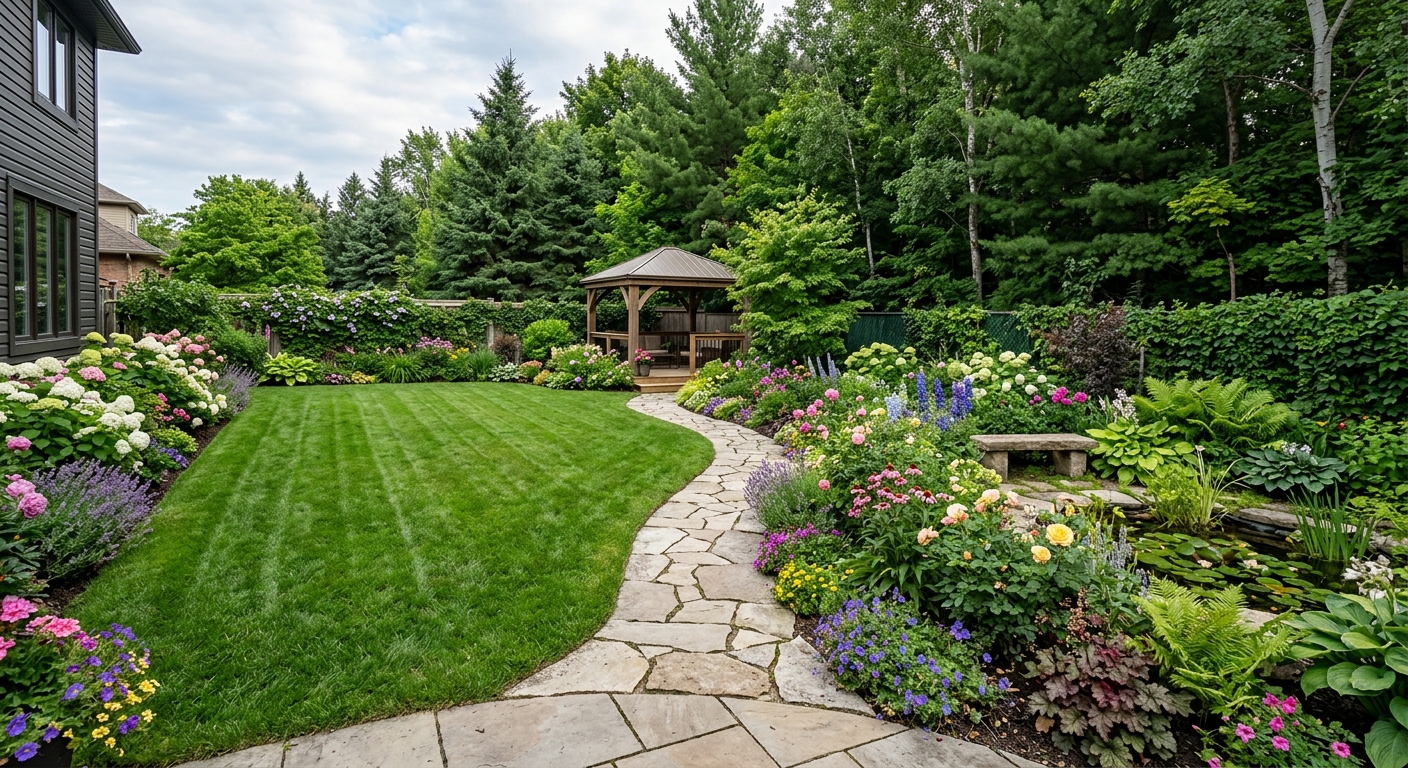
Landscaping options and costs in White Rock
Landscaping in White Rock is shaped by a unique mix of coastal weather and a tight housing market: with 21,939 residents (Statistics Canada, 2021 Census) and a homeowner-leaning community (6,955 homeowner households, 64.8% of households own), many properties have the yard space and long-term ownership incentive to invest in updates like patios, layered planting beds, and drainage fixes. In White Rock alone, the housing stock is older in many areas—39.2% of homes were built before 1981—so homeowners commonly request re-grading, improved soil, and refreshed hardscape bases that can tolerate decades of freeze–thaw movement and heavy winter rainfall.
In the Lower Mainland–Southwest (plant hardiness zones 7–8), costs tend to reflect a longer working and growing season than Prairie cities. Contractors are able to schedule more planting and softscape work through the year, but structural work still needs careful freeze–thaw detailing. That means excavation depth, drainage routing, and compacted bases matter—especially on sloped sites common in neighbourhoods like Ocean Park.
Prices also move with how much of your project is “softscape” (soil, seed, plants) versus “hardscape” (patios, interlocking, retaining walls), and whether you want efficient irrigation (drip + smart controller) for the occasional water-cost or restriction concerns that homeowners watch closely. For a realistic range, many White Rock projects land somewhere between the province-wide price bands for design/installation, lawn conversions, and planting.
Here’s a practical breakdown to compare quotes side-by-side before you choose a contractor.
| Service |
Description |
Season |
Price Range |
| Full landscape design and installation |
Site visit, concept + detailed plan, plant palette, grading/drainage coordination, labour for installation |
Spring–Fall (year-round softscape planning) |
$5,000–$50,000 |
| Sod installation (supply, grade, lay, roll) |
Minor grading/leveling, soil prep, sod delivery + laying, rolling and starter watering schedule |
Spring–Early Summer; Fall (dry windows) |
$2,000–$8,000 |
| Lawn seeding (grade, seed, starter fertilizer) |
Grading to smooth low spots, seed blend, starter fertilizer, light raking and establishment care |
Late spring–Early summer; early fall |
$1,200–$5,500 |
| Interlocking patio or walkway |
Excavate and compact base, geotextile, gravel layers, edge restraint, interlocking stones, leveling |
Spring–Fall (best outside wettest weeks) |
$10,000–$35,000 |
| Retaining wall (interlocking block) |
Layout, excavation/compaction, drainage gravel and weep considerations, block placement and caps |
Spring–Fall |
$10,000–$80,000 |
| Tree and shrub planting |
Soil loosening, amendments, digging + planting, mulch ring, staking (if needed), first-season watering plan |
Spring–Fall |
$1,000–$15,000 |
Prices are estimates only and vary by project scope, site access and material selection.
What affects the price of landscaping in White Rock
Even when two homeowners request the same “new backyard,” quotes in the Lower Mainland–Southwest can differ by 30–50% once you factor in site realities, product choices, and how much groundwork is required. In British Columbia, the plant hardiness zone (7–8) and the coastal frost calendar mean you can plant for a longer window, but labour availability and wet-season access still influence scheduling. In Prairie regions (Zone 2–4), short frost-free windows and harsher winter conditions push many clients toward drought-tolerant, low-maintenance designs, and construction schedules get tighter—so mobilization and labour assumptions differ. Coastal BC can support a more lush palette, but good drainage is non-negotiable on heavy-rainfall soils.
Local examples that raise or lower cost in White Rock include: (1) older yards often need additional soil amendment and regrading, which adds labour and hauling; (2) steep or sloped lots may require deeper excavation for retaining-wall foundations to reduce movement during freeze–thaw cycles; and (3) if you want irrigation upgrades (drip lines, zones, and smart controllers), the materials and trenching can change the price more than many homeowners expect.
As a reference point, softscape upgrades often fit within the $1,000–$15,000 tree and garden planting band, while full design-and-install projects frequently land in the $5,000–$50,000 range depending on how much grading, hardscape, and drainage is included. Also, because 39.2% of homes were built before 1981 (Statistics Canada, 2021 Census), you’ll often see legacy drainage issues that require additional groundwork—turning a “planting-only” request into a broader installation.
| Price Factor |
Why It Matters |
Cost Impact |
| Yard size in sq ft — the primary cost driver for softscape |
More area means more soil prep, mulch, plants, labour time and materials |
Low to high (often the largest line-item swing) |
| Grading and drainage work — slope corrections add significant cost |
Pooling must be eliminated to protect foundations and plant roots |
Can increase total by 15%–40% on sloped lots |
| Drainage bed or French drain installation |
Subsurface drains require excavation depth, aggregate, and routing |
Typically adds a noticeable mid-project premium |
| Plant material tier — native shrubs vs. ornamental vs. mature specimen trees |
Specimen sizes cost more and may need extra labour for planting/staking |
Can double plant budget depending on sizes |
| Hardscape vs. softscape ratio — walls and patios cost more per sq ft than lawn |
Concrete/base materials and base compaction are labour-intensive |
Shifts pricing toward the upper bands |
| Irrigation system design and installation |
Trenching, valve/zone planning, heads, and controllers add cost |
Often a mid-range add-on, especially for multi-zone yards |
| Soil amendment and topsoil required |
Coastal soils can be compacted or nutrient-poor; amendments improve rooting |
Can raise costs depending on haul volume |
| Tree removal or stump grinding before new planting |
Removal changes access, cleanup, disposal, and sometimes replanting layout |
May add a major one-time cost before installation begins |
Permits & regulations in British Columbia
In British Columbia, most planting, sodding, and typical softscape work generally does not require a permit. That includes digging holes for trees and shrubs, installing mulch, seeding lawns, and most standard yard grading done within typical homeowner landscaping limits. However, retaining walls above a height threshold—commonly around 1.0 m (3.3 ft) in many municipalities—often do require a permit, and sometimes engineered drawings depending on height, soil conditions, and proximity to structures.
Grading changes can also trigger approval if they affect lot drainage patterns, especially where runoff could be redirected toward neighbouring properties or storm connections. If your plan involves altering drainage lines, adding catch basins, or changing where water flows, you should ask the contractor to confirm the approval requirements before work begins.
Before anyone digs in White Rock, ensure utility locates are completed: contact the utility-locating service and have lines marked before planting holes, trenching for irrigation, or wall footings. This helps avoid costly delays and safety issues.
To verify a contractor’s standing: (1) check for the appropriate British Columbia licence/registration status where applicable (often via the contractor’s business listing and any trade registration they claim), (2) request a certificate of insurance for general liability that matches the project scope, and (3) confirm workers’ coverage—WSIB/WCB—by asking for the clearance letter or proof of coverage. Don’t accept “we’re covered” statements without documents.
Planning a landscape that thrives in White Rock's climate
In White Rock, the goal is to design with coastal zone conditions (hardiness zone 7–8), steady moisture, and a frost calendar that allows long work and growing windows—but still respects freeze–thaw movement in structural bases. Start with plant selection: choose zone-appropriate, often native or well-adapted species that handle winter wet and cool summers with minimal extra protection. This reduces labour during cleanup and helps avoid constant replanting. Pair that with good soil readiness—compaction relief plus compost/amendments—so roots can hold in rainy months without suffocating.
For turf, many homeowners ask whether sod or seed is better. Sod gives instant green cover and faster curb appeal, but it costs more per sq ft—commonly about 3–4x more than seeding when you compare installed pricing for typical yards. Seeding costs less and works well when the grading is right and you protect the seedbed from heavy foot traffic, but you need patience through establishment.
Drainage and grading are critical in the Lower Mainland–Southwest. Avoid pooling near foundations by setting correct slopes and ensuring sub-surface flow can move. For hardscape like patios and retaining walls, base prep is what prevents heave and wall movement: dig and compact to the right depth, and keep drainage layers intact so water doesn’t freeze beneath the structure.
To keep maintenance reasonable, use groundcovers, mulched shrub borders, and long-blooming perennials. If you want a water-wise angle for the occasional summer demand concerns, look at rain-garden pockets and smart drip irrigation rather than eliminating plant density entirely. A good example: if you’re budgeting $5,000–$50,000 for design and installation, spending an extra $800–$1,500 on proper drainage adjustments often saves more than replacing struggling plants later.
| Element |
Climate Consideration |
Maintenance Level |
Price Band |
| Sod lawn installation |
Works best with timely establishment in spring or early fall; needs consistent moisture until rooted |
Low–Moderate (establishment period + edging) |
$2,000–$8,000 |
| Native perennial garden |
Zone-appropriate plants handle coastal wet winters and cool summers with less winter damage |
Low (mulch refresh + seasonal tidy) |
$1,500–$10,000 |
| Mulched shrub border |
Mulch buffers soil moisture swings and reduces weeding in a region where winters are wet |
Low (trim and mulch top-ups) |
$1,200–$7,500 |
| Interlocking stone patio |
Requires proper base and drainage to tolerate freeze–thaw cycles at structural depth |
Low (occasional cleaning and edge checks) |
$10,000–$35,000 |
| Retaining wall (block) |
Needs compacted foundation and drainage considerations to prevent movement in wet winters |
Low (inspection + drainage upkeep) |
$10,000–$80,000 |
| Drip irrigation system |
Efficient for watering during dry spells; supports smart scheduling for efficiency |
Moderate (controller setup + seasonal check) |
$1,500–$8,000 |
How to choose a landscaping contractor in White Rock
Choosing a contractor in White Rock is mostly about verification and clarity. First, confirm British Columbia trade licensing/registration where applicable for the work you’re buying (especially if hardscape and drainage are involved), then request proof of liability insurance—ask for a certificate of insurance showing your property is covered for the project period. Next, verify workers’ coverage: ask for proof of WSIB/WCB or the applicable clearance letter. A reputable contractor should provide these documents quickly, not after repeated follow-ups.
Get 2–3 itemised written quotes. You want line items that separate labour from materials and clearly state what’s included (excavation depth, base layers, geotextile, disposal, topsoil/soil amendments, and irrigation components if planned). Watch for quotes that only provide a single lump sum; they’re harder to compare and often hide exclusions.
Read the scope carefully. Is the permit pull included if your retaining wall crosses the typical height threshold? Is disposal of old sod, soil, or debris included? Are there allowances for different plant sizes? Clarify warranty terms: workmanship warranty length, product/manufacturer warranty coverage, and whether warranties are transferable if you sell your home.
Payment schedule should be sensible: never pay more than 10–15% upfront, and hold back payment until the job is complete and cleaned. Finally, require a written start date and completion estimate, especially around White Rock’s wetter weeks, so the schedule doesn’t drift.
- Ask for insurance certificate and verify coverage dates match your project
- Request proof of WSIB/WCB coverage (or clearance letter)
- Confirm any required permits in writing for retaining walls and drainage-related grading
- Get an itemised quote (labour, materials, disposal, and equipment time separated)
- Check that base prep details for patios/walkways are included (not just the pavers)
- Confirm drainage scope: grades, downspout routing, French drain if specified
- Request a plant list with sizes (e.g., container size or caliper) and installation spacing
- Ask about soil amendments/topsoil quantities and whether they’re measured
- Clarify irrigation scope: zones, coverage area, and smart controller inclusion (if desired)
- Verify warranty: workmanship duration, what it covers, and how to claim
- Avoid contractors who pressure for large upfront payments
- Ensure the contract includes cleanup and final site restoration
Red flags in White Rock include: (1) refusing to provide insurance/WSIB/WCB documentation, (2) vague “retaining wall” wording without base/drainage details, (3) quoting only a lump sum with no allowances for drainage or disposal, (4) no written timeline or start/completion dates, and (5) “cash-only” arrangements or large upfront deposits without a contract.
Frequently asked questions — landscaping in White Rock
Do I need a permit for a retaining wall in British Columbia?
In British Columbia, many landscaping projects (like planting, sodding, and routine softscape) typically don’t require a permit, but retaining walls can be different. If your block wall is above a common municipal height threshold—often around 1.0 m (3.3 ft)—a permit is frequently required, and engineered drawings may be requested depending on the design and site conditions. In White Rock, where wet winters and freeze–thaw movement matter, contractors should also confirm drainage provisions (backfill and weeping/drainage considerations) since poor drainage can create premature movement and trigger additional reviews. The safest approach is to ask for a written scope note: “Permit pull included or not” before you sign, and ensure the contractor checks the local requirements for your specific location and wall height.
How do I improve drainage in my yard?
Drainage improvements start with diagnosing where water is going and why it’s pooling. In White Rock and the Lower Mainland–Southwest, the most common fixes are re-grading to direct flow away from foundations, improving soil structure with amendments, and installing a subsurface drainage bed or French drain where water collects. If you have downspout runoff issues, routing downspouts to a controlled drainage outlet can prevent soggy planting beds and foundation moisture. For many projects, drainage work is the difference between a simple planting budget and a higher full installation scope. A practical example: if your lawn seeding estimate is in the $1,200–$5,500 range, adding drainage bed work can move the project toward higher design/installation levels (often within the $5,000–$50,000 band) because excavation and base prep become part of the job.
What is xeriscaping and does it suit White Rock?
Xeriscaping is a water-wise landscaping approach that reduces irrigation demand by using drought-tolerant plants, efficient irrigation, and soil/mulch strategies. In White Rock (coastal zone 7–8), you can still benefit from xeriscape principles, but you typically adapt them: winters are wet, so the focus is often more on drainage and root health than on eliminating water entirely. Many homeowners do well with a “rain-garden meets drip” concept—grouping plants by moisture needs and using drip irrigation for targeted summer watering instead of broad, wasteful coverage. Xeriscaping can suit White Rock especially if you want lower upkeep and resilient beds, but it shouldn’t ignore coastal rainfall: make sure drainage and grading are correct so plants don’t sit in saturated soil. A good contractor can mix drought-tolerant elements with lush perennials without creating a yard that looks sparse or struggles in winter.
How do I plan a low-maintenance yard?
A low-maintenance yard is planned around repeatable “systems”: mulch, plant spacing, soil health, and simple turf choices. In White Rock, I typically steer homeowners toward layered shrub borders with mulch, native/perennial gardens with correct plant spacing, and groundcovers that suppress weeds. For turf, consider whether you really need sod—sod gives quick results but costs more per sq ft than seeding (often about 3–4x higher), and it still requires establishment care. Instead of constant weeding, use thick mulch layers, choose plants that naturally grow into the space, and include irrigation only where it’s needed. If you’re budgeting, many planting and bed refreshes land around the $1,000–$15,000 tree and garden planting band, while a complete makeover with design, drainage coordination, and hardscape can fall within the $5,000–$50,000 design & installation range. The key is to spend on the groundwork once.
How deep should a retaining-wall base be for local frost?
For retaining walls, the base depth isn’t based on a single “magic number” alone—it’s based on wall height, soil type, and drainage design. In coastal BC like White Rock, you still have freeze–thaw cycles, so foundations must be excavated and compacted properly to reduce movement, and the base typically goes deeper than what people assume for “only a small wall.” Your contractor should design the foundation depth around local frost considerations and the specific retaining-wall system being installed, including adequate drainage/backfill details behind the wall. Because older homes are common (39.2% built before 1981) and yards may have legacy drainage issues (Statistics Canada, 2021 Census), the excavation and subgrade condition can change depth requirements. If anyone is proposing a retaining wall without discussing compaction, drainage layers, and foundation depth rationale, ask for details in writing.
How much does professional landscape design cost?
Professional landscape design cost can vary widely based on how detailed the drawings need to be and whether the designer also supplies a full installation quote. In White Rock, design-and-install projects commonly sit within the broader $5,000–$50,000 range because most homeowners want the plan plus labour, grading coordination, and planting/hardscape implementation. If you’re only looking for concept design and a planting plan, the price is often lower than full installation work, but you’ll still need to budget for the actual construction. Your quote should clearly separate design time, plan complexity, and site measures from installation labour and materials. A good indicator of value is whether the scope includes a real site visit and practical drainage/grading recommendations—especially important in the Lower Mainland–Southwest where wet winters can turn small grading issues into big ones.