Landscaping options and costs in Dorset Park
Dorset Park, Ontario sits in the Toronto market where homeowners want curb appeal that holds up through wet springs, humid summers, and freeze–thaw winters. In a neighbourhood like Dorset Park, yard upgrades are common because many homes come with dedicated outdoor space; across the area, families account for a large share of the local population (Statistics Canada, 2021 Census), and that typically translates into demand for practical, child- and pet-friendly layouts. With a total population of 25,003 (Statistics Canada, 2021 Census), Dorset Park is dense enough that contractor scheduling matters—especially during the short, reliable planting window from late spring through early fall.
Toronto-area pricing is shaped by climate and soil. We typically work in plant hardiness zones 6a–7a, selecting shrubs, perennials, and small trees that can tolerate winter lows around –23 to –18°C, while still looking good in hot, often humid weather. Freeze–thaw cycles also drive structural costs: retaining walls, patios, and steps often require deeper, well-compacted granular bases, sometimes geogrid, and careful drainage detailing to stay stable over time. Local clay and fill soils can mean more excavation, soil amendment, and drainage work than you’d see in milder climates, which is why the same “interlocking + planting” plan can swing widely between quotes.
In Dorset Park, the trade is especially busy around the busier residential corridors near Lawrence Avenue East and the local shopping nodes, where homeowners tend to prioritize neat front entries and clean walkways for year-round presentation. Below is a straightforward comparison of common landscape scopes and typical price ranges to help you start aligning budgets—then we’ll break down the factors that move the numbers.
| Service |
Description |
Season |
Price Range |
| Full landscape design and installation |
Site visit, concept and layout, grading/drainage review, plant palette, hardscape and softscape installation |
Spring to early fall (best planting window) |
$8,000–$40,000 |
| Sod installation (supply, grade, lay, roll) |
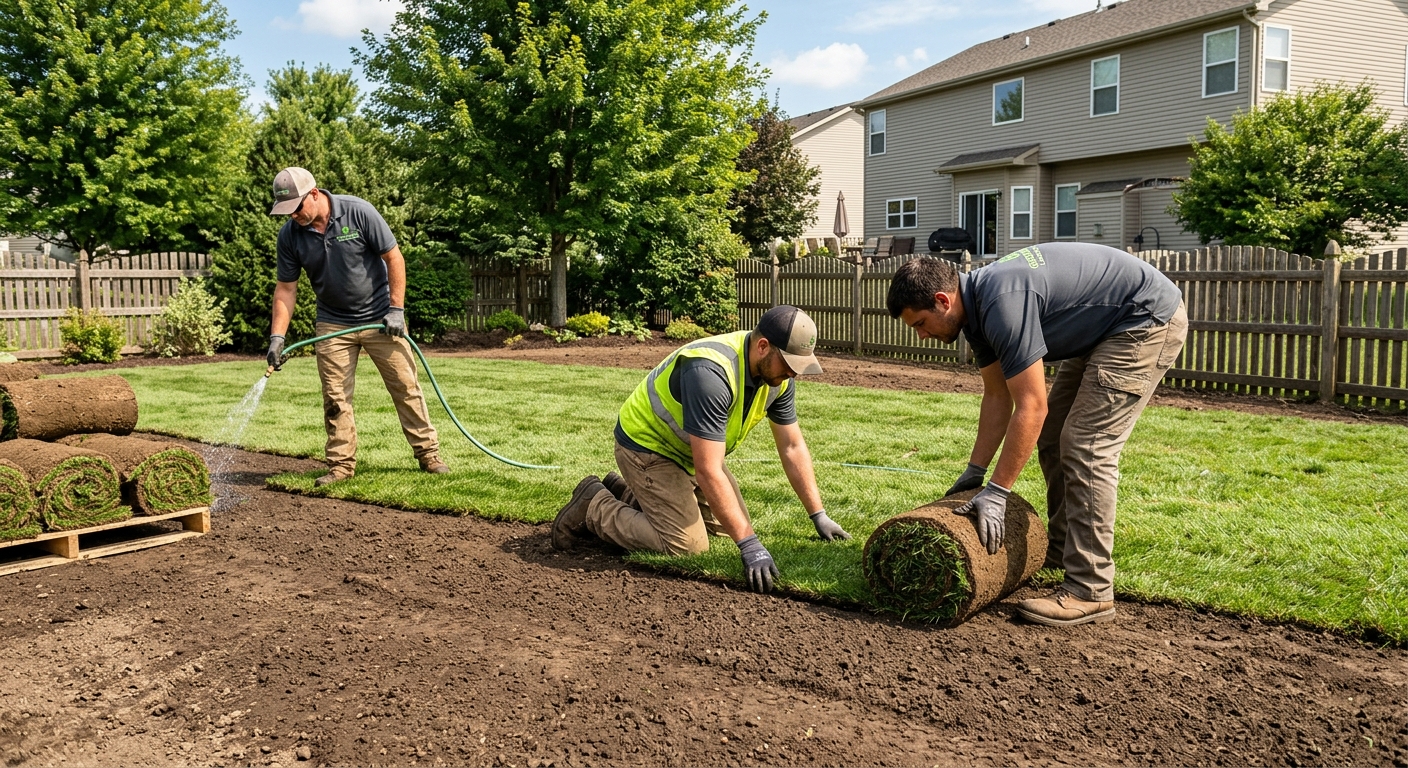
Soil prep/leveling, sod delivery, roll-and-compact, starter fertilizer and light watering setup |
Late spring to early fall |
$2,500–$8,000 |
| Lawn seeding (grade, seed, starter fertilizer) |
Fine grading, seed blend, starter fertilizer, light mulch/cover (as appropriate) |
Spring or early fall |
$1,500–$5,500 |
| Interlocking patio or walkway |
Excavation, base (granular), edge restraints, interlocking stones, compaction and finishing |
Spring to fall (concrete/stone bases depend on ground conditions) |
$6,000–$30,000 |
| Retaining wall (interlocking block) |
Block system, engineered layout where needed, drainage layer, geotextile, backfill and compaction |
Spring to early fall |
$6,000–$30,000 |
| Tree and shrub planting |
Soil amendment, planting holes, staking (if required), mulch rings, watering plan setup |
Late spring to early fall |
$800–$6,000 |
Prices are estimates only and vary by project scope, site access and material selection.
What affects the price of landscaping in Dorset Park
In Dorset Park and across the Toronto area, it’s common to see quotes for the “same type” of landscaping land 30–50% apart once you account for site realities and how contractors price risk. One crew may include grading and drainage fixes that another treats as a separate add-on, and that difference alone can swing the total. Labour availability also matters: during peak spring and fall weeks, scheduling and crew size can affect per-day costs, especially for projects that need a larger install crew for stone, block and soil handling.
Climate and hardiness drive both what grows and when we can do it. In the GTA’s plant hardiness zones 6a–7a, we target plants that tolerate winter lows around –23 to –18°C and select schedules around frost. Prairie regions (Zone 2–4) face short growing seasons and typically require more drought- and wind-tolerant species, plus simpler, lower-risk layouts—while retaining wall base depth must reach below the frost line there. Coastal BC (Zone 7–8) supports longer growing seasons and lush palettes, but heavy-rain drainage detailing is often a bigger engineering focus. Dry BC interior municipalities may require drip designs because water restrictions are common.
Southern Ontario is a “moderate” case: freezing and freeze–thaw still force deep bases and careful drainage, but we’re not dealing with the extreme aridity that can push irrigation-heavy xeric designs in drier regions. In Dorset Park specifically, clay and fill soils can add excavation and soil amendment—so a lawn that’s priced as $2,500–$8,000 on paper can rise if we must rebuild grades or install a drainage bed. If you’re pairing a patio with a retaining wall, the wall base preparation and proper drainage layers often push hardscape into the $6,000–$30,000 band more quickly, because stone and block installs are labour-intensive and depend on stable, compacted granular construction.
| Price Factor |
Why It Matters |
Cost Impact |
| Yard size in sq ft — the primary cost driver for softscape |
More area means more topsoil, labour hours, materials, and maintenance setup |
Low to high—can multiply totals quickly |
| Grading and drainage work — slope corrections add significant cost |
Toronto pooling risk and foundation moisture control require proper grade |
Often +$1,000 to +$8,000 depending on excavation |
| Drainage bed or French drain installation |
Helps manage saturated clay and reduces freeze–thaw movement |
Typically +$1,500 to +$7,500 |
| Plant material tier — native shrubs vs. ornamental vs. mature specimen trees |
Size and source affect purchase cost and installation time |
Can shift planting from $800–$6,000 upward |
| Hardscape vs. softscape ratio — walls and patios cost more per sq ft than lawn |
Stone and block require deeper bases, edges, compaction, and detailing |
High—frequently drives $6,000–$30,000 outcomes |
| Irrigation system design and installation |
Ensures establishment in humid summers and reduces winter stress from poor watering |
Moderate to high; often adds thousands |
| Soil amendment and topsoil required |
Clay/fill may need imported topsoil, compost, and proper blending |
Usually +$500 to +$5,000+ |
| Tree removal or stump grinding before new planting |
Roots, stumps, and access constraints affect labour and disposal |
Can add a few hundred to several thousand |
Permits & regulations in Ontario
In Ontario, most planting and softscape work—like sod installation, seeding, mulch, and shrub/tree planting—typically does not require a permit. If your project includes interlocking patios, walkways, and general landscaping excavation for bases, permits are usually not required either in most routine homeowner scopes. The area where rules often become real is retaining walls and any lot grading changes that can redirect drainage.
Retaining walls above the local threshold—commonly around 1.0 m (3.3 ft) in many municipalities—typically require a building permit and may need engineered drawings depending on height, condition, and soil conditions. Also, changes to lot grading that affect how water drains toward neighbouring properties or storm connections may trigger approval requirements. Before any digging (even for planting holes), ensure the utility locate process is completed so you don’t hit buried services.
To verify an Ontario contractor in Dorset Park, do it step-by-step:
- Confirm their Ontario business registration details and operating address (where applicable through public registries).
- Ask for a current certificate of insurance: general liability with the homeowner named/endorsed where possible.
- Confirm WSIB coverage (or the correct equivalent coverage status for their workers) and obtain documentation showing active coverage or clearance.
- Request a copy of their written scope, including disposal, materials, and any permit responsibility.
- Verify warranty terms in writing before work begins.
For water-use expectations, always confirm irrigation and water-use bylaws for your specific area and season—Toronto rules and enforcement can tighten during drought-like conditions.
Planning a landscape that thrives in Dorset Park's climate
Planning for Dorset Park’s climate means designing with the expectation of hard winters, humid summers, and frequent freeze–thaw. Dorset Park sits in a hardiness range where we can grow reliable, zone-appropriate woody plants and perennials, but we still have to respect frost timing and drainage. Start with plant selection: choose hardy, largely native or well-adapted species that tolerate winter lows around –23 to –18°C and don’t demand constant watering once established. Group plants by water needs and sun exposure to avoid “one schedule fits all” maintenance.
Next, choose turf strategy. Sod delivers instant results, but it typically costs 3–4x more per sq ft than seeding once you include prep and supply. If you need fast visual impact near a front entry, sod can be justified—say you’re fixing a thin, patchy lawn before a summer sale. If your priority is budget control, seeding after proper grading is often the smarter value. In Toronto, the moisture swings between spring rain and summer dry spells make drainage and watering discipline critical during establishment.
Drainage and grading are non-negotiable. In clay/fill soils, poor slopes can cause pooling against foundations, and that’s exactly where freeze–thaw can widen cracks and lift edges. For hardscape like patios and retaining walls, base preparation has to be deep and properly compacted to sit stable through winter movement. Finally, low-maintenance design works best with groundcovers, mulch, and perennial structure—so you get curb appeal without constant weeding.
If you want reduced water use, consider rain gardens in low spots and xeriscape-inspired plant groupings with mulch and selective irrigation. In Dorset Park, these approaches fit well when combined with proper drainage so plants aren’t forced to live in soggy conditions.
Dollar example: If a 500 sq ft lawn repair is priced in the sod band, you might be looking at roughly $2,500–$8,000 total depending on prep. If instead you seed and focus budget on grading/drainage fixes, that same area can often land closer to the seeding band, with the savings better invested into a properly constructed edge or drainage bed that protects the whole yard.
| Element |
Climate Consideration |
Maintenance Level |
Price Band |
| Sod lawn installation |
Needs establishment water in hot weeks and good grading to avoid pooling in spring |
Medium during first season; then low |
$2,500–$8,000 |
| Native perennial garden |
Zone-appropriate perennials handle Toronto winters and recover each spring with mulch |
Low to medium (weeding/feeding seasonally) |
$1,200–$6,000 |
| Mulched shrub border |
Mulch buffers freeze–thaw and reduces moisture swings in humid summers |
Low (mulch refresh and light pruning) |
$800–$4,500 |
| Interlocking stone patio |
Requires compacted base and proper drainage so freeze–thaw doesn’t heave joints |
Low (occasional leveling/cleaning) |
$6,000–$30,000 |
| Retaining wall (block) |
Backfill compaction and drainage layer protect stability through winter movement |
Low (periodic inspection of drainage and joints) |
$6,000–$30,000 |
| Drip irrigation system |
Helps manage watering during humid summers while reducing waste on mulched beds |
Medium (season start/stop adjustments) |
$1,500–$6,500 |
How to choose a landscaping contractor in Dorset Park
Start by verifying licensing and coverage the right way—don’t rely on “we’ve done this for years” alone. In Ontario, ask your contractor for a certificate of insurance (general liability) and make sure it’s current. For workers, confirm WSIB/WCB coverage documentation: you should receive proof of active coverage and a clearance status where applicable. If a contractor can’t provide these documents, treat it as a major risk.
Next, request 2–3 itemised written quotes. You want line items like labour hours, excavation quantities, disposal, base materials, stone/block quantities, and plant counts or sizes—not just a single lump sum. Ask whether design time (if any) is included, and whether the quote includes permit pulls (where retaining wall rules apply), utility locate coordination, and disposal of excess soil.
Warranty matters for workmanship and products. Get the workmanship warranty length in writing and clarify what “warranty service” includes. Also separate product/manufacturer warranties (for plants, stone, or irrigation components) and confirm if they’re transferable if you sell the home.
Payment schedule: never pay more than 10–15% upfront. Hold back the remainder until the job is complete and site cleanup is done to spec. Timeline should be in writing too—start date and completion estimate, including weather contingency notes for freeze–thaw periods and wet ground.
- Insist on an itemised scope with quantities (sq ft, linear ft, and counts).
- Ask for base specs (thickness, compaction, geotextile/geogrid when relevant).
- Confirm drainage detailing (French drain, slope away from foundation, outlet plan).
- Check they include disposal of excavated soil and debris.
- Verify plant sizes, grades, and whether substitutions are pre-approved in writing.
- Get confirmation of material brand/colour/grade for stone and block.
- Ask what happens if frost delays planting (re-schedule terms).
- Review warranty: workmanship start date, length, exclusions, and service process.
- Confirm who pulls locates and whether damages are covered by insurance.
- Request a simple schedule: each phase’s start and finish dates.
- Make sure cleanup and edging details are included (especially along foundations).
- Don’t accept “verbal only” changes—requires written amendments.
Red flags to watch for in Dorset Park: missing itemisation, unclear drainage details, only a lump-sum quote, no proof of WSIB/WCB coverage or insurance, and pressure for large upfront payments (beyond 10–15%).
Frequently asked questions — landscaping in Dorset Park
What is xeriscaping and does it suit Dorset Park?
Xeriscaping is a landscaping approach that reduces irrigation needs by combining drought-tolerant plant selections, efficient watering methods (often drip), and soil improvement like mulch and compost. In Dorset Park, it can suit many yards because we’re in Southern Ontario (Zone 6a–7a) where summer can be humid but dry spells still happen, and Toronto homeowners often want less maintenance without sacrificing appearance. That said, xeriscaping isn’t “no watering”—your soil drainage matters. If you have clay that holds water, a rain garden or drainage fix should come first. Budget-wise, a simple planting refresh paired with smart irrigation can fit within typical tree and garden planting ranges ($800–$6,000), while full irrigation design can add substantially.
How do I plan a low-maintenance yard?
In Dorset Park, low maintenance usually comes from three things: good drainage, a plant palette that’s hardy to local winters, and mulch-based weed control. Plan your beds around structure—grasses, shrubs, and perennial “repeaters”—so you’re not constantly replanting. Choose zone-appropriate woody plants that can handle winter lows around –23 to –18°C, and group plants by sun and water needs to avoid overwatering or stress. For turf, consider seeding if you don’t need instant coverage, and reserve sod for high-visibility areas. A practical strategy is investing where it counts: if grading or drainage is causing problems, that fix often prevents ongoing costs more than repeatedly adjusting sprinklers.
How deep should a retaining-wall base be for local frost?
Retaining-wall base depth isn’t one-size-fits-all, but in Southern Ontario you design for stability through freeze–thaw. That typically means an excavated, compacted granular base plus proper drainage layers behind the wall, and in many cases frost-related depth considerations depending on wall height and soil conditions. As a homeowner, the key is to ensure your contractor provides base build-up details (excavation depth, granular thickness, geotextile/geogrid if required) and a drainage plan. If the wall height approaches the usual permit threshold (commonly around 1.0 m), you may need a permit and possibly engineered details. For budget planning, retaining walls commonly land in the $6,000–$30,000 band because base preparation and drainage are major cost drivers.
How much does professional landscape design cost?
Professional landscape design cost in the Toronto area is commonly included as part of full design-and-install proposals, where the total project often falls in the $8,000–$40,000 range depending on scope. If you’re paying for design-only, many contractors bundle it as a credit toward installation, but that’s contract-specific—so ask upfront. In Dorset Park, design value is highest when your yard has drainage concerns (common with clay/fill soils) or when you’re combining hardscape like interlocking patios with planting. A good designer will specify plant sizes, soil amendment needs, and hardscape base requirements to reduce change orders later.
How do I compare landscaping quotes?
To compare quotes in Dorset Park fairly, ask for itemised line items and compare apples-to-apples. Look for quantities (sq ft/linear ft) and details: excavation depth, base thickness, compaction approach, drainage bed or French drain inclusion, disposal, and the exact plant list with sizes. Confirm whether the quote includes permits where required (especially retaining walls above the typical threshold) and whether utility locates are coordinated. Also compare warranties and payment schedules. If Quote A looks far cheaper than others, it may be leaving out drainage work or using smaller plant sizes—two common causes of 30–50% differences in Toronto-area pricing. For reference, a patio or walkway often sits in the $6,000–$30,000 band, while tree/shrub planting is commonly $800–$6,000.
How long does a landscaping project take in Dorset Park?
Timing depends on weather and scope, but in Dorset Park the reliable window is generally spring through early fall. Planting and mulching are usually quicker once the soil is prepped—tree and shrub planting is often completed in days, while larger plantings can take longer. Sod installation can be fast on paper, but site prep (grading and soil prep) often controls the schedule. Hardscaping and retaining walls typically take longer because they require excavation, base construction, compaction, and sometimes drainage work; cure and base setup conditions can also shift dates after heavy rain or wet ground. If you’re booking in peak season, ask for a written start date and completion estimate, and confirm what happens if freeze–thaw or storms delay work.