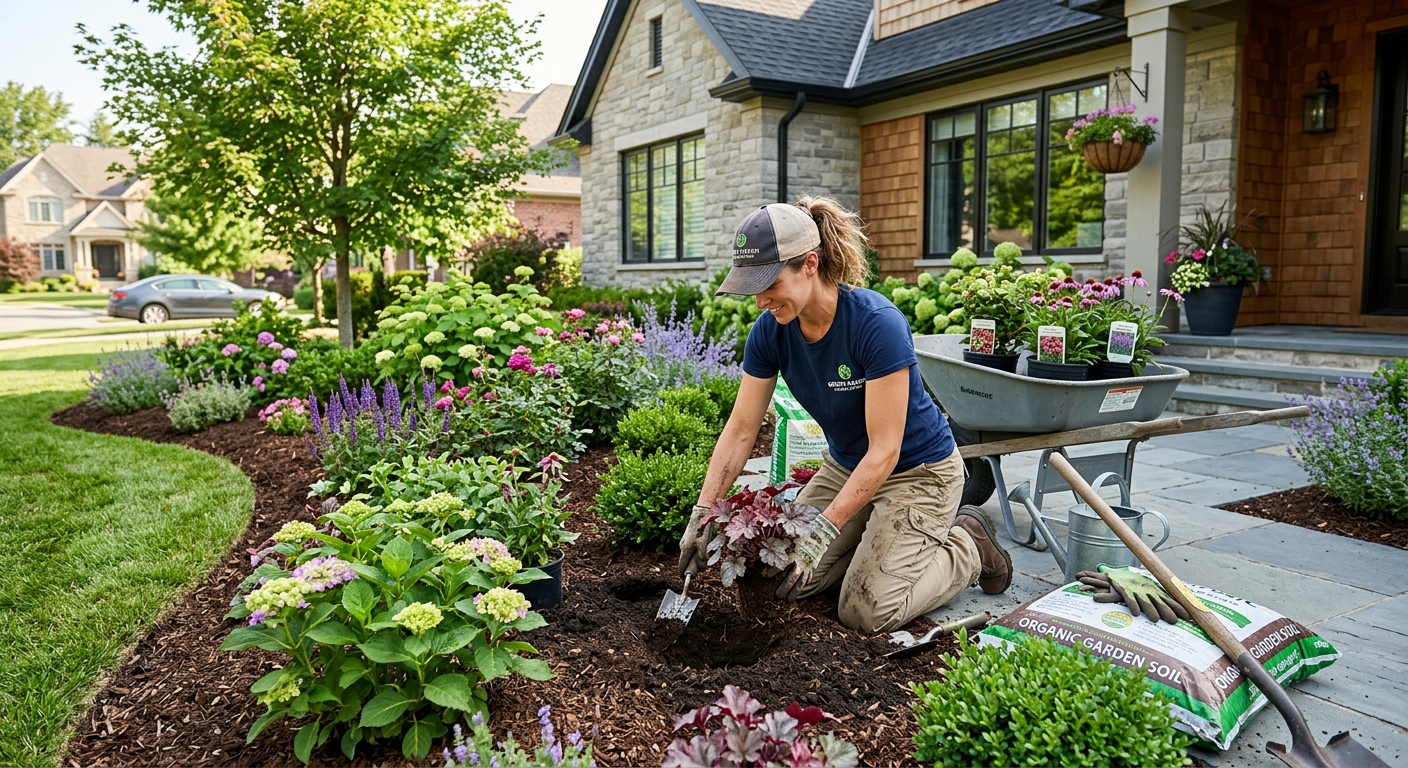
Landscaping options and costs in Stittsville
Stittsville, Ontario homeowners typically have the space and motivation to improve their curb appeal—especially with a local population of 40,889 (Statistics Canada, 2021 Census) living across the wider Ottawa-area market where many properties are built with meaningful yard frontage. That matters because landscape pricing is driven by how much of your property is “softscape” (grass, planting beds) versus “hardscape” (patios, interlock, retaining walls), and a lot of Stittsville lots are set up for full-yard renovations. You’ll also notice higher demand in newer-growth pockets around Ritchie’s Corners, where families often want a fast, finished look after landscaping rough-ins.
Ottawa’s climate—mainly plant hardiness zones 4b to 5a with a real winter and freeze–thaw cycle—pushes labour and material choices in ways that aren’t just cosmetic. Concrete, interlock bases, and retaining wall footings must be built on deep, well-compacted granular layers so they don’t heave. Contractors also plan around a shorter frost-free window (roughly May to October), so schedules can tighten and labour day rates can feel “busy season” specific.
Because of that, two quotes for the same “backyard refresh” can land far apart if one contractor includes proper drainage, soil amendment, and granular base depth while another assumes minimal prep. Use the ranges below to compare like-for-like—then we’ll narrow down your scope, access constraints, and material tier so you can budget confidently before work starts.
| Service |
Description |
Season |
Price Range |
| Full landscape design and installation |
Site visit, grading/drainage approach, plant plan, soil amendments, planting + sod/seed, hardscape basics, cleanup |
May–October |
$5,000–$50,000 |
| Sod installation (supply, grade, lay, roll) |
Base prep, topsoil/loam, grading, sod delivery, placement, rolling, starter fertilizer |
Late April–October |
$1,800–$9,000 |
| Lawn seeding (grade, seed, starter fertilizer) |
Rake/grade, seed application, light cover (as needed), starter fertilizer, first mow guidance |
May–August |
$1,200–$7,000 |
| Interlocking patio or walkway |
Excavation, geotextile, base compaction, edge restraints, pavers/interlock, jointing sand, finishing |
May–October |
$4,500–$24,000 |
| Retaining wall (interlocking block) |
Layout, drainage gravel behind wall, filter fabric, block installation, steps/coping (if specified) |
May–October |
$6,000–$30,000 |
| Tree and shrub planting |
Soil improvement, planting, staking (as required), watering plan, mulch ring beds |
April–June, September–October |
$800–$10,000 |
Prices are estimates only and vary by project scope, site access and material selection.
What affects the price of landscaping in Stittsville
In Stittsville and the wider Ottawa region, quotes for the same visible “landscape” can differ by 30–50% because the pricing isn’t just for the final plants or pavers—it’s for everything required to make the job last through winter: proper drainage, deep compacted bases, and soil preparation. Two crews might both build a patio, but one contractor builds the granular base to suit Ottawa’s freeze–thaw and provides correct edge restraint and slope, while the other may assume a lighter build. The result is a big spread in labour hours and material haul.
Zone and frost timing also drive costs. Ottawa’s plant hardiness zone (4b–5a) and frost-free window (roughly May to October) define what will establish and what can be safely installed without risking winter kill or settlement. In Prairie regions (Zone 2–4), short growing seasons push drought-tolerant, wind-hardy choices; retaining wall base depth must still reach below the frost line, but exposure and freeze depth can shift the granular and drainage approach. Coastal BC (Zone 7–8) allows longer growth and lush palettes but often demands strong drainage in heavy-rainfall areas, while dry BC interior regions can rely on water-efficient irrigation design because watering schedules are restricted. In southern Ontario (Zone 5–6), we typically see moderate summer water needs, but clay-rich soils can keep areas saturated early in spring—meaning grading and soil amendments can swing the budget.
Concrete examples in Stittsville: (1) If you’re correcting a low spot near a foundation, drainage + regrading often pushes a “small patio” from a mid-range estimate into a fuller interlock package. (2) Upgrading soil and adding compost to new planting beds can be a modest line item compared to the long-term cost of replacing struggling shrubs—so the smart spend is usually cheaper than rework.
| Price Factor |
Why It Matters |
Cost Impact |
| Yard size in sq ft — the primary cost driver for softscape |
More area means more soil prep, seed/sod, mulch, and labour hours |
High: can swing total by several thousand dollars |
| Grading and drainage work — slope corrections add significant cost |
Fixes pooling, protects foundations, and prevents spring saturation issues |
Medium to High: commonly adds major labour + materials |
| Drainage bed or French drain installation |
Moves excess water away from root zones and hardscape edges |
Medium: often a meaningful upsell that prevents failure |
| Plant material tier — native shrubs vs. ornamental vs. mature specimen trees |
Mature stock costs more and requires heavier equipment and better staging |
Medium to High: can double planting line items |
| Hardscape vs. softscape ratio — walls and patios cost more per sq ft than lawn |
Interlock and retaining walls require excavation, base build, and compaction |
High: hardscape shifts budgets quickly |
| Irrigation system design and installation |
Ensures establishment and reduces manual watering in summer dry spells |
Medium: varies by zones, controller, and trenching complexity |
| Soil amendment and topsoil required |
Clay-rich soils often need improved structure for roots and drainage |
Medium: depends on how deep the amendment goes |
| Tree removal or stump grinding before new planting |
Clears obstacles and prevents regrowth conflicts with beds and grading |
Medium to High: access and disposal affect cost |
Permits & regulations in Ontario
In Ontario, most typical residential landscaping—like planting shrubs, sodding a lawn, installing seed lawns, and building standard garden beds—generally does not require a permit. Likewise, routine softscape grading for landscaping typically doesn’t trigger approvals unless it affects drainage patterns beyond your lot. The work that does more often require permits includes: (1) retaining walls above a height threshold (commonly around 1.0 m in many municipalities) that may need a building permit and, in some cases, engineered drawings; and (2) changes to lot grading that meaningfully alter drainage direction toward neighbouring properties or storm sewer connections.
Before any excavation—whether you’re digging planting holes, installing a French drain, or building a wall footing—ensure utility locates are completed. Hitting buried services is a safety issue and can create major rework and delays.
For homeowners in Stittsville, verifying contractor credentials is a practical step-by-step process. Start by confirming the contractor’s Ontario business/contractor registration (where applicable) through the appropriate online registry and ensure their contact details match the quote documents. Next, request a certificate of insurance showing general liability coverage amounts appropriate for the project scope; don’t accept expired certificates. Finally, ask for coverage evidence for workplace safety requirements (WSIB/WCB clearance or proof of account/coverage, as applicable). If they can’t provide documentation up front, treat it as a schedule and liability red flag before you sign.
Planning a landscape that thrives in Stittsville's climate
Planning for Stittsville means working with Ontario’s freeze–thaw cycles and zone 4b–5a conditions, not against them. Start with plant selection: choose hardy, zone-appropriate trees and shrubs and build beds with native-leaning species where possible. That reduces winter dieback and often lowers watering needs once established. For lawns, pick sod or seed based on your timeline and tolerance for maintenance. In Ottawa, sod gives instant results but has a higher cost and must be installed into properly prepared soil to prevent winter lifting. Seeding is usually more budget-friendly, but timing matters—seed needs steady moisture for germination and good soil-to-seed contact during May to August.
Drainage and grading are the make-or-break items in Stittsville. Clay-rich soils can stay saturated in spring, so patios and walks should be built on a properly compacted granular base with the right slope away from foundations. Retaining walls need deep, well-compacted granular base layers and drainage gravel behind the wall to reduce hydrostatic pressure—otherwise you get bulging, settlement, and costly repairs.
Hardscape planning also needs to respect the local frost line. Concrete forms, paver bases, and wall footings should be installed to the depth that prevents movement during winter expansion and spring thaw. If you want lower annual upkeep without giving up curb appeal, use mulch, groundcovers, and perennial structures that repeat reliably year to year.
Where water management helps, consider a rain garden or a directed downspout soak-away area—especially around low points that keep staying wet. On cost justification: if sod is priced at roughly $1,800–$9,000 depending on area, moving that budget into soil correction and drainage can be a better “long-term win” than simply laying more sod over the wrong base. In many Stittsville yards, the most sustainable improvements start with grading, then planting, and finally hardscape “finishing touches.”
| Element |
Climate Consideration |
Maintenance Level |
Price Band |
| Sod lawn installation |
Requires solid base prep to avoid winter lifting during freeze–thaw and spring saturation |
Low to Medium (water establishment, mowing frequency) |
$1,800–$9,000 |
| Native perennial garden |
Better winter hardiness in zone 4b–5a and often stronger tolerance of wet spring conditions |
Medium (seasonal weeding, fall clean-up) |
$1,500–$7,500 |
| Mulched shrub border |
Mulch moderates soil temperature swings and helps protect roots through cold nights |
Low (top-up mulch and light pruning) |
$800–$6,000 |
| Interlocking stone patio |
Needs deep, well-compacted granular base to prevent heaving and uneven settlement |
Low (occasional joint sand top-up) |
$4,500–$24,000 |
| Retaining wall (block) |
Freeze–thaw and hydrostatic pressure demand drainage gravel and proper wall base depth |
Low (inspection after severe winters) |
$6,000–$30,000 |
| Drip irrigation system |
Helps establish new plants efficiently during summer dry spells in a controlled, zone-based way |
Medium (winterize steps and seasonal checks) |
$1,200–$7,000 |
How to choose a landscaping contractor in Stittsville
Start by verifying credentials that protect you during construction. For Ontario work, ask for proof of liability insurance (certificate of insurance) and confirm it covers both the installation work and any driveways/adjacent work near your property. Next, ask about WSIB/WCB coverage (or clearance documentation, depending on how they file)—and keep it in your project file. If they can’t provide documentation before you schedule, don’t rely on verbal assurances.
Then request 2–3 itemised written quotes instead of one lump-sum number. A proper quote breaks labour and materials so you can compare: topsoil/loam depth and volume, soil amendment type, base build thickness for interlock, whether drainage is included, and the plant sizes (not just “2–3 shrubs”). Make sure the scope clearly lists what’s excluded—things like stump removal, disposal, utility locate fees, permit pull (if applicable for a retaining wall), and additional grading tied to drainage corrections.
Warranty matters in Stittsville because freeze–thaw failures often show up after the first winter. Look for workmanship warranty length and what it covers (settlement, heaving, plant replacement terms), plus the product/manufacturer warranty details. Confirm whether it’s transferable if you sell your home.
On payment, a safe structure is staged: never pay more than 10–15% upfront; hold back a meaningful portion until the job is complete, inspected, and cleaned. Get a written start date and completion estimate so weather delays and scope changes are documented.
- Ask for a written scope with photos, measurements, and material specifications (paver thickness, wall block type, drainage details).
- Confirm topsoil and soil amendment depth/quantity—especially for clay-rich Stittsville lots.
- Verify they include proper granular base and compaction for interlock and patios.
- Require utility locates before digging planting holes or wall footings.
- Check for liability insurance and request a current certificate of insurance.
- Request WSIB/WCB proof/clearance documentation appropriate to their work.
- Ensure quotes include disposal and debris hauling if you expect clean restoration.
- Ask whether irrigation (if included) is zoned and how winterization is handled.
- Confirm plant warranties: replacement timelines, size at installation, and survival expectations.
- Get start date, milestones, and weather-reschedule process in writing.
- Require a workmanship warranty for at least the first season (and more where interlock is involved).
- Use a payment schedule with a holdback until final grading/cleanup is signed off.
In Stittsville, common red flags include: (1) no itemised pricing (everything is “lump sum”), (2) vague drainage language (“we’ll fix it”) with no granular or French drain detail, (3) promising interlock or patios without specifying base thickness/compaction, (4) refusal to provide insurance/WSIB/WCB documentation, and (5) asking for large upfront payments (well beyond 10–15%).
Frequently asked questions — landscaping in Stittsville
How do I compare landscaping quotes?
When comparing quotes in Stittsville, compare apples to apples by using the scope checklist: base depth and compaction for interlock/patios, whether drainage is included, topsoil/loam depth, and the plant sizes. Ask for an itemised breakdown of labour and materials so you can see what’s driving the number. If one quote is much lower than the others, look for omissions like soil amendment, proper granular bases, or disposal. For ballpark budgeting, a full landscape design and installation commonly sits anywhere from about $5,000–$50,000 depending on hardscape proportion and grading. For smaller lawn work, sod supply and installation often lands around $1,800–$9,000. The lowest quote is not always the best value if it skips the prep work that protects against Ottawa freeze–thaw and spring saturation.
How long does a landscaping project take in Stittsville?
Project duration in Stittsville usually depends on scope and access, but timing is also shaped by our freeze–thaw cycle and the frost-free working window (roughly May to October). Softscape-only jobs like planting and mulch typically take days to a week, assuming soil prep is straightforward. Sod installs can often be done in a short burst of labour (often 1–3 days on many residential lots), but the schedule depends on base prep, rolling, and how quickly you can water for establishment. Interlock patios and walkways generally take longer because excavation, base compaction, and proper edging are non-negotiable for long-term performance. Retaining walls can require more time due to staged base preparation and backfill/drainage. If you’re bundling work (grading + drainage + plants + hardscape), your quote should include milestones so you can see when each phase is finished and why weather could impact the completion date.
What is the best grass type for a Stittsville lawn?
For Stittsville lawns in Ontario’s zone 4b–5a conditions, homeowners commonly do best with cool-season grasses that handle winter dormancy and summer growth. In practice, many lawn specialists recommend a blend approach (for example, combining perennial rye and fescues depending on sun and shade) because it increases resilience to different stressors—spring saturation, summer dry spells, and normal wear from kids or pets. The “best” mix also depends on whether your yard is full sun or partially shaded near tall hedges and mature trees. If you want the fastest results, sod gives instant coverage but still requires correct grading and soil prep. If you’re starting from bare soil and want to control costs, seeding is often a workable option when scheduled for proper germination weather. Either way, the base and drainage matter as much as the seed or sod selection.
When should I aerate and overseed my lawn in Stittsville?
In Stittsville, aerating and overseeding usually works best when the lawn can recover quickly and when soil moisture supports germination. A typical approach is late spring after the ground has warmed (often May into early June) or early fall (August into September), when nights cool but growth still continues. If your yard tends to stay wet in spring due to clay, spring aeration can help relieve compaction, but it’s important not to aerate while the soil is waterlogged. For overseeding, use a seed that matches your existing grass type so the lawn blends in evenly. Then top with a light dressing of compost or starter (as recommended for your lawn condition), and keep the surface consistently moist for germination. If you’re doing a full lawn conversion, ask your contractor whether sod or seeding best matches your timeline and budget—sod projects often cost more upfront (for example, $1,800–$9,000) but can reduce the “waiting period.”
What trees grow best in Stittsville's climate zone?
Stittsville falls mainly in plant hardiness zones 4b–5a, so you’ll want trees proven for cold winters and freeze–thaw conditions. Common successful choices include hardy deciduous species such as serviceberry (Amelanchier) for smaller sites, and disease-tolerant varieties of shade trees like certain maples or hardy elms where appropriate for your soil and space. Fruit trees can also work on the right cultivar and with good siting, but they’re more sensitive to timing and winter injury than many ornamental shade trees. For a safer “works most often” plan, many Stittsville homeowners choose native or locally proven trees and back them with understory shrubs for structure and winter interest. Your exact best pick depends on your yard’s sun exposure, soil drainage, and whether you have clay that stays wet early in spring. A good contractor will match tree size and planting depth to your site so roots establish before the next winter.
How much does sodding a yard cost in Stittsville?
In Stittsville, sodding costs depend on lawn size, site access, and how much prep is needed (grading, topsoil/loam, and fixing low spots). For many residential properties, a typical sod installation budget falls around $1,800–$9,000, but that can move up if drainage corrections are required or if the job needs significant haul-off/disposal. Sod itself is only part of the bill; the base prep and compaction determine how well it holds through Ottawa’s freeze–thaw cycle. If your lawn area is compacted or uneven, spending on proper soil correction can be the difference between a lawn that stays level and one that lifts and opens up after winter. If you’re comparing options, seeding is usually lower cost per project, while sod gives the fastest visual result—just ensure the prep is done to the same standard as hardscape bases.