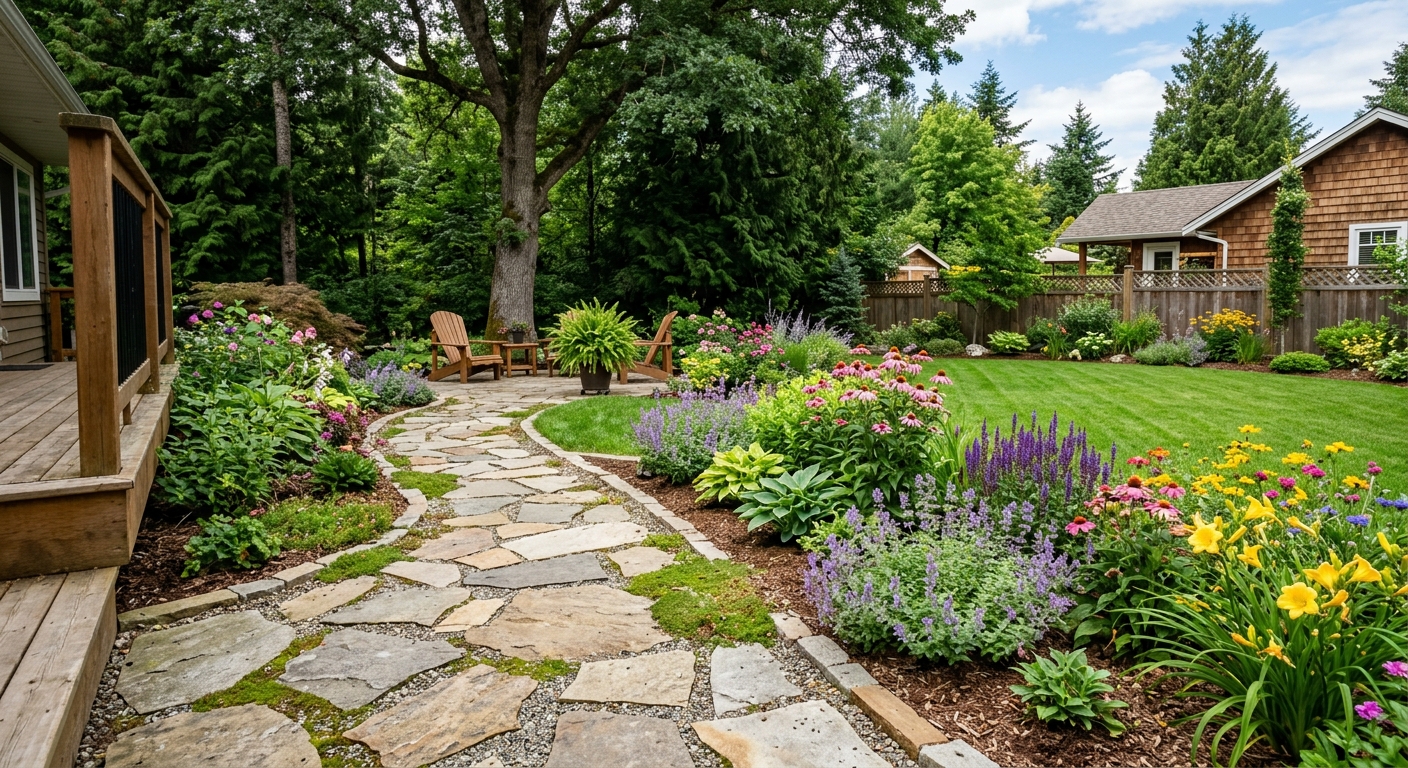
Landscaping options and costs in Guelph
Guelph homeowners typically have plenty of yard to work with—single-detached homes make up 48.6% of dwellings—so it’s common to see driveways, patios, planting beds, and lawn upgrades bundled into one project. In a city where 65.7% of households are owner-occupied (Statistics Canada, 2021 Census), many property owners invest in “problem-solving” landscaping: fixing drainage, smoothing slopes, and upgrading hardscape before planting new trees and shrubs.
In the Kitchener–Waterloo–Barrie area, landscaping costs are shaped by the Zone 5b–6a climate and a defined frost window. Most installation work runs roughly from mid-April through October, but freeze–thaw is what really impacts your budget: retaining walls, patios, and walkways need deep, well-compacted granular bases and proper drainage to prevent frost heave. That adds both material and labour. Contractor availability also concentrates during the drier, warmer months, so late-season scheduling can raise costs and compress job timelines—especially in neighbourhoods with lots of older homes and established landscaping to work around.
In Guelph, this trade is especially in demand around older, established districts such as West Guelph and Guelph Centre where many properties have mature trees, older grading, and frequent foundation-adjacent moisture issues. If you’re comparing quotes, the fastest way to start is with a clear menu of options and typical price ranges—see the table below.
| Service |
Description |
Season |
Price Range |
| Full landscape design and installation |
Site visit, concept + layout, planting plan, grading/drainage (if needed), soil prep, hardscape and softscape installation |
Mid-April to October (phased in spring/fall as needed) |
$8,000–$60,000 |
| Sod installation (supply, grade, lay, roll) |
Minor grading, topsoil/compaction, supply sod, lay/roll, starter fertilizer |
Late April to August (avoid heat spikes) |
$5–$10 |
| Lawn seeding (grade, seed, starter fertilizer) |
Loosen/grade, seed blend, starter fertilizer, light topdressing, first-season care |
April/May and early fall best |
$5–$10 |
| Interlocking patio or walkway |
Excavation, compacted base, polymeric sand, edging, pattern layout, proper drainage slopes |
May to September (base prep is weather-sensitive) |
$120–$300 |
| Retaining wall (interlocking block) |
Excavation, geotextile, compacted granular base, block installation, weep holes/drainage layer |
May to September (best for controlled compaction) |
$120–$300 |
| Tree and shrub planting |
Plant selection, planting holes, amendments, staking (as needed), mulch rings, first watering plan |
Spring and fall planting windows |
$500–$15,000 |
Prices are estimates only and vary by project scope, site access and material selection.
What affects the price of landscaping in Guelph
Two contractors can quote the “same” landscaping project and still land 30–50% apart in the Kitchener–Waterloo–Barrie region, mainly because landscaping pricing is driven by site conditions and how much must be rebuilt to make the work last through Ontario winters. A yard that looks flat on a survey can still have hidden low spots, drainage paths toward foundations, or compacted subsoil that won’t support a stable base. Those details show up in the scope and directly affect costs in the $8,000–$60,000 design/installation band and the $500–$15,000 tree-and-planting range.
The most important local variable is the frost window in Zone 5b–6a. It determines both what you can plant successfully and what you can build safely within the working season. Prairie regions (Zone 2–4) often need drought- and wind-tolerant species and tighter winter hardiness planning; in those places, you may pay for more plant replacements. Coastal BC (Zone 7–8) can support lush palettes and longer growing seasons, but heavy-rain environments push costs toward drainage and soil management—so the “cheap planting” can still be expensive when drainage is poor. In southern Ontario, the growing season is moderate, but summer dry spells still happen, so irrigation design and efficient watering can change the bill even in a city like Guelph.
Here are a few concrete ways local conditions raise or lower pricing in Guelph. First, properties built before 1981—43.7% of homes in the city (Statistics Canada, 2021 Census)—often have older grading and established mature roots, which can add excavation time and disposal costs. Second, a simple patio can jump significantly when the base must be deepened to sit below frost-impacted areas and when drainage is re-engineered. Third, planting costs can climb when you switch from smaller nursery stock to multiple mature trees that establish faster but require bigger holes, amendments, staking and more robust watering plans.
| Price Factor |
Why It Matters |
Cost Impact |
| Yard size in sq ft — the primary cost driver for softscape |
More turf/bed area means more topsoil, amendments, seed/sod, edging and labour hours |
Often the biggest swing; doubling area can add thousands |
| Grading and drainage work — slope corrections add significant cost |
Foundation-safe grading typically requires excavation, re-compaction and shaped drainage flow |
Can add major expense compared to a “level” yard |
| Drainage bed or French drain installation |
Freeze–thaw performance depends on removing excess water below pavement and near structures |
Material + trenching labour can quickly add thousands |
| Plant material tier — native shrubs vs. ornamental vs. mature specimen trees |
Hardiness, size, and container grade affect purchase price and planting labour |
Switching tiers can dramatically change totals (especially trees) |
| Hardscape vs. softscape ratio — walls and patios cost more per sq ft than lawn |
Block, pavers, base materials and compaction equipment drive higher unit costs |
More hardscape usually shifts pricing upward |
| Irrigation system design and installation |
Zoning, valve placement, and trenching for lines depend on layout and site constraints |
Can add cost but reduces water waste in summer dry spells |
| Soil amendment and topsoil required |
Clay-heavy or compacted soils need conditioning for roots and stable turf establishment |
Delivery and labour can increase significantly |
| Tree removal or stump grinding before new planting |
Root systems and access determine machine time and disposal |
Often adds unexpected costs if not planned upfront |
Permits & regulations in Ontario
In Ontario, most typical planting and softscape work doesn’t require a permit—things like sodding, lawn seeding, installing mulch beds, and planting trees and shrubs are generally straightforward from a permitting standpoint. Many homeowners also do not need permits for standard grading for garden beds, as long as the work is not altering drainage in a way that affects neighbouring properties or municipal drainage systems. However, retaining walls above a certain height threshold—commonly around 1.0 m (3.3 ft) in many municipalities—often require a building permit, and sometimes engineered drawings depending on height, design, and loading conditions.
Also watch for work that DOES require extra approval: changes to lot grading that could redirect stormwater to neighbours, new or altered drainage connections tied to storm sewers, and any structural retaining system where the municipality may treat it as a regulated build. Before any digging for planting holes, footing/excavation, or French drains, contractors should arrange utility locates so you avoid hitting buried services.
To verify a contractor in Guelph, start with an Ontario-wide approach: (1) confirm the business is properly licensed/registered for the work they’re advertising, (2) request a Certificate of Insurance and ensure liability coverage is current and matches the project scope, and (3) confirm WSIB/WCB coverage (or the appropriate clearance letter). Ask for the latest clearance documentation before work begins. A reputable contractor won’t hesitate to show these items and will include any permitting responsibilities in the written scope.
Planning a landscape that thrives in Guelph's climate
Planning for Guelph is about working with Zone 5b–6a realities—cold winters, spring/fall frost, and a freeze–thaw cycle that punishes sloppy drainage and shallow bases. Start with plant selection: choose hardy, zone-appropriate options (often native-friendly) and avoid tender species that look good in summer but struggle after repeated freezes. Next, match your lawn method to your timing. Sod gives instant curb appeal and fast erosion control, but it costs roughly 3–4x more per sq ft than seeding once you account for material and labour. Seed is slower to establish, but it’s usually more budget-friendly and can work very well in Guelph when timed for spring or early fall.
Drainage and grading are the make-or-break elements. If you have water pooling near foundations or downspouts, budget for corrective grading and potentially a drainage bed or French drain, because excess moisture plus freezing conditions can lift slabs and damage hardscape edges. For hardscape like patios and retaining walls, base prep must reach below frost-impacted areas with deep, compacted granular layers and appropriate slopes so water doesn’t sit under the stone.
Finally, reduce yearly upkeep with intentional design: mulched shrub borders, groundcovers, and perennials that provide structure without demanding constant reseeding. If you want to cut irrigation use, consider rain gardens and efficient zoned systems for low-lying areas, paired with drought-tolerant plantings for sunnier beds during dry spells.
Dollar example: if you’re upgrading a 500 sq ft lawn, seeding is often far less expensive than sod. Even when sod looks like “faster wins,” the additional material cost can be redirected into better drainage/grading or more resilient plantings—investments that improve winter performance and reduce callbacks.
| Element |
Climate Consideration |
Maintenance Level |
Price Band |
| Sod lawn installation |
Needs good base prep to survive spring/fall temperature swings and freeze–thaw lifting |
Low to moderate (watering and first-season care) |
$5–$10 |
| Native perennial garden |
Hardy choices tolerate Ontario winters with less winter-protection fuss |
Low (mulch refresh and seasonal trimming) |
$500–$15,000 |
| Mulched shrub border |
Mulch stabilizes soil temperature and helps plants handle dry spells and cold snaps |
Low (weed control, annual mulch top-up) |
$500–$15,000 |
| Interlocking stone patio |
Requires deep compacted base and drainage slopes to prevent frost heave |
Low (occasional joint sand top-ups) |
$120–$300 |
| Retaining wall (block) |
Needs proper granular backfill and drainage layers so water doesn’t freeze behind it |
Low (inspection of drainage/weep pathways) |
$120–$300 |
| Drip irrigation system |
Helps manage summer dry spells efficiently in Zone 5b–6a |
Moderate (seasonal adjustments and winterization) |
$8,000–$60,000 |
How to choose a landscaping contractor in Guelph
Start by verifying that your contractor can legally and safely operate in Ontario for the type of work they’re proposing. Ask for current proof of liability insurance, and confirm WSIB/WCB coverage (or the applicable clearance documentation). You should be able to check licensing/registration and coverage through online resources and by reviewing the documents they provide—don’t accept photos of certificates with no clear dates. In Guelph, the best contractors treat winterization and drainage detailing like core skills, not optional add-ons.
Then get 2–3 itemised written quotes. Itemised means you’ll see separate line items for labour and materials (excavation/base materials, pavers/block, soil amendments, topsoil/sod/seed, disposal, edging, and any drainage components). A lump-sum quote can hide scope gaps that later turn into change orders. Pay attention to exclusions: is permit pulling included (when required), is disposal included, and does the quote include compacted base depth and proper drainage slopes for patios and walls?
Warranty matters. Look for a workmanship warranty length and understand what it covers if settlement or heave occurs due to base prep or drainage omissions. Product/manufacturer warranties usually cover plants or materials, while workmanship coverage is where you’ll want a contractor to stand behind installation. Ask whether any warranties are transferable if you sell your home.
For payment scheduling, avoid large upfront payments; a good rule is never pay more than 10–15% upfront, with a holdback until the job is complete and cleaned up. Finally, require a start date and an estimated completion timeline in writing, so your project stays aligned with the mid-April to October install window typical for Guelph.
- Request proof of insurance and confirm coverage dates.
- Verify WSIB/WCB clearance (or equivalent documentation) before work starts.
- Ask whether they pull permits when retaining walls exceed the typical threshold.
- Require itemised labour + materials, not just totals.
- Confirm base depths and compaction standards for patios/walkways.
- Ask how drainage is handled (slopes, weep holes, French drains if required).
- Check plant lists for local hardiness suitability (Zone 5b–6a).
- Confirm disposal/recycling fees are included for excavation and old removal.
- Get a written timeline tied to spring/fall frost realities.
- Clarify warranty terms for workmanship and materials separately.
- Understand irrigation scope: trenching, heads, zoned valves, and winterization.
- Keep a small holdback and require final walkthrough before full payment.
In my experience around Guelph, red flags include: a quote that doesn’t explain grading/drainage methods, a promise to “save money” by reducing base depth for patios/walls, missing or expired insurance/WSIB documents, warranty language that’s vague or limited to materials only, and requests for large deposits with no signed scope or schedule.
Frequently asked questions — landscaping in Guelph
How do I plan a low-maintenance yard?
A low-maintenance yard in Guelph usually comes from fewer “high-touch” tasks: less lawn area to manage, more mulched beds, and plant choices that reliably handle Ontario winters. Start by improving drainage and grading so water doesn’t sit after rain or during freeze–thaw—this reduces plant stress and prevents hardscape shifts. Choose native or zone-appropriate shrubs/perennials and use mulch to suppress weeds and moderate soil temperature. For turf, consider whether seeding fits your timeline or if sod is worth it only in key areas. If you’re budgeting, a full install can land anywhere from $8,000–$60,000, but even a targeted planting plan in the $500–$15,000 range can significantly reduce the amount of seasonal weeding and reseeding.
How deep should a retaining-wall base be for local frost?
For retaining walls in Guelph (Zone 5b–6a), the base depth isn’t one-size-fits-all, because wall height, soil type, and drainage design matter. But the key principle is to build a compacted granular base that sits below frost-impacted effects and to include proper backdrainage so water doesn’t freeze behind the wall. In practice, crews typically excavate deeper than you’d expect for looks alone, then compact in layers and add drainage layers (including weep holes/weep outlets where appropriate). If you see a contractor proposing minimal excavation, skipping geotextile separation, or not addressing drainage, that’s a serious concern given Ontario’s freeze–thaw cycles. A well-built wall often comes in within the typical retaining-wall hardscaping band of $120–$300 (unit pricing varies), but the real value is in correct base preparation and drainage.
How much does professional landscape design cost?
Professional design can be a standalone service or included as part of a larger design-and-install package. In Guelph, full-service landscape design and installation commonly ranges from $8,000–$60,000, depending on yard size, grading/drainage complexity, and how much hardscape/planting you’re adding. A smaller project—like a planting plan and bed layout—can be less, but you’ll typically still pay for site measurement, drawings, and a planting palette tailored to Zone 5b–6a conditions. If your property has older grading (many homes in Guelph are older than 1981 per Statistics Canada, 2021 Census), plan for more design time to address drainage flow and foundation protection, which increases design value and helps prevent costly rework.
How do I compare landscaping quotes?
To compare landscaping quotes in Guelph, insist on matching scope—not just matching totals. Ask each contractor for itemised labour and materials so you can see what’s included for excavation, granular base prep, drainage work, disposal, soil amendment, edging, and whether irrigation is part of the plan. Look for how they handle freeze–thaw risk: patios/walkways and retaining walls should include drainage slopes and properly compacted granular bases. Also confirm what’s excluded (permit pulling when required, stump grinding, and irrigation winterization). If one quote includes drainage beds and deeper base prep while another doesn’t, the “cheaper” quote is often cheaper for a reason and can lead to settlement or heave later.
How long does a landscaping project take in Guelph?
Project length in Guelph depends on weather, scope, and how much excavation/grading is required. Most planting and lawn establishment work is scheduled from mid-April through October, with extra caution around frost in spring and early fall. Simple planting jobs can take a day or two, while interlocking patios, retaining walls, and drainage upgrades often take longer because base preparation and compaction require proper conditions. If your quote includes sod or seeding, timing of topsoil prep and establishment matters to avoid failure during temperature swings. Full design-and-install projects in the $8,000–$60,000 band frequently run in phases (grading/drainage first, then hardscape, then planting) to keep everything within the workable season.
What is the best grass type for a Guelph lawn?
In Guelph, the “best” grass is usually a hardy cool-season turf blend suited to Zone 5b–6a winters and summer dryness patterns. For many homeowners, a blend that includes Kentucky bluegrass and/or perennial rye (depending on shade and foot traffic) performs well because it roots reliably after winter and fills in good-looking density. If you seed, discuss your lawn conditions—sun vs. shade, drainage, and how much traffic it gets—so the contractor selects a seed mix that matches your yard rather than using a generic one. Sod can be successful too, but it’s typically more expensive per sq ft than seeding. If you’re comparing start costs, sod installation commonly falls in the $5–$10 range in local estimates (unit pricing varies with scope), while seeding can be a budget-friendly option for the same area when timed correctly in spring or early fall.