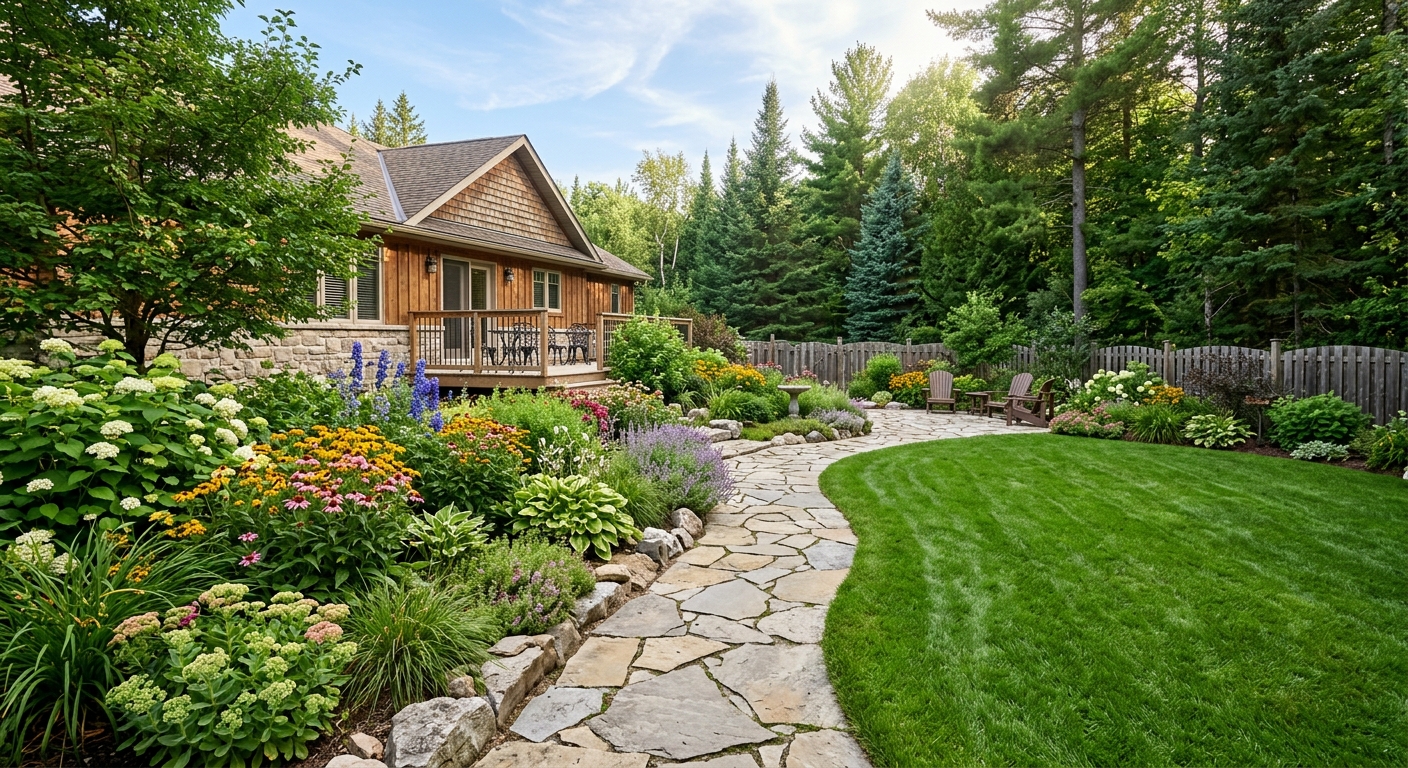
Landscaping options and costs in Pembroke
Pembroke homeowners usually have a lot to work with: with 57.8% of dwellings being single-detached homes, many properties have the yard space to invest in both “front-catch” curb appeal and backyard comfort. At the same time, 73.3% of homes were built before 1981, which often means older grades, mature trees, and established soil conditions—great for character, but it can also mean more foundation-facing drainage work when you add patios, beds, or retaining walls.
In the Kingston–Pembroke region (plant hardiness zones 5a–5b in most areas), landscaping costs are strongly influenced by freeze-thaw cycling and winter wind exposure. We plan most planting and turf establishment for the roughly May–October frost-free window, and we budget for deeper granular bases so patios and retaining walls don’t heave. Contractor availability can also affect pricing in peak months (spring/early summer), because installation crews are busiest when people want quick results before school-year schedules.
Demand is especially steady around downtown Pembroke and the river corridor, where many homeowners prioritize drainage fixes, walkways, and tidy planting transitions. If your quote includes grading, drainage, and proper bases, you’ll often see costs land toward the mid-to-upper end of the bands—because the “invisible” work is what prevents problems in Zone 5 winter weather.
Use the comparison table below as your starting point for scoping and budgeting, then we’ll break down what moves the price up or down.
| Service |
Description |
Season |
Price Range |
| Full landscape design and installation |
Site visit, concept plan, plant list, grading/soil improvement plan, turf/bed/hardscape installation, and cleanup |
May–October |
$4,000–$30,000 |
| Sod installation (supply, grade, lay, roll) |
Remove old turf (if needed), fine grade, soil prep, sod delivery and installation, rolling and start-up watering guidance |
Mid-May–September |
$2,500–$8,000 |
| Lawn seeding (grade, seed, starter fertilizer) |
Light grading/leveling, seed selection for Ontario conditions, starter fertiliser, and straw/mulch where required |
Late April–June or early September |
$1,200–$5,000 |
| Interlocking patio or walkway |
Excavation, compacted granular base, edging, interlock installation, joint sand, and final levelling |
May–October |
$5,000–$35,000 |
| Retaining wall (interlocking block) |
Block wall install with proper drainage fabric, weeping tile/aggregate (as required), compacted base, and backfill |
May–October |
$5,000–$28,000 |
| Tree and shrub planting |
Planting layout, soil amendment, planting holes, staking (if needed), watering schedule, and mulch rings |
May–October |
$1,000–$8,000 |
Prices are estimates only and vary by project scope, site access and material selection.
What affects the price of landscaping in Pembroke
In Pembroke and across Ontario, quotes for the “same” landscaping job can swing by roughly 30–50% because the scope that homeowners don’t always see—grading, drainage, soil conditions, access, and base preparation—changes the labour hours and materials. In a region of 14,364 people (Statistics Canada, 2021 Census), contractors also manage seasonal workload around the limited safe planting and turf window, so spring and early-summer scheduling can tighten up and influence rates.
Hardiness zone and frost timing are a big driver. In Kingston–Pembroke’s Zone 5a–5b, freeze-thaw cycling means turf and hardscape need the right build-up. That’s why base depth, compaction, and drainage matter more than in coastal climates with milder winters. Compare regions: Prairie areas (Zone 2–4) often require more wind- and drought-tolerant planting palettes and can extend time needed for soil prep; coastal BC allows longer growth but demands careful drainage in heavy-rainfall zones; and while Ontario doesn’t typically face the interior BC water restriction environment, we still design efficient watering (drip in beds, properly sized lawn sprinkler heads) for summer dry spells.
Concrete examples from Pembroke pricing: (1) If your yard is sloped toward a foundation, adding proper drainage and regrading can move a walkway or patio project toward the higher end of the hardscape bands (for example, from a mid-range interlock estimate up to $5,000–$35,000 depending on base and excavation). (2) If you need soil removal because old fill or clay compacts poorly, soil amendment/topsoil can push a full design and install toward $4,000–$30,000. Also, many older homes (built before 1981 in 73.3% of cases) may have legacy drainage patterns and tree root impacts that add measurable labour.
Next, here are the most common factors we use when translating your yard’s conditions into a realistic line-by-line budget.
| Price Factor |
Why It Matters |
Cost Impact |
| Yard size in sq ft — the primary cost driver for softscape |
More area means more topsoil/seed/sod, more prep time, and higher material volumes |
Low to very high: can double or triple total cost |
| Grading and drainage work — slope corrections add significant cost |
Correcting slopes reduces pooling and foundation moisture risk |
Often adds $500–$6,000+ depending on site |
| Drainage bed or French drain installation |
Reduces hydrostatic pressure and winter freeze issues |
Typically $1,200–$8,000+ for affected sections |
| Plant material tier — native shrubs vs. ornamental vs. mature specimen trees |
Mature stock costs more and may require extra manpower and equipment |
Can shift the planting portion by 2–5x |
| Hardscape vs. softscape ratio — walls and patios cost more per sq ft than lawn |
Hardscape uses excavation, compacted base, and more labour per area |
Usually increases total by 20–60%+ |
| Irrigation system design and installation |
Ontario efficiency matters: drip for beds, correct spacing/precipitation for lawns |
Often $900–$6,000+ depending on coverage |
| Soil amendment and topsoil required |
Clay/compacted subgrade needs amendment to support roots and drainage |
Commonly $400–$4,000+ |
| Tree removal or stump grinding before new planting |
Roots and stumps complicate grading, and removal is time-sensitive |
Often $300–$2,500+ per tree/stump |
Permits & regulations in Ontario
For most Pembroke landscaping, you typically don’t need permits. Planting beds, sodding, seeding, and the majority of softscape work (mulching, groundcover installation, shrub and tree planting) generally proceed without a building permit. However, retaining walls are the common “yes-permit” area. In many Ontario municipalities, retaining walls above about 1.0 m (3.3 ft) in height may require a building permit and, in some cases, engineered drawings—especially where stability and surcharge loads (like a driveway or deck near the wall) are involved.
Also, be careful with drainage and grading. If proposed lot grading changes how water moves, increases runoff to a neighbour, or ties into storm sewer connections, you may need approval. Any time digging is involved, utility locates are essential before planting holes, footing excavations, or wall trenches.
To verify your contractor in Ontario, do this step-by-step: (1) Check the contractor’s credentials online for Ontario licensing/registration where applicable for landscape contracting. (2) Request a current Certificate of Insurance (liability) and confirm coverage amount and effective dates—ask for the COI to list you as an additional insured if your contract requires it. (3) Confirm WSIB/WCB status: request proof of coverage or clearance that indicates the contractor is eligible to work. If the contractor can’t provide documents quickly, that’s a warning sign. Finally, ask whether permits (if needed for the retaining wall or drainage-related changes) are included in the quote or treated as a separate line item.
Planning a landscape that thrives in Pembroke's climate
To design landscaping that thrives in Pembroke, we match your planting and build details to Kingston–Pembroke’s Zone 5a–5b conditions and the realities of freeze-thaw. Start with plant selection: choose hardy, zone-appropriate native species and sturdy perennials that tolerate winter wind and thaws without excessive dieback. Local gardens do best with layered structure—shrubs for backbone, perennials for seasonal colour, and trees chosen for mature size so they don’t become future removal costs.
For turf, sod versus seed is a classic decision. Sod gives instant, uniform coverage, but it costs about 3–4 times more per sq ft than seeding once you include the material and installation labour. In practical terms, if seeding a patch of lawn is your goal, a smaller seeding project might fit closer to the lower end of lawn seeding budgets (for example, around $1,200–$5,000), while full sod replacement of similar area is more likely to land toward $2,500–$8,000 depending on size, prep, and access. Sod is worth it when you need immediate function, erosion control, or tighter schedules.
Drainage and grading are critical here because pooling water can lead to foundation moisture problems and winter heaving. Hardscape planning must include deep, well-compacted granular bases and correct slopes. In Ontario freeze conditions, we build for the frost line and use proper drainage layers beneath patios and around retaining walls.
For low maintenance, use mulch rings, groundcovers, and perennial “repeats” that look full without constant replanting. Where you want to reduce water use, consider a rain garden in lawn-low spots or a more xeriscape-inspired approach using hardy, drought-tolerant Ontario natives—still designed for freeze tolerance and spring saturation.
| Element |
Climate Consideration |
Maintenance Level |
Price Band |
| Sod lawn installation |
Needs timely establishment in May–September; protect from freeze-thaw stress near edges |
Medium (watering in first weeks) |
$2,500–$8,000 |
| Native perennial garden |
Zone-appropriate plants handle winter; mulch and spacing reduce heaving and wind damage |
Low to medium |
$1,500–$6,000 |
| Mulched shrub border |
Winter structure plus spring resettling; mulch helps regulate temperature swings |
Low |
$1,200–$5,000 |
| Interlocking stone patio |
Proper base build and drainage prevent frost heave and settling |
Low (occasional joint sand/top-up) |
$5,000–$35,000 |
| Retaining wall (block) |
Needs deep compacted base and drainage behind wall for freeze-thaw stability |
Low (periodic inspection) |
$5,000–$28,000 |
| Drip irrigation system |
Efficient bed watering during summer dry spells; smart controller helps avoid overwatering |
Medium (seasonal checks) |
$900–$6,000 |
How to choose a landscaping contractor in Pembroke
Choosing the right contractor in Pembroke starts with verification. First, confirm Ontario licensing/registration where applicable to the type of landscaping work they do. Next, ask for liability insurance and check that the Certificate of Insurance (COI) is current—verify the effective/expiry dates and coverage limits, and ensure it aligns with the scope (especially if they’re excavating near foundations or installing drainage). For worker protection, request WSIB/WCB clearance documentation or proof of coverage (depending on how they’re set up). A reputable contractor can provide documents quickly—no “send it later” runaround.
Then, get 2–3 itemised, written quotes. “Itemised” means labour and materials are separated: topsoil/aggregate quantities, drainage components, plant sizes, interlock square footage, base depth assumptions, and disposal or dump fees. Make sure the quote states what’s included (for example, permit pull if required for a retaining wall, disposal of removed sod/topsoil, and whether utility locates are part of the process). Read exclusions closely: weed control before seeding, rock removal, old stump grinding, and any repairs to downspouts are common scope gaps.
For warranty, ask for the workmanship warranty length and what it covers (settling, heaving, plant replacement policy if applicable). Clarify manufacturer warranties versus workmanship, and whether any warranty is transferable if you sell the home. On payment schedule, never pay more than 10–15% upfront; hold back a portion until the job is complete and cleaned up. Finally, require a written start date and realistic completion estimate—especially for turf establishment and hardscape curing times.
- Request insurance COI and WSIB/WCB clearance before signing.
- Confirm crew size and equipment for excavation/base prep.
- Ask who pulls permits (if needed for retaining wall height) and whether fees are included.
- Ensure utility locates are scheduled before digging.
- Get a written material list (sod type, interlock size/thickness, block system).
- Require base construction details (granular type/compaction approach) for patios/walls.
- Ask how drainage will be handled around foundations and low spots.
- Confirm disposal included for sod, topsoil, and excavation spoils.
- Clarify plant sourcing: local nursery stock and warranty/guarantee expectations.
- Request timeline for delivery (sod/stone blocks can’t wait indefinitely).
- Get warranty terms in writing, including what “fix at no charge” means.
- Use a phased payment schedule with holdback until final walkthrough.
Red flags I see in Pembroke include contractors who won’t provide an itemised quote, vague “we’ll handle permits” wording, asking for large upfront payments, no proof of insurance/WSIB/WCB documentation, and skipping site drainage assessment (especially before patios, walls, or grading changes near older (pre-1981) homes).
Frequently asked questions — landscaping in Pembroke
When should I aerate and overseed my lawn in Pembroke?
In Pembroke, the best aerate-and-overseed timing is usually based on soil temperature and moisture, not just the calendar. For most lawns, aim for spring once the ground is workable (typically late April to May) or do it in early September to early October so seedlings establish before winter. If your lawn struggles in thin, clay-leaning areas—common on older properties—you’ll get better results by aerating to relieve compaction and loosening the surface so seed-to-soil contact is real. For budgeting, many overseeding projects fall within lawn seeding estimates around $1,200–$5,000 depending on yard size and prep. Also, avoid heavy traffic right after seeding; Zone 5 freeze-thaw can heave poorly rooted seedlings if they’re left weak.
What trees grow best in Pembroke's climate zone?
Pembroke sits mainly in hardiness zones 5a–5b, so we prioritize trees that tolerate winter wind, freeze-thaw, and periodic deep cold. Common, reliable options include sugar maple (where conditions suit), red maple, Norway or white spruce for evergreen structure, and serviceberry for a smaller, hardy landscape tree. For shade and long-term performance, we also consider correctly sized specimens—because planting the wrong mature size leads to future root and pruning costs. If your yard has drainage issues (pooling after spring melt), we steer you toward trees tolerant of wetter periods at the site. Mature trees can be a higher-ticket item within the tree and garden planting band, often closer to $1,000–$8,000 depending on size, ball/root protection, and whether staking or special handling is required.
How much does sodding a yard cost in Pembroke?
Sodding pricing in Pembroke depends most on yard size and how much prep is required to get the grade right. If your lawn has compacted soil, low spots, or drainage issues that need regrading, cost rises because sod won’t fix the underlying problem. Most homeowners budgeting for sod typically land in the broader range of $2,500–$8,000 for supply, grade, and installation. If you’re near an older foundation with water tracking concerns, we may include drainage correction, which can push the project higher. In terms of season, sod should be installed in the frost-safe window (mid-May through September) so roots establish before cold snaps.
How do I prevent weeds in my Pembroke garden?
Weed prevention in Pembroke is mostly about a layered system: soil prep, correct mulch depth, and smart plant spacing. Start by removing established weeds and roots; then add a weed-suppressing groundcover strategy where appropriate (mulch first, then perennials/shrubs that “close the canopy”). For shrub borders, use consistent mulch depth (not thin, not piled against stems) and maintain edging so seed-bearing weeds don’t creep in. If you have drainage pockets where weeds thrive, address the moisture first—winter saturation followed by thaw cycles encourages opportunistic growth. A common approach is to refresh mulch and reapply in spring, after beds are cleaned. Many garden installs are built as a low-maintenance foundation, often within $1,000–$8,000 for tree and shrub planting depending on how much bed creation and soil amendment you need.
How do I design a low-water yard in Pembroke?
Even though Ontario isn’t typically under the strict water restriction environment seen in some dry interior regions, Pembroke still benefits from efficient design—especially during summer dry spells. Start with plant selection: zone-appropriate native shrubs and hardy perennials reduce water demand once established. Next, improve soil so it holds moisture without staying soggy—topsoil and amendment where needed can reduce runoff and help plants ride out dry weeks. Then use mulch and add drought-tolerant groundcovers in sunny areas. For irrigation efficiency, consider drip in planting beds and weather-responsive controllers rather than “set it and forget it” schedules. If a low-water design includes irrigation and new beds, budgets often sit within the full design/install range of $4,000–$30,000 depending on how much regrading and hardscape replacement is included.
How do I find a licensed landscaper in Pembroke?
For homeowners in Pembroke, the safest process is to verify documentation before you compare prices. Ask each contractor for (1) proof of insurance (liability COI with current dates), (2) WSIB/WCB clearance or proof of coverage, and (3) the relevant Ontario registration/licensing information for their work type. Then request 2–3 itemised written quotes—labour and materials breakdown—so you can compare base depth, drainage components, disposal fees, and plant sizes. Look for a warranty in writing (workmanship length and whether plant replacement is covered). For hardscape or any retaining wall work that may exceed typical thresholds (often around 1.0 m in many Ontario municipalities), confirm who handles permit steps if required. If a contractor can’t provide insurance/coverage documents quickly or avoids written scope details, move on.