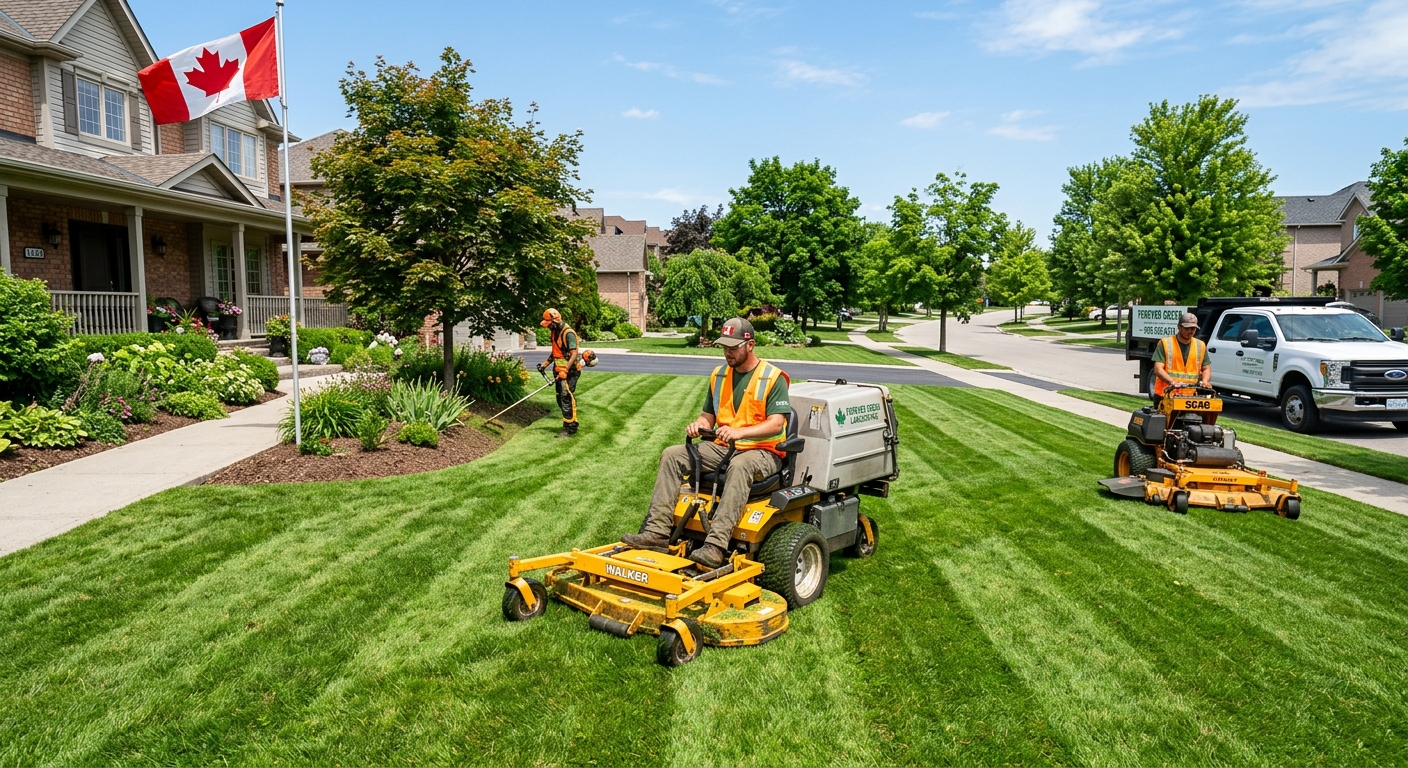
Landscaping options and costs in Port Perry
Port Perry homeowners usually start with a practical question—“what will this yard cost?”—because many lots here come with natural yard space that invites improvements, and the town’s population of 9,553 (Statistics Canada, 2021 Census) supports a steady demand for local softscape and curb-appeal upgrades. In the Port Perry market, landscaping pricing is strongly influenced by Southern Ontario conditions: hard winters, freeze–thaw cycles, and heavier clay or fill soils that often need excavation, soil amendment, and drainage work to protect foundations and keep patios/steps level. The GTA’s plant hardiness range (zone 6a–7a) also shapes what we install—woody plants and hardy perennials that tolerate winter lows around –23 to –18°C, plus designs that can handle hot, often humid summers.
Demand is especially consistent in the residential pockets along Main Street and the older-established neighbourhoods closer to the waterfront, where mature trees, narrow access, and compacted soil can make removal, grading, and base prep more labour-intensive. Labour availability can also tighten during May to October, which is when we can reliably install plants, lawns, and most concrete/stone. That’s why two bids for the same “basic backyard refresh” can differ even before you pick materials—scope, access, drainage, and soil conditions quickly move projects up or down the Toronto price bands.
Below is a quick, homeowner-friendly comparison of common landscaping options and the typical ranges you’ll see for Port Perry jobs—use it to sanity-check itemized quotes as we move into the details.
| Service |
Description |
Season |
Price Range |
| Full landscape design and installation |
Site walk, grading/drainage plan, plant layout, hardscape/softscape install, final cleanup |
May–October |
$8,000–$40,000 |
| Sod installation (supply, grade, lay, roll) |
Remove old turf as needed, grade/roll, install sod, initial watering guidance |
Late April–June or August–September |
$2,500–$8,000 |
| Lawn seeding (grade, seed, starter fertilizer) |
Light grading, seed selection, starter fertilizer, mulch, first-season care |
April–May or August |
$1,800–$5,500 |
| Interlocking patio or walkway |
Excavation, compacted base, leveling sand, interlocking stone, edging, jointing |
May–September |
$6,500–$22,000 |
| Retaining wall (interlocking block) |
Wall layout, excavation, geogrid/backfill, drainage layer, block installation |
May–September |
$6,000–$30,000 |
| Tree and shrub planting |
Soil prep, planting, staking where needed, mulch rings, watering schedule |
April–June or September–October |
$800–$6,000 |
Prices are estimates only and vary by project scope, site access and material selection.
What affects the price of landscaping in Port Perry
In Port Perry (Toronto-area pricing), even “similar” landscaping projects can land 30–50% apart because bids respond to hidden variables: soil conditions, access for skid steers and trucks, grading/drainage complexity, and whether work is truly softscape-only or includes hardscape and excavation. The GTA’s plant hardiness zone (6a–7a) and the seasonal frost calendar shape both what can survive and how long contractors can work. That matters financially because freeze–thaw cycles demand deeper, well-compacted granular bases for patios, steps, and retaining wall footings—often with drainage that can’t be skipped.
Comparatively, Prairie regions (zone 2–4) usually need ultra-hardy, drought-tolerant palettes and simpler layouts because shorter seasons and colder winters compress the work window; retaining walls there still need frost-safe bases. Coastal BC (zone 7–8) can support lush, long-season planting, but it still requires strong drainage planning in heavier-rain areas. In the dry BC interior, water restrictions often drive drip irrigation design and xeric planting, which can add up front costs. Southern Ontario offers a moderate season, but we still build for summer dry spells—so irrigation and soil amendment become key decisions.
Concrete examples from Port Perry pricing: (1) a clay yard that needs 6–12 inches of topsoil plus regrading to fix down-slope pooling can move a lawn refresh from a mid-band to the higher end of sod installation; (2) adding a French drain or daylighting a downspout away from a foundation can increase costs even if you keep the same plant list; (3) upgrading from seeding to sod for a front walk-to-drive area can be justified when you need faster curb appeal—because sod typically costs multiples of seeding per square foot. Use the range benchmarks: tree and garden planting often falls around $800–$6,000, while retaining walls and hardscaping commonly start around $6,000–$30,000.
| Price Factor |
Why It Matters |
Cost Impact |
| Yard size in sq ft — the primary cost driver for softscape |
More turf/soil prep means more labour, material, and cleanup time |
Low-to-high range within the sod and design bands |
| Grading and drainage work — slope corrections add significant cost |
Fixing ponding and directing runoff protects foundations and hardscape |
Often adds a major line item compared with flat yards |
| Drainage bed or French drain installation |
Helps prevent water migration and freeze–thaw heaving under patios/edges |
Can shift the job toward the upper band for hardscape |
| Plant material tier — native shrubs vs. ornamental vs. mature specimen trees |
Mature specimens cost more and may require staking/extra labour |
Can double planting spend vs. shrub-heavy plans |
| Hardscape vs. softscape ratio — walls and patios cost more per sq ft than lawn |
Excavation, base materials, compaction, and stone edges increase cost |
Hardscape-heavy designs usually land in the higher project band |
| Irrigation system design and installation |
Design for freeze-safe components and coverage, plus extra excavation |
Often adds cost but reduces maintenance and summer stress |
| Soil amendment and topsoil required |
Clay/fill soils may need structured amendment and proper grading |
Increases hauling, labour, and material quantities |
| Tree removal or stump grinding before new planting |
Root mass and access limits can require extra equipment/time |
May be a substantial surprise if not included upfront |
Permits & regulations in Ontario
In Ontario, most typical landscaping work—like planting trees/shrubs, sodding or seeding, mulching, and installing many softscape features—generally does not require a permit. Where permits usually come into play is with larger structural elements. For example, retaining walls above a height threshold—often around 1.0 m (3.3 ft) in many Ontario municipalities—commonly require a building permit and sometimes engineered details depending on height, soil conditions, and location. Also, if your project includes changes to lot grading that could affect drainage toward neighbouring properties or to a storm connection, approvals may be required.
Before any digging (planting holes, footing trenches, or drain trenches), you should request utility locates. In practice, you’re protecting your contractor and your property by verifying utilities at the start so equipment doesn’t hit buried lines. It’s also smart to confirm local irrigation and water-use expectations—while drought restrictions are more dramatic in some regions, Ontario homeowners still benefit from efficient irrigation design during dry spells.
To verify contractor compliance in Port Perry, ask for three items and check them in writing: (1) proof of Ontario contractor licensing status (via the relevant online registry the contractor provides or references), (2) a current certificate of liability insurance naming you as additional insured if applicable, and (3) coverage confirmation for workers through WSIB/WCB documentation (request a clearance letter or proof of account/coverage). A reputable contractor should provide these promptly—before you commit to a date.
Planning a landscape that thrives in Port Perry's climate
Planning for Port Perry means designing with zone 6a–7a realities: winter lows near –23 to –18°C, freeze–thaw cycles, and humid summers that can stress poorly-drained soils. Start with plant selection. Choose hardy, zone-appropriate trees and shrubs, then add native perennials where possible to reduce watering and winter protection demands. For lawns, decide early between sod and seeding: sod gives instant coverage and helps control erosion, but it’s typically more expensive—often about 3–4 times per sq ft compared with seeding. Sod is also a better choice when you need immediate curb appeal for a front approach or you’re stabilizing bare soil before heavy rains.
Drainage and grading are the difference between “pretty” and “lasting” here. If you ignore slope and runoff, water can pool around foundations, and repeated freeze–thaw can lift edges or create soft spots under patios and steps. For hardscape, proper base preparation matters: depth and compaction should be planned for local frost action, with drainage layers where water can get trapped. If you’re adding interlocking stone, the upfront cost is easier to justify when it prevents future settlement repairs.
Low-maintenance strategies work well in the Toronto market: mulch in shrub borders, groundcovers to reduce weeding, and a mix of perennials with staggered bloom for curb appeal without constant reseeding. Consider rain gardens or “right-plant, right-place” low-water areas where the yard naturally receives runoff from eaves or downspouts. A small rain garden strip can cost less than a full irrigation system for the same area—especially if it reduces pooling and improves soil infiltration.
Example: if your goal is a 400 sq ft lawn repair, sod may run roughly into the mid-to-upper part of the sod band ($2,500–$8,000) while seeding is often lower; however, if you need the yard usable immediately or you’re replacing eroded topsoil, paying for sod is sometimes the right trade-off.
| Element |
Climate Consideration |
Maintenance Level |
Price Band |
| Sod lawn installation |
Roots establish before winter; protect from winter drying and spring thaw |
Medium (watering windows, first-season mowing) |
$2,500–$8,000 |
| Native perennial garden |
Hardy growth through freeze–thaw; better long-term resilience in zone 6a–7a |
Low (mulch refresh, seasonal tidy) |
$1,200–$5,000 |
| Mulched shrub border |
Mulch insulates roots and helps manage summer moisture; handles clay with proper prep |
Low to medium |
$1,000–$4,500 |
| Interlocking stone patio |
Freeze–thaw-safe base and drainage prevents settlement and edge heaving |
Low (weed control at joints, occasional leveling) |
$6,500–$22,000 |
| Retaining wall (block) |
Requires frost-conscious drainage/backfill so water doesn’t destabilize the wall |
Low after installation |
$6,000–$30,000 |
| Drip irrigation system |
Freeze-safe design and smart zoning reduce waste during hot, humid spells |
Low (winterize/seasonal checks) |
$2,000–$9,500 |
How to choose a landscaping contractor in Port Perry
Choosing the right contractor in Port Perry starts with verifying coverage and legitimacy. For Ontario work, ask for (1) proof of liability insurance (certificate of insurance), (2) WSIB/WCB coverage documentation for their workers, and (3) any relevant Ontario registration or licensing they’re required to carry for the scope you’re buying. How to check: look at the expiry dates on the certificate of insurance, confirm the policy limits are appropriate for property work, and ensure the certificate lists your property correctly (or provides wording for adding you as additional insured). For WSIB/WCB, request proof/clearance documentation rather than a verbal assurance—this is where scams and under-the-table labour are most common.
Next, get 2–3 itemised written quotes. You want line items that separate excavation and base materials, soil/topsoil and amendment quantities, drainage work, plant counts/sizes, and hardscape labour—not just a single lump sum. Also confirm what’s included: permit pull (if needed for the retaining wall), disposal/hauling, utility locating coordination, and top-up materials if settlement occurs during the first season.
Warranty matters too. Ask for the workmanship warranty length (and what it covers), how product/manufacturer warranties work for trees/shrubs, and whether coverage transfers if you sell the home. For payment scheduling, never let the deposit creep too high—keep upfront payments to about 10–15% and hold back a portion until you confirm final grading, cleanup, and commissioning of irrigation (if included). Finally, demand a written start date and a realistic completion estimate based on weather windows in southern Ontario.
- They visit your property (or do a proper site walk) and document drainage and access constraints.
- Quote includes quantities: sq ft for turf/patio, linear ft for edging, and number/sizes of plants.
- Work scope clearly states what’s included/excluded (tree removal, stump grinding, haul-away).
- Retaining walls/hardscape specify base depth, compaction method, and drainage layer details.
- They coordinate utility locates before digging planting holes or wall footings.
- They provide proof of liability insurance and WSIB/WCB coverage before starting.
- They list who supplies materials vs. labour responsibility for each line item.
- They confirm warranty terms in writing, including workmanship and plant replacement policy.
- Payment schedule is staged with milestones; you’re not paying most of the job upfront.
- They show a project timeline tied to Ontario seasonal windows (typically May–October for installs).
- They handle top-up and adjustment after settling (especially for walkways/patio joints).
- They maintain professional site protection (silt control, protective coverings near foundations).
Red flags in the Port Perry landscaping market: (1) “cash-only” quotes or refusing to provide insurance/WSIB proof, (2) no itemized breakdown—just one lump sum with no quantities, (3) skipping drainage/base prep details for patios/retaining walls, (4) promising year-round installation without accounting for frost and freeze–thaw limitations, and (5) pushing for a large upfront deposit or delaying the written contract and start date.
Frequently asked questions — landscaping in Port Perry
What trees grow best in Port Perry's climate zone?
Port Perry sits in the zone 6a–7a range typical for the GTA, so we focus on trees that tolerate winter cold near –23 to –18°C and also handle humid summers. Common, reliable choices include serviceberry (Amelanchier), lilac’s companion understory options like dogwoods (in the right spot), and hardy varieties of maple and birch where soil and drainage suit them. If your yard has heavier clay or tends to stay wet, we prioritize species and planting strategies that manage water movement away from foundations. Because Port Perry lots vary, we match species to sun exposure and drainage before recommending anything expensive.
How much does sodding a yard cost in Port Perry?
In Port Perry, sod pricing typically lands in the broader Ontario/Toronto band of $2,500–$8,000, depending on yard size, how much grading is required, and whether old turf is removed and hauled away. If your lawn needs regrading for drainage or topsoil amendment for clay fill, the project often moves toward the higher side of the range. Access also matters: narrow gates and long reaches can increase labour. If you need immediate coverage for curb appeal, sod is usually the faster route compared with seeding—just make sure drainage and soil prep are included so you don’t pay again next season.
How do I prevent weeds in my Port Perry garden?
Weed control starts before plants go in. In Port Perry, the best approach is to build a clean planting bed with proper soil prep: remove established weeds and roots, loosen compacted soil, and install a weed-suppressing layer where appropriate (like landscape fabric under mulch in certain areas). Then use 2–3 inches of quality mulch and keep beds edged so seeds don’t blow in from turf. Dense, zone-appropriate plants and groundcovers reduce open soil—one of the biggest drivers of weeds. If you’re seeing weeds between pavers, joint sand and stone base quality matters too; poor base prep can create gaps. For new planting, ask your contractor about follow-up weeding and mulch top-ups in the first season.
How do I design a low-water yard in Port Perry?
A low-water yard in Port Perry doesn’t mean “no watering ever”—it means efficient watering and the right plants in the right places. Start by grouping plants by moisture needs, then add mulch to slow evaporation and improve soil structure. Where you have runoff (downspouts or drive-to-lawn slopes), consider a rain garden or infiltration bed to reduce pooling and encourage healthier roots. For irrigation, drip systems are usually more water-efficient than sprinklers and allow targeted watering in hot, humid months. In terms of cost, a full irrigation install can be a separate line item, but compared with repeatedly overwatering stressed turf, it can pay off in summer. Keep an eye on seasonal establishment: even drought-tolerant plantings need deeper watering during the first growing season.
How do I find a licensed landscaper in Port Perry?
In Ontario, “licensed” can be scope-dependent, so the safest approach is to verify coverage and registration documentation before you sign. Start by asking for their proof of liability insurance (certificate of insurance with coverage limits), their WSIB/WCB documentation, and any Ontario registration they’re required to hold for your specific work. Then confirm it’s current—check expiry dates and, if needed, request additional insured wording. Get quotes in writing and insist on itemized scope so you can compare contractors apples-to-apples. A reputable Port Perry contractor will also coordinate utility locates before digging. If someone can’t provide documents quickly or avoids a site walk, that’s usually a sign to keep looking.
How much does landscaping cost in Port Perry?
Landscaping costs in Port Perry generally follow the Toronto pricing bands because of similar labour demands, freeze–thaw constraints, and soil conditions. For example, tree and shrub planting often falls around $800–$6,000, while retaining walls and hardscaping commonly start near $6,000–$30,000 depending on wall length, base preparation, and drainage. Full design-and-install projects can range broadly—often $8,000–$40,000—based on how much hardscape, grading, and plant mass is included. If you’re comparing bids, make sure drainage/soil prep is addressed; in Port Perry, that can swing the price more than material choices.