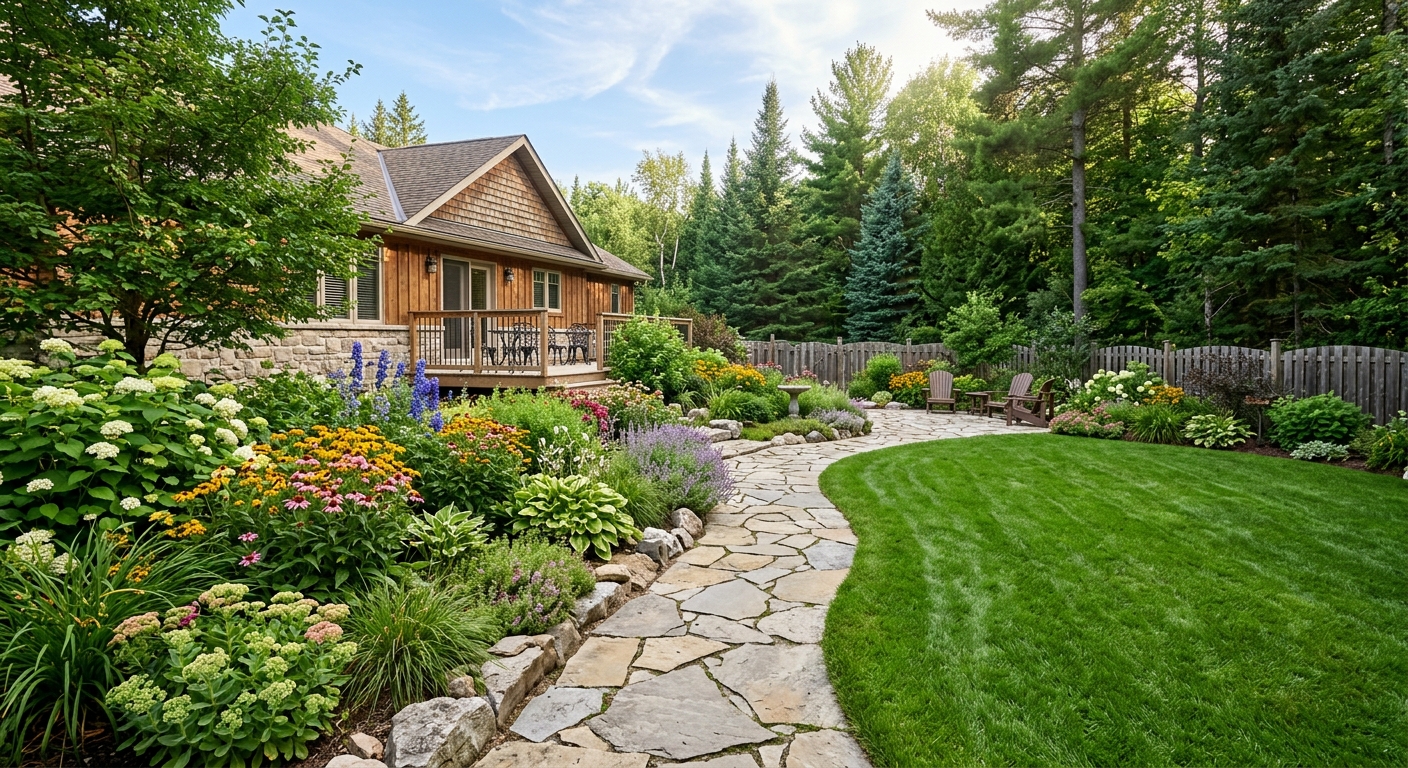
Landscaping options and costs in Rosemount
Rosemount homeowners typically choose landscaping to fit how the local Toronto-area housing stock is laid out—most notably the many detached properties that give you meaningful yard depth to work with. With a population of 5,610 (Statistics Canada, 2021 Census), the demand level is strong enough to keep contractors busy, but not so high that you’ll always get “same-week” availability outside peak season.
In the Greater Toronto Area, costs are strongly shaped by climate and soil. The region sits mostly in hardiness zones 6a–7a, where winter lows commonly reach about –23 to –18°C and freeze–thaw cycles can heave poorly built patios, steps and retaining wall footings. At the same time, the frost-free window (roughly May to October) limits when we can install plants and complete base work, and Toronto’s clay-and-fill soils often need excavation, soil amendment, and sometimes drainage corrections.
Another local cost driver is contractor scheduling around high-demand pockets. In Rosemount, work is especially in demand near the older residential streets where lots have mature trees, deeper service lines, and established gardens that require pruning, cleanup, and careful regrading before new hardscape or planting goes in.
Below is a practical cost comparison for the most common projects—use it as a baseline when you’re moving from ideas to itemised quotes.
| Service |
Description |
Season |
Price Range |
| Full landscape design and installation |
Site measure, design concept, planting palette, grading plan, hardscape/softscape build |
Spring–Fall (with best scheduling in May–June and Sept) |
$8,000–$40,000 |
| Sod installation (supply, grade, lay, roll) |
Excavate/level, topsoil dressing as needed, sod delivery and rolling |
Late April–June and early Sept–mid Oct |
$2,500–$8,000 |
| Lawn seeding (grade, seed, starter fertilizer) |
Surface prep, seed mix application, starter fertiliser and light rolling |
April–June and early Sept |
$1,200–$6,000 |
| Interlocking patio or walkway |
Excavation, base (granular/compaction), geotextile, interlocking stone and jointing |
Spring–Fall (base work depends on soil moisture) |
$6,000–$22,000 |
| Retaining wall (interlocking block) |
Wall layout, excavation, base/weep drainage, geogrid (when needed), block install |
Spring–Fall |
$6,000–$30,000 |
| Tree and shrub planting |
Soil prep, planting holes, staking as required, compost and mulch ring |
Spring (early) and Fall |
$800–$6,000 |
Prices are estimates only and vary by project scope, site access and material selection.
What affects the price of landscaping in Rosemount
Even when two homeowners request the “same” landscaping scope in the Toronto area, quotes can differ by 30–50%. The biggest reason is that local pricing follows real site conditions—especially clay soils, drainage constraints, and how much hardscape or grading is required to survive freeze–thaw cycles. Contractor availability also plays a role: when a crew is booked solid in peak weeks, scheduling and subcontractor costs can rise.
Climate matters because it dictates both what grows and how long we have to build. In southern Ontario’s zone 5–6 growing conditions (Rosemount area aligns closely with GTA hardiness zones 6a–7a), we choose hardy shrubs and perennials that tolerate winter lows near –23 to –18°C and resist summer heat and humidity. That same freeze–thaw reality increases the “hidden” cost of retaining walls, patios and steps—base depth and drainage need to be right, not approximate. By comparison, Prairie regions (Zone 2–4) often need ultra-hardier, drought-tolerant options and have fewer workable weeks, while coastal BC (Zone 7–8) can support lush palettes but still requires strong drainage detailing in heavy-rain areas. In the dry BC interior, irrigation design becomes more complex due to water restrictions, which can also move pricing.
Two concrete examples we see often in Rosemount: (1) If your yard slopes toward the foundation, grading and drainage correction can add thousands, even before plants are touched. (2) If your hardscape sits on soft fill, we may need deeper excavation and more granular base to prevent settlement—pushing a patio toward the upper end of the $6,000–$22,000 band and sometimes nudging a larger “full landscape” toward the higher $8,000–$40,000 design/install range. Older homes with mature trees can also require stump grinding and root management before new beds and lawn come in, which increases labour.
| Price Factor |
Why It Matters |
Cost Impact |
| Yard size in sq ft — the primary cost driver for softscape |
More square footage means more topsoil, seed/sod, mulch, and labour hours |
Often the single biggest variable; can swing total cost several thousand dollars |
| Grading and drainage work — slope corrections add significant cost |
Prevent pooling, protect foundations, and support proper run-off away from structures |
Commonly adds mid-project costs; can move a “lawn-only” job into a full install range |
| Drainage bed or French drain installation |
Redirects excess water and reduces freeze-related heaving around patios/walls |
Can add substantial labour and materials; frequently required on clay sites |
| Plant material tier — native shrubs vs. ornamental vs. mature specimen trees |
Size, pot/root-ball spec, and replacement risk differ by tier |
Mature trees and premium ornamentals push totals upward quickly (especially with multiple specimens) |
| Hardscape vs. softscape ratio — walls and patios cost more per sq ft than lawn |
Stone, excavation depth, base prep, and compaction drive cost |
Shifting 200–400 sq ft from lawn to patio can meaningfully change the quote |
| Irrigation system design and installation |
Even basic systems require layout, backflow/hoses (as applicable), and seasonal tuning |
Adds cost, but can reduce long-term watering issues—especially during dry spells |
| Soil amendment and topsoil required |
Clay and fill often need compost, topsoil dressing, and sometimes regrading |
Can raise totals if excavation is deeper than expected |
| Tree removal or stump grinding before new planting |
Access, disposal, and root/groundwork affect both time and site readiness |
Often adds a noticeable line-item due to equipment and labour |
Permits & regulations in Ontario
In Ontario, most day-to-day landscaping work—planting, sodding, seeding, and typical softscape installation—generally does not require a permit. Where permits become relevant is usually around larger structural elements and lot-altering drainage. For example, retaining walls above a height threshold (commonly around 1.0 m / 3.3 ft in many municipalities) typically require a building permit, and sometimes engineered drawings depending on wall height, soil conditions and design. If your project includes changing lot grading in a way that affects drainage toward neighbouring properties or storm connections, approvals may also be triggered.
Before any digging for planting holes, fence posts, French drains, or wall footings, ensure utility locates are completed. Even small excavations can hit buried services—especially on older streets with service laterals and irrigation-ready conduits.
To verify your contractor’s standing in Ontario, follow a simple, homeowner-friendly checklist: (1) confirm the contractor’s business licensing/registry listing online for the municipality or region they claim to operate in; (2) request a current certificate of insurance for liability (and ask that it lists you as additional insured where applicable); (3) verify WSIB/WCB coverage for workers (or a clearance letter/confirmation if they use contractors). Step-by-step, ask for these documents before signing, and ensure the insurance is active for your project dates—not expired paperwork from the previous year.
Planning a landscape that thrives in Rosemount's climate
Planning for Rosemount means designing with the GTA’s hardiness and winter realities in mind: zones 6a–7a with winter lows around –23 to –18°C, humid summers, and plenty of freeze–thaw movement. The goal is to avoid “pretty but fragile.” Instead, select zone-appropriate and often native species that tolerate cold, rebound after winter, and don’t require constant watering or aggressive winter wrapping.
Start with plant selection: mix hardy shrubs and perennials, and build structure with woody plants that stay attractive when lawns thin or go dormant. Next, match turf approach to results you want. Sod gives instant green but costs roughly 3–4x more per sq ft than seeding because you’re paying for harvesting, delivery, and labour to grade and roll. If you want a quick appearance for a front yard and can commit to watering until roots knit, sod can be worth it; if you’re flexible, seeding is usually the smarter spend.
Drainage and grading are critical in Toronto. Pooling water around foundations increases the risk of basement dampness and can destabilize hardscape. For patios and retaining walls, base preparation must be deep enough to handle frost and compaction—using correct granular layers and drainage details—so it doesn’t settle after one or two winters.
For low-maintenance design, lean on mulch, groundcovers, and repeatable planting blocks. Rain-garden beds and xeriscape-inspired “right plant, right place” layouts can also fit Toronto’s pattern of summer rain variability and dry spells—particularly when paired with efficient irrigation zoning.
Example: A 400 sq ft lawn replacement is often far more budget-friendly as seeding (commonly in the lower part of the $2,500–$8,000 sod band equivalent projects) than sod, but if you’re adding a new patio and need an immediate clean front presentation for a spring event, investing toward the sod end of the range may be justified.
| Element |
Climate Consideration |
Maintenance Level |
Price Band |
| Sod lawn installation |
Needs establishment watering; must be timed for reliable growth (spring or early fall) |
Medium (first season is the busiest) |
$2,500–$8,000 |
| Native perennial garden |
Hardy to GTA winter lows; better resilience to variable summer conditions |
Low to medium (annual cleanup and occasional re-mulch) |
$1,500–$7,000 |
| Mulched shrub border |
Dense planting reduces weed pressure; mulch protects roots during freeze–thaw |
Low (weed control early on, then mostly spot checks) |
$800–$6,000 |
| Interlocking stone patio |
Requires proper base depth and drainage to resist frost heave and settlement |
Low (periodic joint sand/top-up) |
$6,000–$22,000 |
| Retaining wall (block) |
Footing and drainage details protect against freeze-related movement on clay soils |
Low once built correctly |
$6,000–$30,000 |
| Drip irrigation system |
Efficient watering during humid summers and dry spells; supports targeted root zones |
Low (seasonal start-up checks) |
$1,200–$6,500 |
How to choose a landscaping contractor in Rosemount
Choosing a landscaping contractor in Rosemount starts with proof, not promises. First, verify Ontario coverage and standing: request their liability insurance certificate and confirm it covers the type of work you’re hiring for (equipment, excavation, hardscape, and planting). Next, confirm WSIB/WCB coverage for their workers—ask for either a clearance letter or a current confirmation document, and check dates. If they use subcontractors, ensure the subcontractors are covered too. If anything feels vague, it’s reasonable to pause and ask again.
Then get 2–3 itemised written quotes. You want a labour-and-materials breakdown, not a single lump sum. Good quotes clearly list excavation/topsoil, base materials, drainage components (if any), stone and block specs, plant quantities and sizes, and what disposal/cutting is included. Pay close attention to exclusions: Are permits included (when required), is geotextile included, is drainage rock included, and is jobsite cleanup part of the scope?
Warranty also matters. Ask for a workmanship warranty length and what it covers (settlement, edge lifting, failed plant replacement policy, etc.). Confirm whether manufacturer warranties for plants/materials are transferable to you—many plant warranties only cover the original installer or are limited in duration. For payments, never pay more than 10–15% upfront; hold back a portion until you’ve received final walkthrough approval and the contract items are complete. Finally, insist on a written timeline: start date and estimated completion window, with allowances for weather delays during spring thaw and wet fall conditions.
- Ask for WSIB/WCB clearance or confirmation, dated for your project period.
- Request a current liability insurance certificate (and confirm active dates).
- Get 2–3 itemised quotes with separate labour and material lines.
- Confirm if disposal of excavated soil/old sod is included.
- Ask whether geotextile, base compaction, and proper granular layers are included.
- For retaining walls, confirm drainage/weep details and footing plan (not just “block install”).
- Check that plant lists include quantities, sizes, and where seasonal installation will happen.
- Verify permit responsibility if wall height/grade changes require approvals.
- Request a written workmanship warranty (specific coverage, duration, and process).
- Ensure the payment schedule matches risk: small deposit, progress payments, final holdback.
- Ask who will be on-site, and for how many hours/days per phase.
- Review cleanup expectations (leaf/debris removal, final grading touch-ups).
Red flags in Rosemount: a quote that skips drainage or base specifications; refusal to provide WSIB/WCB or insurance documents; “cash only” or vague payment schedules; no written warranty terms; and a scope that includes planting but omits watering instructions and establishment care.
Frequently asked questions — landscaping in Rosemount
What is xeriscaping and does it suit Rosemount?
Xeriscaping is a landscape approach that reduces water use by using drought-tolerant plants, efficient irrigation, and smart layout (for example, grouping plants by sun exposure and moisture needs). In Rosemount and southern Ontario, it can suit your yard well—especially where clay drainage is inconsistent and you want to reduce summer “panic watering.” That said, the GTA isn’t the dry BC interior, so you’re not avoiding water entirely; you’re using it more efficiently. A good xeriscape-style design often combines hardy shrubs and perennials for zone 6a–7a with mulch and targeted drip irrigation, which can sit alongside traditional turf. If you’re comparing options, note that lawn changes are often budget anchors—sod projects commonly land in the $2,500–$8,000 range depending on area.
How do I plan a low-maintenance yard?
For Rosemount, low-maintenance design usually comes down to three choices: plant selection, soil preparation, and irrigation/watering strategy. First, pick winter-hardy shrubs and perennials that fit GTA hardiness (tolerate winter lows around –23 to –18°C) so you’re not constantly replacing winter-killed plants. Second, prepare beds properly—correct grade and drainage so roots don’t sit in wet clay during spring thaw and then bake in summer. Third, use mulch and groundcovers to suppress weeds and reduce routine weeding; mulch rings around shrubs help protect roots through freeze–thaw cycles. If you want quick curb impact with less ongoing work, replacing some lawn with a mulched shrub border and a small interlocking patio often reduces mowing and edging. If your patio is part of the plan, budgeting in the $6,000–$22,000 band is common for many typical walkway/patio scopes.
How deep should a retaining-wall base be for local frost?
There isn’t one universal depth for every retaining wall because soil type, wall height, backfill, and drainage design all change what’s required—but for Ontario, the key is to build a stable base that’s below the influence of frost and built on well-compacted granular material. In the GTA, the freeze–thaw cycle is what causes movement when base prep is shallow or drainage is missing. In practice, that means excavation, geotextile where appropriate, correctly sized granular base layers, and drainage backfill with proper weep pathways (where used). The safest approach is to have a contractor size the base based on wall height and site conditions, then document the plan in the quote. If your wall pushes into permitted territory (often around 1.0 m / 3.3 ft), it’s especially important that the design is done right. Many retaining projects land in the $6,000–$30,000 range depending on height and drainage complexity.
How much does professional landscape design cost?
Professional landscape design in the Toronto area is commonly bundled with installation, and the total design/install range you’ll see for Rosemount projects often sits within the $8,000–$40,000 band depending on how much hardscape, grading, and planting is included. If you’re seeking design only, some firms quote a separate design fee; however, many homeowners prefer design-included packages so revisions and plant selection are handled during the build. A good design scope should include site measurement, a planting plan sized for zone 6a–7a conditions, and a grading/drainage concept that accounts for Toronto’s clay and spring thaw. If your project includes a patio, retaining wall, or drainage corrections, expect the design value to reflect that complexity—those structural items are where poor planning is most expensive to fix later.
How do I compare landscaping quotes?
Start by comparing apples to apples. In Rosemount, two quotes can look similar in total cost but differ dramatically if one includes proper drainage base prep and the other only lists “stone and labour.” Ask for an itemised breakdown for each major component: excavation depth, granular base type and thickness, geotextile use, drainage rock/French drain inclusion, stone or block specifications, and disposal. Confirm who handles permits when required (for example, some retaining-wall projects above common thresholds and grade/drainage changes). Compare plant lists: quantities and sizes should match, not just “shrubs.” Also compare warranty terms and the payment schedule—good contractors typically keep deposits modest (10–15% upfront) and use a holdback until the final walkthrough. If one quote is much lower than the rest, it often means something key is excluded that will resurface later as additional costs.
How long does a landscaping project take in Rosemount?
Typical timelines depend on the scope and the GTA weather window. In Rosemount, spring thaw and wet ground can delay base preparation, while fall can shorten plant establishment time if installs are late. Simple planting refreshes or small shrub borders can take a day to a few days. A lawn replacement with sod might take roughly 1–3 days on-site for prep and install (with establishment watering afterward), while seeding is usually faster to lay down but needs care for germination. Interlocking patios/walkways often take several days because excavation and base compaction need time, and drainage/gravel layers must be installed correctly. Retaining walls can take longer due to excavation, base, block installation, and backfilling. Full landscape design/install projects commonly stretch over multiple weeks, especially if drainage corrections or hardscape and planting happen in phases.