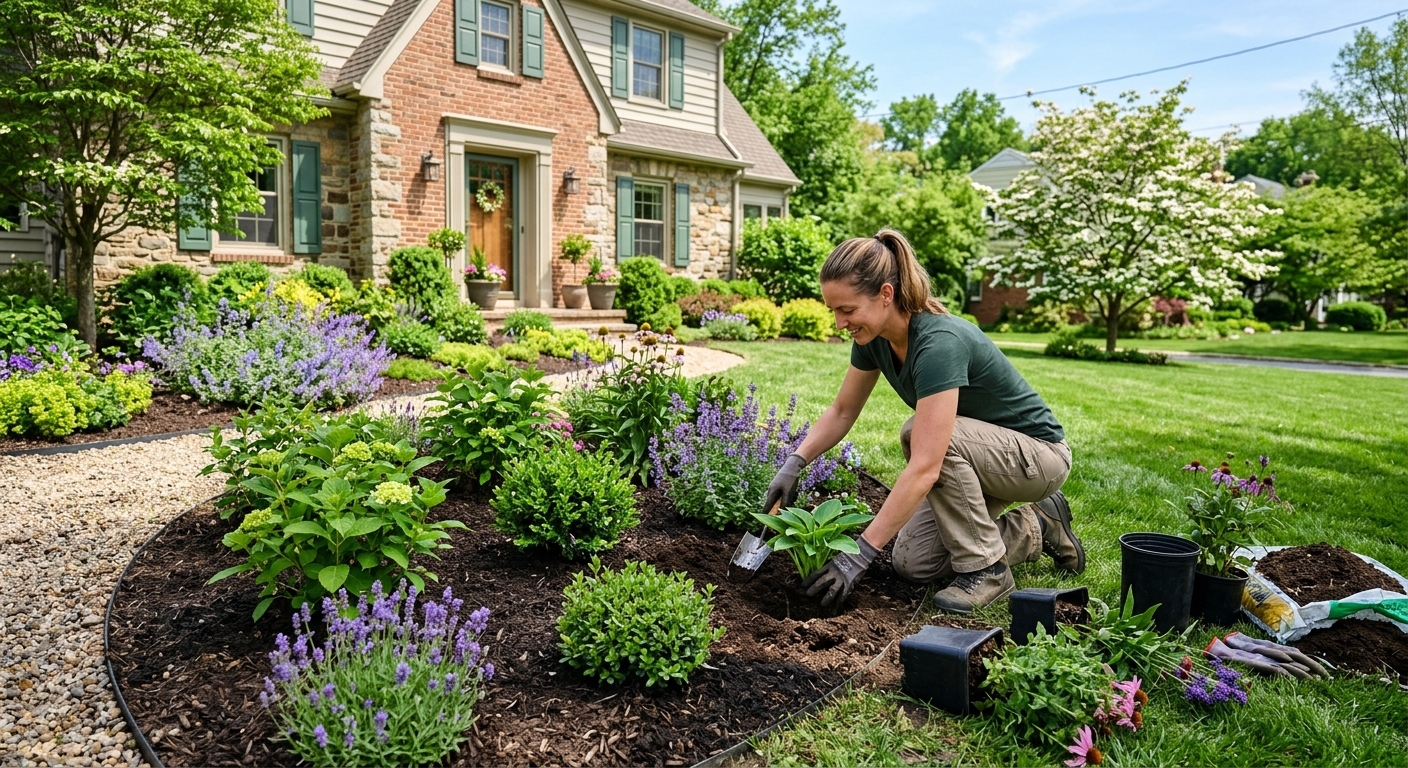
Landscaping options and costs in Tottenham
In Tottenham, Ontario, homeowners typically invest in landscaping because many properties have yard space that can be improved quickly for curb appeal and practical use—especially across the broader Toronto area, where detached homes remain a large part of the housing mix (Statistics Canada, 2021 Census). Tottenham’s population is smaller at 5,143 residents (Statistics Canada, 2021 Census), which usually means fewer local crews available at peak season, so timing and booking can affect final pricing.
Cost in the GTA is shaped by climate and soil. The region sits mainly in hardiness zones 6a–7a, with winter lows that commonly fall near –23 to –18°C and frequent freeze–thaw cycles. That combination is why hardscaping and retaining work often costs more than in milder regions: patios, steps, and walls need deeper, well-compacted granular bases and sound drainage so they don’t heave or settle. On the softscape side, spring and early fall installation windows tend to be the most reliable for plant survival and turf recovery.
In Tottenham, trades demand is especially steady around the community core and along main routes—when new residents move in, they often want a “finished look” for front-yard visibility first. From there, most projects branch into either lawn build-out, interlocking patios/walkways, or a tree-and-shrub refresh tailored to Toronto’s freeze–thaw patterns.
Below is a practical cost comparison you can use as a baseline when you start calling for quotes, then refine it after a site visit.
| Service |
Description |
Season |
Price Range |
| Full landscape design and installation |
Site walk, concept + grading plan, planting and hardscape build, topsoil/soil amendments, cleanup |
Spring to early fall |
$8,000–$40,000 |
| Sod installation (supply, grade, lay, roll) |
Remove debris, grade for slope/drainage, install sod, roll, light watering plan |
Late spring to early fall |
$2,500–$8,000 |
| Lawn seeding (grade, seed, starter fertilizer) |
Grade and prepare seedbed, seed blend, starter fertilizer and light cover |
Spring or early fall |
$1,500–$5,500 |
| Interlocking patio or walkway |
Excavation, compaction, base/granulars, edging, sand bedding, jointing |
Spring to late fall |
$6,000–$22,000 |
| Retaining wall (interlocking block) |
Wall layout, excavation and base prep, geogrid/footing where needed, drainage layer, block + cap |
Spring to late fall (weather-dependent) |
$6,000–$30,000 |
| Tree and shrub planting |
Soil prep, planting layout, amendments, staking (if required), mulch and watering guidance |
Spring or fall |
$800–$6,000 |
Prices are estimates only and vary by project scope, site access and material selection.
What affects the price of landscaping in Tottenham
Two quotes for the “same” landscaping job in Tottenham can differ by 30–50% because what looks identical on a drawing often changes after excavation: soil condition, drainage needs, the amount of demolition, and how hard the site is to access with equipment. In the Toronto region, labour availability also swings during peak months—when crews are booked for patios, wall work, and sod installs, scheduling changes can push costs upward, particularly for full design-and-build projects that require coordinated subcontractors.
Climate drives both plant success and construction sequencing. Tottenham sits in zones 6a–7a, where winter lows and freeze–thaw cycles demand proper base depth for hardscaping and retaining walls, plus reliable drainage. Prairie regions (zone 2–4) face shorter growing seasons and harsher cold/wind, often requiring a simpler, ultra-hardy, drought-tolerant palette and more plan-for-survival planting—while retaining wall base depth there must also be built for deep freeze. Coastal BC (zone 7–8) generally supports lush plant palettes and a longer installation season, but heavy rain still means drainage detailing must be done correctly. In Southern Ontario, summers can be humid with dry spells, so irrigation planning matters even when water isn’t restricted the way it can be in the dry BC interior.
Here are a few Tottenham examples that commonly move the price: (1) a 3–4% slope correction to prevent water pooling near a foundation can add significant grading and re-topsoil cost; (2) clay-filled or compacted soils often require more excavation plus soil amendment to get drainage working; (3) adding a retaining wall tends to shift a project from the “$6,000–$30,000” hardscape band upward because drainage gravel, proper footing, and sometimes geogrid/footing depth are material-heavy and labour-heavy.
| Price Factor |
Why It Matters |
Cost Impact |
| Yard size in sq ft — the primary cost driver for softscape |
More area means more topsoil, seed/sod, edging, and time for prep and finishing |
Typically increases costs proportionally; larger lots can move you from mid to upper price bands |
| Grading and drainage work — slope corrections add significant cost |
Proper runoff prevents foundation moisture and puddling; often requires excavation and regrading |
Can add a major chunk to a project, frequently the difference between similar quotes |
| Drainage bed or French drain installation |
Targets persistent damp spots and downspout overflow; needs correct slope and pipe bedding |
Material + labour intensive; often triggers higher end of walkway/patio or full build pricing |
| Plant material tier — native shrubs vs. ornamental vs. mature specimen trees |
Mature specimens cost more and may require extra labour for planting/staking and care |
Can move planting from the lower to upper end of the $800–$6,000 band |
| Hardscape vs. softscape ratio — walls and patios cost more per sq ft than lawn |
Stonework needs deep base, compaction, edging and careful jointing |
Shifts total project quickly into the $6,000–$30,000 retaining/hardscape range |
| Irrigation system design and installation |
Toronto humidity helps, but dry spells still require reliable watering schedules and coverage |
Higher-cost item when included; can be a major add-on for larger lawns/gardens |
| Soil amendment and topsoil required |
Clay and fill may need screening/amendment to support sod/seeding and healthy roots |
Increases trucking, excavation, and labour time; often overlooked in quick estimates |
| Tree removal or stump grinding before new planting |
Removal adds risk, disposal, and equipment; stumps affect grading and drainage |
Frequently adds cost beyond the “planting only” budget |
Permits & regulations in Ontario
In Ontario, most landscaping and softscape work—like planting, sodding, seeding, mulching, and many typical garden installations—usually does not require a permit. Where permits commonly come into play is for heavier structural work and grading impacts. Retaining walls above a local height threshold (often around 1.0 m / 3.3 ft in many municipalities) typically require a building permit and sometimes engineering or engineered drawings, depending on the height, design, and soil conditions. Also, changes to lot grading that alter drainage toward neighbouring properties or connect materially to storm systems may require approval.
Before any digging for planting holes, French drains, or wall footings, confirm utility locates. Even if you’re only adding shrubs or replacing a small section of lawn, locates help avoid costly strikes and delays.
To verify a contractor in Tottenham, follow a simple step-by-step process:
- Ask for their Ontario business registration details (or the equivalent proof of business standing) and confirm the company name matches their quotes/invoices.
- Request a certificate of insurance showing general liability coverage; keep an eye on expiry dates.
- Confirm WSIB/WCB clearance (or coverage status) and ask what documentation they provide.
- Check online registries where applicable for contractors and review any posted standing or clearance information.
- Verify they include utility locate responsibility in the plan—especially for wall footing and drainage trenching.
If you’re unsure whether your planned wall height or grading change triggers permitting locally, ask the contractor to outline the permit pathway they will handle (or confirm they’ll cooperate with your permit application if needed).
Planning a landscape that thrives in Tottenham's climate
To plan a landscape that thrives in Tottenham, Ontario, design around the site first—then match plants to climate (hardiness and winter stress), and construction to the frost calendar. Tottenham sits mostly in zones 6a–7a, so you want woody plants and perennials that tolerate winter lows near –23 to –18°C, plus a layout that handles spring melt and summer humidity. The goal is less “fighting nature” and more working with it: good drainage, appropriate soil depth, and winter-ready root establishment.
For plant selection, use native and zone-appropriate species where possible. They’re usually better adapted to local conditions, and they often need less watering once established. For turf, sod provides instant curb appeal but costs about 3–4x per sq ft compared with seeding—so it’s worth it when you need results quickly, when erosion risk is high, or when your budget allows a faster fix. In Tottenham, a practical example is choosing sod to stabilize a front slope after topsoil work; if sod is budgeted in the $2,500–$8,000 band, the higher spend can prevent washouts and muddy tracking while seed establishes.
Drainage and grading are critical in the GTA: pooling can lead to foundation moisture and soft ground under patios. For hardscape, the base preparation needs to extend properly below the frost line logic for stable compaction, with enough granular depth and proper compaction methods. Finally, low-maintenance design strategies—mulch rings, groundcovers, and layered perennials—reduce seasonal upkeep while still looking intentional.
If water management is a concern during dry spells, consider a rain garden at downspout discharge points and xeriscape-adjacent planting beds with drought-tolerant perennials and deeper mulch to slow evaporation.
| Element |
Climate Consideration |
Maintenance Level |
Price Band |
| Sod lawn installation |
Needs consistent moisture during establishment; frost-safe grading prevents early failure |
Medium early (watering and settling), then low |
$2,500–$8,000 |
| Native perennial garden |
Zone-appropriate survival through winter lows; better resilience during humid summers |
Low to medium (mulch refresh, seasonal trimming) |
$1,200–$6,000 |
| Mulched shrub border |
Mulch moderates soil temperature swings from freeze–thaw and reduces drying in summer |
Low (weed control and occasional pruning) |
$800–$4,500 |
| Interlocking stone patio |
Freeze–thaw demands deep, compacted base and correct drainage slopes |
Low (seasonal sweeping and occasional joint maintenance) |
$6,000–$22,000 |
| Retaining wall (block) |
Soil pressure + frost action require proper footing and drainage layer behind the wall |
Low (visual checks and clearing weep/edge areas) |
$6,000–$30,000 |
| Drip irrigation system |
Helps control watering during dry spells and supports root establishment with targeted delivery |
Low after setup (spring start-up checks) |
$1,500–$7,500 |
How to choose a landscaping contractor in Tottenham
Choosing the right landscaping contractor in Tottenham starts with proof, not promises. For Ontario projects, verify three key items: licensing/business standing, liability insurance, and WSIB/WCB coverage.
How to check each:
- Ontario licensing/business standing: ask for their business information and confirm the contractor name matches their quote and invoices.
- Liability insurance: request a certificate of insurance showing general liability; ensure coverage is active for the project dates and that the limit is appropriate for landscaping operations.
- WSIB/WCB clearance: ask for clearance documentation (or coverage proof) so you’re not exposed if an injury happens on your property.
- References: request recent local photos from similar Tottenham jobs, not just “portfolio” pictures from elsewhere.
Next, get 2–3 itemised written quotes. You want a breakdown that separates labour and materials (excavation, base materials, stone/block, soil/topsoil, plant material, disposal). A good quote also lists what’s excluded so there are no surprises—things like permit handling (if required), haul-away/disposal, utility locate costs, or additional grading if hidden issues appear.
Confirm warranty terms. Ask for the workmanship warranty length and what it covers, and whether manufacturer warranties on plants/pavers are included and whether they’re transferable. For payment, never pay more than 10–15% upfront; hold back a portion until the job is complete and corrected. Finally, insist on a start date and an estimated completion timeline in writing—weather can shift installs, but timelines should still be documented.
- Ask whether they do site cleanup after each work stage.
- Confirm who handles utility locates.
- Make sure drainage details are described (slope, outlets, or French drain tie-ins if needed).
- Request base thickness/specs for patios and walls (not vague “proper base”).
- Clarify plant sizes/species and whether substitutions are allowed.
- Confirm sod/seeding methods (rolling, starter fertilizer, seed blend, and seeding rate).
- Ask how they protect existing landscaping during construction.
- Check if disposal/hauling is included for removed soil, stumps, and debris.
- Verify edging details and jointing material for interlocking stone.
- Review the schedule: when topsoil is installed vs when sod/seed goes down.
- Confirm irrigation tie-ins if you already have a system or want one installed.
- Get warranty details in writing, including start date and claim process.
Red flags in Tottenham include: vague quotes with no material specs or quantities; refusal to provide insurance and WSIB/WCB clearance documentation; pressure for large upfront payments; promising “no need for drainage” on clay-heavy sites; and work schedules that rely on verbal estimates with no start/completion dates.
Frequently asked questions — landscaping in Tottenham
What is xeriscaping and does it suit Tottenham?
Xeriscaping is a landscaping approach that reduces water use by using drought-tolerant plants, efficient irrigation (often drip), mulching, and thoughtful soil preparation so moisture is held longer. In Tottenham and the broader Toronto area, it can be a great fit for reducing summer watering during dry spells, especially in beds far from downspouts where grass struggles. However, it shouldn’t mean “no lawn” everywhere—many homeowners do best with a mixed design: sod or seed for traffic areas, and xeriscape-style planting beds for edging, slopes, and garden zones. If you’re budgeting, a targeted approach can be practical: for example, combining planting refresh in the $800–$6,000 band with a drip system can be more effective than replacing an entire lawn at once. The key is choosing zone-appropriate species (hardiness zones 6a–7a) that can handle winter lows near –23 to –18°C.
How do I plan a low-maintenance yard?
In Tottenham, low-maintenance planning usually comes down to three decisions: simplify the lawn, design for drainage, and choose plants that don’t require constant correction. Start by preventing pooling near foundations and walkways with grading and—if needed—a drainage bed/French drain. Next, decide between sod and seeding based on your timeline. Sod gives instant results but typically costs more and still requires establishment watering; seeding is cheaper and can be great in spring or early fall, but it needs patience. For plant beds, use mulch as your “maintenance tool”: it suppresses weeds, insulates roots through freeze–thaw, and reduces the number of times you’ll weed. Build layered borders with a mix of native perennials and sturdy shrubs so you’re not replanting every year. If you want a curb-appeal anchor, add an appropriately sized interlocking patio or stepping area—done right, that base work is built for the GTA’s winter cycles and can keep annual upkeep low.
How deep should a retaining-wall base be for local frost?
Retaining-wall base depth isn’t one “magic number” for every Tottenham project because it depends on wall height, soil conditions, wall system, and drainage design. That said, the GTA’s freeze–thaw cycles are a major reason contractors build properly below the depth that keeps the base stable through winter expansion and contraction. For interlocking-block walls, reputable installers plan for excavation depth that supports a compacted base/granular footing and correct drainage behind the wall (often with a drainage layer and weep/drainage provisions). If you’re dealing with clay and fill, base requirements and soil stabilization can increase excavation and material costs. Because Ontario permitting can also apply at certain wall heights (commonly around 1.0 m / 3.3 ft in many municipalities), you’ll want a contractor who specifies base prep and drainage in writing. If a quote is vague about footing depth or doesn’t mention drainage behind the wall, that’s a common shortcoming that can lead to shifting later.
How much does professional landscape design cost?
In the Tottenham area, professional design is often bundled into a design-and-install package, and many homeowners see it more as a total project cost decision. For budgeting, the “design & installation” backbone in the GTA tier is commonly $8,000–$40,000 depending on yard size, whether hardscape/retaining is included, and how complex grading and plant palettes are. If you’re only doing a smaller planting plan, the design-only cost can vary and may be priced separately, but your best comparison is to look at what the package includes: site walk, concept, planting layout, grading considerations, and (if needed) a materials plan. Tottenham’s smaller population (5,143 in 2021) can also influence availability and scheduling, which can affect how quickly a designer/crew can start. For most homeowners, the value of design is avoiding expensive mistakes—like poor drainage placement, mismatched plant selections for zone 6a–7a, or hardscape bases that don’t respect freeze–thaw movement.
How do I compare landscaping quotes?
To compare landscaping quotes in Tottenham fairly, treat them like you’re comparing “apples to apples,” not just total dollars. Ask for an itemised breakdown: labour vs materials, excavation/base specs for patios and walls, soil/topsoil and amendment quantities, plant sizes/species, and disposal/haul-away. Confirm what’s included for drainage—grading slopes, outlets, and whether a French drain or drainage bed is part of the scope. Check whether permits are included if your plan triggers them (for example, many retaining walls above a typical threshold around 1.0 m / 3.3 ft may require a permit). Also compare timelines and payment schedules. A quote that includes warranty details and workmanship coverage is usually easier to evaluate than one with a low number but vague specifications. As a rule, you should expect turf and softscape projects to fall into the turf bands—like sod work commonly landing in the $2,500–$8,000 range—unless the scope includes major grading, drainage, or hardscape changes.
How long does a landscaping project take in Tottenham?
Project length in Tottenham depends mainly on weather, the amount of excavation, and how much hardscape or drainage work is required. Typically, smaller planting jobs can be completed in a day to a couple of days (often fitting into spring/fall windows for best establishment). Sod installation can take a short on-site window once grading and base prep are done, but the full job timing still depends on how quickly your contractor can manage soil readiness and access. Patios and walkways often take several days because excavation, compaction, base layering, edging, and final jointing require careful staging. Retaining walls usually take longer—more excavation, heavier materials handling, and drainage construction behind the wall. Even for the same scope, freeze–thaw conditions can affect workability of soil and the order of operations. If you’re aiming for a design-and-install approach, the overall timeline can be longer (site walk, design, ordering plant material). The best way to plan is to request a written start date and completion estimate, and agree on weather contingencies before work begins.