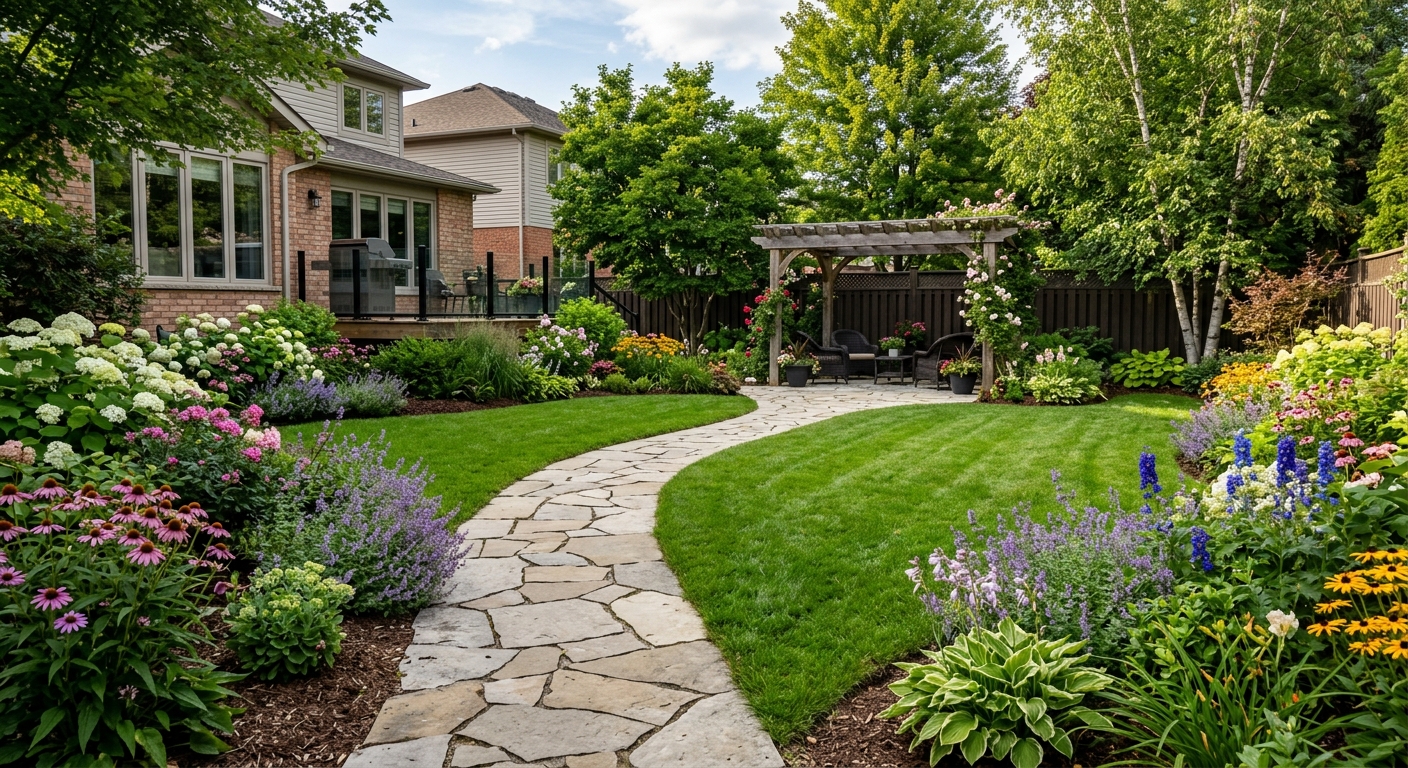
Landscaping options and costs in Newmarket
Newmarket homeowners often have room to improve curb appeal because a majority of local housing stock is single-detached—59.8% of dwellings are detached—plus many households are owner-occupied (75.8% of households own) (Statistics Canada, 2021 Census). That ownership tilt matters: when you live in the home long-term, you’re more likely to invest in durable hardscape and established planting beds rather than quick cosmetic fixes.
In the GTA, landscaping pricing is driven by our freeze–thaw winters and the short, reliable planting window. Work is typically concentrated from late spring through early fall (roughly May to October), so labour scheduling and crew availability in Newmarket can tighten when demand spikes. Soil conditions also play a role: many lots have clay and/or imported fill, so we frequently see the need for excavation, soil amendment, and sometimes sub-drainage to protect both lawns and patios.
Across Toronto-area suburbs, retaining walls and patios tend to cost more than many people expect because the base must be built for stability below frost-impacted layers. That’s also why companies serving south and west Newmarket—think the Yonge Street corridor and areas near Davis Drive—are especially busy with interlocking patios, step/entry redesigns, and walkways for older lots (30.1% of homes were built before 1981) (Statistics Canada, 2021 Census). Next, here’s a practical comparison of common options and typical cost ranges to help you calibrate your expectations.
| Service |
Description |
Season |
Price Range |
| Full landscape design and installation |
Site walk, concept plan, grading/drainage plan, planting layout, and installation of hardscape + softscape |
Spring to fall |
$8,000–$40,000 |
| Sod installation (supply, grade, lay, roll) |
Minor grading, soil prep, sod delivery, laying pattern, rolling, and starter watering plan |
Late spring to early fall |
$2,500–$8,000 |
| Lawn seeding (grade, seed, starter fertilizer) |
Grading/topping where needed, seed selection, starter fertilizer, light raking, and first-cycle watering |
Spring or early fall |
$1,200–$4,500 |
| Interlocking patio or walkway |
Excavation, compacted base, pavers, edging, and jointing sand; includes drainage considerations |
Spring to fall |
$6,000–$30,000 |
| Retaining wall (interlocking block) |
Excavation, geogrid or footing as needed, drainage fabric, weeping tile/rock where appropriate |
Spring to early fall |
$6,000–$25,000 |
| Tree and shrub planting |
Soil amendments, planting holes, staking as required, mulch rings, and follow-up watering guidance |
Spring or fall |
$800–$6,000 |
Prices are estimates only and vary by project scope, site access and material selection.
What affects the price of landscaping in Newmarket
In Newmarket and the wider Toronto area, two bids for the “same” landscaping idea can differ by 30–50% because contractors price risk and complexity differently. A well-documented job with clear measurements and a proper base/drainage plan typically costs less than an ambiguous scope that later turns into extra excavation, additional soil, rework, or change-order labour. When projects compete for crews during the May–October window, overhead and scheduling pressure can also push totals upward—even if material prices stay similar.
Climate and plant hardiness (Zones 6a–7a in the GTA) affect both what survives and when we can install it. Frost can reach into the soil deeper than many homeowners expect, and freeze–thaw cycles are a structural cost driver for patios, steps and retaining walls. By contrast, Prairie regions (Zone 2–4) often face shorter growing seasons and more drought pressure, so designs lean toward drought-tolerant species and simplified palettes; labour schedules can be different because fewer weeks are practical for planting. Coastal BC (Zone 7–8) can support larger, lush plant selections with a longer growing season, but good drainage is still critical in heavy-rain zones. In the dry BC interior and Alberta, water restrictions can require drip irrigation design and low-precipitation approaches.
Concrete examples from Newmarket: (1) If your yard needs regrading to shed water away from the foundation, you’ll pay for extra excavation and topsoil/amendment before any sod goes down—grading can shift a lawn project toward the upper end of the $2,500–$8,000 band. (2) If you add an interlocking walkway with correct base depth, geotextile and proper bedding, the work can move toward the $6,000–$30,000 band because base preparation is where stability is won or lost over the years. (3) Older lots (especially those built before 1981) often have more mature trees and uneven drainage patterns, which can mean higher “prep” time before we plant or place stone.
| Price Factor |
Why It Matters |
Cost Impact |
| Yard size in sq ft — the primary cost driver for softscape |
More area means more sod/seed, more soil amendments, more edging, and longer install time |
Often the biggest swing; can change totals by several thousands |
| Grading and drainage work — slope corrections add significant cost |
Fixing ponding and redirecting runoff requires excavation, reshaping, and compaction |
Commonly adds major labour + material charges |
| Drainage bed or French drain installation |
Protects lawns, foundations and hardscape by collecting and routing water |
Can move a “minor refresh” into a full hardscape/softscape budget |
| Plant material tier — native shrubs vs. ornamental vs. mature specimen trees |
Size, survivability, and transplant shock risk increase with larger, more mature stock |
Upgrades can add hundreds to thousands per specimen |
| Hardscape vs. softscape ratio — walls and patios cost more per sq ft than lawn |
Pavers/block work requires deeper bases and stricter compaction standards |
Raises budget quickly compared with planting-only projects |
| Irrigation system design and installation |
Tailored zones prevent dry spots and reduce water waste in summer dry spells |
Typically a noticeable add-on, especially for larger lawns/bed areas |
| Soil amendment and topsoil required |
Clay-heavy soils often need amendment for rooting; low-quality fill leads to future grading |
Can substantially increase materials and delivery charges |
| Tree removal or stump grinding before new planting |
Disposal, equipment time, and restoration of grades affect both schedule and costs |
Often adds a few hundred to several thousand depending on scope |
Permits & regulations in Ontario
For most homeowners in Newmarket, planting and typical softscape work doesn’t require a permit. That generally includes installing sod, seeding, mulched beds, garden planting, and most routine grading for landscape purposes. However, certain hardscape and drainage changes can trigger approval steps. In Ontario, retaining walls above a height threshold—commonly 1.0 m (3.3 ft) in many municipalities—typically require a building permit and may involve engineering drawings. Also, if your project changes lot grading in a way that affects drainage toward neighbouring properties or alters connections to storm sewers, you may need municipal approvals before work starts.
Before any digging (planting holes, pipe runs, wall footings), you should ensure utility locates are completed. Even a “small” retaining wall footing or trench for a French drain can strike buried services if locates are skipped.
To protect yourself, verify contractor legitimacy step-by-step:
- Confirm the contractor’s Ontario business details and licensing/registration where applicable (using provincial/official business lookup sources, plus their own posted credentials).
- Request a certificate of liability insurance with your address/contractor named; ensure it’s current.
- For labour coverage, ask for proof of WSIB/WCB coverage or clearance letter (and keep it in your project file).
- Check that the contractor provides a written scope (what’s included/excluded), and that any permits (if needed) are clearly stated.
Planning a landscape that thrives in Newmarket's climate
Designing a landscape that thrives in Newmarket starts with working with our Zone 6a–7a conditions, our humid summers, and the reality of frost and freeze–thaw. First, choose plant material that’s reliably hardy locally. Native and zone-appropriate shrubs/perennials establish faster, need less winter protection, and usually need less fuss than borderline imports—especially after our winter lows near –23 to –18°C. Second, decide between sod and seeding based on your timeline and tolerance for maintenance. Sod gives instant curb appeal, but you’re typically paying about 3–4 times more per square foot than seeding when you factor in product and install labour. In practice, seeding is a great “value” option if you can accept slower greening.
Third, get drainage and grading right. In Toronto-area clay and fill-heavy lots, pooling water can stress roots and create foundation-moisture problems. Fourth, for hardscape like patios and retaining walls, base preparation needs to be built for frost impacts: proper depth, compacted granular base, geotextile where needed, and reliable runoff management.
Finally, build low-maintenance structure with mulched beds, groundcovers and perennial blocks—then reduce watering with thoughtful layout. If you want a lower-water yard, consider rain gardens in the low spot and xeriscape-style planting (still using Ontario-hardy species) for beds that don’t receive heavy summer irrigation. One dollar reality: if your goal is 400 sq ft of lawn, sod often lands nearer the upper part of the $2,500–$8,000 band, while seeding may be closer to the lower-cost approach; the extra sod cost is justified when you need immediate coverage for pets, kids or curb appeal before a sale, otherwise seed can be the smarter long-term spend.
| Element |
Climate Consideration |
Maintenance Level |
Price Band |
| Sod lawn installation |
Fast establishment before summer heat; must be scheduled for the best rooting window in Zone 6a–7a |
Medium (watering establishment period + seasonal mowing) |
$2,500–$8,000 |
| Native perennial garden |
Better winter survival and less replanting; suited to GTA humidity and cold snaps |
Low to medium (weeding in year one; mulch refresh) |
$1,200–$6,000 |
| Mulched shrub border |
Mulch buffers temperature swings and protects crown roots during freeze–thaw |
Low (occasional pruning + mulch top-ups) |
$800–$4,500 |
| Interlocking stone patio |
Needs frost-safe base depth and proper drainage slope to prevent heaving and edge settlement |
Low (seasonal cleaning, occasional joint sand top-up) |
$6,000–$30,000 |
| Retaining wall (block) |
Drainage behind the wall is non-negotiable to avoid hydrostatic pressure in spring thaws |
Low (inspection for drainage function; minor re-leveling if required) |
$6,000–$25,000 |
| Drip irrigation system |
Helps manage summer dry spells efficiently while targeting roots; reduces evaporation |
Medium (seasonal checks, winter shutoff/service) |
$1,500–$6,500 |
How to choose a landscaping contractor in Newmarket
Choosing the right contractor in Newmarket is mostly about proof, paper, and details. Start by verifying Ontario business legitimacy and insurance coverage:
- Liability insurance: request a current certificate of insurance naming your contractor (and ensure it covers the type of work being quoted).
- WSIB/WCB coverage: ask for proof of clearance or coverage before work begins; don’t rely on verbal confirmation.
- Work documentation: get itemised estimates and written scope—especially for hardscape base prep and drainage.
Next, get 2–3 itemised written quotes. You want a breakdown that shows labour and materials separately (pavers/block/sod/seed, excavation, topsoil/compost, geotextile, drainage rock, disposal, and any irrigation components). Avoid “lump sum only” pricing unless the scope is extremely detailed and measured.
Read the scope for what’s excluded: Who provides disposal? Is permit pulling included if a retaining wall permit is required? Are property clean-up and base compaction included? Warranty matters too—ask for the workmanship warranty length, what it covers, and whether product warranties are manufacturer-backed and transferable. Finally, payment schedule: never pay more than 10–15% upfront, and insist on a holdback until completion and walkthrough.
Ask for timeline commitments in writing: a start date and a completion estimate tied to weather limitations. A good crew will plan for Newmarket’s frost/temperature swings and explain their approach clearly.
- Bring your address and site plan to the estimate to avoid “assumption pricing.”
- Confirm who handles utility locates before trenching.
- Ask how they build frost-safe bases for patios/walkways/steps.
- Verify drainage slope and where runoff is routed (away from foundations).
- Get exact dimensions for sod/seed, beds, and hardscape surface area.
- Require a plant list with common + Latin names and plant sizes.
- Confirm edging type and finish details (stepped vs. straight, colour/blend).
- Ask whether soil amendment includes compost/topsoil and the intended depth.
- Request a disposal statement (haul-away included or extra?).
- Clarify who owns leftover materials after project completion.
- Ensure warranties are in writing and specify how to claim service.
- Use a payment schedule linked to milestones, not just “progress.”
Red flags in Newmarket: vague scope language (“prepare site” with no measurements), reluctance to provide proof of liability insurance/WSIB/WCB, no written warranty details, demanding large upfront payments beyond 10–15%, and promising “year-round planting” without acknowledging frost and the May–October installation reality.
Frequently asked questions — landscaping in Newmarket
What is the best grass type for a Newmarket lawn?
In Newmarket (Toronto area, Zone 6a–7a), most homeowners do best with a cool-season turfgrass that handles freezing winters and hot, humid summers. A common recommendation is Kentucky bluegrass blends, sometimes combined with fine fescues for shade tolerance and reduced drought stress. If your yard gets heavy shade from mature trees, fescue-rich mixes usually outperform thicker, sun-loving mixes. When you talk to contractors, ask what the blend is specifically (and whether it’s intended for Ontario conditions), and how they plan to manage spring recovery after freeze–thaw. For new lawns, seeding can be the cost-efficient path; sod is faster for immediate coverage, but it typically lands higher in the $2,500–$8,000 range depending on yard size and prep.
When should I aerate and overseed my lawn in Newmarket?
For Newmarket lawns, the timing that generally works best is early spring or early fall—typically around the periods when the soil temperature starts supporting new growth and before summer heat or deep winter sets in. Aeration helps relieve compaction and improves seed-to-soil contact, which matters on clay-heavy lots. If you aerate in spring, follow up with overseeding promptly and keep the surface lightly moist to support germination. In early fall, you can often get stronger establishment because the grass doesn’t have to fight the hottest part of summer. Avoid aerating right before a hard freeze, and don’t overseed into standing water. If you’re doing a full rework, ask your contractor whether grading/drainage corrections are needed first, since aeration alone won’t fix persistent ponding.
What trees grow best in Newmarket's climate zone?
Newmarket’s climate supports many hardy deciduous trees and select conifers, but the “best” choice depends on light and soil drainage. Common strong performers in southern Ontario include sugar maple (where drainage is reliable), serviceberry, and littleleaf linden in appropriate sites. For smaller yards, consider ornamental varieties that mature at a manageable height. If you’re dealing with low, wet areas, avoid forcing trees that hate soggy roots—drainage improvements may be the difference between a thriving tree and repeated replanting. Because Newmarket winters include freeze–thaw cycles, proper planting depth, mulching practice, and water establishment are crucial in the first 1–2 seasons. Tree and shrub planting projects usually fall into the $800–$6,000 band depending on number of plants, size, and whether staking or special soil amendment is required.
How much does sodding a yard cost in Newmarket?
Sodding cost in Newmarket depends primarily on square footage and how much preparation your lawn needs. For typical projects, many homeowners end up within the $2,500–$8,000 range for sod supply and installation when factoring grade checks, soil prep, laying, and rolling. If your yard has drainage issues, compaction, or requires regrading, the prep work can push you toward the upper end because you’re not just laying turf—you’re building a stable rooting base for winter survival. Access matters too: long carries, gate constraints, and tight rear yards increase labour time. If you’re comparing options, seeding is often a lower-cost route, but sod is ideal when you need quick visual results (for sale timing or kids/pets) and you can commit to the establishment watering plan.
How do I prevent weeds in my Newmarket garden?
Weed prevention in Newmarket is mostly about preparation and ongoing surface management. Start with a clean bed: remove established weeds and roots (not just the tops), and loosen compacted soil so your planting can fill in. Use a strong mulch layer—thick enough to block light—then keep mulch topped up after the first season. Landscape fabric alone isn’t a guarantee and can trap moisture or become ineffective once organic matter builds up; better results come from correct bed depth and selecting dense, competitive plants (native groundcovers and well-spaced shrubs). Also, control weeds early: the fastest win is preventing seedlings from taking hold before they go to seed. If your soil is thin or clay-heavy, amendment and healthier plant establishment reduces bare spots where weeds thrive. A “prevention first” approach often costs less than repeated weed-and-spray cycles.
How do I design a low-water yard in Newmarket?
Designing a low-water yard in Newmarket focuses on reducing irrigation demand while still meeting Ontario hardiness needs. Start with zones: keep one area “sun and dry” (near driveways or exposed beds) for drought-tolerant, hardy plants, and keep another for plants that need more moisture. Use mulch generously to cut evaporation, and choose native perennials and shrubs that match your site conditions rather than forcing thirsty species into dry pockets. For watering efficiency, consider drip irrigation targeted to root zones (rather than sprinklers), and install it during landscaping so lines are planned before hardscape and planting go in. If you have a spot that collects water, a rain garden can redirect runoff and reduce stress elsewhere—this also supports healthier soil structure over time. For budgeting, drip systems are often an add-on within the $1,500–$6,500 range depending on yard size and number of zones, but they can extend the life of your beds and reduce summer watering costs.