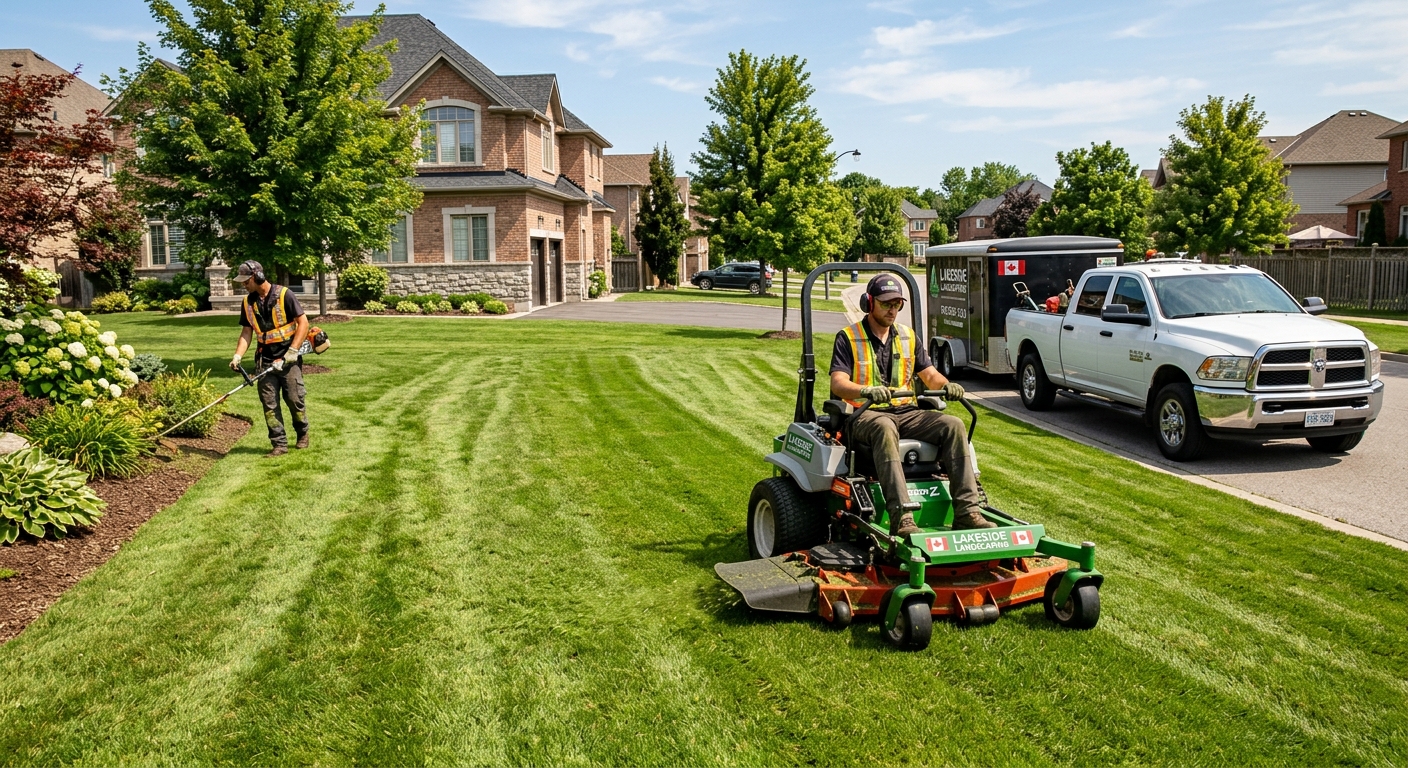
Landscaping options and costs in Airdrie
Airdrie homeowners have plenty of motivation to upgrade their yard—especially because many households in the city are owner-occupied (79.3%) and the housing stock leans heavily toward single-detached homes (65.4% of dwellings). That typically translates into more driveways, more usable yard space, and more opportunities for projects like patios, shrub borders, and yard drainage that protect foundations.
In Airdrie and the wider Calgary market, pricing is shaped by Prairie hardiness zones 3–4, late-spring frosts, early fall cold snaps, and severe freeze–thaw cycles. Those conditions push contractors toward deeper, well-compacted base preparation for walkways and retaining walls, plus cold-hardy, drought-tolerant planting palettes. Labour availability also affects cost: comprehensive installs across Calgary, Airdrie, Cochrane, Okotoks, and Rocky View often compress schedules when weather windows open, so earlier booking helps lock in a competitive rate.
One area where landscaping work is especially in demand is around Windsong and Bayside, where new builds and expanding neighbourhoods create ongoing demand for grading, sod/seed, and low-maintenance planting that can handle wind and chinook weather swings. The result is that quotes can feel “all over the map” until the scope is clearly defined—so below is a straightforward cost comparison you can use to benchmark bids.
Use this table to compare the most common options, then we’ll break down what drives the biggest price differences in the next section.
| Service |
Description |
Season |
Price Range |
| Full landscape design and installation |
Site walk, grading/drainage plan, hardscape/softscape build, planting, and irrigation (as required) |
Late April to October (weather-dependent) |
$12,000–$45,000 |
| Sod installation (supply, grade, lay, roll) |
Soil prep, grade to contour, base compaction, sod delivery/laying, rolling and start-up watering plan |
Mid May to early September |
$2,000–$6,000 |
| Lawn seeding (grade, seed, starter fertilizer) |
Final grading, seed selection, starter fertilizer, light raking/rolling, and establishment watering schedule |
Late April to early June (or fall overseeding) |
$1,500–$4,000 |
| Interlocking patio or walkway |
Excavation, geotextile, compacted base layers, edge restraints, and interlocking stone setting |
May to September |
$8,000–$28,000 |
| Retaining wall (interlocking block) |
Excavation, compacted granular base, block installation, drainage layer, and weep/no-drain options where suitable |
May to September |
$10,000–$38,000 |
| Tree and shrub planting |
Soil amendments, planting holes, staking (as needed), mulching, and watering plan for establishment |
Spring and fall (weather-window dependent) |
$900–$14,000 |
Prices are estimates only and vary by project scope, site access and material selection.
What affects the price of landscaping in Airdrie
Even when homeowners ask for the “same job,” quotes in Airdrie and the Calgary region can differ by 30–50%. The biggest drivers are site conditions and how thoroughly a contractor prices the real work behind the finish—especially grading, base depth, and drainage. In a semi-arid, Prairie climate, small mistakes can show up fast: washboarding after spring melt, heaving after freeze–thaw, or soft spots under pavers. That’s why two crews can price the same patio footprint very differently depending on excavation depth, compaction practices, and disposal requirements.
Hardiness zone 3–4 and frost timing also define both what grows and how long we can work on site in Alberta. Short growing seasons mean plants must be selected for cold hardiness and wind tolerance, while drainage and base prep must be designed for the freeze–thaw cycle. In coastal BC (often zone 7–8), contractors can work longer into the season and use a broader palette, but heavy rainfall makes drainage design and erosion control a central cost. In the dry BC interior, water restrictions typically push drip irrigation and xeriscape, while southern Ontario (zone 5–6) generally has a moderate season where irrigation design focuses more on summer dry spells. In Airdrie, we balance both: efficient irrigation where needed, and soil improvement and drought-tolerant planting where it reduces ongoing demand.
Concrete examples in Airdrie: (1) If your yard needs re-grading to move water away from the house, you can add thousands—often shifting a mid-range install toward the upper end of the $12,000–$45,000 full-project band. (2) A retaining wall built over unstable fill or without a proper drainage layer costs more upfront to get right; it may land near the $10,000–$38,000 range. (3) Homes built before 1981 are relatively uncommon, but older properties can have established drainage patterns or compacted subsoil that require additional excavation and soil replacement, which also affects labour and material quantities. Median household income in Calgary’s economic region was about $110,000 (Statistics Canada, 2021 Census), so many projects are designed to be durable rather than “quick fixes,” especially around foundations and walkways.
| Price Factor |
Why It Matters |
Cost Impact |
| Yard size in sq ft — the primary cost driver for softscape |
More area means more sod/seed, mulch, topsoil, and labour hours |
Can swing total cost by 20–40% depending on footprint |
| Grading and drainage work — slope corrections add significant cost |
Proper slopes and away-from-foundation contouring prevents pooling |
Often adds several thousand dollars on top of materials |
| Drainage bed or French drain installation |
Captures and routes subsurface water during spring melt |
Typical major add-on; can move a mid project to upper band |
| Plant material tier — native shrubs vs. ornamental vs. mature specimen trees |
Mature specimens require bigger root balls, more labour, and staking |
Can change planting budgets by $800–$10,000+ for the same layout |
| Hardscape vs. softscape ratio — walls and patios cost more per sq ft than lawn |
Excavation, base layers, and stone setting raise costs |
Higher hardscape ratio increases project total quickly |
| Irrigation system design and installation |
Zoned coverage and freeze-protected components reduce winter damage |
Adds cost on its own, but can prevent rework and dead plants |
| Soil amendment and topsoil required |
Compacted prairie soils often need reconditioning and proper depth |
Can increase costs notably if removal/replacement is required |
| Tree removal or stump grinding before new planting |
Access, debris handling, and stump work drive extra labour |
Usually a distinct line item that can add $1,000–$5,000+ |
Permits & regulations in Alberta
In Alberta, most landscaping work such as planting, sodding, and typical softscape installs usually do not require a permit. You can generally proceed without municipal paperwork for work like seeding, laying sod, installing mulch beds, and planting trees and shrubs—provided you’re not altering major drainage patterns or building structures that fall under “retaining wall” thresholds.
Where permits do come into play is usually for retaining walls above a certain height threshold (commonly around 1.0 m or 3.3 ft in many municipalities) and for any site work that changes lot grading in a way that can redirect water toward neighbouring properties or storm sewer connections. Utility locates are also critical: call before digging to avoid hitting buried power, gas, telecom, or water service lines—especially for planting holes, drainage trenches, and retaining wall footings.
For an Airdrie homeowner verifying a contractor, the practical steps are straightforward: (1) confirm their business is properly registered and licensed for the scope they’re claiming; (2) request proof of liability insurance and read the certificate for coverage limits and effective dates; (3) verify WSIB/WCB clearance for work activity so you’re not exposed if someone is injured on site; and (4) ask for a copy or photo of their clearance letter before work starts. Finally, confirm irrigation and water-use expectations with the contractor and follow local watering bylaws during drought conditions—this matters for efficient irrigation design even when restrictions aren’t constant year-round.
Planning a landscape that thrives in Airdrie's climate
To build a landscape that thrives in Airdrie, design around zone 3–4 realities: shorter growing windows, wind exposure, and strong freeze–thaw cycles. Start with plant selection—choose cold-hardy, Alberta-suited species (often native or well-adapted cultivars) so you don’t pay twice through winter dieback and spring replacement. Winter protection can be as simple as proper spacing, mulching, and wind-tolerant placement near sheltered zones, but it’s not optional if you’re using marginal plants.
Sod vs. seed is where many budgets either land perfectly or drift off course. Sod gives instant curb appeal, but it costs roughly 3–4x more per sq ft than seeding once you account for supply, installation, and waste. Seeding is slower—requiring consistent establishment moisture—but it’s often the better choice if you’re working within a tighter budget and can accept a “grow-in” period. For drainage and grading, the Calgary/Airdrie expectation is simple: avoid pooling and foundation moisture by building correct slopes and using deep, compacted bases for walkways and retaining wall footings. This is exactly what reduces heaving and failures in freeze–thaw conditions.
For low-maintenance design, blend groundcovers, mulched shrub borders, and perennials that don’t require constant deadheading or frequent watering. If you want to reduce watering further, incorporate xeriscape-style layouts: drought-tolerant grasses, gravel mulch zones, and targeted drip irrigation. In practice, that often complements Alberta’s periodic irrigation limits by focusing water where plants actually need it.
As a dollar example, if a 600 sq ft front lawn area is on the table, seeding might sit near the $1,500–$4,000 band, while sod on a similar footprint commonly approaches the $2,000–$6,000 range due to material and labour. If you need the yard to look “complete” for a sale or family event, sod may be justified—if drainage and base prep are done correctly so you don’t fight lift and uneven settling later.
| Element |
Climate Consideration |
Maintenance Level |
Price Band |
| Sod lawn installation |
Needs warm soil and careful freeze-safe edges; base prep reduces heaving |
Medium (establishment watering for the first weeks) |
$2,000–$6,000 |
| Native perennial garden |
Cold-hardy species handle wind and winter; mulch helps stabilize soil |
Low (seasonal tidy and occasional weeding) |
$3,000–$12,000 |
| Mulched shrub border |
Wind exposure improves with proper spacing; deep soil and drainage prevent stress |
Low to medium (spring shaping and mulch refresh) |
$1,800–$8,000 |
| Interlocking stone patio |
Freeze–thaw requires deep, well-compacted base and restrained edges |
Low (periodic cleaning) |
$8,000–$28,000 |
| Retaining wall (block) |
Needs drainage layer and proper footing depth below frost for stability |
Low (visual inspections after major thaws) |
$10,000–$38,000 |
| Drip irrigation system |
Freeze-protected components and zoned run times reduce winter damage |
Low (seasonal check and controller setup) |
$1,500–$6,500 |
How to choose a landscaping contractor in Airdrie
Choosing the right contractor in Airdrie starts with verifying they can legally and safely perform the work you’re buying. For Alberta coverage, request (1) proof of liability insurance—look for current dates and adequate limits on the certificate; (2) WSIB/WCB coverage—ask for a clearance letter or confirmation document and ensure it’s valid for the timeframe of the project; and (3) confirmation they’re set up to do the specific scope you’re asking for (especially hardscape excavation and retaining wall builds). Don’t rely on verbal assurances—ask for documents before work begins and keep copies for your records.
Next, get 2–3 itemised written quotes rather than a lump sum. You want a breakdown that separates labour and materials (stone, block, sod/seed, topsoil, drain rock, geotextile, irrigation components). Review exclusions carefully: disposal included or not, topsoil depth included or “as needed,” permit fees included or not, and whether excavation is based on a stated depth. For warranties, ask what workmanship warranty length is offered and whether product/manufacturer warranties apply to the installed components (and whether they’re transferable to you as the homeowner).
For payment scheduling, plan to keep it conservative: never pay more than about 10–15% upfront for materials and mobilization, and hold back the final payment until the job is complete and cleaned up. Finally, insist on a written start date and a realistic completion timeline that accounts for weather windows in our Prairie climate.
- Ask for a written scope that lists dimensions and elevations where relevant (especially drainage and base prep).
- Confirm disposal and dump fees—“haul away” should be stated, not implied.
- Require the base build details (geotextile, depth, compaction plan) for patios and walkways.
- For sod, confirm soil prep depth, rolling, and watering guidance for establishment.
- For retaining walls, confirm drainage layer design (weeping gravel/pipe) and how they handle frost-depth footing.
- Check insurance certificate date validity and that your address is covered under the policy period.
- Request WSIB/WCB clearance documentation and verify it’s active.
- Ask what’s excluded for common site surprises (rock, unforeseen drainage issues, tree stumps).
- Ensure irrigation is listed by zone/coverage area and controller model when included.
- Make sure warranty terms are in writing, including duration and what “workmanship” covers.
- Get a payment schedule tied to milestones, with a final holdback until walkthrough sign-off.
- Confirm the crew lead’s availability and who your on-site contact will be during the build.
Red flags to watch for in Airdrie: (1) quotes that avoid talking about drainage and base depth; (2) refusal to provide insurance and WSIB/WCB clearance proof; (3) pressure to pay large deposits upfront; (4) vague warranties (“guaranteed”) without a written term; and (5) incomplete scopes that don’t specify soil/topsoil depth, disposal, or what happens if frost affects staging.
Frequently asked questions — landscaping in Airdrie
Sod vs seed — which is better for a Airdrie lawn?
In Airdrie, sod is best when you need fast visual results, because it gives instant coverage and helps control erosion right away. The trade-off is cost: sod installs commonly land around $2,000–$6,000 depending on yard size, grade prep, and access. Seeding is usually the better value if you can wait for establishment and you’re okay with the lawn filling in over time; seeding projects often sit near $1,500–$4,000. The bigger factor than preference is your site prep: if drainage is poor or the grade dips, either option can fail through freeze–thaw cycles. We usually recommend seeding on areas that can be prepared and watered consistently, and sod on high-visibility areas where you want immediate curb appeal.
How much does a retaining wall cost in Airdrie?
Retaining wall pricing in Airdrie is driven by height, length, base depth, and whether drainage work is required behind the wall. Because freeze–thaw is severe in our Prairie climate, walls need deep, well-compacted bases and proper drainage layers to prevent heaving and water buildup. For interlocking block retaining walls, you’ll commonly see budgets around $10,000–$38,000 in the Calgary-area market. If your site requires significant excavation, additional drain material (or a French drain), or extra disposal, the cost trends toward the upper end. If you’re comparing quotes, make sure each bid includes drainage behind the wall—not just block installation—because that’s where stability is won or lost.
When is the best time to landscape in Airdrie?
For Airdrie, the main window for hardscape and major installs is generally late spring through summer, then into early fall if the weather holds. Patios, walkways, and retaining walls typically go in from May to September, because crews need stable ground for base excavation and compaction. Planting is flexible: spring and early fall are both workable for many trees and shrubs, but you still need to respect cold snaps and soil temps. For lawns, mid-May to early September is usually the best sod period, while seeding is often done in late April to early June (and sometimes in fall for overseeding). The right schedule also depends on how close you are to frost timing and how quickly your soil drains—new builds in neighbourhoods like Windsong or Bayside can have compacted subsoils that require extra preparation before turf or plants go down.
Do I need a permit for a retaining wall in Alberta?
Often, you do not need a permit for typical softscape landscaping in Alberta, such as planting or sodding. Retaining walls are different. In many municipalities, retaining walls above a height threshold—commonly around 1.0 m (3.3 ft)—typically require a building permit, and engineered drawings may be requested depending on the design and site conditions. Also, if you’re changing lot grading in a way that impacts drainage toward neighbouring properties or storm connections, approvals can be triggered. The safest approach for Airdrie homeowners is to ask the contractor to confirm permit requirements before work starts. When requesting quotes, clarify whether permit pull is included, who submits the paperwork, and how long permitting might add to your timeline.
How do I improve drainage in my yard?
In Airdrie, drainage fixes usually work best when you combine grading changes with drainage infrastructure where needed. The goal is to direct surface water away from the foundation and prevent subsurface saturation during spring melt. Common solutions include re-grading the slope, adding a drainage bed (often with geotextile separation), installing a French drain to intercept groundwater, and ensuring downspouts discharge to a safe location. For freeze–thaw durability, drainage work must be built with the right materials and compaction so the system doesn’t shift over winter. If you’re considering a patio or retaining wall, drainage should be planned upfront, because retrofits after hardscape is installed cost more. A contractor should be able to explain how water will move before any stone or block goes in.
What is xeriscaping and does it suit Airdrie?
Xeriscaping is a water-smart approach that uses drought-tolerant plants, efficient irrigation (often drip), and soil/mulch strategies to reduce watering demand while keeping curb appeal. It suits Airdrie well because we’re in Prairie hardiness zones 3–4 with wind exposure and periodic dryness, and freeze–thaw makes soil care and plant hardiness even more important. That said, “xeriscape” doesn’t mean rock-only lawns. A practical Airdrie version often includes native or zone-appropriate shrubs and perennials, mulched borders, gravel or groundcover zones, and targeted irrigation for establishment. If your goal is a low-water landscape, you may still invest in base prep and soil amendment—those costs are usually justified because they reduce failures and replacements. Many full installs land within the broader landscaping range of $12,000–$45,000, depending on how extensive the irrigation and hardscape are.