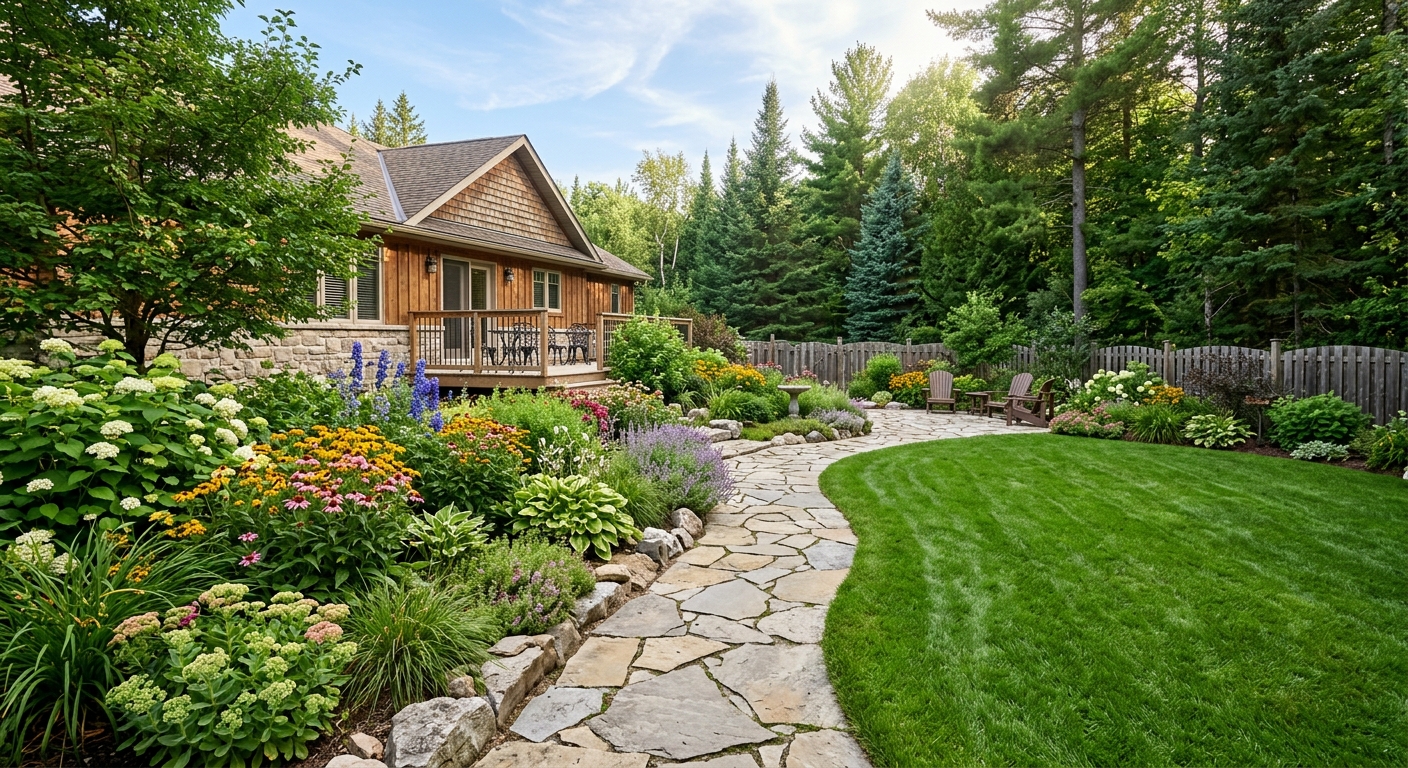
Landscaping options and costs in East Richmond-Fraser Lands
East Richmond-Fraser Lands is a smaller community with a lot of detached homes and yard space—homeowners often have the incentive to invest in a finished landscape because it directly boosts daily comfort and curb appeal. With a population of 4,595 (Statistics Canada, 2021 Census), demand is steady but still tight enough that well-organized crews are booked quickly in peak spring and early summer. In the Lower Mainland–Southwest region, landscaping pricing is shaped by plant hardiness zones 7–8, mild wet winters, and long, cool summers. That “long season” can reduce schedule risk for planting and softscapes, but it also increases labour competition, especially around popular neighbourhood pockets like Steveston.
Because winters in coastal BC rarely keep soil frozen for extended periods, contractors can often start earlier and finish later than in colder provinces. Structural work still needs freeze–thaw planning for patios and retaining walls—bases are dug deeper and drainage is engineered to prevent movement on sloped sites. Meanwhile, even without the strict drought bans common in drier parts of BC, water costs and occasional irrigation limits push many homeowners toward efficient drip irrigation, healthier soil build-up, and fewer thirsty lawns.
Below is a practical cost range for common landscape scopes you’ll see in East Richmond-Fraser Lands, including both “softscape” and “hardscape” projects. Use this as a baseline before you compare itemized quotes.
| Service |
Description |
Season |
Price Range |
| Full landscape design and installation |
Site visit, concept + planting plan, grading/soil prep, irrigation plan (if included), and complete installation of softscape and hardscape where scoped |
Year-round (peak March–June, September–November) |
$10,000–$50,000 |
| Sod installation (supply, grade, lay, roll) |
Remove debris, grade to slope, add topsoil/compaction layers as needed, install sod, roll, and initial watering plan |
Spring through early fall (avoid waterlogged wet weeks) |
$3,500–$7,500 |
| Lawn seeding (grade, seed, starter fertilizer) |
Light grading, seed + starter fertilizer, soil amendment where needed, erosion control on slopes |
Best spring or early fall |
$1,800–$4,800 |
| Interlocking patio or walkway |
Excavation, compacted base, bedding sand, edging, pavers or blocks, and proper drainage detailing |
March–June and September–November |
$10,000–$45,000 |
| Retaining wall (interlocking block) |
Block wall install with base prep, drainage gravel behind wall, filter fabric, and proper geogrid/ties where required |
Dry periods preferred; rain breaks can extend timeline |
$18,000–$75,000 |
| Tree and shrub planting |
Layout, amendments, planting holes, staking (as required), mulch rings, and first-season care plan |
Planting windows spring to fall |
$2,500–$14,000 |
Prices are estimates only and vary by project scope, site access and material selection.
What affects the price of landscaping in East Richmond-Fraser Lands
In East Richmond-Fraser Lands, you can see the same “headline” job come in 30–50% apart because Lower Mainland–Southwest projects are highly sensitive to site complexity, drainage needs, and the level of finish expected. Labour and materials fluctuate across British Columbia, and contractors price differently depending on how much excavation, grading, and installation detail is required to make the work last through wet winters and freeze–thaw periods. In zones 7–8 (coastal BC), many plants tolerate milder conditions, and the long growing season supports lush planting palettes—however, the cost is still governed by how much heavy prep is needed. In colder Prairie zones (2–4), builders often focus on drought-tolerant, wind-hardy species and deeper freeze considerations for structural base work; that can compress schedules and shift costs. Southern Ontario (zone 5–6) also has a moderate season but faces different dry-spell irrigation demands. Water-use policy in the drier BC Interior tends to push more efficient irrigation design there, whereas coastal yards are often more about drainage performance and soil health.
Concrete examples from East Richmond-Fraser Lands: (1) A sloped backyard that needs regrading and improved runoff control will typically add cost to a “simple” refresh because you’re paying for excavation, trucking, compaction and new drainage detailing—often pushing a lawn-only project into the higher end of lawn installation ranges like $3,500–$7,500 for sod when prep is included. (2) If you add a French drain or a proper drainage bed behind a wall, expect a noticeable jump—retaining wall scopes commonly land in the $18,000–$75,000 band when drainage gravel and filter layers are done correctly. (3) Older homes with established trees may require stump grinding and careful root-safe planting, which can raise tree planting budgets by forcing hand digging and more labour.
| Price Factor |
Why It Matters |
Cost Impact |
| Yard size in sq ft — the primary cost driver for softscape |
More area means more labour hours, more material (soil, seed, sod, mulch), and more finishing work |
Can swing costs by 20–60% depending on scale |
| Grading and drainage work — slope corrections add significant cost |
Fixing uneven grades to move water away from foundations requires excavation, re-laying base layers, and compaction |
Often adds $2,000–$10,000+ for typical backyards |
| Drainage bed or French drain installation |
Heavy-rain accumulation zones need engineered drainage to prevent pooling and wall/foundation moisture issues |
Commonly increases hardscape/retaining budgets by thousands |
| Plant material tier — native shrubs vs. ornamental vs. mature specimen trees |
Size at purchase changes install time, soil volume, and sometimes equipment needs |
Mature specimens can double planting material line items |
| Hardscape vs. softscape ratio — walls and patios cost more per sq ft than lawn |
Pavers/blocks require deeper excavations, proper base build-up, and edging |
Shifts overall project cost quickly into hardscape-heavy pricing |
| Irrigation system design and installation |
Drip lines, valves, backflow testing requirements (where applicable), and controller setup add parts and labour |
Can add meaningful cost, but reduces long-term watering |
| Soil amendment and topsoil required |
Soil structure affects rooting and weed pressure; poor native soil needs bulk import and amendments |
Often adds $500–$5,000+ depending on base condition |
| Tree removal or stump grinding before new planting |
Hauling, disposal, stump grinding, and root management increase labour and access complexity |
Can add $800–$4,000+ per tree depending on size |
Permits & regulations in British Columbia
In British Columbia, most landscaping and planting work typically does not require a permit—this includes sodding, planting beds, and most softscape installations such as mulch, groundcovers, and garden edging. That said, retaining walls can trigger permits depending on height and how they’re classified by the municipality. In many BC municipalities, retaining walls above a threshold (commonly around 1.0 m) typically require a building permit and sometimes engineered details. Changes to lot grading are also a common trigger: if grading affects drainage toward neighbouring properties or storm sewer connections, you may need approval.
Before any digging for planting holes, footing trenches, or drainage lines, ensure utility locates are called. This is critical in East Richmond-Fraser Lands because unforeseen underground services can delay a project and create cost spikes. Also confirm water-use and irrigation bylaw rules, especially during dry spells—coastal BC generally has fewer strict rationing measures than the BC Interior, but restrictions and efficiency expectations can still apply.
To verify a contractor’s readiness in BC, do these steps: (1) Check their business/contractor registration and any required provincial/municipal standing via official online listings. (2) Request a certificate of liability insurance and confirm the coverage limits match the job size. (3) Ask for proof of workers’ compensation coverage (WCB/clearance). (4) Confirm the scope includes utility locate responsibility and who pays for any uncovered service conflicts—your contract should state it clearly.
Planning a landscape that thrives in East Richmond-Fraser Lands's climate
To plan landscaping that thrives in East Richmond-Fraser Lands, start by designing with the region’s zone 7–8 conditions and its wet winters in mind—not against them. Choose plants that match the climate’s mild winter temperatures and cool summers so you can reduce winter protection and avoid “over-engineering” watering. Native and zone-appropriate species also tend to handle local rainfall patterns better, lowering stress during shoulder-season wet weeks. For lawns, consider sod versus seed based on how fast you need results and how complex your grading is. Sod gives instant curb appeal, but it costs roughly 3–4x more per sq ft than seeding when you factor in material and preparation.
Drainage and grading are the make-or-break items here. In the Lower Mainland–Southwest, pooling can lead to foundation moisture concerns and root issues even when plants are winter-hardy. That’s why topsoil placement, slope direction, and compacted base preparation matter as much as the plant palette. For hardscape like patios and retaining walls, base preparation should account for freeze–thaw cycles: bases must be excavated deeper where needed, and drainage layers must be installed correctly to prevent frost heave and wall movement on sloped lots.
Low-maintenance strategies work well in this market: mulched shrub borders, dense groundcovers, layered perennials, and smart irrigation (often drip) reduce annual upkeep without sacrificing a lush look. If you want a water-smart approach without a sterile yard, consider a rain-garden pocket or well-draining garden swales that capture roof runoff and seasonal storm water.
Dollar example: if your yard is about 500 sq ft and you’re deciding between sod and seed, sod might land in the $3,500–$7,500 band including prep, while seeding could be closer to $1,800–$4,800 depending on soil conditioning. If you need a finished front lawn quickly for a listing or event, sod can be justified; if you can wait a season for full density, seeding plus proper soil amendment often delivers better value.
| Element |
Climate Consideration |
Maintenance Level |
Price Band |
| Sod lawn installation |
Root establishment in cool, wet periods; avoid waterlogged weeks and keep drainage consistent |
Medium (watering discipline first 4–8 weeks, then routine mowing) |
$3,500–$7,500 |
| Native perennial garden |
Zone-appropriate species thrive with seasonal rainfall; thick planting improves soil structure |
Low to medium (spring cleanup and occasional weed touch-ups) |
$2,500–$10,000 |
| Mulched shrub border |
Mulch helps manage moisture swings and reduces weed germination in rainy shoulder seasons |
Low (mulch refresh 1–2x/year, pruning as needed) |
$1,500–$8,000 |
| Interlocking stone patio |
Base and drainage layers are critical to handle freeze–thaw movement and avoid settling |
Low (occasional joint sand top-up, pressure wash as required) |
$10,000–$45,000 |
| Retaining wall (block) |
Drainage behind the wall prevents hydrostatic pressure during heavy rainfall |
Low (visual inspection and keeping weep channels clear) |
$18,000–$75,000 |
| Drip irrigation system |
Efficient watering supports lush planting without waste during occasional restrictions |
Low (seasonal checks, filter maintenance, controller updates) |
$1,200–$6,500 |
How to choose a landscaping contractor in East Richmond-Fraser Lands
Choosing the right contractor in East Richmond-Fraser Lands starts with proof, not promises. Ask for their British Columbia licence/registration details (where applicable) and confirm they carry liability insurance—request a certificate of insurance and verify the job is covered under the stated policy limits. For labour coverage, request evidence of WCB/coverage status (commonly shown as a clearance letter). If the contractor can’t provide these documents promptly, treat it as a red flag.
Next, get 2–3 itemised written quotes. You want line items that separate labour and materials, including excavation, base prep, drainage components, plant supply (with sizes), soil amendments, delivery, and any disposal/hauling. A lump-sum quote with vague wording (“site prep included”) often hides exclusions like footing depth, drainage gravel, or how they handle wet weeks. Confirm whether permits are included if a retaining wall requires approval, and whether utility locates are handled by the contractor or by you.
Warranty matters in this coastal climate where workmanship determines drainage performance. Ask for the workmanship warranty length, whether any product/manufacturer warranties apply (for pavers, sod, irrigation components), and if warranties are transferable to future owners. For payment, never pay more than 10–15% upfront; hold back a portion until completion and final grading/cleanup are confirmed. Finally, get a written timeline with a start date and an estimated completion window that accounts for rain interruptions—don’t rely on verbal scheduling.
- Ask for insurance certificate + confirm liability limit matches the job scope.
- Request WCB/clearance proof and confirm workers are covered for the whole project window.
- Ensure the quote itemizes excavation, base layers, drainage work, and disposal.
- Confirm plant sizes and counts (e.g., “#3 container” or specified height), not just plant names.
- Ask how the contractor handles saturated soil weeks common in coastal winters.
- Verify who calls for utility locates and when they’ll do it before digging.
- Review grading drawings: slope away from the house and any drainage routes.
- Confirm irrigation scope (drip vs sprinkler, controller type, and zone layout).
- Ask about weed control approach: pre-emergent vs landscape fabric vs sheet mulching strategy.
- Get the paver/block system details: base thickness, compaction method, edge restraint.
- Set a payment schedule tied to milestones, with a clear holdback percentage.
- Require a written start date, completion estimate, and weather contingency statement.
Red flags in East Richmond-Fraser Lands: contractors who won’t show insurance/WCB documents; quotes that omit drainage details behind walls or base prep for patios; unclear plant sizing (only “varieties,” no counts or pot sizes); “all-inclusive” language that doesn’t specify disposal and saturated-soil handling; and requests for large upfront payments (beyond 10–15%) without a signed schedule.
Frequently asked questions — landscaping in East Richmond-Fraser Lands
What trees grow best in East Richmond-Fraser Lands's climate zone?
In East Richmond-Fraser Lands and the Lower Mainland–Southwest (coastal BC, hardiness zone 7–8), many homeowners do well with broadleaf and evergreen options that handle mild winters and cool, wet shoulder seasons. Common choices include columnar or upright evergreens for screening, as well as deciduous trees like Japanese maple varieties (where mature size suits the yard). Because your site is only one block away from a different sun/shade pattern, it’s worth matching trees to conditions—wet or clay-prone areas benefit from trees that tolerate periodic saturation. Also, plan for fall leaf and spring fruit/pollen expectations if you’re close to property lines. Your contractor should propose varieties that fit your drainage reality, not just the label hardiness rating (Statistics Canada, 2021 Census).
How much does sodding a yard cost in East Richmond-Fraser Lands?
Sodding in East Richmond-Fraser Lands usually lands in the $3,500–$7,500 range for many typical residential scopes, depending on how much grading/topsoil and prep is required. If your yard needs significant drainage correction or deep soil import to create a smooth slope away from the home, that pushes costs toward the top of the band. Sod is priced higher than seeding because you’re buying finished turf and paying for labour to lift, place, and roll it to eliminate air pockets. A good quote should specify how they grade, what soil/compaction layers they use, and whether initial watering guidance is included for the first several weeks.
How do I prevent weeds in my East Richmond-Fraser Lands garden?
Weed prevention works best when you layer the approach: site prep, proper soil depth, and a barrier strategy matched to how the area will be used. In East Richmond-Fraser Lands, wet shoulder seasons can encourage germination, so start with removing established weeds and roots, then add a weed-suppressing mulch depth (typically a few inches) for shrub and perennial beds. Many homeowners also use a landscape fabric or cardboard/sheet-mulch method under mulch to reduce recurring seeds—but it must be installed correctly so plants can establish. Avoid thin mulch layers and don’t bury woody debris in a way that leaves voids. If your contractor offers pre-emergent herbicide options, ask what they use, where it’s applied, and how it affects new plantings.
How do I design a low-water yard in East Richmond-Fraser Lands?
Even in coastal BC, low-water yards are increasingly popular because water costs rise and restrictions can tighten during dry spells. For East Richmond-Fraser Lands, focus on soil health first: good compost and proper grading reduce stress and improve water retention where you want it. Then swap thirsty lawn areas with zone-appropriate shrubs, native perennials, and groundcovers that close canopy over time. Use mulch to slow evaporation and consider a drip irrigation system with a smart controller so watering matches plant needs. If you have seasonal runoff, a rain-garden style pocket can capture storm water and reduce reliance on irrigation. The goal isn’t a barren xeriscape; it’s a lush, layered yard that wastes less water.
How do I find a licensed landscaper in East Richmond-Fraser Lands?
To find a suitable landscaper in East Richmond-Fraser Lands, verify documents before you sign. Ask for proof of liability insurance (certificate of insurance) and confirm WCB/coverage via a clearance letter. Request their BC business/registration details if applicable and ensure they’re willing to put everything in writing: scope, timelines, warranty, and any permits needed. For retaining walls that cross the local threshold (often around 1.0 m), permits may be required, so make sure they’re familiar with that process. When you review quotes, choose the contractor who provides an itemised breakdown (labour vs materials), lists plant sizes/counts, and explains how they handle drainage and saturated conditions during rainy periods.
How much does landscaping cost in East Richmond-Fraser Lands?
Landscaping costs in East Richmond-Fraser Lands vary widely based on how much prep, drainage, and hardscape you include. Many homeowners spend in the $10,000–$50,000 range for full design and installation when grading, planting, and at least one hardscape component are included. If you’re focused on lawn improvements only, sod projects often come in around $3,500–$7,500, while seeding is typically less. Retaining walls and patios are frequently the biggest drivers because they require deep base preparation for freeze–thaw performance and proper drainage detailing. A clear, itemised quote is the fastest way to understand where your project sits within these ranges.