Landscaping options and costs in Amherstburg
In Amherstburg, landscaping choices often start with what homeowners can see from the street—especially in a community where many properties have the space to invest. Amherstburg includes 83.0% single-detached houses, and with homeowner households making up 85.4% of all households (Statistics Canada, 2021 Census), it’s common to see upgrades that go beyond “curb appeal” into drainage corrections, garden beds, and longer-lasting hardscapes. Market demand is particularly strong around the riverfront and older residential corridors, where lots can be mature and tight-access, and where owners want improvements that look established rather than “patched.”
Windsor–Sarnia’s zone 6b–7b climate helps keep installation costs more predictable than in colder regions: the practical working window is roughly May–October, with spring frosts typically landing late April to early May and fall frost around late October. That longer season supports more trades available for builds, but freeze–thaw cycles still affect retaining walls, patios, and bases. In Amherstburg, many yards sit over heavier clay, so contractors often allocate budget to proper grading, sub-base, and drainage—work that can raise costs, but also prevents heaving and ponding later.
Below is a practical price range guide to help you compare scope with confidence, before you narrow down materials and site-specific details.
| Service |
Description |
Season |
Price Range |
| Full landscape design and installation |
On-site consult, grading concept, plant/hardscape plan, soil prep, installation of beds/trees plus selected hardscape and lawn work |
Spring to fall (most common May–October) |
$8,000–$35,000 |
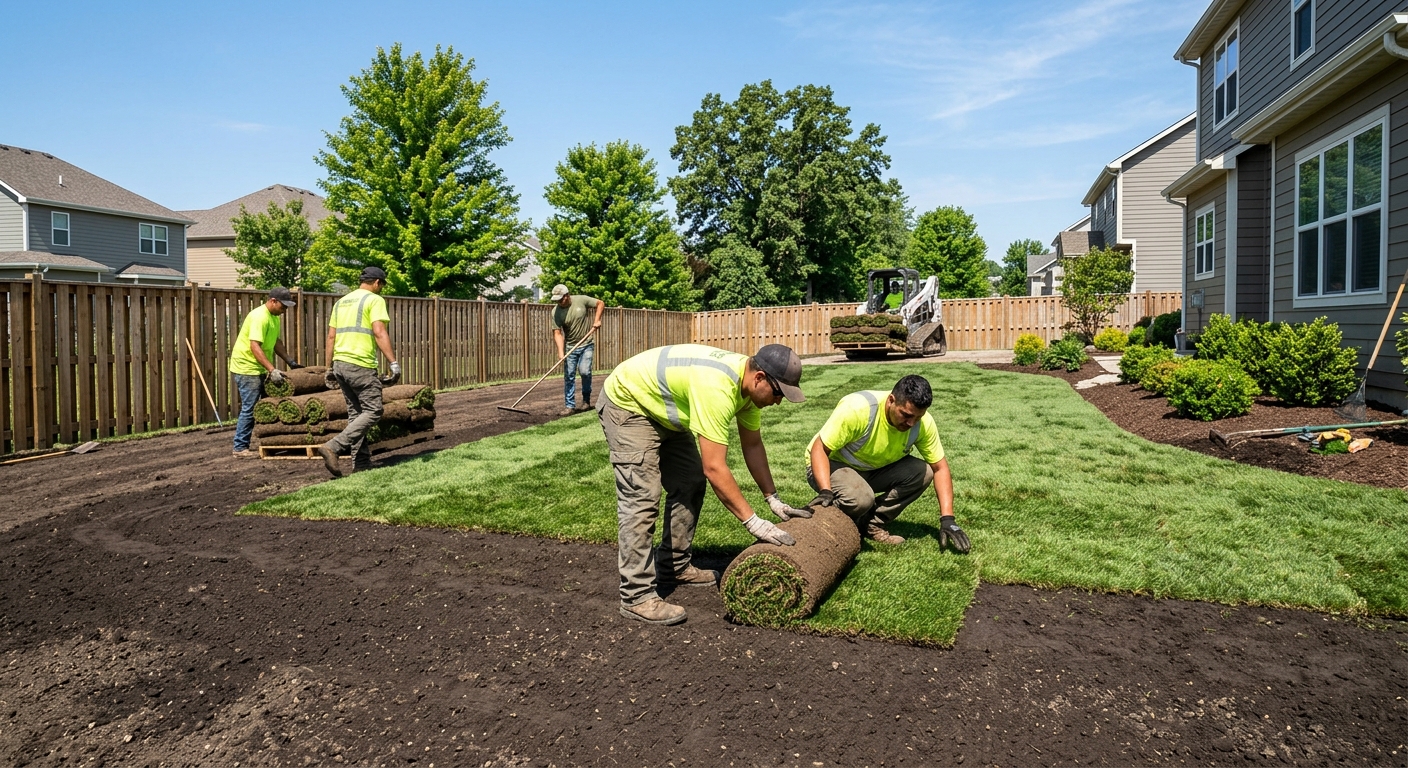
| Sod installation (supply, grade, lay, roll) |
Fine grading as required, soil conditioning, sod supply, layout, rolling, and initial watering guidance |
Late spring to early fall |
$2,500–$9,000 |
| Lawn seeding (grade, seed, starter fertilizer) |
Light topdressing/grade touch-ups, seed selection, starter fertilizer, raking and rolling |
Spring or early fall (frost-safe timing) |
$1,600–$6,000 |
| Interlocking patio or walkway |
Excavation, geotextile, engineered base/sub-base, paver installation, edge restraints, and compaction |
Spring to fall (weather-dependent) |
$6,500–$22,000 |
| Retaining wall (interlocking block) |
Excavation, compacted base, drainage/gravel backfill, filter fabric, block installation, cap/finish |
Spring to fall |
$6,000–$40,000 |
| Tree and shrub planting |
Soil amendment, spacing, staking/anchoring when needed, mulching, and basic aftercare instructions |
Spring or fall (best survivability windows) |
$1,500–$10,000 |
Prices are estimates only and vary by project scope, site access and material selection.
What affects the price of landscaping in Amherstburg
In Amherstburg and across the Windsor–Sarnia region, quotes for the “same” landscaping project can vary by 30–50% because the real cost is in the hidden scope: grading tolerances, drainage strategy, how much soil is being moved or hauled away, and whether the contractor is building to handle freeze–thaw and clay soils. Even when the visible elements look similar—say, a 20 m walkway and a few shrub beds—the base preparation and plant size selection can shift labour hours and material quantities substantially. That’s why a homeowner might see one proposal in the $8,000–$35,000 range for design-and-install work while another sits higher after drainage, utility coordination, and a larger plant palette are included.
Climate and season matter too. Zone 6b–7b tells us what survives, but frost dates determine when excavation, sub-base work, and planting can happen reliably. Southern Ontario also offers a moderate season with irrigation needs during summer dry spells, so lawn establishment, sod timing, and early watering plans affect both labour effort and product selection. Compare that to Prairie regions (Zone 2–4), where shorter seasons and harsher winter conditions drive designs toward more drought- and cold-tolerant choices, often at the expense of lushness. Coastal BC (Zone 7–8) supports a longer growing season for layered planting, but heavy-rain drainage requirements can raise the complexity of any grading and base work. In Amherstburg, the most common cost multipliers are not the plants alone—they’re the soil and water movement.
Two concrete examples from local jobs: first, a yard needing slope correction and removal of compacted clay often adds more labour and topsoil haul than homeowners expect—easily pushing a walkway project upward within the $6,000–$40,000 retaining-wall/hardscape band if a wall is required for soil retention. Second, switching from small nursery shrubs to taller, more mature plantings (or adding 2–3 specimen trees) can add thousands, though it may still stay within the $1,500–$10,000 planting band because the contractor adjusts spacing, staking, and post-plant care. Home construction age matters as well: with 50.5% of homes built before 1981 (Statistics Canada, 2021 Census), older lots frequently have older drainage patterns or compacted fill, which can increase grading and drainage costs.
| Price Factor |
Why It Matters |
Cost Impact |
| Yard size in sq ft — the primary cost driver for softscape |
More turf and planting area means higher material quantities, labour hours, and vehicle trips for soil amendments |
Often the biggest swing; a modest increase in area can change the total by several thousand dollars |
| Grading and drainage work — slope corrections add significant cost |
Clay soils and freeze–thaw require correct slopes away from foundations and toward approved drainage points |
Can add $2,000–$10,000+ depending on how much excavation/repair is needed |
| Drainage bed or French drain installation |
Drain lines, gravel bedding, perforated pipe, and discharge routes affect excavation depth and restoration complexity |
Frequently raises projects into higher hardscaping bands when coupled with patios or walls |
| Plant material tier — native shrubs vs. ornamental vs. mature specimen trees |
Larger caliper trees and premium ornamentals cost more and need more labour (hoisting, staking, wider backfill) |
Can shift a planting scope toward the upper end of the $1,500–$10,000 band |
| Hardscape vs. softscape ratio — walls and patios cost more per sq ft than lawn |
Pavers, base aggregates, restraints, and compaction are labour- and material-intensive |
Commonly moves budgets upward toward the $6,000–$40,000 range |
| Irrigation system design and installation |
Valve placement, zone design, backflow prevention, and trench depth add cost—especially on larger lawns |
Often a major difference between basic watering plans and automated systems |
| Soil amendment and topsoil required |
Testing and importing quality topsoil (and compost/stone) improves rooting and reduces future settlement |
Can add thousands on clay-heavy or compacted yards |
| Tree removal or stump grinding before new planting |
Removal involves disposal, equipment, and stump grinding/restoration for new beds |
Can be a “hidden” cost that pushes a job into a higher quote |
Permits & regulations in Ontario
For most landscaping in Ontario, you typically do not need a permit to plant trees and shrubs, add mulch, lay sod, seed a lawn, or build standard garden beds. That said, permitting can apply when the work affects structural elements, lot drainage, or involves changes that require oversight. In particular, retaining walls above a height threshold (commonly 1.0 m in many municipalities) usually require a building permit, and sometimes engineered drawings depending on height, soil conditions, and the design.
Also consider permitting/approval when there are changes to lot grading that alter how water drains toward a neighbouring property or storm connections. Amherstburg homeowners should treat drainage work as “approval-sensitive,” especially if the project involves lowering/raising elevations, installing weeping tile tie-ins, or directing runoff in a new way. Before digging for any planting holes, French drains, irrigation trenches, or wall footings, contractors should complete utility locates so you avoid hitting buried services.
To verify an Ontario contractor is properly covered, you can follow a simple step-by-step:
- Check the contractor’s Ontario business registration/licensing and any trade-specific credentials they claim (ask for their reference number).
- Request an updated certificate of insurance (liability) listing your address as an additional insured where applicable.
- Confirm WSIB/WCB coverage: ask for proof of clearance or coverage documentation.
- Ask whether they carry landscape installation liability for hardscape/retaining-wall work.
- Keep copies of everything with your quote so scope disputes are easier to resolve.
Planning a landscape that thrives in Amherstburg's climate
Planning a landscape for Amherstburg means working with the reality of zone 6b–7b winters, freeze–thaw cycles, and summer dry spells—not against them. Start with plant selection: choose zone-appropriate perennials, shrubs, and trees that don’t require constant winter protection. Native and locally suited species tend to establish faster in Windsor–Sarnia soils and can reduce watering and replacement rates over time. For lawns, the choice between sod and seed is both budget and timing: sod gives instant green and quicker erosion control, but it typically costs about 3–4 times per square foot compared with seeding. If your priority is “ready for summer photos,” sod is often worth it—otherwise seeding can be the smarter long-term path.
Drainage and grading are critical in Amherstburg because clay soils can hold water and then heave with freeze–thaw. That’s why we design slopes away from foundations and ensure downspouts and runoff paths have a clear outlet. For hardscape and retaining walls, base preparation matters: excavation depth, geotextile, compacted sub-base, and drainage backfill must reach frost-behaviour considerations so the patio and wall don’t shift over the years.
For low maintenance, layer your design: mulch ring zones, groundcovers, and perennials that repeat seasonally. Add rain-garden pockets or a small xeriscape-inspired border (where appropriate) to capture roof runoff and reduce irrigation demand. A $2,500–$9,000 sod installation can make sense when you’re restoring a small high-visibility area, but if your lawn area is large and drainage is unresolved, you’ll often get better value by first fixing grading and adding soil amendment—then seeding.
| Element |
Climate Consideration |
Maintenance Level |
Price Band |
| Sod lawn installation |
Planting through late spring/early summer helps roots establish before fall frost; protect from dry spells during the first month |
Low short-term, medium early (watering/establishment period) |
$2,500–$9,000 |
| Native perennial garden |
Zone-appropriate plants handle winter lows and return reliably with less watering after establishment |
Low to medium (spring clean-up, occasional weeding) |
$2,000–$8,500 |
| Mulched shrub border |
Mulch moderates soil temperature and moisture through freeze–thaw cycles; choose shrubs suited for zone 6 conditions |
Low (mulch top-ups and occasional pruning) |
$1,500–$7,500 |
| Interlocking stone patio |
Proper base and drainage reduce movement during freeze–thaw; select edges that resist shifting |
Low (seasonal cleaning) |
$6,500–$22,000 |
| Retaining wall (block) |
Clay soils require engineered base compaction and back drainage; frost-related movement must be managed |
Low (inspection and minor touch-ups) |
$6,000–$40,000 |
| Drip irrigation system |
Targets water to roots during warm spells; helps reduce waste compared with broad spray in summer |
Low (seasonal check/adjust) |
$2,000–$9,000 |
How to choose a landscaping contractor in Amherstburg
Choosing the right landscaping contractor in Amherstburg comes down to proof and clarity. First, verify Ontario coverage. Ask for their liability insurance certificate (request the COI at the address level if possible), then confirm WSIB/WCB coverage with documentation or a clearance letter/proof. For licensing, don’t rely on a verbal “we’re licensed”—ask what specific Ontario registrations apply to the work they’re bidding and check any online registries tied to their business details. If they’re building hardscape or retaining walls, ask whether their team is set up for safe excavation, base preparation, and competent drainage detailing in clay soils.
Next, get 2–3 itemised written quotes. The best quotes break down labour and materials separately—for example, excavation, geotextile, base aggregate, paver units, edge restraints, topsoil, compost, and plant quantities/sizes. Carefully read what’s excluded: disposal/hauling, permit fees, excavation depth assumptions, replacing broken sprinkler heads, temporary fencing, or tree protection. Also ask whether the quote includes utility locates and whether topsoil is screened/quality-approved.
Warranty matters: request the length of workmanship warranty, how product warranties apply to plants (and whether replacements are included), and whether warranties are transferable if you sell your home. For payments, avoid large deposits—never pay more than about 10–15% upfront, and hold back until key milestones and final clean-up are complete. Finally, demand a start date and a completion estimate in writing so weather and scheduling risks are transparent.
- Request a certificate of insurance and confirm it’s current.
- Verify WSIB/WCB coverage with clearance proof.
- Ensure the quote is itemised (labour + materials, not one lump sum).
- Confirm if utility locates are included and who requests them.
- Ask what disposal/hauling is included for excess soil, roots, or old turf.
- Review grading notes: where does water go, and how is runoff managed?
- Check drainage details: French drain specs, outlet locations, and backfill.
- For hardscape, confirm base thickness assumptions and geotextile use.
- Verify plant list includes sizes, counts, and species/varieties.
- Ask about irrigation—basic hose timers vs. drip zones—and what’s excluded.
- Confirm warranty terms for both materials and workmanship.
- Set a clear payment schedule with a holdback until completion.
In Amherstburg, common red flags include: refusing to provide WSIB/WCB proof; quotes that don’t list plant quantities/sizes; unclear grading/drainage plans (no mention of slopes or runoff direction); asking for large upfront payments beyond 10–15%; and vague wording that omits disposal, utility locates, or base thickness details for patios and walls.
Frequently asked questions — landscaping in Amherstburg
How do I improve drainage in my yard?
In Amherstburg, drainage issues usually come from clay-heavy soils and freeze–thaw cycles that hold water and then shift ground. Start by identifying where water pools during a heavy rain—near foundations, low corners, or along fence lines. A good contractor will assess grades and propose a fix such as correcting the slope (often small changes make a big difference), adding a drainage bed or French drain, and ensuring downspouts discharge to a controlled outlet rather than the low spot. Because many homes were built earlier (50.5% pre-1981, Statistics Canada, 2021 Census), older lot grading can also cause recurring problems.
Costs vary widely based on excavation and outlet complexity, so compare quotes that specify excavation depth, pipe type, gravel sizing, filter fabric, and restoration. For many yards, drainage work is the first step before sod or seeding. If your drainage plan is solid, lawn and bed installation budgets like sod at $2,500–$9,000 tend to last longer.
What is xeriscaping and does it suit Amherstburg?
Xeriscaping is a design approach that reduces irrigation demand through plant selection, soil improvements, and smart placement (often paired with mulch, groundcovers, and efficient irrigation like drip). In Amherstburg’s zone 6b–7b climate, xeriscaping can suit parts of your yard—especially sunny borders, slopes, and areas that dry quickly after rain—but it’s not “no-water ever.” Southern Ontario still has summer dry spells, and newly planted areas typically need establishment watering. A practical Amherstburg plan often blends native shrubs and perennials with drought-tolerant choices, using mulch to reduce evaporation and rain gardens to capture roof runoff.
If you’re comparing proposals, ask how much of the design is truly low-water. Also confirm irrigation scope: a basic watering plan is different from a drip system. If your goal is reduced yearly upkeep, drip can support xeriscape designs, while a traditional lawn-only approach generally needs more consistent water, especially during warm, dry weeks.
How do I plan a low-maintenance yard?
A low-maintenance yard in Amherstburg usually comes from three decisions: (1) pick plants that thrive locally and don’t require constant winter protection, (2) improve soil so plants establish quickly, and (3) reduce bare soil so weeds don’t fill the gaps. Build with layers: mulch shrub borders, groundcovers between perennials, and repeated species for a cohesive look. Mulch helps buffer freeze–thaw and moisture swings, which is important in clay soils. You can also use “functional” elements—like a rain-garden pocket or swales—to manage runoff with less manual effort.
For lawn, sod can be low maintenance after establishment, but it costs more upfront. Seeding can be a better budget choice when drainage is corrected first. When comparing quotes, watch for scope differences. A full landscape design-and-install project might land in the $8,000–$35,000 range, but the maintenance payoff often depends more on plant selection and drainage/grading detail than on the hardscape alone.
How deep should a retaining-wall base be for local frost?
For retaining walls in Amherstburg, the “correct” base depth isn’t a single number—it depends on wall height, soil type, engineering requirements, and drainage behind the wall. However, it’s crucial that the base is built to account for frost behaviour and the need for proper compaction, plus drainage to prevent water pressure buildup. Freeze–thaw can move poorly built structures, especially in heavier clay soils.
Practically, reputable contractors design retaining walls with an excavated and compacted granular base, geotextile where appropriate, and a gravel backfill/drainage layer to relieve hydrostatic pressure. For taller walls (often above about 1.0 m in many municipalities), permits and sometimes engineering drawings are required, and base design should follow those plans. If you’re shopping quotes, ask for the base and backfill details—geotextile use, drainage material, compaction method, and how they manage water behind the wall.
How much does professional landscape design cost?
Professional landscape design in Amherstburg is commonly bundled with installation when homeowners want a single coordinated team, but it can also be quoted as a stand-alone design service. For a full design-and-install project, budgeting is often in the $8,000–$35,000 band depending on yard size, complexity (grading, drainage, hardscape), and the number of plantings. If your property needs drainage corrections or a retaining wall, that can shift the scope upward because engineered bases and proper back drainage are labour- and material-intensive.
To compare fairly, ask whether the design cost includes an on-site visit, drawings, a plant list with quantities, and a final layout plan. Also confirm whether the quote assumes irrigation, topsoil import, and disposal. A project that only “includes ideas” but not a build-ready plan will almost always cost more later when changes happen mid-install.
If you want a quick benchmark, planting-only scopes often start around $1,500–$10,000, while design-and-install will generally be higher due to grading, detailing, and coordination.
How do I compare landscaping quotes?
To compare landscaping quotes in Amherstburg, don’t focus only on the total price—match the scope. Start by checking that each quote lists: (1) what’s included (excavation, base prep, geotextile, drainage work, disposal), (2) what’s excluded (permits, utility locates, haul-away, irrigation), and (3) product specifics (plant species/varieties and sizes, sod/seed type, paver thickness/base build-up). Quotes that only describe outcomes but don’t describe construction methods are hard to compare and often lead to change orders.
Next, look for price alignment with the right bands: sod installation commonly falls in the $2,500–$9,000 range, while retaining walls/hardscaping can run $6,000–$40,000 depending on height and drainage. Confirm the schedule in writing and ask about warranty terms for workmanship and plants. If one contractor is missing drainage details or provides vague hardscape base notes, treat it as a red flag—even if the number is lower.