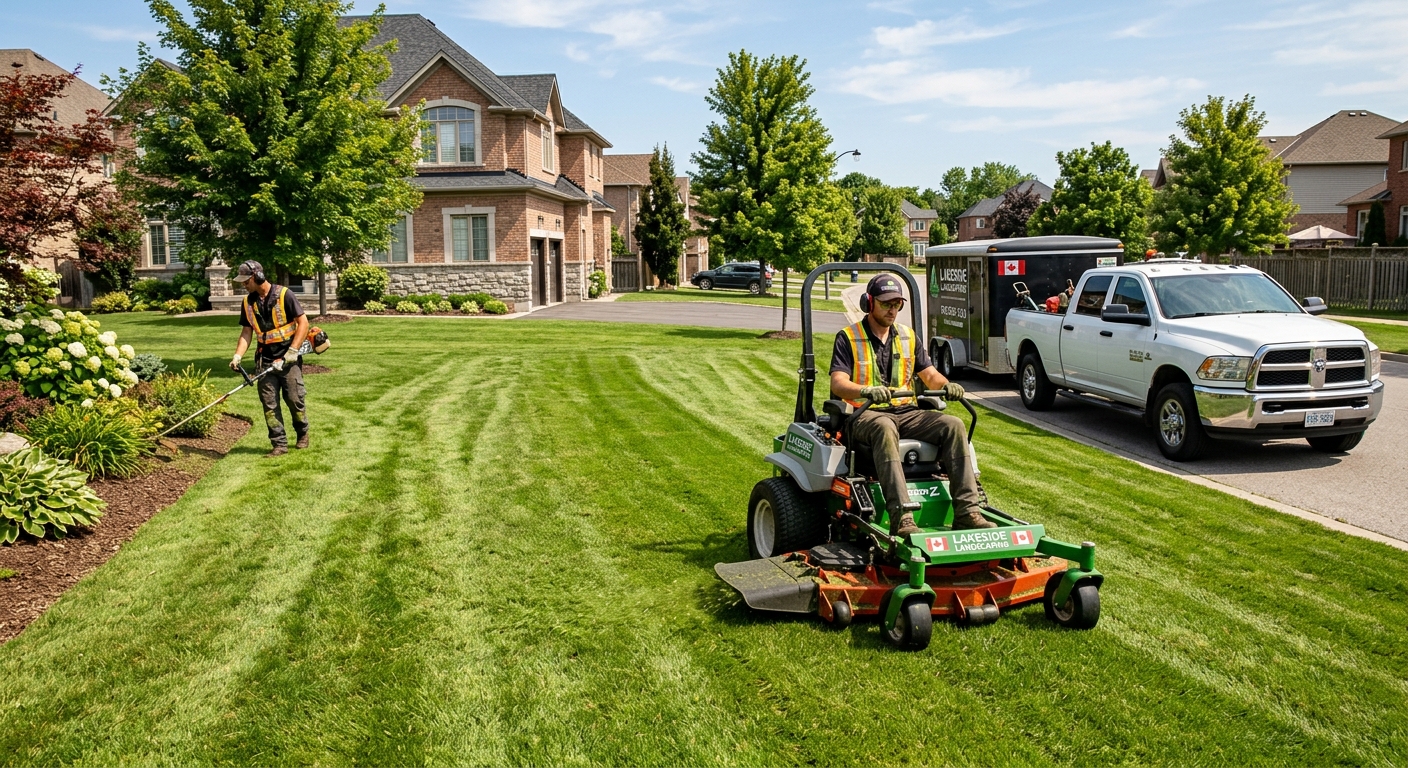
Landscaping options and costs in Aurora
Aurora homeowners typically choose landscaping based on how much yard they have, how long they plan to stay, and how quickly they want curb appeal to show. With 62,057 residents in the 2021 Census and about 17,475 homeowner households (81.2% owning), many detached properties—single-detached make up 60.4% of dwellings—have enough outdoor space to justify a full makeover rather than piecemeal touch-ups. That demand is especially strong in neighbourhoods with lots of family homes and established lots, including areas around Yonge Street and the Aurora Heights/River isles pockets where mature trees and older landscaping are common.
In the Toronto region, pricing is shaped by climate and soil as much as design. Aurora sits roughly in plant hardiness zones 6a–7a, so we can plan for woody structure and cold-hardy perennials, but working season is constrained by winter frost and freeze–thaw cycles. Deep frost also drives the need for proper bases and drainage under patios, steps, and retaining walls—more excavation, more granular base, and more labour when clay or fill soils are encountered. Contractor availability is also seasonal: if you want sod, planting, and hardscape done in the same summer window, scheduling matters and can affect the “busy-season” quote.
Below are realistic Aurora budget ranges so you can compare like-for-like scopes. If you’re preparing a backyard for entertaining, expect the hardscape and drainage line items to carry the biggest cost share.
| Service |
Description |
Season |
Price Range |
| Full landscape design and installation |
Site assessment, design concept, grading/drainage coordination, planting plan, hardscape (as included), topsoil/soil amendments, and installation |
Apr–Oct (best results in spring/early fall) |
$8,000–$40,000 |
| Sod installation (supply, grade, lay, roll) |
Light grading or regrading as needed, soil prep, sod delivery and installation, rolling and initial watering plan |
Late Apr–Jun and Aug–Sep |
$2,500–$8,000 |
| Lawn seeding (grade, seed, starter fertilizer) |
Existing lawn grading/seedbed prep, seed selection, starter fertilizer, seeding and light topdressing as required |
Late Apr–May and Aug–Sep |
$900–$3,000 |
| Interlocking patio or walkway |
Excavation, compaction, base/granular layers, edge restraints, interlocking stone, and clean-up |
May–Oct |
$6,000–$30,000 |
| Retaining wall (interlocking block) |
Block retaining wall, base preparation, drainage stone, and weeping/weep-hole considerations where needed |
May–Oct (weather dependent) |
$6,000–$30,000 |
| Tree and shrub planting |
Digging, soil amendment, staking/tying where needed, mulching, and initial watering guidance |
Apr–Jun and Sep–Oct |
$800–$6,000 |
Prices are estimates only and vary by project scope, site access and material selection.
What affects the price of landscaping in Aurora
In Aurora and across the wider Toronto market, quotes for the “same” landscaping job can swing by 30–50% because the scope differences are often hidden in the early line items—excavation depth, drainage needs, soil condition, and plant size. Labour rates and seasonal scheduling also play a role: when crews are booked solid in late spring and early summer, contractors may price in faster turnarounds. Homeowners in older areas (22.2% of homes built before 1981) often face more mature root systems, older topsoil, and inconsistent fill, which can increase excavation and regrading time.
Climate and the local frost calendar determine what can be installed and how it must be built. In southern Ontario’s zone range of about 6a–7a, freeze–thaw cycles demand stable hardscape bases and proper drainage. That’s why retaining wall footing depth and granular drainage layers can be significant cost drivers. In Prairie regions (zone 2–4), shorter seasons and drought push designs toward ultra-hardy, drought-tolerant species and simpler grading; in dry BC interior areas, water restrictions shape irrigation toward drip and xeric planting. Coastal BC (zone 7–8) supports lush growth and longer seasons, often reducing “planting window” pressure—but drainage still matters in heavy rainfall pockets.
Two common Aurora examples: (1) clay soils that hold water can require subdrains or a French drain bed—often adding meaningful excavation and stone supply cost to what would otherwise be a straightforward grade. (2) A sloped backyard that needs recontouring for patio drainage may push you from a mid-range patio budget toward higher tiers like “retaining walls & hardscaping” pricing.
| Price Factor |
Why It Matters |
Cost Impact |
| Yard size in sq ft — the primary cost driver for softscape |
More area increases topsoil, seed/sod, mulch, labour hours, and watering/maintenance materials |
Low to very high; can double total price on “same design” |
| Grading and drainage work — slope corrections add significant cost |
Fixing ponding requires excavation, recontouring, and compaction layers |
Often +20% to +40% depending on how much regrading is required |
| Drainage bed or French drain installation |
Protects foundations and prevents softscape failure; includes perforated pipe, stone, and outlets |
Can add several thousand dollars in typical backyards |
| Plant material tier — native shrubs vs. ornamental vs. mature specimen trees |
Mature specimens cost more to source and install, and may need stronger staking and labour |
Tree planting can move from entry budgets into higher bands quickly |
| Hardscape vs. softscape ratio — walls and patios cost more per sq ft than lawn |
Stonework requires excavation, base layers, edge restraints, and compaction |
Shifts totals toward retaining wall & hardscaping ranges |
| Irrigation system design and installation |
Coverage, zoning, and backflow prevention (where applicable) add complexity and materials |
Moderate to high; can be a meaningful add-on in larger lawns |
| Soil amendment and topsoil required |
Improves rooting and turf/plant performance; helps when existing soil is compacted or poor |
Often +$500 to +$3,000 depending on volume needed |
| Tree removal or stump grinding before new planting |
Clearing increases access and allows correct planting depth and drainage routing |
Can add significant labour and disposal costs |
Permits & regulations in Ontario
In Ontario, most planting and soft landscaping work—things like sod installation, seeding, mulching, and routine shrub/tree planting—typically does not require a permit. However, certain hardscape and drainage-related projects can trigger permitting requirements depending on size and the effect on neighbouring properties and municipal systems.
Work that often does require a permit in Ontario includes retaining walls above a local threshold (commonly around 1.0 m/3.3 ft in many municipalities), particularly if the wall is structural in nature and may require engineering or additional drawings. Also, changes to lot grading that meaningfully affect drainage direction—especially where it alters runoff toward neighbouring properties or storm sewer connections—can require approval. Even if a permit isn’t required for the planting itself, utility locating is critical: call for locates before digging planting holes, drainage trenches, or wall footings so you avoid underground service strikes.
For Aurora homeowners verifying a contractor’s compliance: first, check their Ontario business details through the appropriate online registry to confirm they’re properly registered for the trade. Next, request an up-to-date certificate of insurance (general liability) and ensure it matches the job address and dates. Finally, confirm workers’ coverage through WSIB (WCB in some older references is still commonly used by contractors); ask for their clearance letter or proof of coverage status. A reputable landscaper will provide these documents before work starts and will be able to explain whether any wall permit or grading approval is needed for your scope.
Planning a landscape that thrives in Aurora's climate
Designing for Aurora means working with local hardiness and freeze–thaw realities rather than fighting them. In zones around 6a–7a, we prioritize cold-tolerant structure (hardy shrubs, ornamental grasses, and conifers suited to Ontario) and we plan planting and mulch depth to protect roots through winter. Precipitation in the GTA can swing between wet spring periods and drier stretches in summer, so soil health and moisture management matter.
For turf, sod gives instant results and can be easier to establish quickly after a regrade, but it costs more up front. As a practical rule, sod is commonly about 3–4 times the cost per square foot compared with seeding once you include prep and materials. For example, if a typical mid-size lawn area might land around the $2,500–$8,000 band for sod installation, seeding is often a far lower-budget pathway when you can wait for full density—especially when you’ll also be improving drainage or adding topsoil.
Drainage and grading are the make-or-break items in Toronto-area yards. Patio and retaining wall bases must be built to resist frost movement: proper excavation depth, compacted granular layers, and drainage rock/wrap where required help prevent settlement and weed-prone seams. On the low-maintenance side, use mulched shrub borders, groundcovers, and perennials with staggered bloom so you reduce annual upkeep without losing curb appeal. If you want a water-conscious option, consider a rain-garden or xeriscape-inspired planting areas using mulch, native-friendly perennials, and targeted irrigation—often better than trying to force a thirsty plant palette through summer heat and irregular rain.
| Element |
Climate Consideration |
Maintenance Level |
Price Band |
| Sod lawn installation |
Needs good establishment in the late spring/early fall window and protection from drying winds |
Low once established; higher during the first season (watering and monitoring) |
$2,500–$8,000 |
| Native perennial garden |
Hardy to Ontario winters; performs better with soils amended for rooting |
Low to medium (mulch refresh, light pruning) |
$1,500–$7,000 |
| Mulched shrub border |
Winter mulch protects crown; dense planting helps suppress weeds |
Low (weed control early, annual mulch top-up) |
$800–$6,000 |
| Interlocking stone patio |
Requires frost-stable base and drainage to prevent heaving and settlement |
Low (occasional cleaning; check for joint sand) |
$6,000–$30,000 |
| Retaining wall (block) |
Freeze–thaw stability depends on correct footing depth and drainage stone behind wall |
Low after completion; periodic inspection for drainage weeping/anchors if specified |
$6,000–$30,000 |
| Drip irrigation system |
Supports moisture control through Ontario summers; paired with mulch reduces evaporation |
Low after set-up; winterize as part of seasonal routine |
$1,500–$7,500 |
How to choose a landscaping contractor in Aurora
Choosing the right contractor in Aurora starts with proof, not promises. For Ontario work, verify general liability insurance and ask for the certificate of insurance with the correct project address and coverage limits. Next, confirm WSIB coverage—request a WSIB clearance letter (or equivalent proof) so you know your project isn’t exposed to labour compliance gaps. Licence/registration requirements vary by trade and contractor model, so also check their business standing through Ontario registries and ensure they operate under the legal entity that will sign your contract.
Then get 2–3 itemised written quotes. Look for a breakdown that separates labour from materials and specifies quantities (e.g., excavation depth, granular base thickness, number of trees/shrubs, soil volume, and irrigation heads if included). Don’t accept only a lump sum unless it’s paired with a detailed scope. Confirm what’s excluded: is disposal/haul-away included? Is permit pulling included for retaining walls that exceed typical thresholds (often around 1.0 m in many municipalities)? Will they address existing drainage issues or only make cosmetic adjustments?
For warranty, ask for both workmanship and product/manufacturer warranty details, including the duration and whether the warranty is transferable to you as the homeowner. For payment, a safe approach is never paying more than 10–15% upfront; hold back a portion until completion and cleanup are verified. Get a written start date and an estimated completion timeline tied to typical weather windows.
- Request COI and WSIB clearance before scheduling equipment or excavation.
- Make sure the quote includes exact site work items (grading, drainage, base prep) not just “landscape labour.”
- Ask who supplies topsoil/soil amendments and the type (composted, screened, delivery quantity).
- Confirm stone base and compaction details for patios/paths/steps.
- Verify drainage rock and geotextile specifications behind retaining blocks where needed.
- Check that plant counts and sizes are listed (container size/canopy size), not just “shrubs included.”
- Confirm disposal/haul-away is included if excavation is involved.
- Ask how they handle erosion control during installation and before winter.
- Ensure they provide a watering and winterization plan for the first season.
- Review the warranty length in writing and what triggers it (and what voids it).
- Confirm schedule constraints: if sod is part of the plan, ask for an installation date window.
- Get payment terms in the contract, including a completion-based final holdback.
In Aurora, red flags include: (1) no WSIB proof or refusal to provide a certificate of insurance; (2) quotes that omit drainage/grading details while still pricing hardscape work; (3) paying a large deposit (more than ~15%) without a clear schedule and contract milestones; (4) vague product descriptions (no plant sizes or stone thickness specs); and (5) no written timeline or no clear warranty terms.
Frequently asked questions — landscaping in Aurora
How do I prevent weeds in my Aurora garden?
Weed prevention in Aurora usually starts before you plant. First, tackle soil prep: remove existing weed roots, then correct grading so water doesn’t pool (soggy spots encourage weeds). For beds, a mulched shrub border is effective when mulch is installed at the right depth and kept off plant crowns. A quality weed barrier can help, but it must be paired with mulch and proper edges—otherwise weeds creep through or under. Dense planting also reduces open soil where seeds germinate. If you’re budgeting, investing in a proper planting and mulching package is typically far less than repeated weed control; many shrub/planting projects fall within $800–$6,000 depending on size and material tier. Finally, plan an early-season weeding pass—after that, prevention pays off.
How do I design a low-water yard in Aurora?
A low-water yard in Ontario isn’t about zero water—it’s about delivering moisture efficiently. Start with plant selection suited to zone 6a–7a: native-friendly shrubs, hardy perennials, and ornamental grasses tend to establish well and need less intensive watering once rooted. Improve soil structure with compost/topsoil so it holds moisture instead of running off. Use mulch heavily (and correctly) to reduce evaporation, and group plants by water needs so you aren’t overwatering everything. Where summers dry, consider drip irrigation designed by zones; a simple drip setup often lands within the irrigation add-on range. If you want to reduce lawn area, replace some turf with a native perennial garden—often a smarter use of budget than constantly re-seeding stressed grass. For drought-conscious designs, rain-garden elements help manage runoff while supporting plants that can handle variable moisture.
How do I find a licensed landscaper in Aurora?
In Aurora and across Ontario, “licensed” can mean different things depending on the contractor and scope, but you can still verify professionalism. Start with their legal business details through Ontario registries, then ask for proof of general liability insurance showing the Aurora address and coverage dates. Next, request WSIB clearance (WSIB proof) so you know the contractor’s workers are properly covered. For hardscape that may require permits—like retaining walls above typical thresholds (commonly around 1.0 m in many municipalities)—a reputable contractor will explain whether permit pulling is needed and who handles it. Get 2–3 itemised written quotes and confirm they include labour + materials and disposal where excavation occurs. Avoid anyone who won’t provide certificates promptly; in practice, lack of documentation is a strong indicator of trouble later.
How much does landscaping cost in Aurora?
Landscaping costs in Aurora depend on whether you’re doing softscape only (planting and turf), hardscape (stonework, walls), or a full design/installation. For budgeting, Aurora commonly falls within these regional price bands: full landscape design and installation is often $8,000–$40,000 depending on grading/drainage, hardscape scope, and the plant tier. Sod installation typically runs about $2,500–$8,000 for many residential properties, while more extensive hardscape like patios or retaining walls often overlaps the $6,000–$30,000 range. The biggest cost swings usually come from excavation depth (clay/fill), drainage corrections, and whether you’re adding a wall. Because Aurora has a significant stock of established lots (with many older homes), expect some projects to include extra preparation even if the final look is “simple.”
What plants thrive in Aurora's climate zone?
Aurora’s zone range (about 6a–7a) supports many cold-hardy shrubs, perennials, and ornamental grasses that tolerate winter lows and recover well after freeze–thaw. Look for plants suited to Ontario conditions rather than delicate species that only survive with heavy winter protection. In practice, native or native-friendly shrubs and hardy perennials tend to perform best with less ongoing watering. For structure, use well-branched woody plants that can handle Ontario winters and spring winds. If you’re aiming for low maintenance, choose plants with good spacing and mulch coverage to reduce weed competition. Your exact list should be tailored to sun exposure (full sun versus shade near mature trees) and soil moisture—especially if you have clay that can hold water. A planting budget in the $800–$6,000 band often covers a meaningful upgrade when plant sizes and quantities are properly matched to the site.
Sod vs seed — which is better for a Aurora lawn?
In Aurora, the “better” choice depends on your timeline and what the lawn area needs structurally. Sod gives instant visual coverage and can be easier if you’re regrading and want fast results in the active season. However, sod typically costs about 3–4 times more per square foot than seeding once you include the preparation work. Sod installation commonly falls around $2,500–$8,000 for many typical residential areas, while seeding can be a more budget-friendly route when you can manage establishment. Seeding can work very well if the soil is prepared properly (grading, aeration or topsoil where needed) and if you’re able to water consistently through germination. If you’re dealing with drainage problems that cause pooling, fix grading first—otherwise either sod or seed may fail. For the most reliable outcome, many homeowners seed in areas that only need density, and use sod where instant coverage is important.