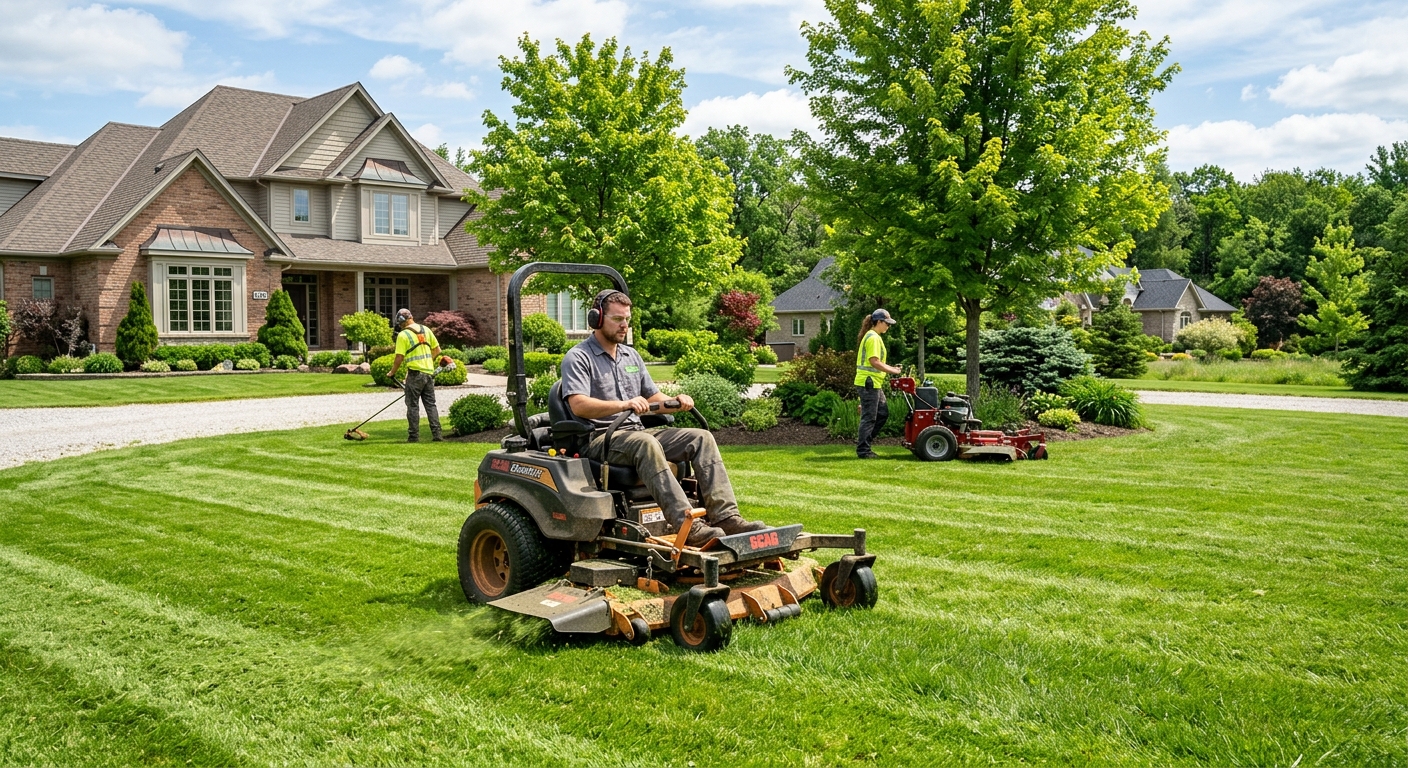
Landscaping options and costs in Collingwood
Landscaping in Collingwood comes with a wide range of options and budgets, because the town’s housing stock is largely geared toward homeowners who can invest in their outdoor space. In Collingwood’s housing profile, 56.4% of dwellings are single-detached homes, and 72.8% of households are owner households (Statistics Canada, 2021 Census). That combination—detached yards plus ownership—creates strong demand for full-service makeovers in neighbourhoods such as Craigleith and the south end around the waterfront and Georgian Bay corridor.
In the broader Kitchener–Waterloo–Barrie economic region, projects are shaped by Zone 5b–6a conditions: cold winters, a clear frost window, and freeze–thaw cycles that can punish poorly built patios, walks, and retaining walls. Most planting and installation work typically runs from mid-April through October, with heavier structural work (grading, bases, drainage) concentrated in the drier months. Labour availability also fluctuates because contractors are competing for the same spring start dates, so rush timelines can add cost.
Pricing is also affected by how much of your scope needs “frost-proofing” (deep compacted granular bases, proper drainage, and weed barrier under hardscape edges). For example, a full landscape design and installation can be positioned around Ontario mid-range project budgets—often starting at around $8,000–$60,000 for comprehensive plans—while more limited upgrades like interlocking patios may fall into a hardscape-focused band (often $120–$300 per unit area depending on the system and site access).
Use the comparison table below to benchmark common Collingwood scopes, then you can tighten your quote by clarifying yard area, drainage issues, and plant tiers.
| Service |
Description |
Season |
Price Range |
| Full landscape design and installation |
Site visit, plan set, grading/drainage strategy, topsoil prep, planting + hardscape coordination, cleanup |
Mid-April to October |
$8,000–$60,000 |
| Sod installation (supply, grade, lay, roll) |
Soil testing/grade correction, starter fertilizer, sod delivery/installation, rolling and first watering plan |
Late spring through summer (best before peak heat) |
$5–$10 |
| Lawn seeding (grade, seed, starter fertilizer) |
Reseeding or new seeding, light raking, starter fertilizer, mulch for erosion control where needed |
Spring or early fall frost-safe windows |
$1,200–$2,800 |
| Interlocking patio or walkway |
Excavation, compacted base (frost-resistant), bedding sand, edge restraint, stones, jointing sand |
May to September (weather-dependent) |
$4,500–$22,000 |
| Retaining wall (interlocking block) |
Layout, granular base + drainage layer, block installation, weep holes/cap, backfill compaction |
May to September |
$6,000–$28,000 |
| Tree and shrub planting |
Soil amendments, planting layout, staking where needed, mulch rings, initial watering plan |
Spring to early fall |
$500–$15,000 |
Prices are estimates only and vary by project scope, site access and material selection.
What affects the price of landscaping in Collingwood
In Collingwood and across the Kitchener–Waterloo–Barrie region, it’s normal to see pricing swing 30–50% for the “same” landscaping idea, because the scope definition changes quietly. A backyard refresh can become full regrading, a simple planting plan can become a drainage correction, and a small patio can require extra excavation if the soil is wet or previously disturbed. Labour and materials also respond to timing: spring starts are limited, and companies can charge more when schedules are tight.
The biggest pricing driver is how the local climate and working season affect build quality. In Zone 5b–6a, the frost window and freeze–thaw cycles demand deeper granular bases and drainage layers for hardscaping—cost increases that show up quickly in patios, walks, and retaining walls. Prairie regions (Zone 2–4) generally add cost for hardiness and drought/wind resilience because the growing season is shorter and winter stress is higher; coastal BC (Zone 7–8) can support longer plant variety and faster establishment, but heavy rainfall can make drainage design critical. Dry interior BC and some Alberta areas also bring water restrictions, which changes irrigation design requirements. In Southern Ontario, you usually get a moderate season, but summer dry spells still mean you’re planning efficient irrigation and choosing turf/plant selections that won’t struggle.
Here are practical examples that change cost in Collingwood: (1) Homes built before 1981—39.8% of dwellings locally (Statistics Canada, 2021 Census)—often have older grading patterns that push runoff toward foundations, which can require drainage bed upgrades and higher topsoil/compaction levels. (2) A 200–400 sq ft change in lawn area can shift your estimate sharply because sod and installation labour scale with square footage, while seeding changes the per-area labour/material balance. (3) Adding mature trees or switching from basic shrubs to ornamental specimen stock can move your planting budget toward the $500–$15,000 band, while a streamlined install stays closer to the lower end of the same service. All of this is why a “budget” and a “full-service” landscape can land anywhere inside the broader design-and-install range of $8,000–$60,000.
| Price Factor |
Why It Matters |
Cost Impact |
| Yard size in sq ft — the primary cost driver for softscape |
More area means more topsoil/seed/sod, more labour hours, and more edging/finishing |
Small changes can shift total by thousands due to linear edging and hauling |
| Grading and drainage work — slope corrections add significant cost |
Proper slope to daylight or storm tie-in reduces pooling and frost-lift risk |
Often one of the largest add-ons; can raise scope by 20%+ on uneven lots |
| Drainage bed or French drain installation |
Freeze–thaw magnifies damage if water is trapped under bases and turf |
Increases material and excavation time; frequently bumps estimates materially |
| Plant material tier — native shrubs vs. ornamental vs. mature specimen trees |
Mature stock costs more and takes more labour for planting, staking, and root handling |
Can swing planting budgets into higher tiers quickly |
| Hardscape vs. softscape ratio — walls and patios cost more per sq ft than lawn |
Hardscape requires deep bases, compaction, restraint, and careful jointing |
Rebalancing 1 area can change total drastically; patios/walks add cost fastest |
| Irrigation system design and installation |
Zoned heads, controls, and winterization planning affect both system complexity and season success |
Often a major mid-project cost; smart zoning usually lowers long-term water waste |
| Soil amendment and topsoil required |
Poor soils need engineered amendments for drainage, rooting depth, and nutrient support |
Bulk hauling and prep can add significant line items |
| Tree removal or stump grinding before new planting |
Stumps and roots interfere with grading, irrigation lines, and planting layouts |
Adds separate equipment/labour cost; also affects timing |
Permits & regulations in Ontario
For most landscaping in Ontario, planting, sodding and typical softscape work does not require a building permit. If your scope is things like installing sod, seeding, mulched shrub borders, and routine tree/shrub planting, contractors usually proceed without pulling permits. However, there are key exceptions where approvals are commonly required. Retaining walls above a height threshold—typically 1.0 m (3.3 ft) in many municipalities—often require a building permit, and sometimes engineered drawings. In Collingwood, it’s smart to ask your contractor to confirm whether your wall size, height, and base design triggers permitting.
Another common trigger is changes to lot grading that affect drainage direction—especially if it redirects runoff toward neighbouring properties or connects toward storm drainage in a way that changes how water flows. In those cases, approvals may be needed because drainage design impacts flooding risk and neighbourhood storm systems. Before digging planting holes, wall footings, or drainage trenches, always ensure utility locates are completed (Ontario “Call Before You Dig” process) so you avoid hitting buried services.
To verify your contractor’s credentials in Collingwood, ask for: (1) an Ontario licence/registration where applicable for the work type (contractors should be able to identify what category they’re operating under), (2) current liability insurance certificate, and (3) WSIB coverage or a clearance letter showing account status. You should request documents before work starts, and match the named company/individual on the paperwork to the contract. A reputable installer will provide certificates promptly, answer questions clearly, and document exclusions so there are no surprises.
Planning a landscape that thrives in Collingwood's climate
Planning a yard that thrives in Collingwood is about working with Zone 5b–6a realities—hard freezes, freeze–thaw cycles, and a growing season that’s strong but not year-round. Start with plant selection: choose native and zone-appropriate species that can handle winter wind and spring thaw swings with minimal winter protection. In practice, that usually means building around hardy shrubs and perennials, then adding color with annuals only where you can manage replanting after cold snaps.
Next, decide between sod and seed. Sod delivers instant green and erosion control, but it typically costs about 3–4 times more per square foot than seeding once you include prep and installation labour. Seeding is slower to “read” as a finished lawn but is often the best budget choice when you want to establish turf over a season or in areas that can be protected during germination.
Drainage and grading are critical in Kitchener–Waterloo–Barrie’s frost-influenced soils. If you don’t build slopes correctly, water pools in spring, and frost heave can lift edges and turf—leading to repeat labour and rework. Hardscape needs frost-conscious base preparation: deep compacted granular layers, proper bedding sand thickness, and edge restraint prevent movement during winter expansion and thaw.
Finally, use low-maintenance design strategies that still look polished: mulch rings, groundcovers in sunny or shady zones, and perennials that re-bloom reliably. Consider rain-garden pockets or xeriscape-inspired planting (drought-tolerant perennials and grasses) where summer dry spells show up, paired with efficient zoned irrigation.
Dollar example: If you’re filling a 400 sq ft lawn area, sod can land in the higher installation band (often aligning with the $5–$10 sod pricing guidance per sq ft when you include typical supply/installation structure). If that same area is reseeded, you can typically stay closer to the seeding project band (often around the $1,200–$2,800 range for many Collingwood yards), accepting a longer “finish” timeline to protect your budget for drainage fixes—which are often the best long-term money spent.
| Element |
Climate Consideration |
Maintenance Level |
Price Band |
| Sod lawn installation |
Needs reliable establishment before hard frosts; drainage and soil prep prevent winter die-back |
Medium (watering the first season, mowing cadence) |
$5–$10 |
| Native perennial garden |
Choose hardy perennials for freeze–thaw and spring wet soils; mulch helps stabilize temperature |
Low to Medium (spring cleanup, occasional dividing) |
$2,000–$8,000 |
| Mulched shrub border |
Winter structure in shrubs; mulch buffers root zone and reduces heaving risk |
Low (top up mulch 1x/year, light pruning) |
$1,500–$6,500 |
| Interlocking stone patio |
Frost-safe base and drainage prevent heaving and settling |
Low (periodic joint sand/top-up) |
$4,500–$22,000 |
| Retaining wall (block) |
Drainage layer and backfill compaction are essential to survive freeze–thaw |
Low (visual inspection after thaw periods) |
$6,000–$28,000 |
| Drip irrigation system |
Efficient water delivery supports drought-tolerant planting during summer dry spells |
Low (seasonal checks and winterization) |
$2,000–$10,000 |
How to choose a landscaping contractor in Collingwood
Choosing the right contractor in Collingwood comes down to proof, process, and clarity—not just price. Start by verifying Ontario licensing/registration where relevant to the work type (your contractor should clearly identify what categories apply). Then ask for: (1) current liability insurance—request a certificate of insurance with the correct legal name, (2) WSIB/WCB coverage or a clearance letter showing account status, and (3) confirmation of who is responsible for site safety. A legitimate installer will provide documents quickly and won’t be vague about coverage.
Next, get 2–3 itemised written quotes with labour and materials broken out. You want line items such as excavation, base materials, delivery/hauling, plant counts and sizes, irrigation components (if included), disposal fees, and labour hours by task. Avoid a “lump sum” quote that doesn’t say what’s excluded—especially for drainage corrections and hardscape base thickness.
Read the scope like a checklist: is permit pulling included if your retaining wall triggers requirements? Is disposal/rock and debris removal included, or is it extra? Are utility locates included or is the homeowner expected to arrange them? Ask how they’ll protect existing landscaping and structures during excavation.
For warranty, confirm workmanship warranty length, and whether product/manufacturer warranty applies to plants, soil amendments, or irrigation components. Also ask if the warranty is transferable if you sell the property.
Payment schedule matters. Never pay more than 10–15% upfront; hold back the remainder until the job is complete and cleaned. Finally, insist on a written timeline with a start date and completion estimate—spring scheduling in Southern Ontario can shift quickly, so clarity prevents delays.
- Request liability insurance certificate and confirm the insured party matches the contract name.
- Provide WSIB/WCB clearance letter or confirmation of coverage status.
- Ask which Ontario registrations/licence categories apply to their scope and verify they match your project type.
- Get 2–3 itemised quotes (labour + materials), not just one total number.
- Confirm disposal included: topsoil spoils, old sod, excavated material, and packaging waste.
- Confirm drainage scope: grading plan, outlets, and any French drain/bed line items.
- For patios/walks, ask for base build-up details (granular layers) and compaction expectations.
- For retaining walls, ask who designs drainage/backfill and whether permit might be required for wall height.
- Ask for plant lists with quantities and sizes (e.g., container size, height), not “allowances only.”
- Confirm irrigation design includes winterization and seasonal shut-down steps (where applicable).
- Review warranty terms in writing: workmanship length, exclusions, and how claims are handled.
- Lock the payment schedule: keep upfront deposit at 10–15%, and hold back until final walkthrough.
Red flags in Collingwood: (1) quotes that omit drainage and base thickness for hardscaping, (2) refusing to provide insurance/WSIB documentation, (3) vague “allowances” instead of defined quantities and plant sizes, (4) asking for large upfront payments beyond 10–15%, and (5) no written start/completion dates tied to weather windows for Zone 5b–6a work.
Frequently asked questions — landscaping in Collingwood
What is the best grass type for a Collingwood lawn?
In Collingwood (Zone 5b–6a), the “best” choice is usually a blend that tolerates cold winters and spring freeze–thaw without turning thin after rough weather. Many homeowners do well with perennial ryegrass for fast establishment and strong wear tolerance, paired with fine fescues for better texture and drought resilience during summer dry spells. If you’re reseeding bare spots, ensure you match the blend to your sun exposure—shade areas often need more fine fescue content to avoid patchiness. Because your yard may be shaped by older grading patterns (39.8% of local homes were built before 1981 per Statistics Canada, 2021 Census), addressing drainage first often matters as much as grass selection. For lawn budgets, seeding projects commonly fall in the $1,200–$2,800 band depending on square footage and prep.
When should I aerate and overseed my lawn in Collingwood?
In Collingwood, aim for aeration and overseeding when the soil is workable and grass can root before hard freezes. A reliable approach is late spring (after snow melt, when the lawn starts actively growing) or early fall, because cooler temperatures help new seed germinate without scorching. If you seed in fall, leave enough time to establish rooting before the frost window tightens. Aerating too late can leave seedlings exposed, especially where freeze–thaw lifts thin turf. If your lawn stays damp due to grading or drainage issues, fix that first—poor drainage can make overseeding fail even with the right seed. For homeowners comparing options, sod is faster for “instant curb appeal,” but seeding is commonly a lower-cost route often aligning with the $1,200–$2,800 band for many typical yards.
What trees grow best in Collingwood's climate zone?
In Collingwood’s Zone 5b–6a, you generally have good success with hardy deciduous trees and well-adapted ornamentals—especially when planted in properly amended, well-drained soil. Common choices homeowners like include serviceberry (Amelanchier), Japanese tree lilac (Syringa reticulata, depending on availability), and hardy maples and oaks where site conditions suit them. For long-term yard performance, choose trees that match your soil and moisture profile rather than picking only for curb appeal. If your yard has older drainage patterns (Statistics Canada, 2021 Census notes 39.8% of homes built before 1981), ask your contractor to evaluate where water pools after spring thaw so roots aren’t sitting in saturated ground. Planting projects in Collingwood often range broadly, and tree/shrub planting can land anywhere from $500–$15,000 depending on tree sizes and quantities.
How much does sodding a yard cost in Collingwood?
Sodding cost in Collingwood depends heavily on prep and the amount of grading and topsoil required, not just the sod itself. Pricing is commonly guided by per-square-foot supply and install ranges, and many homeowners see sod installation commonly referenced around $5–$10 when comparing typical local scopes. The final quote rises if you need significant regrading, drainage work, or removal of existing dead turf, because excavation and base/topsoil delivery add labour and hauling. For example, if your lawn area is level and the soil is workable, the budget typically lands closer to the lower end; if the yard is uneven or repeatedly wet in spring, you’ll pay more to correct drainage so the new sod survives winter. Your contractor should itemise grade corrections and disposal so you can understand exactly what you’re buying.
How do I prevent weeds in my Collingwood garden?
Weed prevention in Collingwood is most effective when you combine site prep with the right barrier and consistent mulch depth. Start by addressing the soil surface and any persistent drainage problems—wet areas often invite weeds and weak turf. For garden beds, use a properly installed weed-control fabric where appropriate, then cover with 2–3 inches of quality mulch to block light. Don’t rely on fabric alone; mulch protects it and improves soil moisture stability through freeze–thaw cycles. Planting density also helps: well-spaced shrubs and hardy groundcovers reduce open soil where weeds take hold. If you’re planning a border refresh, ask about a mulch shrub border scope that typically fits within the $1,500–$6,500 style band for many homeowners depending on lengths, plant counts, and whether soil amendments are required. Also avoid late-season fertilizing that triggers weed flushes before frost.
How do I design a low-water yard in Collingwood?
Even though Collingwood isn’t under the same strict water restrictions you see in parts of the dry interior in other provinces, summer dry spells are common enough that a “low-water” yard can save money and reduce maintenance. Start with plant selection: choose hardy natives and drought-tolerant perennials designed for Zone 5 conditions, then group them by sun exposure so you don’t overwater shade areas. Add mulch consistently to reduce evaporation and improve soil temperature stability through winter freeze–thaw. Where you have downspouts or runoff, a rain-garden pocket can capture water and reduce manual watering. If irrigation is part of your plan, design a zoned system with efficient drip or smart scheduling, ideally with winterization handled properly. Homeowners also like these approaches because they keep your landscape within realistic project budgets; for drip irrigation installs, many projects commonly fall into the $2,000–$10,000 range depending on yard size and zone complexity.