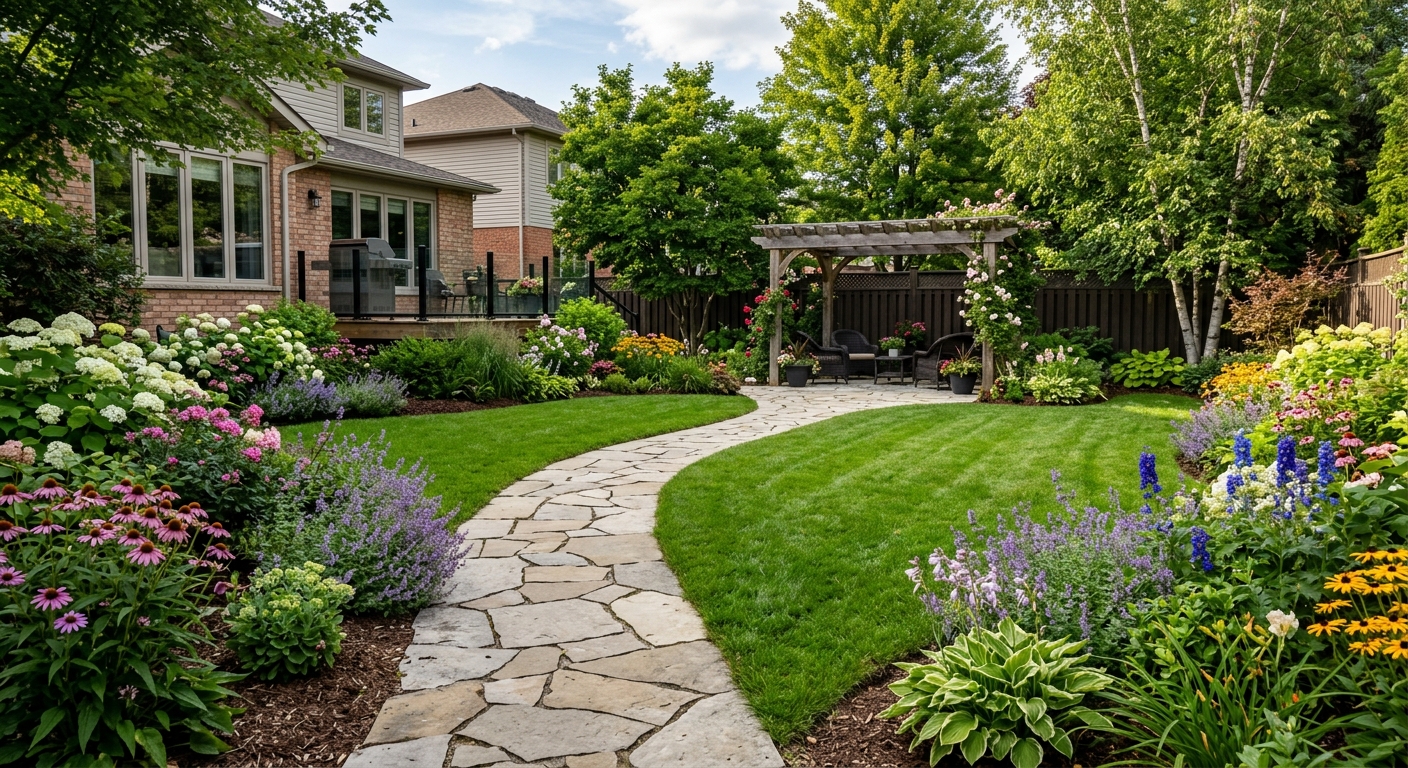
Landscaping options and costs in Halton Hills
Halton Hills homeowners typically have yard space to work with—helped by the fact that single-detached homes make up about 73.0% of local dwellings, and many households own their properties (85.3% of households are owner households, Statistics Canada, 2021 Census). That combination is why landscaping demand is steady across the town, especially in family-heavy pockets like Georgetown, where older lots often need drainage fixes, fresh planting beds, and updated walkways.
In the Greater Toronto Area, pricing is shaped by climate and soil. Most of the GTA sits in plant hardiness zones around 6a–7a, so we can install a wide range of shrubs, perennials, and trees that can handle winter lows near –23 to –18°C, but the season is still limited by frost and freeze–thaw cycles. Those cycles raise the cost of retaining walls, patios, and steps because contractors need deeper granular bases, proper compaction, and drainage so structures don’t shift. Add in local clay and fill soils—often meaning excavation, soil amendment, and sometimes subdrains—and you’ll see why “same size” projects can differ across quotes.
Contractor availability is also seasonal: the reliable install window is roughly late spring through fall, so booking earlier usually improves the price and reduces rushed scheduling. With that context, here’s a practical way to compare common landscaping scopes in Halton Hills.
| Service |
Description |
Season |
Price Range |
| Full landscape design and installation |
Site assessment, layout, soil and drainage plan, planting palette, hardscape/softscape build (scope-dependent) |
Late spring to fall |
$8,000–$40,000 |
| Sod installation (supply, grade, lay, roll) |
Grading for slope correction, topsoil/seedbed prep, sod supply and installation |
Late spring to early fall |
$2,500–$8,000 |
| Lawn seeding (grade, seed, starter fertilizer) |
Seedbed prep, seed mix, starter fertilizer, light roll, first-season establishment |
Spring or early fall |
$1,200–$4,500 |
| Interlocking patio or walkway |
Excavation, compacted granular base, geotextile/geogrid as needed, interlocking stone, joint sand, edging |
Late spring to fall |
$6,000–$20,000 |
| Retaining wall (interlocking block) |
Wall layout, excavation, base granular layers, proper drainage behind wall, block installation, caps/finishing |
Late spring to fall |
$6,000–$30,000 |
| Tree and shrub planting |
Planting holes, soil amendment, staking, mulch rings, watering plan (small-to-mid palette) |
Spring or fall |
$800–$6,000 |
Prices are estimates only and vary by project scope, site access and material selection.
What affects the price of landscaping in Halton Hills
In Halton Hills and across the Toronto region, two contractors can quote the “same” project and still land 30–50% apart. The gap is usually not marketing—it’s differences in site conditions, drainage strategy, labour productivity, and the level of workmanship built into the base and soil prep. In a market where many homes are older, with about 46.3% built before 1981 (Statistics Canada, 2021 Census), you’ll often see established clay fill, outdated grading, and harder-to-work access around mature trees.
Climate and frost timing are a major driver. Zones around 6a–7a let us grow a strong plant palette, but the freeze–thaw cycle means contractors must design for stability. In Halton Hills, grading and subsoil handling aren’t optional: patio and retaining-wall bases often need construction below frost-impacted soils, and drainage must be reliable before winter. Compare that to Prairie regions (Zone 2–4), where the shorter season and drought push designs toward simpler, drought-tolerant palettes and tougher perennials; coastal BC often supports lush growth, but heavy rain can require aggressive drainage planning. In Southern Ontario, you’ll also see seasonal irrigation needs when summer dry spells hit, even though restrictions are typically less severe than in the driest parts of BC interior.
Concrete examples: (1) If your yard has a slope and downspouts dump toward the foundation, adding grading corrections and a drainage bed can move a project from “planting-only” into a mid-tier build; it can align more with a hardscape/retaining-wall band like $6,000–$30,000 rather than a planting-only band. (2) If the project involves moving topsoil and amending heavy clay, even a modest patio can creep toward the upper end of $8,000–$40,000 for a full install once excavation, disposal, and base materials are included.
| Price Factor |
Why It Matters |
Cost Impact |
| Yard size in sq ft — the primary cost driver for softscape |
More area means more labour hours, more materials (topsoil, seed, sod, mulch), and longer install time |
Can change the budget by several thousand dollars depending on how much lawn or bedwork you add |
| Grading and drainage work — slope corrections add significant cost |
Fixing ponding, redirecting runoff away from foundations, and achieving proper slopes require excavation and re-compaction |
Often adds a large “invisible” cost that can push a job into a higher design/install bracket |
| Drainage bed or French drain installation |
Helps manage water in clay soils; requires trenches, perforated pipe, clean stone, and sometimes cleanout access |
Frequent mid-to-high add-on, especially for basement seepage risk or low spots |
| Plant material tier — native shrubs vs. ornamental vs. mature specimen trees |
Native and smaller nursery stock generally costs less and establishes faster; mature specimens and premium cultivars cost more |
Can swing a planting budget by hundreds to thousands depending on size and quantity |
| Hardscape vs. softscape ratio — walls and patios cost more per sq ft than lawn |
Patios and walkways require deeper bases and skilled stone setting; walls need stronger structural detailing |
Shifts the job toward higher price bands even when total yard area stays the same |
| Irrigation system design and installation |
Sprinkler layout, backflow preventer requirements (where applicable), trenches, and head selection increase scope |
Often adds substantial cost, but can reduce long-term watering labour and plant losses |
| Soil amendment and topsoil required |
Clay and compacted fill may need aeration, amendments, and imported topsoil to support healthy roots |
Can materially increase material and disposal costs |
| Tree removal or stump grinding before new planting |
Removal is disposal-heavy; stump grinding affects excavation planning and re-grading |
Often adds days and equipment time, increasing overall project cost |
Permits & regulations in Ontario
In Ontario, most straightforward landscaping activities—like planting, sodding, seeding, and typical softscape work—generally do not require a building permit. That includes work such as laying sod, installing garden beds, mulching, and planting trees/shrubs. You also usually don’t need a permit for small grade adjustments that don’t materially change drainage to neighbouring properties.
Where permits can come up is with retaining walls above the local height threshold (commonly around 1.0 m (3.3 ft) in many municipalities) and projects involving major lot grading changes that could redirect runoff toward neighbouring lots or storm connections. Also, any work that involves excavation near services requires safety planning: call for utility locates before digging for planting holes, drainage runs, or wall footings.
Step-by-step, here’s how a Halton Hills homeowner can verify a contractor properly:
- Ask for their Ontario business details and confirm the appropriate licensing/registration where applicable for contracting activities.
- Request a Certificate of Insurance (general liability) and confirm it’s active for the project dates.
- Ask for proof of coverage for worker protection (WSIB/WCB as applicable) so you’re not exposed if there’s an injury on site.
- Request a copy of their clearance letter (where issued/available) rather than taking verbal assurances.
- Verify any permit pull: ensure it’s included in writing if the scope triggers approval.
Finally, confirm irrigation and water-use expectations with your contractor and applicable local rules—Ontario’s rules can tighten seasonally, and you’ll still want sensible systems for summer dry spells.
Planning a landscape that thrives in Halton Hills's climate
Planning for Halton Hills means designing around the reality of the local zone (roughly 6a–7a), freeze–thaw impacts, and the seasonal rhythm of Ontario winters. Start with plant selection: choose zone-appropriate, native-leaning shrubs and perennials that handle winter cold without excessive finicky protection, and build in mulch and proper planting depth so roots aren’t exposed during temperature swings. This reduces watering needs and lowers spring “failures,” which is where many budgets quietly balloon.
Next, decide between sod and seeding. Sod gives instant curb appeal and faster functional use of your lawn, but it typically costs about 3–4x more per sq ft than seeding once you include supply and labour. Seeding can be the smarter choice for larger lawns if you can accept a longer establishment period in the first season.
Drainage and grading are critical in the Toronto market, especially on clay and fill soils. A yard that looks fine in July can pool in spring thaw—leading to foundation moisture risk and patchy turf. For hardscape, plan for the frost line: patios, steps, and interlocking walkways need proper excavation and base prep with correct compaction, and retaining walls need drainage behind them so hydrostatic pressure doesn’t undermine the wall.
Low-maintenance strategies help you keep costs under control year after year: groundcovers, mulched shrub borders, and durable perennials reduce mowing and weeding. A rain garden can also be a practical “soft” alternative to fighting pooling with only turf—especially when downspouts dump toward a low spot.
Dollar example: If you have a small front lawn area and want instant results, sod may land around $2,500–$8,000 for a typical install. If you’re budget-conscious and the area is larger, seeding may cut that significantly (often closer to the lower end of lawn budgets), and you can redirect the savings toward proper drainage grading—which is where the long-term value usually is.
| Element |
Climate Consideration |
Maintenance Level |
Price Band |
| Sod lawn installation |
Requires good soil temps and consistent moisture during establishment through spring/early fall |
Low after establishment, higher during first 4–8 weeks |
$2,500–$8,000 |
| Native perennial garden |
Zone-appropriate plants handle winter cold; mulch buffers root exposure during freeze–thaw |
Low to moderate (weeding year 1, then seasonal trimming) |
$1,500–$6,500 |
| Mulched shrub border |
In Halton Hills, borders help manage slope runoff and reduce evaporation compared with bare soil |
Low (refresh mulch, minimal watering once established) |
$1,200–$5,000 |
| Interlocking stone patio |
Needs deeper base and proper drainage to handle freeze–thaw movement in Ontario winters |
Low (occasional joint sand topping and inspection) |
$6,000–$20,000 |
| Retaining wall (block) |
Freeze–thaw and water pressure require a stable base and drainage behind the wall |
Low (visual inspections after heavy storms) |
$6,000–$30,000 |
| Drip irrigation system |
Helps control watering during summer dry spells and reduces water waste versus full spray in beds |
Moderate (seasonal winterization checks) |
$2,000–$7,500 |
How to choose a landscaping contractor in Halton Hills
Choosing a contractor is mostly about verifying credentials and making sure the quote matches the real job. In Ontario, confirm licensing/registration where applicable and ask for their general liability insurance (with the active coverage dates) and proof of worker coverage such as WSIB/WCB. A reputable Halton Hills landscaper should provide certificates without hesitation. If they can’t, or they only send a photo, that’s a red flag.
Then get 2–3 written, itemised quotes—not one-page totals. You want line items that separate labour and materials (excavation, granular base, geotextile/geogrid if used, stone supply, plant materials, topsoil, disposal). Read the scope for what’s excluded: is hauling/disposal included, are utility locates included, does the price cover regrading and compaction, and is any required permit pull included?
Warranty matters in landscaping because Ontario winters reveal weak bases and poor drainage. Ask for the workmanship warranty length (often 1–3 years depending on scope), whether product warranties apply to plants or stone materials, and whether those warranties are transferable to you as the homeowner. Finally, payment scheduling should protect you: avoid paying more than 10–15% upfront. Hold back the remainder until the job is complete and cleaned up to spec.
Get a written start date and completion estimate, and confirm weather contingency planning—especially for sodding, seeding, and hardscape base construction where conditions affect compaction and curing.
- Verify their Ontario business details and appropriate registration/licensing for the work they’re doing.
- Request and review their Certificate of Insurance (general liability) before signing.
- Ask for WSIB/WCB coverage proof (and any clearance letter, where applicable).
- Insist on itemised quotes: labour vs. materials, and quantities where possible.
- Confirm disposal/haul-away is included if excavation is required.
- Ask whether utility locates are included and who books them.
- Check that drainage/grading steps are described (slopes, base depth, compaction notes).
- Ask about base build: geotextile/geogrid, granular layers, and locking/edge restraint.
- Clarify plant sourcing and what “plant sizes” mean (e.g., height at planting, caliper for trees).
- Confirm irrigation scope (if any): heads, zones, controller location, and winterization plan.
- Review warranty terms in writing: workmanship, plant replacement policy, and what voids coverage.
- Set a payment schedule that holds back funds until punch list items are complete.
In Halton Hills specifically, avoid contractors who (1) provide only a lump-sum without drainage/grading detail, (2) can’t show insurance/coverage documents, (3) quote patios/steps without discussing freeze–thaw base depth and compaction, (4) demand large upfront payments, or (5) skip a written timeline and weather contingencies for sod and hardscape.
Frequently asked questions — landscaping in Halton Hills
What trees grow best in Halton Hills's climate zone?
Halton Hills is typically suited to many cold-tolerant trees that handle Ontario winters and spring thaws. Common picks include serviceberry (Amelanchier) for smaller yards, paper birch or white spruce for structure (depending on sun and soil), and hardy flowering options like crabapple cultivars if you want curb appeal. For shade and long-term height, consider species that match your spacing and expected mature size—especially important in older neighbourhood lots. Because freeze–thaw cycles can stress poorly drained sites, we prioritize trees that tolerate your soil moisture pattern, often pairing them with soil amendment and mulch rings. If you’re planning a full planting refresh, tree and shrub planting typically falls around $800–$6,000 depending on number and tree size (and whether any removals are needed).
How much does sodding a yard cost in Halton Hills?
For Halton Hills, sod pricing commonly lands in the $2,500–$8,000 range for typical residential lawn installs, depending on yard size, access, and how much prep is required. If you only need to level minor bumps, costs stay closer to the middle; if grading requires excavation, soil amendment for clay, and re-compaction, budgets climb. Sod also needs careful establishment after install—watering schedules and first-season timing matter for winter readiness. Many homeowners save time by getting sod installed in late spring or early fall, when it still roots well before winter dormancy. If your goal is “instant green” for curb appeal, sod can be worth it; if you have larger lawn areas, seeding may be a lower-cost route while you correct drainage.
How do I prevent weeds in my Halton Hills garden?
Weed control starts below the surface. In Ontario gardens, the biggest wins come from correct bed prep: remove existing weed roots, pull invasive perennial patches, and amend soil so you’re not fighting compacted clay that makes it harder for desirable plants to establish. Use proper mulch depth (typically 2–3 in), and avoid leaving bare soil between plants—bare ground is where weed seedlings take hold. For tough areas, we often recommend landscape fabric or a targeted approach under mulch in specific situations, but we still favour healthy plant spacing and groundcovers so you’re not relying on fabric alone. A good perennial plan matters because it shades soil and reduces weed germination. If you’re investing as part of a broader install, the full design/installation band of $8,000–$40,000 often includes the detailed bed layout and soil prep that reduce future weeding.
How do I design a low-water yard in Halton Hills?
Even though Halton Hills isn’t in the water-scarce Prairie or dry BC interior, summers can still be dry enough that watering is a real cost and hassle. Low-water design here usually means planting that matches your site (sun/shade), improving soil structure, and using targeted irrigation where needed. Start with zone-appropriate, native-leaning shrubs and perennials, then group plants by water needs so you don’t overwater everything. Mulch and compost reduce evaporation and slow surface drying. For stormwater and pooling, a rain garden or properly graded swales can help manage runoff while providing moisture where plants can use it. If you want automated watering, drip irrigation is typically more water-efficient than sprinklers for beds. Many homeowners find that budgeting for a drip system (often in the $2,000–$7,500 range) pays back through fewer plant losses and less frequent hand watering.
How do I find a licensed landscaper in Halton Hills?
In Ontario, you can’t rely on “word of mouth” alone—verify documents and scope. Start by asking the landscaper to provide their insurance Certificate (general liability) and proof of worker coverage such as WSIB/WCB as applicable. A licensed/qualified contractor should also provide clear business details and a written contract. Then request 2–3 itemised quotes showing labour and materials; “lump sum only” is hard to compare and often hides risk like drainage/grading prep or disposal. Look for written scope items: are utility locates included, is permit pull included if required, and how is base preparation handled for patios or retaining walls under Ontario freeze–thaw conditions? A reputable contractor should also stand behind workmanship and provide a timeline. If you’re comparing bids that include interlocking or retaining work, you’ll usually see those in realistic ranges like $6,000–$30,000 for many wall projects, depending on height, length, and drainage complexity.
How much does landscaping cost in Halton Hills?
Landscaping in Halton Hills varies mainly due to scope: lawn-only work is different from drainage correction plus hardscape and planting. As a planning benchmark, full landscape design and installation commonly ranges from $8,000–$40,000, especially when soil amendment, grading, and base construction are included. Sod installation typically lands around $2,500–$8,000 for many residential yards, while interlocking patios and walkways can start around the mid $6,000 range and go higher depending on size and excavation needs. Retaining walls are often among the costliest line items because they require structural detailing and drainage behind the wall; budgets frequently sit in the $6,000–$30,000 band. If you want a sharper estimate, focus your quote request on site access, drainage conditions, and the exact quantities (sq ft of lawn, length of wall, number of trees), because those are what drive the real cost in Southern Ontario.