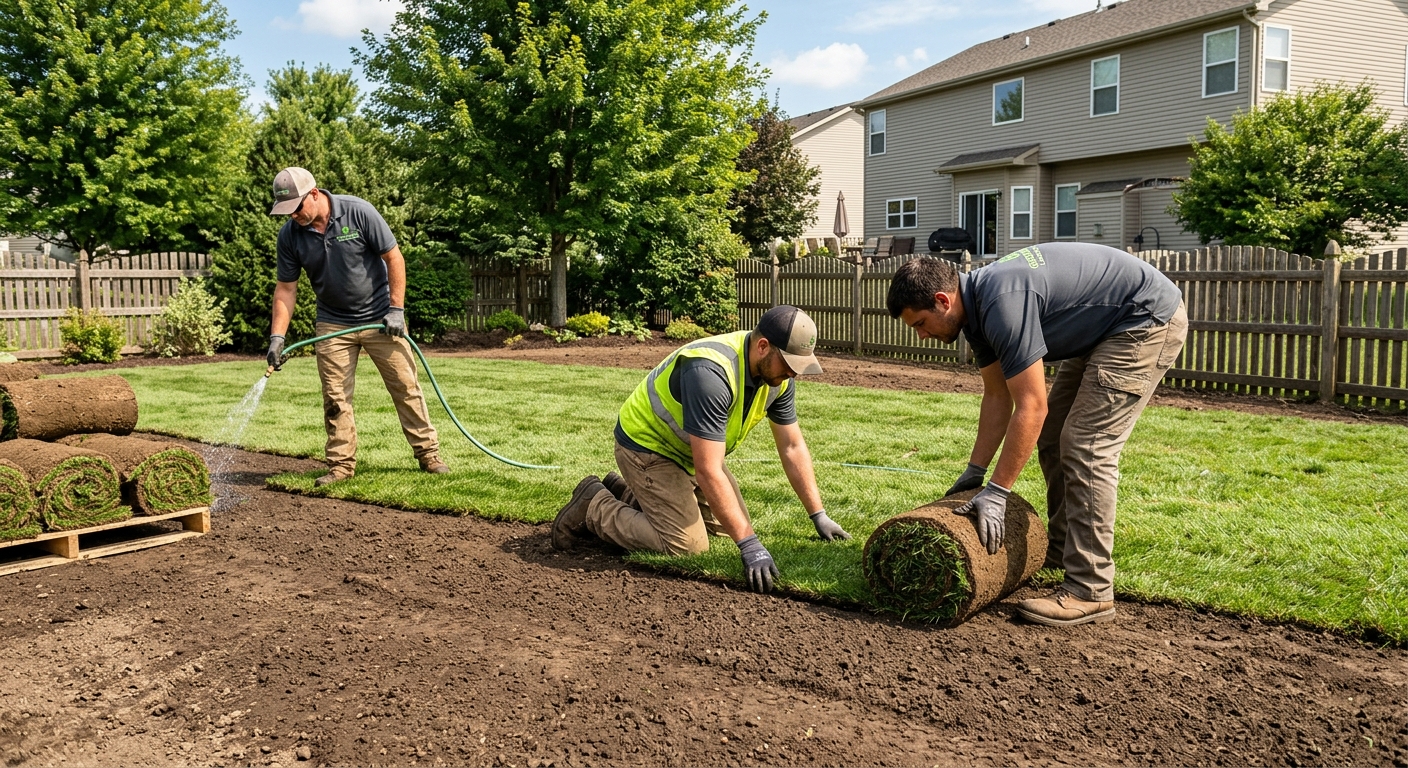
Landscaping options and costs in Huntsville
Landscaping in Huntsville is a practical upgrade for many homeowners, especially with the area’s housing profile—about 79.9% of dwellings are single-detached homes, and 80.4% of households own. That ownership mix matters because most yards are tied directly to curb appeal, kids/pets, and long-term outdoor use, so people are more willing to invest in graded turf, defined beds, and walkways. Huntsville also has a meaningful amount of older housing stock (45.3% of homes were built before 1981), which often means mature trees, compacted soils, and occasional foundation drainage considerations—conditions that can raise costs for excavation and drainage corrections.
In the Muskoka–Kawarthas region, landscaping pricing is shaped by plant hardiness zones 4b–5b, a typical last spring frost in early–mid May, and a first fall frost in late September to early October. That compressed season (often only 4½–5 months of strong install weather) affects scheduling and labour availability. Freeze–thaw cycles also increase the importance of deeper, well-compacted bases and proper drainage under patios and retaining walls to reduce heaving and cracking. In demand spots like the Rosseau Road corridor and the Huntsville town-centre/Walker’s Point area, contractors are especially busy because lots tend to be serviced, but access and rock/excavation can vary.
Below is a typical comparison of common landscaping scopes in Huntsville so you can anchor your budget before you talk to installers.
| Service |
Description |
Season |
Price Range |
| Full landscape design and installation |
Site walk, layout, grading/drainage plan, plant beds, lawn establishment, and hardscape/edges as needed |
Spring to early fall (May–mid Oct) |
$8,000–$35,000 |
| Sod installation (supply, grade, lay, roll) |
Soil prep, topsoil placement, grading to drainage, sod delivery and rolling, light finishing |
Late spring to early fall (May–Sep) |
$2,000–$8,000 |
| Lawn seeding (grade, seed, starter fertilizer) |
Minor grading, seed selection for zone conditions, starter fertilizer, raking/rolling |
Spring (mid May–June) or early fall (Aug–Sep) |
$1,200–$5,000 |
| Interlocking patio or walkway |
Excavation, base stone, compaction, edge restraints, interlocking pavers, simple drainage tie-in |
Late spring to early fall |
$6,500–$22,000 |
| Retaining wall (interlocking block) |
Excavation, engineered/approved base as required, block wall build, backfill, drainage gravel/weeps |
Spring to early fall |
$6,000–$40,000 |
| Tree and shrub planting |
Soil amendments, planting holes, staking (if needed), watering plan, mulch and bed edging |
Spring (after frost) and early fall |
$1,000–$8,000 |
Prices are estimates only and vary by project scope, site access and material selection.
What affects the price of landscaping in Huntsville
In Huntsville and across Muskoka–Kawarthas, two quotes for what looks like the “same” job can differ by 30–50% because the real scope is rarely identical: base prep, drainage tie-ins, excavation difficulty, and plant size/tier quickly change the total. Compared with many parts of Ontario, the local mix of shoreline influence, Canadian Shield rock pockets, and freeze–thaw service needs also pushes material handling and labour higher than you’d expect from the cheapest suburban pricing you might see online. Skilled crews may be in the 50–100/hour range, and schedule availability during the May–September window can add cost when multiple projects overlap.
Your landscape plan is also constrained by zones 4b–5b and frost timing (roughly early–mid May for last spring frost, and late September to early October for first fall frost). That means sod, concrete, and planting must land in a shorter prime window than warmer regions. Prairie areas (Zone 2–4) usually need drought-tolerant palettes and deeper frost-safe bases, while coastal BC (Zone 7–8) can install longer and often grows faster—so designs there can be more lush and less “safety-first.” In contrast, Huntsville typically needs dependable drainage and frost-ready construction, so a basic lawn plus edges can land near the lower end of $8,000–$35,000 for design+installation, while patios and walls that require proper underdrain/backfill frequently sit in the higher bands like $6,000–$40,000 for retaining/hardscape scopes.
Concrete examples from Huntsville: (1) If a yard needs re-grading to send water away from the foundation, the extra excavation and compacted base can add thousands versus “top dress only.” (2) Installing interlocking surfaces over a shallow or poorly draining base often triggers redo work; contractors protect against that with deeper stone and drainage, which costs more up front but prevents settlement. (3) Older lots (like the 45.3% built before 1981) often have mixed fill or hidden roots, raising soil disposal and excavation time—sometimes by $1,000–$3,000 depending on access and how much gets removed.
| Price Factor |
Why It Matters |
Cost Impact |
| Yard size in sq ft — the primary cost driver for softscape |
More turf and bed area means more soil/topsoil, labour hours, and materials (seed, sod, mulch, plants) |
Often the largest line-item; can swing totals by 20–60% depending on area |
| Grading and drainage work — slope corrections add significant cost |
Freeze–thaw demands proper slope away from foundations and compacted subgrade |
Commonly adds $1,500–$8,000 on mid-sized lawns and entries |
| Drainage bed or French drain installation |
Controls pooling and protects patios, walls, and basement moisture |
Typically increases project cost by $1,000–$6,500 |
| Plant material tier — native shrubs vs. ornamental vs. mature specimen trees |
Mature specimens cost more and require larger pits, stakes, and sometimes more labour |
Can add $500–$5,000+ depending on size/quantity |
| Hardscape vs. softscape ratio — walls and patios cost more per sq ft than lawn |
Pavers and block systems need excavation, base stone, and compaction |
Hardscape-heavy yards often land toward the high end of typical bands |
| Irrigation system design and installation |
Sprinkler/drip layouts must account for frost, spray coverage, and bed needs |
Frequently adds $800–$6,000+ depending on zone count |
| Soil amendment and topsoil required |
Correcting poor soils improves rooting and reduces winter heave risk |
May add $500–$4,000 based on import volume |
| Tree removal or stump grinding before new planting |
Removal/disposal and stump grind depth affect excavation time and equipment needs |
Often adds $300–$2,500 per tree depending on size/access |
Permits & regulations in Ontario
In Ontario, most landscaping work—planting, sodding, mulching, and typical softscape installation—usually does not require a permit. However, there are a few high-impact exceptions where permits or approvals are commonly required. Retaining walls above a local threshold (often around 1.0 m / 3.3 ft in many Ontario municipalities) typically need a permit and may require engineered drawings, particularly if the wall supports added surcharge (like a driveway or structure nearby). Also, changes to lot grading that could redirect drainage toward a neighbour or storm connections can trigger review or approval—especially where the work affects how surface water leaves your property.
Before digging, ensure utility locates are done. In practice, most contractors will request locates for hydro, gas, telecom, and other buried services prior to any excavation for planting holes, French drains, irrigation lines, or wall footings.
To confirm your contractor is properly set up, follow a simple homeowner check list for Huntsville projects: (1) Verify the contractor’s Ontario licence/registration using the relevant online registry for your contractor type, if applicable; (2) ask for a current certificate of insurance—confirm liability coverage is active for the project dates; (3) request proof of WSIB/WCB coverage (and clear status if they are exempt); (4) ask for a clearance letter or coverage confirmation document; and (5) keep everything in writing with your signed contract and scope.
Planning a landscape that thrives in Huntsville's climate
To plan a landscape that thrives in Huntsville, you want to design “with” the seasons—especially freeze–thaw, frost heave risk, and the 4b–5b hardiness reality. Start with plant selection: choose native and zone-appropriate species that tolerate Ontario winters, then group them by sun/shade and moisture so watering is predictable. Many homeowners in Huntsville also benefit from adding winter interest (evergreens, textured bark, and structure) so the yard doesn’t look bare through long shoulder seasons.
For lawn establishment, the sod-versus-seed decision is mostly about timing and results. Sod gives instant coverage and erosion control, but in Huntsville it can cost about 3–4x more per square foot than seeding when you compare full installed totals. Seeding is more budget-friendly and works well when you can water reliably during germination. A common example: if you need a 500 sq ft repair area, sod might be a line-item closer to $2,000–$4,500, while seeding for similar coverage is often closer to the lower band around $1,200–$5,000 depending on grading and seed strategy—so seeding is justified when you can accept a slower “fill-in” phase.
Drainage and grading are non-negotiable in Muskoka–Kawarthas. Build slopes that move water away from foundations and use properly compacted bases under patios. For hardscape, patio and retaining-wall base prep must consider frost depth and local freeze–thaw movement, using quality aggregates and drainage bedding so water can escape instead of expanding under slabs. Low-maintenance design strategies—mulched shrub borders, groundcovers, and perennial beds with repeatable plant groupings—reduce annual upkeep while keeping curb appeal. Where water is a concern (especially during dry stretches), consider rain-garden pockets or xeriscape-informed layouts (mulch depth, drought-tolerant natives, and smarter irrigation zoning) rather than trying to force high-water plants into shaded or clay-prone spots.
| Element |
Climate Consideration |
Maintenance Level |
Price Band |
| Sod lawn installation |
Needs reliable establishment during the short frost-free window; proper base/rolling helps prevent winter heave |
Low to moderate (initial watering until rooted) |
$2,000–$8,000 |
| Native perennial garden |
Zone-appropriate perennials tolerate winter swings; deep roots improve resilience to freeze–thaw and dry spells |
Moderate (spring cleanup, light seasonal refresh) |
$1,500–$6,000 |
| Mulched shrub border |
Mulch buffers temperature swings and protects roots; choose shrubs that match soil moisture conditions |
Low (weed control with the right spacing and mulch depth) |
$1,000–$5,500 |
| Interlocking stone patio |
Base stone and compaction must handle Ontario frost movement; include drainage to prevent pooling |
Low (occasional cleaning and joint maintenance) |
$6,500–$22,000 |
| Retaining wall (block) |
Backfill and drainage gravel are critical for freeze–thaw; wall must be founded on stable base |
Low (inspect after extreme winters) |
$6,000–$40,000 |
| Drip irrigation system |
Better water efficiency for beds; must be winterized properly to prevent freeze damage |
Low to moderate (seasonal adjustment and shutoff) |
$800–$6,000+ |
How to choose a landscaping contractor in Huntsville
Choosing a contractor in Huntsville starts with proof and process. First, verify Ontario coverage basics: ask for a current certificate of insurance showing liability coverage, and confirm WSIB/WCB status with documentation (not just an email promise). If the work includes excavation, drainage, or hardscape base prep, ensure the contractor’s coverage clearly applies to the scope you’re buying. Next, request 2–3 written, itemised quotes that break down labour and materials (e.g., excavation/stone/base compaction/plants/sod quantities), rather than a single lump sum. Itemisation helps you compare apples-to-apples and reduces the chance of change-order surprises.
Read the scope carefully for exclusions: disposal/haul-away included or not, permit/pull included if required, and whether topsoil import, compaction, and drainage tie-ins are part of the price. For warranties, ask what is covered for workmanship (commonly in the months-to-seasons window after installation), what’s covered under product/manufacturer warranties, and whether any warranty is transferable if you sell the home.
Payment terms matter. A safe rule is never more than 10–15% upfront, with the remainder tied to milestones; hold back until the final inspection and cleanup are complete. Finally, get a start date and completion estimate in writing—because Huntsville’s May–September workload can move quickly, and delays often affect sod timing and planting success.
- Confirm active liability insurance (ask to see the certificate and dates).
- Verify WSIB/WCB coverage status with documentation for the crew doing the work.
- Ask who will be on-site and who supervises grading/drainage tie-ins.
- Get itemised quotes showing quantities (sq ft, linear ft, plant counts/sizes).
- Confirm sod/seed type and seeding rate (not “generic seed”).
- Ask about base stone depth and compaction method under patios/walls.
- Confirm disposal/haul-away is included for excess soil/stone.
- Ask whether topsoil import and soil amendment are included.
- Verify drainage provisions (French drain, downspout tie-in, weeping lines).
- Clarify whether edging/restraints are included (they prevent paver movement).
- Review warranty terms in writing, including workmanship and any product coverage.
- Use a milestone payment schedule and keep 10–15% holdback until closeout.
In Huntsville, red flags often include: (1) refusing to provide itemised quotes; (2) vague drainage promises like “it’ll be fine” without explaining grading or underdrains; (3) asking for large upfront payments (beyond ~10–15%); (4) no proof of insurance/WSIB/WCB; and (5) starting without confirming locates or discussing how they’ll handle frost-safe base preparation for hardscapes.
Frequently asked questions — landscaping in Huntsville
How much does landscaping cost in Huntsville?
In Huntsville, landscaping costs depend mainly on how much yard you’re covering and whether the scope includes drainage and hardscape. For many homeowners, a partial refresh (beds plus edging and a lawn upgrade) can start near the lower landscape installation band, while full design-and-install projects commonly land across $8,000–$35,000 depending on grading, plant tier, and access. Sod-only projects are often budgeted within $2,000–$8,000, while interlocking patios and walkway work can range broadly once excavation and base prep are included (often higher on sloped or drainage-challenged lots). Because Huntsville’s zone 4b–5b climate and freeze–thaw cycles require proper bases and drainage, “cheap” quotes that skip underdrain or compacted stone frequently cost more later.
What plants thrive in Huntsville's climate zone?
Huntsville sits in hardiness zones 4b–5b, so the best performers are winter-hardy, zone-appropriate species that can handle cold snaps and freeze–thaw stress. Many homeowners do well with native shrub and perennial selections suited to Ontario’s conditions—plants that establish deeper roots and need less fuss. Aim for groupings based on sun and moisture: choose different plants for drier, sunnier borders versus shaded areas that hold moisture. If your yard has older, compacted soil (common in homes built decades earlier), prioritize soil amendment and mulch first, then plant sturdy natives/ornamentals in the right spots. A good contractor can also recommend mature sizes that match your expectations and timeline so you don’t overpay for plants that won’t establish well.
Sod vs seed — which is better for a Huntsville lawn?
Sod is usually better when you want instant coverage, erosion control, or a fast curb-appeal boost—especially if you’re replacing a lawn in early spring before weeds take over. In Huntsville, sod can cost roughly 3–4x more per square foot than seeding, and the typical installed sod range falls around $2,000–$8,000 depending on your area and grading needs. Seed can be the better choice if you can commit to watering during germination and you’re okay with a slower fill-in. Practically, many homeowners use a hybrid approach: seed where soil prep is simpler and sod for high-visibility strips near entryways. Either way, quality base prep and correct slope for drainage are the difference between a lawn that survives winter and one that struggles in year two.
How much does a retaining wall cost in Huntsville?
Retaining wall costs in Huntsville vary most with wall height, length, excavation difficulty, and whether drainage/backfill details are fully included. Typical block wall pricing commonly falls within $6,000–$40,000 as the scope expands from a short segment to a longer wall that stabilizes a larger grade change. Freeze–thaw seasons make drainage provisions essential—reliable contractors include proper base stone, backfill specifications, and drainage gravel/weeping features rather than “solid block only.” If your wall supports a driveway, walkway, or surcharge loads, expect more engineering attention and a higher budget. Get itemised quotes so you can compare whether underdrain and disposal are included.
When is the best time to landscape in Huntsville?
For most landscaping in Huntsville, the best window is late spring through early fall because it aligns with frost timing and gives plants time to root before the first cold snaps. In practice, last spring frost is typically early–mid May and the first fall frost is usually late September to early October, so the prime install window is about 4½–5 months. Sod and seeding are timed for establishment: sod is often installed late spring into summer, while seeding is commonly done mid May–June or early fall (often August into September). Hardscape work and retaining walls are usually scheduled for late spring through early fall to avoid frost issues during base preparation and curing. A good contractor will also discuss weather-dependent delays—especially for drainage work and concrete.
Do I need a permit for a retaining wall in Ontario?
In Ontario, many softscape activities (like planting and sodding) typically don’t require a permit, but retaining walls are different. Most municipalities commonly require a building permit when a retaining wall exceeds a threshold often around 1.0 m (3.3 ft), and sometimes engineered details are needed depending on the design and loads near the wall. Also, if your wall project involves changes to lot grading that could affect drainage direction, review and approvals may be triggered. Before digging, ensure utility locates are done. For peace of mind, ask your contractor whether they will pull the permit (and include it in the quote if needed) and confirm the final design meets Ontario municipal requirements for drainage and setbacks.