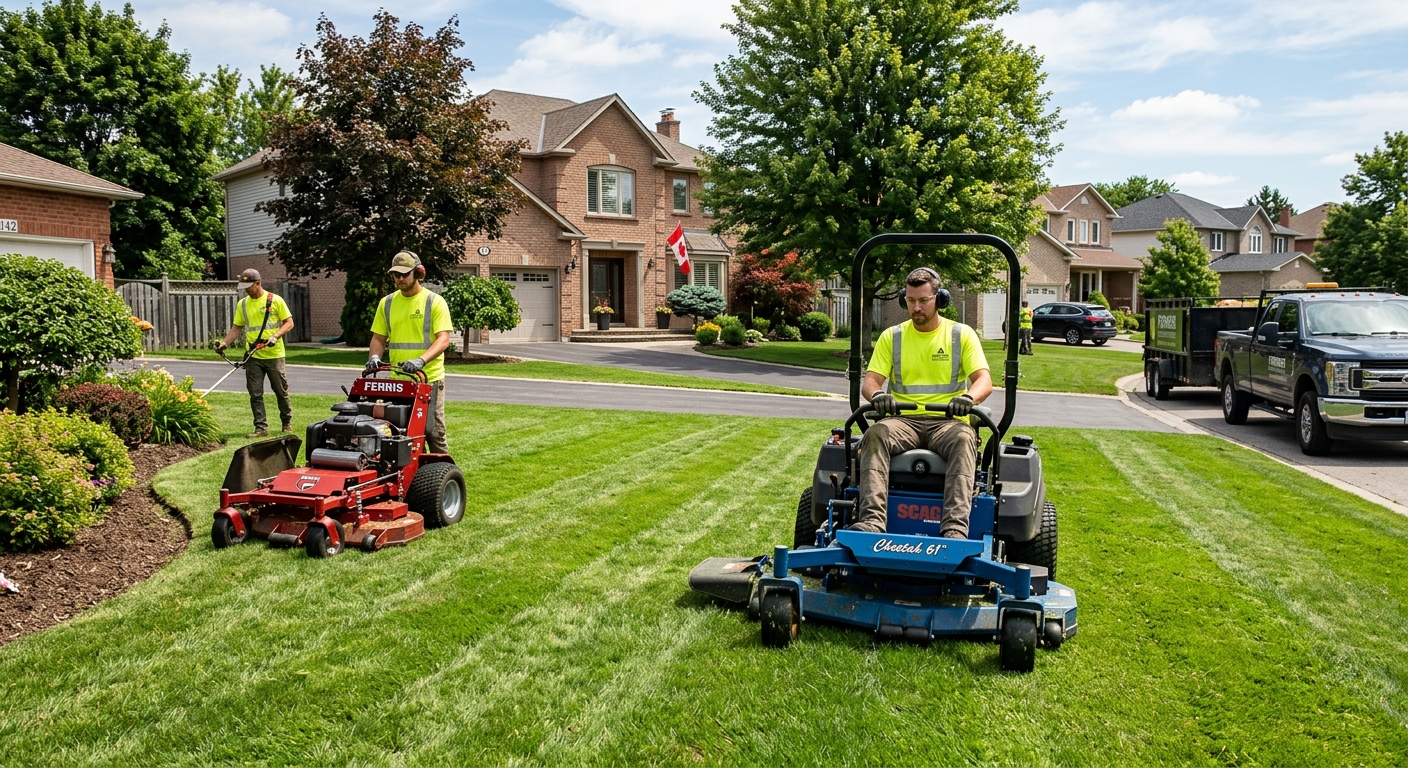
Landscaping options and costs in Kanata
Landscaping in Kanata is a smart investment because most homes here sit on a property where you can see (and enjoy) the results year-round—and, according to the 2021 Census, Kanata’s broader area is home to roughly 90,000 residents (Statistics Canada, 2021 Census). Many neighbourhoods are built around single-detached housing patterns, which means there’s real driveway, lawn, and bed space to improve—so competitive pricing and scheduling are often strongest when homeowners plan projects together.
In Ottawa’s plant hardiness range (Zone 4b–5a), the climate directly shapes cost. You’ve got a genuine winter, a pronounced freeze–thaw cycle, and a frost-free window roughly May to October. That matters because soil work, planting, and the granular base prep needed for patios or interlocking all have to be done when the ground isn’t frozen and when drainage can be properly established. It also affects contractor availability: by late spring and early summer, demand spikes in areas like Kanata West and the Beaverbrook/Kanata Lakes corridors where family homes commonly need curb-appeal refreshes and backyard upgrades.
For budgeting, the biggest swings usually come from how much of your yard is softscape versus hardscape, plus whether you need grading corrections for clay-rich soils. A comprehensive plan (design + installation) might run mid-five figures for full-yard scope, while more focused work—like sod, seeding, or a retaining wall—fits within defined price bands. Use the table below to compare typical options and then match your scope to the right contractor.
| Service |
Description |
Season |
Price Range |
| Full landscape design and installation |
Site visit, concept + layout, grading/soil amendments, planting, lawn plan, hardscape (as selected), and installation coordination |
May to September |
$5,000–$50,000 |
| Sod installation (supply, grade, lay, roll) |
Light grading, soil prep, nutrient starter, sod delivery, laying pattern, rolling, and initial watering guidance |
Late April to early June (or fall in limited cases) |
$1,500–$8,500 |
| Lawn seeding (grade, seed, starter fertilizer) |
Fine grading, seed selection for northern lawns, starter fertilizer, seeding, light raking, and mulching where needed |
May and early September |
$1,200–$6,500 |
| Interlocking patio or walkway |
Excavation, deep compaction, base/sub-base, bedding sand, paver installation, and edging |
May to September |
$4,000–$25,000 |
| Retaining wall (interlocking block) |
Engineering/plan support when needed, base excavation, compacted granular backfill, drainage layer, and block installation |
June to September |
$4,000–$30,000 |
| Tree and shrub planting |
Soil amendment, digging, staking (if required), root protection, mulch ring, and plant placement for winter hardiness |
April to October (best in spring and early fall) |
$800–$10,000 |
Prices are estimates only and vary by project scope, site access and material selection.
What affects the price of landscaping in Kanata
In Kanata and the wider Ottawa area, quotes for the same “type” of landscaping can still vary by 30–50% because contractors may price different levels of site prep, drainage detail, and plant size. Two yards can look similar on a brochure, but if one has compacted clay, a slope, and poor runoff management, the labour and materials required jump quickly. That’s why a patio with the same square footage can land far above a baseline if the contractor has to build a deeper granular base and add proper drainage to manage freeze–thaw movement.
Climate is part of the equation. Kanata sits around Zones 4b–5a with freeze–thaw cycles that can heave poorly built patios, steps, and retaining walls if the base isn’t deep and well compacted. Ottawa’s frost-free growing season is roughly May to October, so most planting and soil work must fit inside that narrower window—meaning crews and equipment are in higher demand during summer. Prairie regions (Zone 2–4) generally need more drought- and wind-tolerant palettes and can have short growing windows, so their labour may be priced differently; coastal BC (Zone 7–8) often supports a longer planting season and lush growth, but heavy rainfall makes drainage a different cost driver. In southern Ontario (Zone 5–6) you still need irrigation planning for summer dry spells, but constraints are usually less extreme than the dry BC interior, where water restrictions can force drip-focused designs.
In Kanata specifically, two common cost changers are: (1) clay-rich soils that require soil amendment quantities and proper grading to prevent spring saturation, and (2) access constraints—tight driveways or backyard gates—that increase labour for hauling stone and topsoil. If your project includes a retaining wall, the need for deep granular backfill and drainage can push hardscape budgets toward the $4,000–$30,000 range, while a lawn replacement via sod may land inside the $1,500–$8,500 band depending on yard size and prep complexity.
| Price Factor |
Why It Matters |
Cost Impact |
| Yard size in sq ft — the primary cost driver for softscape |
More area means more topsoil, amendment, labour time, and material quantities (seed/sod, mulch, plants) |
Higher area typically multiplies both labour and materials; small yards can cost more per sq ft |
| Grading and drainage work — slope corrections add significant cost |
Proper slope and runoff control reduces pooling and foundation moisture risk |
Often adds the equivalent of a “major item” even when hardscape stays the same |
| Drainage bed or French drain installation |
Clay soils trap water; drains manage freeze–thaw and prevent spring saturation |
Material + excavation + pipe/gravel costs can noticeably increase totals |
| Plant material tier — native shrubs vs. ornamental vs. mature specimen trees |
Genetics, size, and root-ball quality change both price and planting labour |
Upgrading to mature stock can shift budgets by thousands |
| Hardscape vs. softscape ratio — walls and patios cost more per sq ft than lawn |
Hardscape needs excavation, compaction, base layers, pavers/block, and often more perimeter detailing |
More stone means higher overall budget even if “total square footage” looks similar |
| Irrigation system design and installation |
Zones, head type, backflow prevention (where applicable), and layout affect coverage and labour |
Can add substantial cost, but may reduce replanting and water waste |
| Soil amendment and topsoil required |
Ottawa clays and disturbed soils often need structured amendments to support roots |
Large amendment volumes increase material delivery and spreading time |
| Tree removal or stump grinding before new planting |
Root removal, hauling, and stump grinding are separate scope items with specific equipment needs |
Can add several thousand depending on access and disposal requirements |
Permits & regulations in Ontario
In Ontario, most typical landscaping work—like planting beds, sodding, lawn installation, mulching, and the majority of softscape—typically does not require a building permit. That said, certain projects cross into “structure” and “grade change” territory. A retaining wall is the most common example: if the wall height is above the municipal threshold (commonly around 1.0 m in many areas), you should expect a building permit and sometimes engineered drawings. Also pay attention to changes to lot grading: if your grading plan redirects surface water toward a neighbouring property or toward storm infrastructure in a way that’s not already approved, it can trigger approvals or require documentation.
Before any digging—planting holes, drain trenches, or wall footings—ensure utility locates are completed. Even if you’re only putting in a small French drain, you still need to know where services run. For water-use rules, Ontario homeowners generally don’t face the same daily watering bans as parts of the dry BC interior, but you should still confirm irrigation and watering-bylaw expectations for your specific township/municipality during summer and any drought advisories.
To verify a contractor is compliant in Ontario, do it in three steps: (1) confirm their business licence/registration status and credentials through online provincial/municipal resources where applicable; (2) request a certificate of insurance showing liability coverage (and ask whether sub-contractors are insured); and (3) verify WSIB/WCB clearance (or an equivalent status letter) before work starts. Ask for the clearance letter directly—reputable crews provide it without resistance.
Planning a landscape that thrives in Kanata's climate
A successful Kanata landscape works with Zone 4b–5a winters and Ottawa’s freeze–thaw cycle instead of fighting it. Start with plant selection: choose hardy, zone-appropriate species and build a layered mix of shrubs and perennials that can handle winter burn, spring thaw, and humid summers. If you’re aiming for lower watering and fewer failures, native and climate-tested plants are usually the best value over the long run because they’re better adapted to our soils and cold snaps.
Sod versus seed is another key planning decision. Sod gives instant visual results, but in practice it costs roughly 3–4x more per sq ft than seeding because you’re paying for the sod product and tighter installation labour. Seeding is slower to fully “feel finished,” but it’s more economical and often performs very well when timed right for our frost-free growing season (roughly May to October). As a budget example: if your project targets a lawn renewal in the $1,500–$8,500 range, you may be able to expand planting areas or add proper topsoil and amendment prep instead of upgrading to full sod—particularly if you can tolerate a seed establishment period.
Drainage and grading are make-or-break in Ottawa. Clay-rich areas can pond in spring, increasing foundation moisture risk and stressing new plants. For hardscape like patios and retaining walls, base prep must account for frost depth: deep, well-compacted granular layers and proper drainage layers reduce heaving and long-term settlement. For low maintenance, use mulched shrub borders, groundcovers, and perennials to reduce annual weeding; consider rain-garden elements or a bioswale-style planting bed for runoff management when you want curb appeal without constant watering.
| Element |
Climate Consideration |
Maintenance Level |
Price Band |
| Sod lawn installation |
Best established before summer heat and during the May–early June window; needs consistent early watering |
Low short-term, moderate ongoing (first season focus) |
$1,500–$8,500 |
| Native perennial garden |
Hardy species handle spring thaw and winter dieback better than tender ornamentals |
Low to moderate (spring cleanup, occasional top-ups) |
$1,200–$6,000 |
| Mulched shrub border |
Mulch insulates roots through freeze–thaw and moderates moisture in humid summers |
Low (weed suppression + periodic mulch refresh) |
$800–$4,500 |
| Interlocking stone patio |
Requires deep compaction and drainage to prevent heaving during winter cycles |
Low (periodic joint sand/edge checks) |
$4,000–$25,000 |
| Retaining wall (block) |
Needs granular backfill and drainage behind the wall to manage water pressure and freeze–thaw |
Low after installation (inspection for drainage/settlement) |
$4,000–$30,000 |
| Drip irrigation system |
Helps protect new plantings through summer dry spells while improving watering efficiency |
Moderate (seasonal checks, winterisation) |
$1,000–$6,000 |
How to choose a landscaping contractor in Kanata
Choosing the right landscaping contractor in Kanata is mostly about verifying capacity and protecting yourself on paper. For Ontario compliance and risk control, ask for three things before signing: (1) proof of liability insurance (and confirm the coverage is current and that sub-contractors are covered); (2) WSIB/WCB coverage or a current clearance letter/status document (request it by name and show the dates); and (3) confirmation the contractor operates lawfully as a business in Ontario where applicable.
Then get 2–3 itemised written quotes—not just a single “lump sum.” Your quote should break labour and materials separately (for example: topsoil + amendment quantities, sod/seed amount, stone base depth, drainage pipe and gravel, and plant sizes). Read the exclusions: is disposal included (soil/rock haul-away)? Are utility locates included? Is topsoil re-use allowed or does everything get removed? Does the price assume normal access or does it include extra costs for crane/raised delivery or long haul from the front?
Warranty matters too. Ask for the workmanship warranty length and what it covers (settlement, heaving, plant replacement policy) and whether it’s tied to ongoing maintenance requirements. Product/manufacturer warranties are usually limited to the plant/material itself, so make sure you understand what’s “workmanship” versus “plant performance.”
For payments, avoid heavy upfront transfers: never pay more than about 10–15% upfront, and use a holdback (often until final grading and cleanup are complete). Finally, demand a written start date and a completion estimate; Ottawa weather can shift timelines, but good contractors document contingencies.
- Confirm liability insurance and request the certificate before any work begins.
- Request WSIB/WCB clearance/status letter and verify the dates.
- Insist on itemised pricing: labour, materials, and equipment separate.
- Ask who pulls permits (if required) and whether permit fees are included.
- Confirm disposal/haul-away is included for excavated soil/stone.
- Check base build specifications: depth, compaction method, and drainage layers.
- Verify plant sizes, cultivars, and replacement terms for failed stock.
- Get the irrigation scope in writing (if included): zones, head types, winterisation steps.
- Ask for a detailed timeline with start and completion dates.
- Review the warranty details in plain language (workmanship vs materials).
- Ensure a payment schedule includes a holdback until substantial completion.
- Confirm equipment access plan for Kanata driveways and backyard gates.
Red flags in Kanata: (1) no WSIB/WCB clearance letter or refusal to provide it; (2) vague “we’ll level it” language without grading/drainage specifics; (3) a quote that’s mostly lump sum with no base-depth or drainage-layer detail; (4) asking for large upfront payments well beyond 10–15%; and (5) promising winter-proof patios/retaining work without discussing proper granular bases and drainage for freeze–thaw.
Frequently asked questions — landscaping in Kanata
How long does a landscaping project take in Kanata?
In Kanata, timing depends on scope and on how weather impacts excavation and soil work. Most planting and softscape tasks can be done within days to a couple of weeks once materials arrive, but complete yard projects often take longer because crews need time for excavation, base construction, compaction, drainage work, and final finishing. Interlocking patios and walkways typically require several days for demo, base build, stone setting, edging, and cleanup, while retaining wall projects can take longer due to layered granular backfill and drainage details. Because the frost-free growing season runs roughly May to October, scheduling flexibility matters; spring saturation and late fall frost can slow work. Homeowners in Ottawa should also plan for material lead times, especially for stone and larger plant stock (Statistics Canada, 2021 Census).
What is the best grass type for a Kanata lawn?
For Kanata lawns in Ontario’s Zone 4b–5a, the “best” grass is usually a blend of cool-season turf types chosen for northern performance and winter hardiness. Contractors commonly recommend mixes that tolerate cold, spring thaw stress, and summer humidity. If you’re comparing options for budget, seeding is often a better match for smaller, patchy areas because it establishes well when timed for May and early September. If you need rapid coverage for appearance—like before a family event—sod can work, but it’s typically in the $1,500–$8,500 band depending on prep and yard size. A good contractor should also specify seeding rates and include starter fertilizer guidance so the lawn roots deeply enough to handle freeze–thaw cycles.
When should I aerate and overseed my lawn in Kanata?
In Kanata, aeration and overseeding are usually best in early fall (often August through early September) when temperatures cool and the lawn can recover before winter. Spring can work, but avoid doing it too early if the lawn is still under stress from thaw conditions—waterlogged soil can make compaction worse. If you’ve got heavy clay, aeration helps open soil channels so roots and seed can connect. After overseeding, keep the top layer consistently moist for germination (without flooding), and then switch to deeper, lighter watering habits. If your contractor quotes full-yard refresh work as part of a broader plan, ask whether soil amendment is included, since that impacts how well aeration and seed establish during Ottawa’s wet spring shoulder season.
What trees grow best in Kanata's climate zone?
Kanata’s Zone 4b–5a climate favours hardy deciduous and conifer trees that can handle winter cold and spring moisture swings. Common “safe bet” selections include varieties of spruce, pine, and cold-tolerant shade trees (with spacing appropriate for mature width). Your best fit depends on sun exposure and soil drainage: in lower spots, trees that tolerate wetter conditions usually do better than those that prefer very dry sites. If you’re planning a layered landscape, a typical approach is to pair a few structural trees with shrubs and perennials to create year-round coverage. For homeowners budgeting planting-only work, tree and shrub installation is often in the $800–$10,000 range depending on how many specimens, their sizes, and whether any stump grinding or excavation is required.
How much does sodding a yard cost in Kanata?
Sodding in Kanata typically lands in the $1,500–$8,500 range, but the final number depends heavily on preparation. If your existing lawn is uneven, compacted, or has drainage issues, costs rise because contractors may need more grading, soil amendment, and base prep for stable rooting. Access also matters: hauling sod through tight gates or long backyard runs adds labour time. Timing affects success as well; sod is usually easiest to install during late April to early June in Ottawa conditions (with continued attention during establishment). If your yard is relatively small and you’re not fighting drainage, seeding can be more budget-friendly, freeing dollars for planting borders or drainage improvements.
How do I prevent weeds in my Kanata garden?
Weed prevention starts with soil and mulch, not just pulling weeds. In Kanata, the freeze–thaw cycle can loosen topsoil and bring weed seeds to the surface, so clean bed preparation matters: remove existing weeds (including roots), amend the soil if it’s clay-heavy, and then install a thick mulch layer to block light. Use proper plant spacing so beds fill in—bare soil is where weeds win. For annual maintenance, plan a spring “reset” where you edge beds and refresh mulch before weeds establish. If you’re installing new shrub borders, consider landscape fabric only when used correctly under mulch (otherwise it can trap moisture and complicate future weeding). A well-designed border with native, zone-appropriate plants also reduces the frequency of rework. If drainage is poor, weeds can look worse—fixing water pooling helps every bed.