Landscaping options and costs in Waterloo
In Waterloo, landscaping budgets range widely because most homes sit on lots where you can both improve curb appeal and manage drainage, and the city’s housing mix supports that demand—about 49.2% of dwellings are single-detached homes (Statistics Canada, 2021 Census), and 61.3% of households are homeowners, which typically means residents invest in long-lived upgrades. With 32.9% of homes built before 1981 (Statistics Canada, 2021 Census), many properties also face older grading patterns and aging walkways or retaining edges that need correction.
In the Kitchener–Waterloo–Barrie region (Zone 5b–6a), winters are cold and the frost window is real. That pushes up costs for projects like patios, walkways and retaining walls because contractors must build deep, well-compacted granular bases and detailed drainage so freeze–thaw doesn’t lift the surfaces. Crews are most available from mid-April through October, so timing affects scheduling and sometimes pricing for longer installs. When summer dry spells hit, efficient irrigation zoning and drought-tolerant turf and planting also become a cost consideration—especially for larger properties.
Demand is especially strong in neighbourhoods with lots that tend to be larger and more established, such as north Waterloo areas near Erbsville Road and the Bridgeport/University corridor, where families often update both front and backyard functionality in the same season.
Below is a practical way to compare typical Waterloo scopes and price bands—then you can match the option to your goals and the condition of your yard.
| Service |
Description |
Season |
Price Range |
| Full landscape design and installation |
Site visit, layout, grading/drainage plan, plant + hardscape install, and cleanup |
Mid-April through October (best availability) |
$8,000–$60,000 |
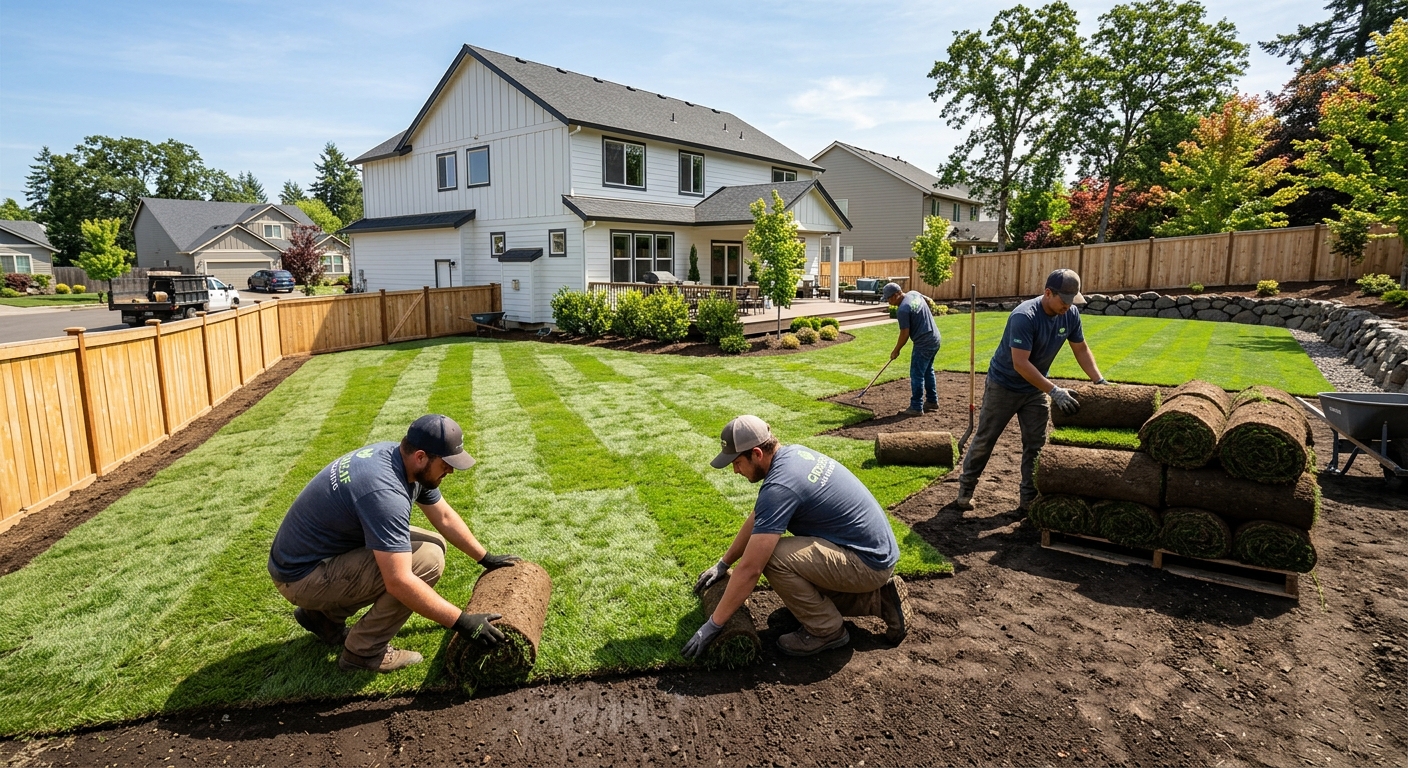
| Sod installation (supply, grade, lay, roll) |
Topsoil prep, base/grade corrections, sod delivery, lay, roll and starter fert |
Late spring to early fall (avoid extreme heat) |
$5,000–$10,000 |
| Lawn seeding (grade, seed, starter fertilizer) |
Light grading, seed blend, starter fertilizer, mulch (as needed) |
Early spring and early fall |
$1,200–$4,000 |
| Interlocking patio or walkway |
Excavation, granular base, edge restraints, interlocking stones, joint sand |
Warm, drier months |
$3,500–$18,000 |
| Retaining wall (interlocking block) |
Base prep, drainage layer, filter fabric, block placement and caps |
April to September |
$5,000–$25,000 |
| Tree and shrub planting |
Soil amendment, planting, staking (if needed), mulching and watering plan |
Spring and fall |
$500–$15,000 |
Prices are estimates only and vary by project scope, site access and material selection.
What affects the price of landscaping in Waterloo
In Kitchener–Waterloo–Barrie, you can see quotes for the “same” landscaping idea vary by 30–50% because the final cost is driven by unseen site realities—soil condition, drainage, access, and how much frost protection a contractor has to build into the base. Even within Ontario’s moderate climate, job difficulty can change quickly from one property to the next: a backyard with good soil and flat grades may fit the lower end of the $8,000–$60,000 full-install range, while a sloped lot with drainage issues can push the same plan toward the top.
The plant hardiness zone and frost dates shape both what grows and what the working season allows. In a Zone 5b–6a yard, crews must complete structural base work in suitable weather and build for freeze–thaw, not just “good summer days.” In colder Prairie regions (Zone 2–4), projects often require even more drought- and wind-hardy species and careful base depth for longevity. Coastal BC (Zone 7–8) tends to allow longer growing windows and lush planting palettes, but the heavy rain profile can increase drainage costs. By contrast, southern Ontario offers a moderate season with irrigation needs during summer dry spells, especially in established neighbourhoods where clay soil and impervious surfaces can dry unevenly.
Concrete Waterloo examples: (1) If your property has low spots near the foundation, correcting grading and adding drainage can move a patio from “surface-level” pricing into full base reconstruction—often a several-thousand-dollar swing. (2) If you’re choosing mature specimen trees versus smaller stock, the difference can be substantial because larger sizes require bigger root balls, stricter installation and sometimes staking and extra amendments. (3) If your plan includes retaining walls, costs rise because the base must be deep and granular and the drainage layer must be engineered for freeze conditions.
Lastly, older housing stock matters—homes built before 1981 often have outdated drainage or compacted soils, which can mean additional soil amendment and re-grading that aligns with the region’s frost-protection expectations and increases labour time.
| Price Factor |
Why It Matters |
Cost Impact |
| Yard size in sq ft — the primary cost driver for softscape |
More lawn and planting means more topsoil, labour hours and materials |
Can move pricing by several thousand dollars |
| Grading and drainage work — slope corrections add significant cost |
Pooling and foundation risk require re-shaping the yard |
Often increases scope beyond initial estimates |
| Drainage bed or French drain installation |
Reduces freeze–thaw damage by moving water away |
Typical hard cost bump for added excavation + pipe + stone |
| Plant material tier — native shrubs vs. ornamental vs. mature specimen trees |
Larger, premium stock costs more and needs more labour to install |
Can shift the job into the mid/high end of the $500–$15,000 planting band |
| Hardscape vs. softscape ratio — walls and patios cost more per sq ft than lawn |
Stone, base, and structural work are labour- and material-intensive |
Often raises project totals faster than adding more turf |
| Irrigation system design and installation |
Zoned coverage and efficient heads matter during dry spells |
Changes pricing depending on controls, zones and trenching |
| Soil amendment and topsoil required |
Clay compaction, low organic matter and poor drainage reduce plant survival |
Additional truckloads and amendments increase labour and disposal complexity |
| Tree removal or stump grinding before new planting |
Clearing impacts excavation, roots, and re-grading requirements |
Can add notable extra days and equipment rental |
Permits & regulations in Ontario
For most Waterloo homeowners, the good news is that typical planting and softscape work generally does not require a permit in Ontario. Sodding, seeding, mulching, shrub and tree planting, and most driveway/adjoining lawn touch-ups are usually handled as landscaping work without a permit.
Where it changes is for retaining walls and grading that can affect drainage. In most municipalities, retaining walls above a height threshold—commonly around 1.0 m (3.3 ft)—often require a building permit and sometimes engineered drawings, especially if drainage, surcharge loads, or structural considerations are involved. Also watch grading: changing lot grading that directs water toward a neighbour or alters storm drainage connections can trigger approval requirements depending on how and where water will flow.
Before you dig any planting holes, install footings or trenches for drainage, always request utility locates (Call Before You Dig) so you don’t hit buried services. For water-use rules, confirm your irrigation approach aligns with local bylaws and seasonal restrictions—while Waterloo doesn’t typically mirror the strictest interior BC patterns, enforcing efficient irrigation habits is still common practice during dry stretches.
To verify a contractor properly in Ontario: (1) check the business licence/registration status where applicable via local/official listings, (2) request a certificate of insurance showing general liability coverage and confirm limits are appropriate for your scope, (3) ask for WSIB/WCB clearance documentation (or the correct proof for your contractor type), and (4) ensure everything is in writing before work starts, including what happens if permit requirements are triggered.
Planning a landscape that thrives in Waterloo's climate
To plan landscaping that truly thrives in Waterloo, work with Zone 5b–6a conditions, not against them. That means choosing plants that can handle cold winters and freeze–thaw, and designing drainage so water doesn’t sit in low areas where it will freeze and lift surfaces. In Waterloo’s market, we also balance cost and results: sod gives instant visual impact, but it’s usually more expensive and less tolerant of contractor shortcuts in preparation.
Plant selection: Prioritise native and hardy species suited to the local zone. They establish more predictably and require less winter protection than marginal varieties. Sod vs. seed: Sod is typically about 3–4x the cost per sq ft compared to seeding, but it can be justified if you need quick usable lawn for kids/pets or to prevent erosion on a newly graded slope. If your goal is “green coverage this season,” that premium can be worth it; if your goal is long-term cost control, seeding paired with correct soil prep often wins.
Drainage and grading: Proper grading is essential in the Kitchener–Waterloo–Barrie region. It prevents pooling, reduces foundation moisture risk, and helps keep roots from freezing and thawing repeatedly. Hardscape base prep: Patios and retaining walls must be built on deep, well-compacted granular bases with proper drainage so frost heave doesn’t crack or lift stone.
Low-maintenance strategy: Use mulch rings, groundcovers, and perennials to cut annual weeding, and add a rain garden or bioswale in wetter spots. In drier stretches, pair efficient zoned drip irrigation with drought-tolerant turf and plantings to avoid overwatering.
Dollar example: if you’re replacing a lawn area and comparing a sod install at the higher end of the lawn band versus seeding, spending more on sod may be justified for a small, visible front-yard area—while a larger backyard often makes better financial sense with seeding and better grading first.
| Element |
Climate Consideration |
Maintenance Level |
Price Band |
| Sod lawn installation |
Needs strong soil prep to survive spring/fall temperature swings and winter heave risk |
Low to moderate (watering the establishment period is key) |
$5,000–$10,000 |
| Native perennial garden |
Hardy structure for Zone 5b–6a; better resilience through freeze–thaw cycles |
Low (weed control early, then mulch and seasonal tidy-ups) |
$2,500–$12,000 |
| Mulched shrub border |
Mulch moderates soil temperature and helps reduce winter stress |
Low (pruning and occasional top-up mulch) |
$1,500–$7,500 |
| Interlocking stone patio |
Granular base depth and drainage prevent frost-driven movement |
Low (periodic joint sand and occasional spot leveling) |
$3,500–$18,000 |
| Retaining wall (block) |
Drainage layer behind wall is critical to avoid freeze–thaw damage |
Low (annual inspection for cracks/settling) |
$5,000–$25,000 |
| Drip irrigation system |
Zoned, efficient watering helps during summer dry spells |
Moderate (winter blow-out/seasonal adjustments) |
$1,200–$6,500 |
How to choose a landscaping contractor in Waterloo
When you’re hiring in Waterloo, start with proof—not promises. First, ask for Ontario licensing/registration details where applicable, then request a certificate of insurance showing general liability coverage. Next, confirm WSIB/WCB coverage and ask for clearance documentation (or the correct proof tied to the contractor’s work classification). A contractor who can’t provide these documents quickly is a risk, especially on projects that involve excavation, drainage trenches or hardscape.
Get 2–3 itemised written quotes, not one lump-sum. A proper quote breaks labour and materials line-by-line (topsoil/stone volumes, base thickness, stone type, plant count and sizes, excavation depth, disposal, and irrigation components). Read the scope carefully for exclusions: is demolition included? Is disposal included or will you pay separate dump fees? Is an erosion-control plan included for grading? Will they pull permits if retaining wall thresholds or drainage changes require it?
Warranty matters too. Ask for the workmanship warranty length and what it covers (settlement, re-levelling, plant replacement). Confirm product/manufacturer warranties separately and whether they’re transferable to you as the homeowner. For payments, never pay more than 10–15% upfront; hold back the remainder until the job is complete and walk the site with the contractor. Also get the start date and an estimated completion timeline in writing—especially important in Zone 5b–6a because weather can compress the season.
- Request WSIB/WCB clearance proof before work starts.
- Confirm general liability insurance with policy limits on the certificate.
- Ask for 2–3 recent Waterloo project references with photos and contact info.
- Get itemised quotes with quantities (sq ft, linear ft, tree sizes, plant counts).
- Ensure drainage/grading assumptions are written down (slope targets, outfall location).
- Clarify hardscape base specs (granular type/thickness, compaction, edge restraints).
- Ask whether disposal, site cleanup, and final grading are included.
- Confirm topsoil/soil amendment type and volume (not “topsoil” with no numbers).
- Verify plant warranty: replacement for winter kill/establishment failures.
- Review the schedule: start date, weather contingency, and final completion estimate.
- Payment schedule: no large upfront deposits; keep a holdback until acceptance.
- Make sure they provide a contract with scope, warranty and total price.
Common red flags in Waterloo: vague scope that doesn’t list base thickness or drainage details; refusal to provide WSIB/WCB or insurance paperwork; “cash discount only” without a written contract; missing disposal/cleanup terms; and a warranty that’s limited to “materials only” with no workmanship coverage.
Frequently asked questions — landscaping in Waterloo
How do I prevent weeds in my Waterloo garden?
Weed prevention starts with correct soil prep and a clean planting layout—especially in Waterloo where freeze–thaw and spring melt can expose bare soil. For garden beds, we recommend a thick 5–7 cm mulch layer (replenish annually) and using landscape fabric only where appropriate (it’s not a universal solution, particularly in areas you want roots to expand). The biggest win is reducing bare ground: add a groundcover layer or dense perennial planting so weeds don’t get light. If you’re seeding a lawn, seed-to-soil contact matters—poor grading leads to thin spots where weeds move in. For larger projects, a full bed refresh can also be priced within typical landscape installation ranges from $8,000–$60,000, depending on excavation and planting quantity (Statistics Canada, 2021 Census).
How do I design a low-water yard in Waterloo?
A low-water yard in Waterloo focuses on efficient watering and drought-tolerant choices that still handle Zone 5b–6a winters. Start with grading: if water runs off too quickly, plants dry out; if it pools, roots suffer and then fail in the freeze–thaw cycle. Then choose hardy, native or zone-appropriate shrubs and perennials that don’t need heavy summer watering once established. For irrigation, design zoned coverage with drip irrigation in beds (and separate zones for any turf). Add smart controls or a rain-sensor so the system doesn’t overwater after rainfall. If you’re comparing lawn options, seeding is often a lower-cost path than sod, but it still needs establishment watering; sod can be more expensive, commonly landing in the range of $5,000–$10,000 for many typical residential sizes, so we use it strategically for visible, quick-results areas.
How do I find a licensed landscaper in Waterloo?
In Waterloo (Ontario), you’ll want to verify three things before hiring: licensing/registration where applicable, general liability insurance, and WSIB/WCB coverage. Ask for the contractor’s proof of insurance (certificate of insurance) and confirm the policy covers landscaping/excavation-related work if your project includes drainage trenches or hardscape bases. For WSIB/WCB, request clearance documentation or the correct proof tied to the contractor’s classification. Next, compare at least 2–3 itemised quotes so you can see whether they’re using realistic quantities and base specs. Avoid contractors who won’t put scope details in writing (what’s included/excluded, disposal, permit responsibility). For many neighbourhood projects around Waterloo, experienced crews work primarily mid-April through October due to frost and weather, so confirm their season availability and timeline in your contract.
How much does landscaping cost in Waterloo?
Landscaping cost in Waterloo depends on how much hardscape, grading and planting are involved. For full-service design and installation, many residential projects fall into the mid-range of $8,000–$60,000 depending on yard size, site access, and whether drainage corrections or retaining walls are needed. Lawn work varies: sod installs are often budgeted higher than seeding, with typical sod projects commonly landing in the $5,000–$10,000 range for many standard residential areas, while seeding and prep may be far less. If you’re adding trees and shrubs, planting-only budgets often fit within $500–$15,000 based on the number of plants and whether you’re using larger specimens. Waterloo’s Zone 5b–6a climate also drives costs for stonework because frost protection requires proper base depth and drainage to reduce freeze–thaw damage.
What plants thrive in Waterloo's climate zone?
Waterloo’s Zone 5b–6a climate favours hardy plants that tolerate cold winters and handle freeze–thaw cycles. In practice, we steer homeowners toward native or well-adapted shrubs and perennials that don’t require delicate winter shelter. For lawns, a resilient turf choice matters because spring conditions can be wet and winter conditions can be harsh. In beds, mature shrubs and perennials establish better when installed into properly amended soil and mulched correctly. If you’re building a border that also supports low water, mix drought-tolerant perennials with hardy woody plants so you’re not relying on one species. If you’re planting into an area with pooling, drainage improvements should come first—otherwise even the best plant palette can fail. Many planting projects budget in the $500–$15,000 band depending on plant sizes and counts.
Sod vs seed — which is better for a Waterloo lawn?
In Waterloo, sod often looks better immediately, but it’s typically more expensive and more sensitive to prep quality. Seeding costs less and can be very effective when you do the grading right and keep consistent establishment moisture. A common rule of thumb is that sod costs about 3–4x more per sq ft than seeding because you’re paying for the sod rolls plus the added logistics. If your goal is quick curb appeal on a front lawn or erosion control on newly graded areas, sod can be worth budgeting at the higher end of lawn projects, often around $5,000–$10,000. If your goal is long-term value on a larger backyard, seeding usually wins—especially when paired with proper topsoil depth and starter fertilizer. Either way, Waterloo’s freeze–thaw cycle means you should plan timing carefully in spring or early fall rather than rushing in mid-winter.