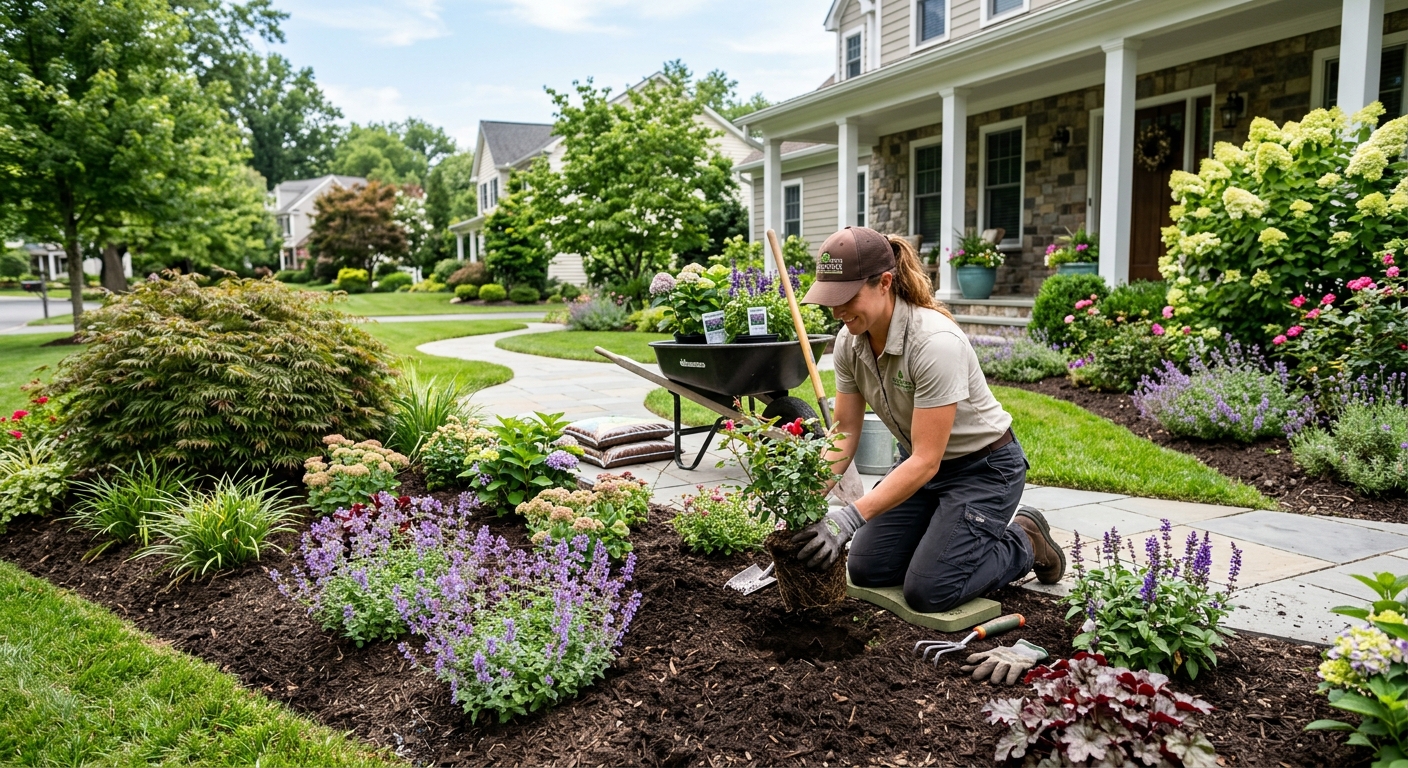
Landscaping options and costs in Milton
Milton, Ontario is a popular place to invest in outdoor living, and it shows: with 56.7% of area dwellings being single-detached homes, many properties have the yard footprint that makes patios, walkways and planted borders worth doing. Homeownership is also strong—33,085 homeowner households (82.6% of households own)—so many clients are willing to upgrade drainage, replace older lawns, and build long-term hardscape that won’t heave during Toronto-area freeze–thaw cycles. In the GTA (roughly plant hardiness zones 6a–7a), we design around winter lows near –23 to –18°C and hot, often humid summers, which typically means a reliable working window from late April/May through October. Labour availability can tighten near peak summer, and that affects scheduling and sometimes pricing, especially in high-demand areas.
In Milton, we see especially strong demand in and around Milton Heights, where many homes have established lots and homeowners want curb appeal upgrades that also manage water runoff toward municipal drains. Because local clay and fill soils can stay wet or compact unevenly, many projects start with excavation, soil amendment, and proper granular base prep—cost items that don’t look dramatic in a quote, but make the difference between “nice on day one” and “still solid after winters.” Use the table below as a realistic budget guide for common options; your final number depends on yard size, access, and material tier.
| Service |
Description |
Season |
Price Range |
| Full landscape design and installation |
Site visit, grading/drainage plan, planting plan, softscape + hardscape buildout |
Spring to fall (typically May–October) |
$8,000–$40,000 |
| Sod installation (supply, grade, lay, roll) |
Light grading, soil prep, sod delivery + install, starter fertilizer |
Late spring to early fall |
$2,500–$8,000 |
| Lawn seeding (grade, seed, starter fertilizer) |
Rake/breakup, grade correction, seed blend, starter fertilizer, light topdressing |
Best in spring and early fall |
$1,500–$5,500 |
| Interlocking patio or walkway |
Excavate, compact base, geotextile, interlocking stones, edge restraint, jointing sand |
Spring to fall |
$6,000–$25,000 |
| Retaining wall (interlocking block) |
Wall system, drainage rock/weep provisions, excavation and base build |
Spring to fall |
$6,000–$30,000 |
| Tree and shrub planting |
Soil prep, planting holes, staking as needed, mulch rings, watering guidance |
Spring to early summer; fall planting where soil isn’t frozen |
$800–$6,000 |
Prices are estimates only and vary by project scope, site access and material selection.
What affects the price of landscaping in Milton
In Milton, two homeowners can get quotes that look wildly different for what seems like the same yard update. In the Toronto area, it’s common to see pricing vary by roughly 30–50% because the “hidden” work—excavation, drainage correction, base prep for hardscape, and soil conditioning—can change a lot from lot to lot. Even when the end result is similar, one contractor may be building on properly compacted base and drainage layers while another is doing less of the stability work, and that difference shows up later when freeze–thaw cycles start pushing weak areas up or cracking edges.
Design choices also follow climate and the calendar. Ontario sits around hardiness zones 6a–7a, so we select plants that handle winter lows near –23 to –18°C, but we still plan installations around frost-free conditions. In Prairie regions (Zone 2–4), short seasons and frequent drought often force drought-tolerant, wind-hardy species and simpler grading, while retaining walls must reach below the frost line even more carefully. Coastal BC (Zone 7–8) supports a lush palette and longer growing window, which can lower labour pressure for planting but demands excellent drainage in heavy-rain zones. In southern Ontario, the season is moderate, yet summer dry spells still require irrigation planning.
Concrete examples from Milton: (1) If your yard slopes toward the foundation, the added grading and a proper drainage bed/French drain can move a project into a higher band—often pushing softscape within the $8,000–$40,000 “full install” range rather than a smaller planting-only budget. (2) If you’re replacing a struggling lawn with sod, sod installation typically lands in the $2,500–$8,000 band because the material quantity and prep matter. (3) Older homes—there’s a meaningful share built before 1981—can have older grading patterns or buried issues, which often requires extra excavation and soil amendment before you can build stable patios or walls.
| Price Factor |
Why It Matters |
Cost Impact |
| Yard size in sq ft |
Softscape quantities (sod/seed/soil/topsoil, mulch, labour days) scale directly |
Often the biggest swing; larger yards can double or triple material + labour |
| Grading and drainage work |
Toronto-area clay and fill can hold water; correcting slopes protects foundations and hardscape |
Can add substantial labour and trucking costs; frequently the main “scope” difference between quotes |
| Drainage bed or French drain installation |
Improves flow away from structures; reduces pooling and seasonal soft ground |
Material (pipe/rock/geotextile) + trenching increases costs, especially on tight lots |
| Plant material tier |
Native shrubs and smaller stock cost less; ornamental and mature specimens cost much more |
Premium plants can quickly move a project from “planting” into “full landscape install” pricing |
| Hardscape vs. softscape ratio |
Patios and retaining walls require deeper base, compaction, stone blocks, and stricter tolerances |
Hardscape tends to cost more per sq ft than lawn or shrub borders |
| Irrigation system design and installation |
Sprinkler/drip layout needs zone planning for Milton’s sun/shade and water demand |
Not always required, but full systems can add meaningful line-item cost |
| Soil amendment and topsoil required |
Clay-heavy sites may need import and conditioning for root development and drainage |
Costs vary with how much you need to remove/import and what’s available locally |
| Tree removal or stump grinding before new planting |
Impacts excavation access and can reveal additional buried roots or uneven grade |
Often adds labour and disposal; removal complexity drives price variability |
Permits & regulations in Ontario
In Ontario, most typical landscaping work does not require a permit, including planting beds, sodding, seeding, mulch installation, and routine grading that does not significantly alter drainage patterns. For most homeowners in Milton, you can usually have sod, lawn seeding, shrub borders, and patio “beautification” projects built without municipal approvals. However, retaining walls above the local height threshold—commonly around 1.0 m (3.3 ft) in many municipalities—often require a building permit, and the municipality may request engineered drawings depending on the wall design and soil conditions.
Also pay attention to any work that changes how water moves. Lot grading changes that affect drainage toward neighbouring properties or toward storm connections can trigger approval requirements. Before you dig for wall footings, drains, or even larger planting holes, contractors should arrange utility locates to avoid damaging buried services.
To verify a Milton contractor is properly set up, follow a practical step-by-step:
- Check the contractor’s Ontario business/contractor registration details on the appropriate public-facing sources (and confirm the correct legal entity matches the quote).
- Ask for certificate of insurance (liability insurance) naming your address as additional insured if required by your contract.
- Confirm WSIB/WCB clearance (or provide proof of coverage status). Don’t accept “we’re covered” without documentation.
- Request the contractor’s landscape scope breakdown in writing before work begins—especially for drainage layers and disposal.
- For permit-triggering wall projects, ask who pulls the permit and whether any permit fees are included.
For water-related work, confirm whether your contractor follows local irrigation and water-use rules—especially relevant during drought-prone periods, since water conservation expectations rise during dry spells in the region.
Planning a landscape that thrives in Milton's climate
In Milton, your best results come from designing for hardiness zone realities and how Toronto’s weather swings stress plants and surfaces. With winters that can plunge near –23 to –18°C and summers that are often humid, choose plants that are both zone-appropriate and region-ready for soils that can stay wet. Start with plant selection: favour hardy natives and proven perennials and woody shrubs that establish quickly, then reduce the amount of winter-specific protection needed.
Decide early between sod and seed. Sod gives instant curb appeal and quicker usability, but it’s usually about 3–4x more per sq ft than seeding once you factor in material and installation. Seeding is slower (and needs consistent moisture), yet it can be a smart approach for budget-conscious homeowners repairing lawn thinning.
In Toronto-area clay and fill, drainage and grading can be more important than plant variety. Pooling water stresses roots, creates patchy turf, and contributes to foundation moisture. For hardscape like patios and retaining walls, base preparation matters because freeze–thaw cycles punish shallow foundations—so we build granular bases and ensure proper geotextile and compaction depth.
To keep annual upkeep reasonable, use low-maintenance strategies such as mulched shrub borders, groundcovers, and perennial groupings rather than scattered, high-maintenance plants. Where appropriate, consider rain-garden style beds for stormwater capture and well-placed xeriscape zones (especially along hot, sunny edges) to reduce summer watering demand.
As a dollar example: if your front lawn needs a 400 sq ft replacement, sod often falls in the $2,500–$8,000 range depending on prep and access, while seeding can be less expensive and still produce a healthy lawn—provided drainage and irrigation are addressed. If water is pooling, paying for sod without fixing grade can cost you again.
| Element |
Climate Consideration |
Maintenance Level |
Price Band |
| Sod lawn installation |
Fast establishment before winter; requires correct grading to avoid winter heave and summer stress |
Medium (watering after install, mow schedule, minor repairs) |
$2,500–$8,000 |
| Native perennial garden |
Zone-appropriate plants handle Toronto winters and humid summers with less intervention |
Low to medium (seasonal pruning, mulch refresh) |
$2,000–$10,000 |
| Mulched shrub border |
Mulch stabilizes soil moisture and buffers freeze–thaw at the surface |
Low (weed control, occasional shaping and mulch top-ups) |
$800–$6,000 |
| Interlocking stone patio |
Needs a stable granular base to resist freeze–thaw movement and prevent edge settling |
Low (sweeping, occasional joint sand top-up) |
$6,000–$25,000 |
| Retaining wall (block) |
Correct base depth and drainage rock/weep provisions protect wall stability in winter cycles |
Low (inspection for settlement, keep drainage clear) |
$6,000–$30,000 |
| Drip irrigation system |
Targets roots and reduces evaporation during hot, humid summers; supports efficient watering during dry spells |
Medium (seasonal adjustments and controller checks) |
$2,500–$10,000 |
How to choose a landscaping contractor in Milton
Choosing the right landscaper in Milton is less about flashy photos and more about proof: insurance, coverage, written scope, and workmanship accountability. Start with licensing and coverage. In Ontario, you should verify that the contractor can legally operate and that they carry liability insurance. Ask for a certificate of insurance and confirm the coverage is active at the time of the project. Next, confirm WSIB/WCB coverage (or clearance status, depending on the contractor’s coverage situation). The practical way to check is to request a document or clearance letter and verify the company name matches the quote and contract—then keep it on file.
When you get quotes, require 2–3 itemised written estimates rather than lump sums. You want labour and materials broken out (excavation, base materials, stone/sod/seed quantities, drainage components, disposal, and any taxes). Read exclusions carefully: is disposal included? Is geotextile included under stone? Is the permit included if a retaining wall meets the threshold for approval? If irrigation is in the plan, confirm whether it includes trenching, backflow prevention requirements (where applicable), and controller/zoning.
On warranty, ask for two parts: a workmanship warranty (how long and what it covers) and any product/manufacturer warranty for stones, pavers, or plants. Also ask if warranties are transferable to future owners.
For payment, never agree to more than 10–15% upfront. Use a holdback until the job is complete and surfaces are accepted (especially for sod/seed and base prep items that reveal issues after settling).
- Confirm start date and target completion timeline in writing.
- Verify liability insurance before any materials arrive.
- Request WSIB/WCB clearance documentation.
- Ask for municipal permit responsibility for retaining walls if applicable.
- Ensure utility locates are included before digging.
- Demand itemised quantities (sq ft/linear ft) for sod, seed, stone, and drainage.
- Check whether grading includes topsoil import and removal/disposal.
- Ask what base depth and compaction standard is used under patios/walls.
- Confirm how drainage is handled at downspouts and low spots.
- Get a written maintenance handoff for lawns (watering schedule, first mow height).
- Clarify plant warranty terms (replacement policy if plants fail).
- Use a written change-order process for add-ons.
Red flags we see in Milton: contractors who won’t provide insurance/WSIB proof, quotes that omit disposal or base-depth details for stonework, “lowest price” offers with no drainage plan, vague scopes that change daily on site, and payment schedules asking for large upfront deposits without a signed agreement.
Frequently asked questions — landscaping in Milton
How long does a landscaping project take in Milton?
Most Milton projects take anywhere from a few days to several weeks, depending on whether you’re doing softscape only or combining hardscape, drainage, and planting. A small sod or mulched shrub refresh is often a shorter window, while patio and retaining wall work needs additional excavation, base preparation, and cure/settling time. In practice, we plan work around Ontario’s frost-free stretch (roughly May to October) and also consider that clay soils can be slow to dry after heavy rains. For example, an interlocking walkway can be completed in about 1–3 weeks including prep and finishing, while a full landscape design and installation—typically priced within the $8,000–$40,000 range—can run longer if drainage, multiple plant zones, and stone features are involved.
What is the best grass type for a Milton lawn?
For lawns in Milton, the “best” grass depends on sun exposure and how much maintenance you want, but most homeowners do well with cool-season turf grasses. Common choices include Kentucky bluegrass blends or tall fescue blends (often with fine fescue components), because they perform reliably through Ontario winters and recover after hot, humid stretches when watered properly. If your yard gets shade from trees, fescue-based mixes tend to hold up better. The key is not only the seed type—drainage and soil quality drive results as much as grass species. If your lawn struggles because of pooling, simply reseeding won’t fix the root cause. When you do choose between seed versus sod, remember sod is typically the faster route, often falling in the $2,500–$8,000 range for many Milton lots.
When should I aerate and overseed my lawn in Milton?
In Milton, the best aeration and overseeding timing is usually late spring to early summer, and again in early fall—whenever temperatures are suitable for germination and growth, without deep frost risk. If your lawn is compacted (common in high-traffic driveways near older patios or in yards with heavy fill), aeration helps seed-to-soil contact. Aeration alone won’t work if drainage is off; if water sits after rain, you’ll get patchy results. For overseeding, use the correct seed rate for your grass mix and apply starter fertilizer. If you’re debating sod replacement versus overseeding, note that sod offers quicker visual results but costs more; sod installation is often budgeted around the $2,500–$8,000 band, while overseeding programs can be less expensive and work well when soil and watering are dialled in.
What trees grow best in Milton's climate zone?
Milton sits around hardiness zones 6a–7a, so many common Ontario-appropriate trees can thrive when planted with proper spacing and soil prep. Homeowners often do well with hardy street-tree options such as serviceberry, small-to-medium ornamental cherries (where suited), and other cold-tolerant deciduous trees that establish reliably after winter lows. For privacy and structure, homeowners also choose layered plantings rather than relying on one large tree too close to foundations. The “best” tree depends on your site: full sun vs shade, how close roots will be to sidewalks or downspouts, and whether you have clay-heavy soil that needs amendment. A tree planting quote often falls in the $800–$6,000 band when it’s a small install, but mature specimen trees can push higher due to size, equipment needs, and staking.
How much does sodding a yard cost in Milton?
Sodding in Milton typically depends on yard size, how much grading is needed, and whether topsoil/soil amendment is required. For many residential lots, sod installation budgets commonly land in the $2,500–$8,000 range. If your lawn has low spots or poor drainage, expect the total to increase because prep work (excavation, soil amendment, and regrading) is what prevents uneven settling and winter heave. If access is tight—long wheelbarrow runs or limited equipment placement—labour and time can also add cost. A contractor who quotes low without accounting for grade correction is often skipping the work that protects the lawn after freeze–thaw. If you’re trying to replace a larger area quickly for curb appeal, sod is usually the fastest route.
How do I prevent weeds in my Milton garden?
Weed prevention in Milton starts with how the bed is built, not just spraying later. First, remove existing weeds and roots before planting, then improve soil structure so your plants establish and can outcompete opportunistic weeds. Apply a proper weed-control layer where appropriate (commonly fabric under certain paths/areas, but bed design still matters), then use a thick mulch layer—often 2–3 inches—around shrubs and perennial groupings. Mulch buffers soil temperature through Ontario winters and helps reduce moisture swings that trigger weed germination. Plant spacing matters: thin, overcrowded areas invite weeds. Also, choose hardy, zone-appropriate plants so they fill in faster. If you’re building a shrub border as part of a broader landscape install, many homeowners budget in the $800–$6,000 range for planting and materials, and that structure is what keeps maintenance lower over time.