Landscaping options and costs in Smiths Falls
Smiths Falls homeowners typically have a lot to work with: with a population of 9,254 (Statistics Canada, 2021 Census) and 53.0% of dwellings being single-detached homes, most properties have real yard area where softscape improvements (grass, planting beds, walkways) pay back visually and functionally. That matters here because 79.8% of homes were built before 1981 (Statistics Canada, 2021 Census), so many yards already have older drainage patterns, settled topsoil, and established shrub lines—changing the price even when the “look” you want is similar.
In Kingston–Pembroke (plant hardiness zones 5a–5b with pockets of 4b), landscaping costs are influenced by freeze-thaw cycling and the frost line. We design and build patios, retaining walls, and drainage systems with deeper, compacted granular bases so they don’t heave. The main seasonal constraint is the frost-free growing window (roughly May–October), which affects labour availability and how quickly crews can install and establish sod or perennials. In Smiths Falls—especially around town’s east-end and the areas near the Rideau Canal corridor—requests for clean curb appeal, low-maintenance borders, and regraded drainage are steady each spring as homeowners refresh older properties.
Below is a practical comparison of common landscape packages so you can sanity-check quotes before you book site visits.
| Service |
Description |
Season |
Price Range |
| Full landscape design and installation |
Site assessment, design/layout, grading and drainage coordination, planting plan, soil prep, seeding/sod, hardscape integration (patio/walk), and installation by crew |
May–October (design often starts earlier) |
$4,000–$30,000 |
| Sod installation (supply, grade, lay, roll) |
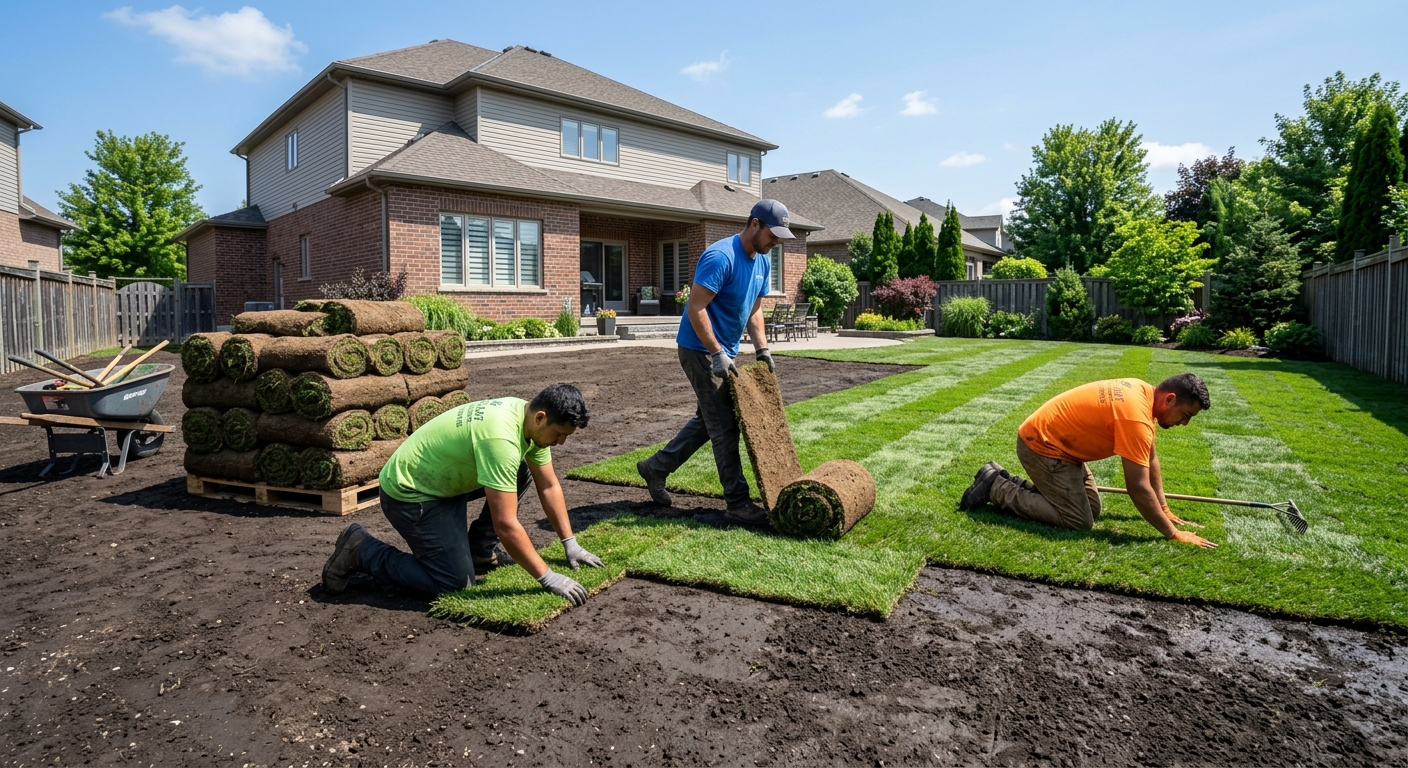
Grading to finish level, topsoil where required, sod supply, install, rolling, and cleanup; includes initial watering plan |
Late April–early October (best results in late spring/early summer) |
$2,500–$8,000 |
| Lawn seeding (grade, seed, starter fertilizer) |
Minor grading, seed selection for local conditions, starter fertiliser, light covering, and initial watering guidance |
April–June or late August–September |
$1,200–$5,000 |
| Interlocking patio or walkway |
Excavation, compacted granular base, geotextile, edge restraint, pavers, joints, and final leveling |
May–October (winter stone not typical) |
$5,000–$25,000 |
| Retaining wall (interlocking block) |
Layout, excavation, compacted base, drainage/gravel backfill, block installation, and cap/finish |
May–October |
$5,000–$35,000 |
| Tree and shrub planting |
Soil preparation, plant selection matched to zones 5a–5b/4b pockets, planting, staking where required, and mulch ring |
May–October (and spring window for bare-root, if offered) |
$1,000–$8,000 |
Prices are estimates only and vary by project scope, site access and material selection.
What affects the price of landscaping in Smiths Falls
In Smiths Falls and across Kingston–Pembroke, two contractors can price the same “yard refresh” 30–50% apart, even before you change materials. The biggest reasons aren’t brand-new trends—they’re site conditions, labour scheduling, and how much base preparation and drainage work is actually needed. In southern Ontario (zone 5–6), we usually have adequate rainfall compared with drier Prairie regions, but we still see summer dry spells that make mulch, soil improvement, and smart irrigation design important. Meanwhile, freeze-thaw cycling means patios and retaining walls often need deeper bases than homeowners expect, which drives cost into the $5,000–$35,000 retaining-wall band when site correction is required.
The climate shapes both what grows and when we can work. Zones 5a–5b (with some 4b pockets inland/northward) limit how long a planting crew can safely establish new turf or delicate perennials before winter. That’s why a sod job can sit in the $2,500–$8,000 band when soil prep and proper timing are included, while seeding may be lower but still needs correct grading and seed-to-soil contact.
Concrete examples from local jobs: (1) If your yard slopes toward the house, we often add regrading and surface drainage. That can bump labour because you’re not just “moving dirt,” you’re fixing the water path. (2) Older pre-1981 properties frequently have compacted layers and uneven topsoil; replacing or amending it costs more upfront, but it reduces future patching and plant stress. (3) If you want a mature specimen tree, you’re paying for larger root balls and more intensive planting labour, often pushing you toward the upper end of the $1,000–$8,000 planting range.
When you compare quotes, ask what each contractor is including for drainage, base depth, and soil amendments—those line items usually explain the spread.
| Price Factor |
Why It Matters |
Cost Impact |
| Yard size in sq ft — the primary cost driver for softscape |
More area means more labour hours, more topsoil/seed or sod, and more materials (mulch/edging) to finish cleanly |
Large projects can increase total cost by 40%–100% versus a smaller adjacent job |
| Grading and drainage work — slope corrections add significant cost |
Ontario freeze-thaw punishes poor drainage; fixing slope toward the right outlets protects foundations and lawns |
Can add a noticeable premium, commonly 10%–30% depending on how far regrading goes |
| Drainage bed or French drain installation |
Underground drainage requires excavation, gravel, perforated pipe, filter fabric, and routing to safe discharge |
Often shifts a “lawn-only” plan into a full install budget |
| Plant material tier — native shrubs vs. ornamental vs. mature specimen trees |
Size, transplant difficulty, and survival risk drive both material and labour costs |
Can double planting line items if moving from standard sizes to larger specimens |
| Hardscape vs. softscape ratio — walls and patios cost more per sq ft than lawn |
Hardscape needs excavation, granular base, and precise compaction; softscape is comparatively lighter work |
Switching 1,000 sq ft from lawn to patio can add thousands to the total |
| Irrigation system design and installation |
Even without strict provincial water bans in Ontario, efficient watering protects new sod and plantings during summer dry spells |
Typically adds a meaningful add-on cost when moving from manual watering to drip/smart timers |
| Soil amendment and topsoil required |
Clay/loam and older soils often need improvement for root establishment and drainage consistency |
Usually increases cost by the volume you’re importing (delivery + placement + compaction) |
| Tree removal or stump grinding before new planting |
Root work and stump grinding add equipment time and disposal costs before anything can be planted or graded |
Can add several thousand dollars depending on access and stump quantity |
Permits & regulations in Ontario
In Ontario, most typical yard work—planting beds, sodding, seeding, and most softscape additions—generally does not require a building permit. For a homeowner in Smiths Falls, that usually includes regrading within your existing landscape footprint, installing mulch and edging, laying sod, and planting shrubs and trees. The work that does require extra attention is retaining-wall construction when it crosses the municipal threshold (commonly around 1.0 m / 3.3 ft), where a building permit and sometimes engineered/structural documentation are needed. Also watch for any change to lot grading that alters drainage direction toward neighbouring properties or affects storm connections; those drainage changes can trigger approvals or additional requirements.
Before digging, confirm utility locates through the appropriate “call before you dig” process so you can protect buried services—especially for new planting holes, drain work, or wall footings. For irrigation, confirm Ontario and local water-use bylaws and watering-time guidance; while Ontario’s restrictions are not typically as strict as some western drought regions, municipal messaging is still common during hot spells and after dry periods.
To verify a contractor properly, do this step-by-step: (1) Ask for proof of general liability insurance and confirm it matches the job size and address; (2) check WSIB/WCB coverage where applicable by requesting clearance documentation and verifying it’s current; (3) confirm Ontario registration/licensing for the contractor category relevant to their scope (hardscape, drainage, excavation-related work can vary by trade); and (4) request a written proposal that states permit responsibility and whether any drawings/engineering are included if a retaining wall permit is required.
Planning a landscape that thrives in Smiths Falls's climate
Planning for Smiths Falls means building your yard around Kingston–Pembroke’s zone 5a–5b reality: cold winters with freeze-thaw, winter wind exposure, and a frost-free growing season that’s roughly May–October. Start with plant selection. Choose hardy, zone-appropriate native species and perennials that can handle winter conditions with less intensive protection. This approach matters because older homes (built before 1981 in many areas) often have established microclimates near foundations—sometimes drier, sometimes shaded—so matching plants to actual light and drainage saves you from constant replanting.
Next, decide sod versus seed carefully. Sod gives instant green, but in practice it can cost 3–4x more per square foot than seeding once you factor in the prep and materials. If you need quick curb appeal before a sale or event, sod is worth it; if you can wait for establishment, seeding often stretches your budget. For example, a 500 sq ft sod area often lands in the $2,500–$8,000 band depending on prep and soil import, while seeding a comparable area may fall within roughly the $1,200–$5,000 range when grading and starter fertilizer are included. That difference is justified when you’re trading cost for speed and uniformity.
Drainage and grading come before plants. Pooling water and foundation moisture are common failure points here, so plan surface grading and consider a drainage bed or French drain where the yard directs runoff improperly. For patios and retaining walls, base preparation is critical: deep, compacted granular bases and proper drainage backfill help prevent heaving during Ontario’s winter cycles.
Finally, use low-maintenance strategies: mulched shrub borders, groundcovers, and well-spaced perennials reduce annual upkeep. A rain-garden style planting area can also work well in this region when sized for runoff, letting you manage water efficiently without turning the yard into a constant watering project.
| Element |
Climate Consideration |
Maintenance Level |
Price Band |
| Sod lawn installation |
Needs a stable, well-prepped base and correct planting window before colder nights; protects against spring washouts |
Medium for the first season (watering + light care), then low |
$2,500–$8,000 |
| Native perennial garden |
Zone-appropriate plants tolerate winter cold better and rebound after freeze-thaw when mulch is applied |
Low once established (weeding early years, seasonal pruning) |
$1,000–$6,000 |
| Mulched shrub border |
Mulch buffers soil temperature swings and reduces moisture loss during summer dry spells |
Low (refresh mulch, periodic shaping) |
$1,500–$7,000 |
| Interlocking stone patio |
Requires deeper base and proper drainage to avoid settlement and frost heave |
Low (occasional joint sand touch-up) |
$5,000–$25,000 |
| Retaining wall (block) |
Needs compacted granular base and drainage backfill to handle freeze-thaw pressures |
Low after build (regular visual checks for drainage flow) |
$5,000–$35,000 |
| Drip irrigation system |
Helps during summer dry spells and targets watering to roots—important in zone 5 summers |
Low after setup (seasonal adjustments, controller checks) |
$1,500–$6,500 |
How to choose a landscaping contractor in Smiths Falls
Choosing a contractor in Smiths Falls is mostly about proof and process. Start with verification: ask for their Ontario business information (as applicable to their scope), a current certificate of general liability insurance (and confirm it lists you/address), and proof of WSIB/WCB clearance where applicable. Don’t just accept a verbal statement—request the clearance letter or documentation, check expiry dates, and make sure the coverage aligns with the type of work (excavation, hardscape, drainage, and landscaping crews can have different risk profiles).
Get 2–3 itemised written quotes—ideally separated into labour and materials. A good quote lists things like topsoil/soil amendments volume, stone sizes, geotextile use, base depth assumptions, planting counts/species sizes, and disposal/haul-away. Avoid “lump sum only” numbers if you want apples-to-apples comparisons.
Read the scope line by line: what’s excluded (tree removal, stump grinding, separate utility marking costs, permit fees if required for a retaining wall), is debris disposal included, and who is responsible for utility locates? For warranties, confirm workmanship warranty length and whether it covers settlement, heaving, and plant survival policies. Also ask if product/manufacturer warranties apply and whether they’re transferable to the homeowner.
Payment schedules should be conservative: never pay more than about 10–15% upfront. Use a holdback until the job is complete and you’ve confirmed grading, drainage flow, and cleanup.
Finally, insist on a written timeline: start date, expected duration, and key milestones like soil prep completion and when planting/sod will occur.
- Ask for proof of liability insurance and confirm coverage dates
- Request WSIB/WCB clearance documentation (not just a policy number)
- Get 2–3 itemised quotes with labour and material breakdowns
- Verify base depth and drainage notes for patios/retaining walls (freeze-thaw depends on it)
- Confirm whether topsoil and soil amendments are included and in what amounts
- Check disposal/haul-away is included (or clearly priced as an add-on)
- Ensure utilities locates (“call before you dig”) are part of the plan
- Ask how they prevent weeds (weed fabric use, soil prep, mulch thickness)
- Confirm plant substitutions policy if a nursery item is unavailable
- Review warranty terms in writing (workmanship + any product coverage)
- Use a payment schedule with a holdback until final grading/cleanup is verified
- Get start and completion dates in writing, including weather contingencies
Red flags to watch for in Smiths Falls: (1) quotes with no drainage/base details for patios or walls; (2) “we’ll figure out the permit later” without assigning responsibility; (3) large upfront payments (beyond 10–15%); (4) vague scope language like “prepare area” without topsoil/stone quantities; and (5) no proof of insurance/WSIB/WCB when asked.
Frequently asked questions — landscaping in Smiths Falls
How long does a landscaping project take in Smiths Falls?
In Smiths Falls, most landscape installs follow a May–October schedule, so timelines depend on frost-free conditions, material availability, and how much grading/drainage is required. A simple planting day (mulch + shrubs + basic edging) can be completed in 1–3 days. A sod replacement typically takes 2–5 days on site depending on grading and how much turf area you’re covering. Interlocking patios usually take longer because we need careful excavation, base compaction, and clean edge restraint—often 5–10 days for labour time, plus cure/finish considerations. Retaining walls take the longest when drainage backfill and proper block base work are included. If your scope is a full landscape design and installation, plan for multiple visits over 1–3 weeks.
What is the best grass type for a Smiths Falls lawn?
For Smiths Falls and Kingston–Pembroke (zone 5a–5b), homeowners usually do best with cool-season, hardy turf mixes that handle winter stress and spring thaw better than warm-season grasses. In practice, that means fine fescues and/or Kentucky bluegrass blends depending on sun exposure and soil drainage. If your yard is shady or tends to stay damp, we often steer toward fescue-heavy mixes. If your lawn is more sun and you want a fuller look, a bluegrass blend may be preferred. Your contractor should match the seed mix to your conditions and include starter fertilizer and correct prep—otherwise even a good grass type won’t establish well.
When should I aerate and overseed my lawn in Smiths Falls?
Aeration and overseeding in Ontario work best when the lawn can recover quickly. In Smiths Falls, a reliable window is late August through September, when temperatures are cooling but the ground is still warm enough for roots to grow before winter. Spring aeration can work too, but it’s usually tighter because of early growth timing and wet soil. If you’re on a schedule for overseeding, the job is often planned together with topdressing/seed placement and a light fertiliser program so seed-to-soil contact is good. If you’re switching from a weak patchy lawn, ask your contractor whether seeding (instead of sod) makes sense for your timeline and budget—seeding is commonly within the $1,200–$5,000 band for many mid-sized areas, while sod typically lands higher.
What trees grow best in Smiths Falls's climate zone?
In Smiths Falls (zone 5a–5b), you can grow many cold-hardy trees, but the “best” choice depends on space, soil drainage, and whether the tree will face winter wind exposure near foundations. Common reliable options include serviceberry, paper birch (where conditions suit), lilac tree (Syringa reticulata) for some sites, and several hardy maples depending on your yard’s moisture and mature size needs. For structure and long-term canopy, we often suggest hardy varieties that won’t outgrow the space within a few decades. If you’re planting near older homes built before 1981, remember roots and drainage patterns matter—so you may get better long-term results by choosing smaller, site-appropriate specimens rather than forcing a large tree into tight corners.
How much does sodding a yard cost in Smiths Falls?
Sod pricing in Smiths Falls typically depends on turf area size and how much grading/topsoil is needed before we lay sod. For many homeowner projects, sod installation (supply, grade, lay, roll) commonly falls in the $2,500–$8,000 range. A plain “sod only” estimate without proper base prep is where homeowners get surprises—if the site is uneven or drainage is off, the cost increases because we’re fixing the substrate so the sod roots instead of failing. If you want to reduce cost while still improving the lawn, consider seeding (often within the $1,200–$5,000 range for comparable areas when starter fertilizer and prep are included), but expect a longer “instant curb appeal” timeline.
How do I prevent weeds in my Smiths Falls garden?
Weed prevention is mostly preparation plus consistent mulch and edging, especially in Smiths Falls where spring thaw can bring weeds back quickly. Start by removing existing weeds with roots (not just cutting tops), then improve soil contact and use a weed-suppression approach like geotextile in the right areas (commonly under larger planting bed mulches, not as a substitute everywhere). Apply mulch at a depth that actually smothers weed seedlings (often around 2–3 inches) and refresh it annually. Use proper plant spacing so beds fill in, and avoid leaving bare soil between shrubs/perennials. If you have drainage or pooling issues, correct them first—wet areas invite weeds. For borders, we also recommend choosing hardy, zone-appropriate plants that establish well in your sunlight and moisture conditions.