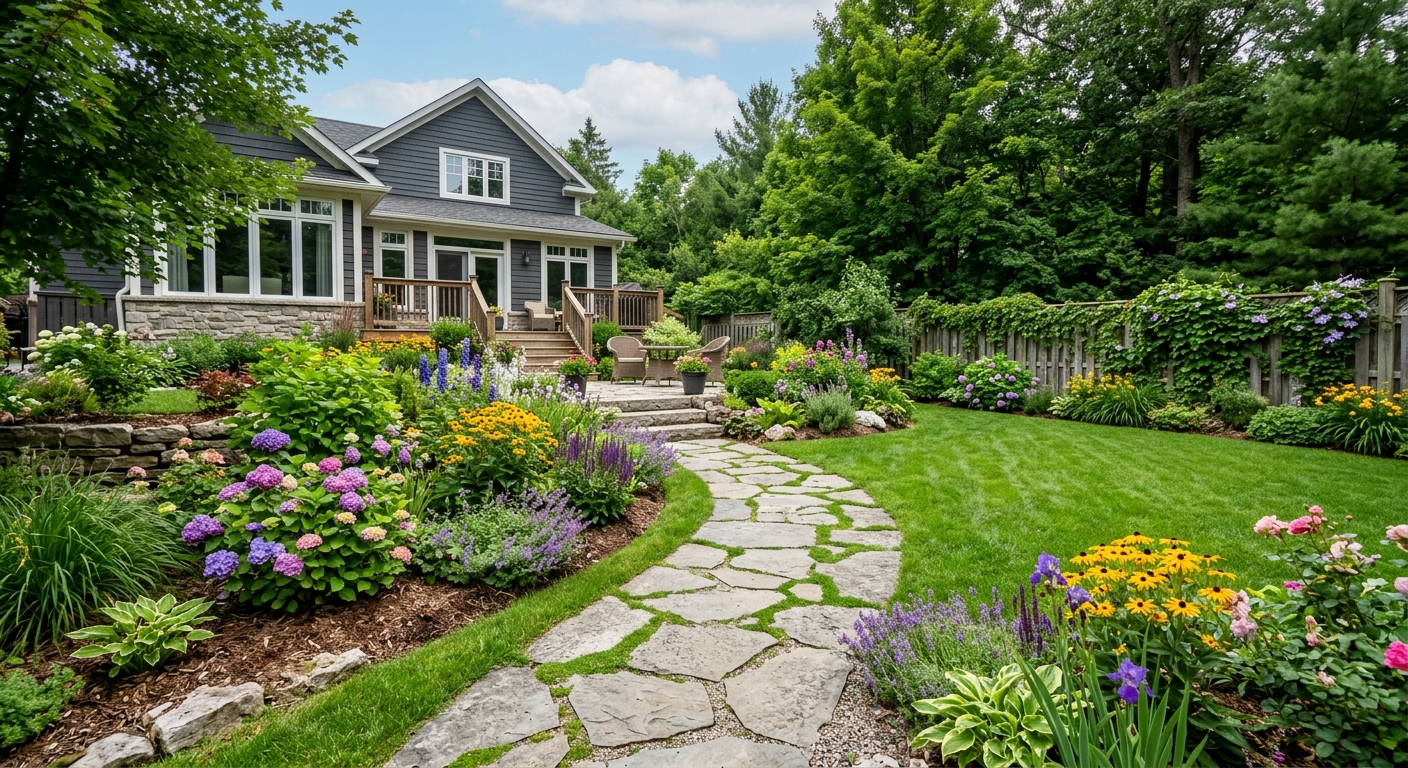
Landscaping options and costs in Wellesley
Wellesley homeowners usually have plenty of space to landscape—especially since single-detached homes make up 84.5% of dwellings, and most households are owner-occupied (86.9% of households own). That ownership mindset often shows up in front-yard curb appeal upgrades and backyard hardscaping that can handle long winters and freeze–thaw cycles. In Wellesley and the surrounding Kitchener–Waterloo–Barrie market, pricing is shaped by a defined planting window and contractor availability: most landscaping construction and planting runs roughly from mid-April through October, with heavier structural work in the drier, warmer months.
Because the region sits around Plant Hardiness Zone 5b–6a, quotes depend on selecting plants that can tolerate cold snaps and thaws without heaving. Freeze–thaw is a cost driver for patios, walks, and retaining walls: deeper, well-compacted granular bases and proper drainage are what keep edges from settling or lifting. Summer dry spells are also common, so many projects include efficient irrigation design (zoned control, rain sensing, and drought-tolerant turf/planting), which adds cost but reduces future water waste.
In Wellesley, upgrades are especially in demand along the busiest residential corridors where visible landscaping matters most—front elevations on routes people drive through tend to attract repeat work like patios, interlocking walkways, and foundation planting. From there, most homeowners want a simple way to compare “good/better/best” scopes, so the table below breaks down common options and realistic price bands.
| Service |
Description |
Season |
Price Range |
| Full landscape design and installation |
Site walk, grading & drainage plan, planting design, and installation of hardscape/softscape (topsoil, mulch, plants, and/or sod) |
Mid-April to October (weather-dependent) |
$8,000–$60,000 |
| Sod installation (supply, grade, lay, roll) |
Soil prep, grading, topsoil/compost amendment as needed, delivery and lay/roll for turf establishment |
May to early October |
$5–$10 |
| Lawn seeding (grade, seed, starter fertilizer) |
Light grading, seed selection for shade/sun, starter fertilizer, and establishment care |
Spring or early fall |
$2–$6 |
| Interlocking patio or walkway |
Excavation, geotextile, compacted base, leveling sand, edging, and joint sand; typically includes drainage considerations |
May to September |
$120–$300 |
| Retaining wall (interlocking block) |
Wall layout, excavation, compacted granular base/backfill, weeping/drainage layer where required, and block placement |
May to September |
$120–$300 |
| Tree and shrub planting |
Planting holes, soil improvement, stakes/support as needed, mulch beds, and first-season establishment care |
May to October |
$500–$15,000 |
Prices are estimates only and vary by project scope, site access and material selection.
What affects the price of landscaping in Wellesley
In Wellesley (and across the wider Kitchener–Waterloo–Barrie area), the same “type” of landscaping job can come in anywhere from roughly 30% to 50% apart between quotes. The difference is usually in what the contractor includes: how much excavation, whether drainage is engineered into the scope, what soil amendments are specified, and whether hardscape work is built to resist frost heave. Ontario projects also cost differently because of labour demand in summer, trucking/delivery distances, and material pricing for aggregates and pavers—costs that sit mid-range compared with Toronto premium pricing, but still higher than small-town markets.
On top of that, the Zone 5b–6a climate defines both plant survival and the work season. The frost window limits when you can safely excavate for drainage and footings, and freeze–thaw demands base depth built below frost influence. Prairie regions (Zone 2–4) tend to need even tighter winter hardiness and drought/wind-tolerant selections; coastal BC (Zone 7–8) typically allows longer planting and lush palettes but relies heavily on drainage in higher-rainfall conditions, while dry interior BC can push irrigation-focused design. In Southern Ontario, we get a moderate growing season with intermittent summer dry spells—so irrigation design and drought-tolerant plant choices can move a budget up or down.
Concrete Wellesley examples: (1) If your property has older grading from homes built before 1981 (44.1% of dwellings), the ground often settles or slopes toward foundations—adding drainage and regrading can shift a mid-range patio plan into the full-service design tier (for many projects, that’s where $8,000–$60,000 budgets start to make sense). (2) A retaining wall that needs proper granular backfill and drainage can cost significantly more than a “decorative” block stack. (3) Tree planting differs a lot: a few smaller shrubs may land in the lower end of $500–$15,000, while mature specimen installs (and any removal first) push the job toward the higher band.
| Price Factor |
Why It Matters |
Cost Impact |
| Yard size in sq ft — the primary cost driver for softscape |
More area means more topsoil, labour hours, and materials for sod, seed, or mulch |
Typically the largest variable; doubling area can nearly double labour/materials |
| Grading and drainage work — slope corrections add significant cost |
Correcting ponding and redirecting runoff is essential in Zone 5b–6a for foundation protection |
Often adds substantial labour and trucking; can raise total by 20%–40% on drainage-heavy lots |
| Drainage bed or French drain installation |
Sub-surface drainage reduces frost heave damage and keeps soil from staying saturated |
Material + excavation intensity usually increases hardscape/planting budgets noticeably |
| Plant material tier — native shrubs vs. ornamental vs. mature specimen trees |
Hardy natives can be more economical; mature trees and premium cultivars cost more and need more labour |
Can shift planting from lower-band to upper-band quickly, especially with large root balls |
| Hardscape vs. softscape ratio — walls and patios cost more per sq ft than lawn |
Interlocking and base construction are labour- and material-intensive |
Hardscape-heavy designs commonly push projects toward the mid-to-upper design/install tier |
| Irrigation system design and installation |
Zoned systems, rain sensors, and efficient heads help during summer dry spells |
Adds line-item cost but can prevent rework and reduce ongoing water use |
| Soil amendment and topsoil required |
Poor native soil may need compost, topsoil, and conditioning to support roots |
Can add trucking and spreading costs; increases when soil tests show poor composition |
| Tree removal or stump grinding before new planting |
Removal changes access, excavation scope, and often requires hauling/disposal |
Typically adds cost and time; affects both hardscape base work and planting layout |
Permits & regulations in Ontario
In Ontario, most landscaping activities—like planting, sodding, and typical softscape installs—generally do not require a building permit. The work that can require approval is usually the structural part: retaining walls above a municipal threshold (often 1.0 m / 3.3 ft in many Ontario municipalities) may trigger a building permit and, in some cases, engineered drawings. Also watch for projects that change lot grading in a way that affects drainage toward a neighbour’s property or ties into storm connections—those grading/drainage changes may require review because they can impact runoff and servicing.
Before any digging for planting holes or wall footings, confirm utility locates (the “call before you dig” concept) so contractors can identify underground services. For irrigation, it’s also important to confirm local watering by-laws and any seasonal restrictions. While Wellesley doesn’t face the strict water regimes sometimes seen in other regions, summer dry spells still happen, so an efficient plan is both practical and easier to keep compliant.
How to verify a contractor (step-by-step) in Ontario: (1) Ask for their Ontario licence/registration details and check the applicable online registry listing for the company/person. (2) Request a certificate of liability insurance showing adequate coverage for landscaping/hardscape work and confirm the policy is active for the dates of your project. (3) Ask for clearance documentation for workplace coverage (commonly WSIB/WCB coverage). (4) Ensure their quote clearly states what’s included for excavation, drainage, disposal, and any permit responsibility—so you’re not surprised later.
Planning a landscape that thrives in Wellesley's climate
Designing for Wellesley’s climate means planning around hardiness, frost timing, and drainage—not just choosing what looks good in July. With the region sitting around Zone 5b–6a, winters can be cold enough to stress shallow roots and expose poorly drained soils. Start with plant selection: focus on native and zone-appropriate shrubs, perennials, and trees that handle freeze–thaw and don’t demand heavy seasonal watering. For lawn, decide between sod and seeding based on your timeline and budget. Sod gives instant coverage and faster curb appeal, but it generally costs about 3–4x more per sq ft than seeding once you include prep and supply. Seeding is slower, but it’s a smart way to stretch a budget if you can maintain establishment watering during the first weeks.
Next, get drainage right. In Kitchener–Waterloo–Barrie, pooling can keep soils saturated into freeze periods, increasing frost heave risk and foundation moisture issues. That’s why grading corrections and properly built drainage beds/French drains are often the difference between a “nice-looking” patio and one that stays level. For hardscape like interlocking patios and retaining walls, base preparation is built for the frost line: compacted granular layers, proper geotextile use, and drainage layers reduce shifting.
Finally, aim for low-maintenance structure: mulch beds, groundcovers, and perennial “repeaters” cut annual upkeep while keeping visual consistency. If you want a water-wise angle, consider rain-garden pockets downspout-to-soil pathways and xeriscape-inspired plantings in dryer zones. Where irrigation is needed, use zoned drip or efficient sprinklers and pair them with rain sensing. A practical dollar example: for a typical front-lawn refresh, choosing seeding instead of sod can keep the lawn portion closer to the lower band (seeding is often far below the $5–$10 sod installation range), letting you redirect budget into better drainage or more durable interlocking at entrances—work that lasts longer in freeze–thaw climates.
| Element |
Climate Consideration |
Maintenance Level |
Price Band |
| Sod lawn installation |
Needs reliable establishment before early fall cold; benefits from spring/early summer prep |
Medium (watering during establishment, mowing) |
$5–$10 |
| Native perennial garden |
Zone-appropriate plants handle freeze–thaw; fewer winter-cover gaps than tender ornamentals |
Low to medium (mulch top-ups, light weeding) |
$500–$15,000 |
| Mulched shrub border |
Mulch protects root crowns and improves moisture retention during dry spells |
Low (pruning as needed, periodic mulch refresh) |
$500–$15,000 |
| Interlocking stone patio |
Requires deep, compacted base and drainage to resist frost heave and settling |
Low (sweeping, occasional joint sand top-up) |
$120–$300 |
| Retaining wall (block) |
Backfill and drainage layers prevent water pressure and reduce winter movement |
Low (visual checks; avoid unaddressed drainage issues) |
$120–$300 |
| Drip irrigation system |
Zoned, targeted watering supports drought tolerance without wasting water |
Medium (seasonal adjustments, occasional repairs) |
$1,500–$6,000 |
How to choose a landscaping contractor in Wellesley
Choosing the right landscaper in Wellesley is mostly about proof. Start by verifying Ontario licensing/registration for the individual or company performing the work, then confirm insurance and workplace coverage. Ask for a certificate of liability insurance (coverage amount should be appropriate for hardscape/excavation work) and confirm it’s valid for your project dates. For workplace coverage, request proof of WSIB/WCB clearance or equivalent coverage documentation—contractors should be able to provide it without hesitation.
Next, get 2–3 itemised written quotes. A good quote breaks labour and materials into lines (excavation/grading, base and geotextile, pavers/blocks, drainage components, topsoil/compost, plants and mulch, and disposal/haul-away). Avoid “lump sum only” proposals, because you can’t fairly compare what each includes. Read exclusions carefully: is the contractor responsible for utility locates, disposal, permit pulls (if required for a taller retaining wall or grading approval), and any rework due to poor base prep? Also ask for warranty terms: workmanship warranty length, product/manufacturer warranty, and whether warranties are transferable if you sell your home.
Payment scheduling matters. A common safe approach is not paying more than 10–15% upfront for materials and scheduling, with progress payments tied to measurable milestones and a holdback until the job is complete and cleaned. Finally, insist on a written timeline: include the start date, expected completion window, and what happens if weather delays planting or hardscape curing.
- Provide proof of Ontario registration/licence for the responsible person/company.
- Show a current certificate of liability insurance (request the policy effective dates).
- Confirm WSIB/WCB clearance documentation before any site work begins.
- Use itemised quotes with labour + materials separate (not one blended number).
- Include explicit scope for grading, drainage, and base preparation for patios/walls.
- State whether geotextile, compacted granular layers, and proper drainage layers are included.
- Clarify who handles utility locates and any locates required before digging.
- Confirm disposal/haul-away included or priced separately.
- List plant sizes, quantities, and whether substitutions are allowed (and on what terms).
- Ask for warranty length for workmanship and the manufacturer warranty documentation.
- Negotiate a payment schedule with only 10–15% upfront and a holdback at completion.
- Get start date and estimated completion date in writing (with weather contingency wording).
Red flags I see with landscaping contractors in Wellesley: (1) quotes that skip drainage or base build-up but still promise “no settling”; (2) unwillingness to provide insurance/WSIB/WCB clearance or details of coverage; (3) pressure to pay most of the price upfront; (4) vague scope language like “we’ll fix it later” without specifying what “it” is; and (5) replacing a detailed plan with verbal promises only—especially around retaining walls and grading.
Frequently asked questions — landscaping in Wellesley
How do I design a low-water yard in Wellesley?
To design a low-water yard in Wellesley, start by grouping plants by how much water they actually need and placing them where sun and wind match their tolerance (front elevations often dry out faster than shaded corners). Use mulch beds to reduce evaporation and choose zone-appropriate, drought-tolerant plants for Zone 5b–6a winters and summer dry spells. If you’re replacing lawn, consider seeding in fall for less upfront turf cost than sod (sod installation is commonly priced in the $5–$10 range, depending on prep and establishment requirements), then thicken the result with proper fertilization. For irrigation, ask for a zoned system with rain sensing and targeted drip lines for shrubs/beds rather than broad lawn spraying. If you have downspouts or pooling spots, a small rain-garden or swale can soak runoff where it belongs—reducing both water use and frost-heave risk from saturated soil.
How do I find a licensed landscaper in Wellesley?
In Ontario, the quickest way to find a reliable landscaper in Wellesley is to verify credentials before you accept a quote. Ask who will be responsible for the work and request their Ontario registration/licence details, then check the applicable online registry listing for that person/company. Also request a certificate of liability insurance with active dates and adequate coverage for the type of work you’re doing (excavation, hardscape base work, retaining walls). For workplace coverage, ask for WSIB/WCB clearance documentation. Then compare quotes that are itemised and match the same scope—if one quote omits drainage or base prep, it may look cheaper but will struggle with freeze–thaw. As a homeowner, you should be able to confirm documentation first, then schedule a site walk to finalize quantities and plant choices that fit the Zone 5b–6a growing and frost window.
How much does landscaping cost in Wellesley?
Landscaping cost in Wellesley varies a lot based on yard size, grading/drainage needs, and how much of the project is hardscape versus planting. For full-service design and installation, many projects fall into the $8,000–$60,000 band depending on whether you’re adding patios, drainage, and multiple plant zones. Lawn work is typically priced by approach: sod installation is often budgeted in the $5–$10 range (with grading and prep included in the overall project), while seeding is usually less expensive. Interlocking patios and walkway builds commonly relate to the $120–$300 band (again, based on thickness, excavation depth, drainage considerations, and edging). Tree and shrub planting can range from a few hundred dollars for starter quantities to the $500–$15,000 range for larger plantings or specimen trees. Because Wellesley has many older homes (44.1% built before 1981), regrading and drainage repairs can be a common cost driver, so make sure your quote explicitly addresses drainage.
What plants thrive in Wellesley’s climate zone?
For Wellesley (Zone 5b–6a), plants that tolerate cold winters and freeze–thaw cycles perform best. I typically steer homeowners toward native or well-adapted shrubs and perennials that can handle winter desiccation and spring thaw. In borders, use a mix of structure plants (hardy shrubs) and long-bloom perennials so the garden still looks good when spring growth is delayed. For trees, choose species that are hardy to at least the local zone and appropriate for your soil and drainage—especially if you’ve got any moisture issues. If you’re trying to reduce watering, combine drought-tolerant perennials with a mulched layer and group them by sun exposure. If your yard had settling or uneven drainage (more common on older properties), address pooling first—otherwise even the best plant palette can struggle.
Sod vs seed — which is better for a Wellesley lawn?
Sod is usually better when you need immediate results or you’re restoring a lawn area quickly for curb appeal. Seed is usually better when you want to manage budget and you can commit to establishment care (watering, light fertilizing, and weed control). In Wellesley’s climate, timing matters: spring and early fall can work well for seeding, while sod needs stable conditions to root before colder weather. Price-wise, sod installation is commonly budgeted around the $5–$10 range, while seeding is typically lower cost per sq ft once prep is accounted for. Where sod shines is “instant coverage”—which can also help prevent soil erosion on sloped areas. Where seeding wins is flexibility and cost control, leaving budget for better drainage or interlocking near entrances, which tends to hold up better through Ontario freeze–thaw cycles.
How much does a retaining wall cost in Wellesley?
Retaining wall pricing in Wellesley depends mainly on height, length, site access, and whether drainage is included. Interlocking block walls are commonly estimated within the $120–$300 band, but that’s not the whole story—walls that require deeper excavation, proper backfill, and weeping/drainage layers will land toward the higher end because those details protect the wall through freeze–thaw. If your wall height is above a municipal threshold (often around 1.0 m / 3.3 ft), you may need a permit and sometimes additional documentation, which can affect timelines and cost. Before quoting, good contractors should ask about drainage patterns and confirm whether the wall is replacing deteriorating grade that could be contributing to foundation moisture or pooling. Always request an itemised quote that specifies base depth, drainage components, and disposal/haul-away so you can compare apples-to-apples.